Presentation
On
Brick
Submitted To:
Hossain Murad
Assistant Professor
Department Of Architecture
Premier University
Submitted By:
Alisha -
Chandrima Nath -
Tahmina Habib – 2001811600335
Israt Jahan Isha - 2001811600329
Definition Of Brick
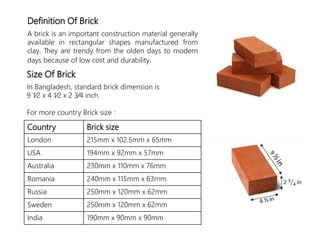
A brick is an important construction material generally
available in rectangular shapes manufactured from
clay. They are trendy from the olden days to modern
days because of low cost and durability.
Size Of Brick
In Bangladesh, standard brick dimension is
9 1⁄2 x 4 1⁄2 x 2 3⁄4 inch.
For more country Brick size :
Country Brick size
London 215mm x 102.5mm x 65mm
USA 194mm x 92mm x 57mm
Australia 230mm x 110mm x 76mm
Romania 240mm x 115mm x 63mm
Russia 250mm x 120mm x 62mm
Sweden 250mm x 120mm x 62mm
India 190mm x 90mm x 90mm
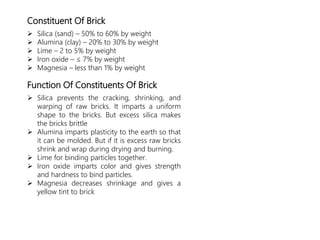
 Silica (sand) – 50% to 60% by weight
 Alumina (clay) – 20% to 30% by weight
 Lime – 2 to 5% by weight
 Iron oxide – ≤ 7% by weight
 Magnesia – less than 1% by weight
Constituent Of Brick
Function Of Constituents Of Brick
 Silica prevents the cracking, shrinking, and
warping of raw bricks. It imparts a uniform
shape to the bricks. But excess silica makes
the bricks brittle
 Alumina imparts plasticity to the earth so that
it can be molded. But if it is excess raw bricks
shrink and wrap during drying and burning.
 Lime for binding particles together.
 Iron oxide imparts color and gives strength
and hardness to bind particles.
 Magnesia decreases shrinkage and gives a
yellow tint to brick
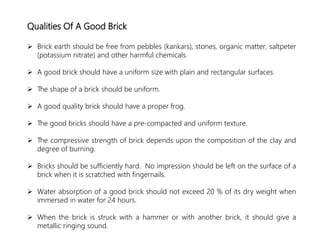
Qualities Of A Good Brick
 Brick earth should be free from pebbles (kankars), stones, organic matter, saltpeter
(potassium nitrate) and other harmful chemicals.
 A good brick should have a uniform size with plain and rectangular surfaces.
 The shape of a brick should be uniform.
 A good quality brick should have a proper frog.
 The good bricks should have a pre-compacted and uniform texture.
 The compressive strength of brick depends upon the composition of the clay and
degree of burning.
 Bricks should be sufficiently hard. No impression should be left on the surface of a
brick when it is scratched with fingernails.
 Water absorption of a good brick should not exceed 20 % of its dry weight when
immersed in water for 24 hours.
 When the brick is struck with a hammer or with another brick, it should give a
metallic ringing sound.
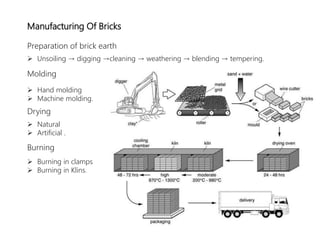
Manufacturing Of Bricks
 Unsoiling → digging →cleaning → weathering → blending → tempering.
Preparation of brick earth
Molding
 Hand molding
 Machine molding.
Drying
 Burning in clamps
 Burning in Klins.
Burning
 Natural
 Artificial .
Types Of Bricks
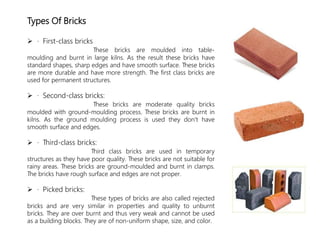
 · First-class bricks
These bricks are moulded into table-
moulding and burnt in large kilns. As the result these bricks have
standard shapes, sharp edges and have smooth surface. These bricks
are more durable and have more strength. The first class bricks are
used for permanent structures.
 · Second-class bricks:
These bricks are moderate quality bricks
moulded with ground-moulding process. These bricks are burnt in
kilns. As the ground moulding process is used they don't have
smooth surface and edges.
 · Third-class bricks:
Third class bricks are used in temporary
structures as they have poor quality. These bricks are not suitable for
rainy areas. These bricks are ground-moulded and burnt in clamps.
The bricks have rough surface and edges are not proper.
 · Picked bricks:
These types of bricks are also called rejected
bricks and are very similar in properties and quality to unburnt
bricks. They are over burnt and thus very weak and cannot be used
as a building blocks. They are of non-uniform shape, size, and color.
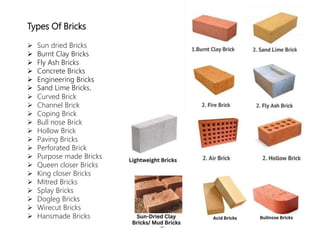
Types Of Bricks
 Sun dried Bricks
 Burnt Clay Bricks
 Fly Ash Bricks
 Concrete Bricks
 Engineering Bricks
 Sand Lime Bricks.
 Curved Brick
 Channel Brick
 Coping Brick
 Bull nose Brick
 Hollow Brick
 Paving Bricks
 Perforated Brick
 Purpose made Bricks
 Queen closer Bricks
 King closer Bricks
 Mitred Bricks
 Splay Bricks
 Dogleg Bricks
 Wirecut Bricks
 Hansmade Bricks
Technical Terms Of Brick
 Stretcher - The longer face of a brick showing in the
surface of a wall
 Header - The end face of a standard brick
 Bed Face - The top and bottom face of a brick
 Arris - Any straight edge of a brick formed by the
junction of its faces
 Frog - An indentation in the top bed face of a
moulded or pressed brick
 Perforation - Holes through extruded bricks from
the top bed to the bottom be
 Brick on bed - The most common orientation for
bricks to be laid
 Soldier course - Normally used as a decorative
detail, to make brick features stand out
 Brick on edge - Normally used to form a capping
detail on top of walls
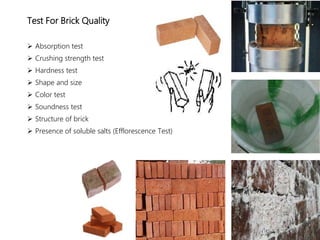
Test For Brick Quality
 Absorption test
 Crushing strength test
 Hardness test
 Shape and size
 Color test
 Soundness test
 Structure of brick
 Presence of soluble salts (Efflorescence Test)
Types of bond with brick
 Stretcher Bond
 English Bond
 English Garden Bond
 English Cross Bond
 Flemish Bond
Precaution Of Casting Process
 Sand should not have fine grains
 Should be free from silt
 Should be of required FM Coarser
 Proper water quantity of water should be
maintained
 Should be soaked in clean water
.Advantages Of Brick
 Economical (Raw material is easily available)
 Hard and durable
 Compressive strength is good enough for ordinary construction
 Different orientations and sizes give different surface textures
 Very low maintenance cost is required
 Demolishing of brick structures is very easy, less time consuming
and hence economic
 Reusable and Recyclable
 Highly fire resistant
 Produces less environmental pollution during manufacturing
process
.Disadvantages Of Brick
 Time consuming construction
 Cannot be used in high seismic zones
 Since bricks absorb water easily, therefore, it causes fluorescence
when not exposed to air
 Very Less tensile strength
 Rough surfaces of bricks may cause mold growth if not properly
cleaned
 Cleaning brick surfaces is a hard job
 Color of low quality brick changes when exposed to sun for a long
period of time

BFM-Presentation-On-Brick.pptx

  • 1.
  • 2.
    Submitted To: Hossain Murad AssistantProfessor Department Of Architecture Premier University Submitted By: Alisha - Chandrima Nath - Tahmina Habib – 2001811600335 Israt Jahan Isha - 2001811600329
  • 3.
    Definition Of Brick Abrick is an important construction material generally available in rectangular shapes manufactured from clay. They are trendy from the olden days to modern days because of low cost and durability. Size Of Brick In Bangladesh, standard brick dimension is 9 1⁄2 x 4 1⁄2 x 2 3⁄4 inch. For more country Brick size : Country Brick size London 215mm x 102.5mm x 65mm USA 194mm x 92mm x 57mm Australia 230mm x 110mm x 76mm Romania 240mm x 115mm x 63mm Russia 250mm x 120mm x 62mm Sweden 250mm x 120mm x 62mm India 190mm x 90mm x 90mm
  • 4.
     Silica (sand)– 50% to 60% by weight  Alumina (clay) – 20% to 30% by weight  Lime – 2 to 5% by weight  Iron oxide – ≤ 7% by weight  Magnesia – less than 1% by weight Constituent Of Brick Function Of Constituents Of Brick  Silica prevents the cracking, shrinking, and warping of raw bricks. It imparts a uniform shape to the bricks. But excess silica makes the bricks brittle  Alumina imparts plasticity to the earth so that it can be molded. But if it is excess raw bricks shrink and wrap during drying and burning.  Lime for binding particles together.  Iron oxide imparts color and gives strength and hardness to bind particles.  Magnesia decreases shrinkage and gives a yellow tint to brick
  • 5.
    Qualities Of AGood Brick  Brick earth should be free from pebbles (kankars), stones, organic matter, saltpeter (potassium nitrate) and other harmful chemicals.  A good brick should have a uniform size with plain and rectangular surfaces.  The shape of a brick should be uniform.  A good quality brick should have a proper frog.  The good bricks should have a pre-compacted and uniform texture.  The compressive strength of brick depends upon the composition of the clay and degree of burning.  Bricks should be sufficiently hard. No impression should be left on the surface of a brick when it is scratched with fingernails.  Water absorption of a good brick should not exceed 20 % of its dry weight when immersed in water for 24 hours.  When the brick is struck with a hammer or with another brick, it should give a metallic ringing sound.
  • 6.
    Manufacturing Of Bricks Unsoiling → digging →cleaning → weathering → blending → tempering. Preparation of brick earth Molding  Hand molding  Machine molding. Drying  Burning in clamps  Burning in Klins. Burning  Natural  Artificial .
  • 7.
    Types Of Bricks · First-class bricks These bricks are moulded into table- moulding and burnt in large kilns. As the result these bricks have standard shapes, sharp edges and have smooth surface. These bricks are more durable and have more strength. The first class bricks are used for permanent structures.  · Second-class bricks: These bricks are moderate quality bricks moulded with ground-moulding process. These bricks are burnt in kilns. As the ground moulding process is used they don't have smooth surface and edges.  · Third-class bricks: Third class bricks are used in temporary structures as they have poor quality. These bricks are not suitable for rainy areas. These bricks are ground-moulded and burnt in clamps. The bricks have rough surface and edges are not proper.  · Picked bricks: These types of bricks are also called rejected bricks and are very similar in properties and quality to unburnt bricks. They are over burnt and thus very weak and cannot be used as a building blocks. They are of non-uniform shape, size, and color.
  • 8.
    Types Of Bricks Sun dried Bricks  Burnt Clay Bricks  Fly Ash Bricks  Concrete Bricks  Engineering Bricks  Sand Lime Bricks.  Curved Brick  Channel Brick  Coping Brick  Bull nose Brick  Hollow Brick  Paving Bricks  Perforated Brick  Purpose made Bricks  Queen closer Bricks  King closer Bricks  Mitred Bricks  Splay Bricks  Dogleg Bricks  Wirecut Bricks  Hansmade Bricks
  • 9.
    Technical Terms OfBrick  Stretcher - The longer face of a brick showing in the surface of a wall  Header - The end face of a standard brick  Bed Face - The top and bottom face of a brick  Arris - Any straight edge of a brick formed by the junction of its faces  Frog - An indentation in the top bed face of a moulded or pressed brick  Perforation - Holes through extruded bricks from the top bed to the bottom be  Brick on bed - The most common orientation for bricks to be laid  Soldier course - Normally used as a decorative detail, to make brick features stand out  Brick on edge - Normally used to form a capping detail on top of walls
  • 10.
    Test For BrickQuality  Absorption test  Crushing strength test  Hardness test  Shape and size  Color test  Soundness test  Structure of brick  Presence of soluble salts (Efflorescence Test)
  • 11.
    Types of bondwith brick  Stretcher Bond  English Bond  English Garden Bond  English Cross Bond  Flemish Bond
  • 12.
    Precaution Of CastingProcess  Sand should not have fine grains  Should be free from silt  Should be of required FM Coarser  Proper water quantity of water should be maintained  Should be soaked in clean water .Advantages Of Brick  Economical (Raw material is easily available)  Hard and durable  Compressive strength is good enough for ordinary construction  Different orientations and sizes give different surface textures  Very low maintenance cost is required  Demolishing of brick structures is very easy, less time consuming and hence economic  Reusable and Recyclable  Highly fire resistant  Produces less environmental pollution during manufacturing process
  • 13.
    .Disadvantages Of Brick Time consuming construction  Cannot be used in high seismic zones  Since bricks absorb water easily, therefore, it causes fluorescence when not exposed to air  Very Less tensile strength  Rough surfaces of bricks may cause mold growth if not properly cleaned  Cleaning brick surfaces is a hard job  Color of low quality brick changes when exposed to sun for a long period of time