Construction
Sequencing with
4D BIM
Scheduling &
Simulation
www.topbimcompany.com
What is 4D BIM ?
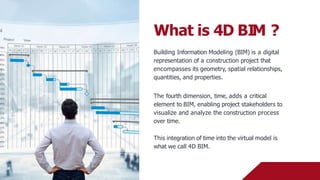
Building Information Modeling (BIM) is a digital
representation of a construction project that
encompasses its geometry, spatial relationships,
quantities, and properties.
The fourth dimension, time, adds a critical
element to BIM, enabling project stakeholders to
visualize and analyze the construction process
over time.
This integration of time into the virtual model is
what we call 4D BIM.
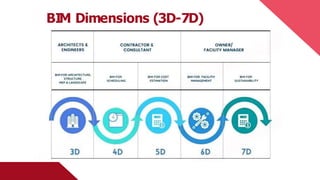
BIM Dimensions (3D-7D)
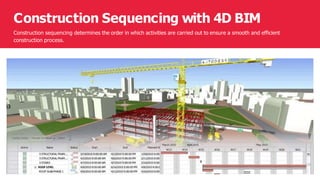
Construction Sequencing with 4D BIM
Construction sequencing determines the order in which activities are carried out to ensure a smooth and efficient
construction process.
1
Integration of 4D BIM into the scheduling process: 4D BIM integrates the construction sequence
with the virtual model, creating a dynamic timeline that reflects the project's progress over time.
2
Creating a virtual construction timeline: Through 4D BIM software, project teams can develop a
detailed construction timeline that incorporates all activities, dependencies, and constraints.
3
Incorporating dependencies and constraints: 4D BIM allows the visualization and analysis of
dependencies between different construction activities, enabling better coordination and resource
allocation.
4
Monitoring progress and identifying potential delays: By comparing the virtual construction
timeline with the actual progress, project teams can identify potential delays and take corrective
actions before they impact the project timeline.
Key Points of 4D BIM Process
2
Enhanced project planning and coordination:
The integration of time enables precise
scheduling and coordination of construction
activities, reducing conflicts and delays.
4
Early identification of clashes and conflicts:
By simulating the construction sequence,
potential clashes and conflicts can be identified
early, enabling proactive resolution and avoiding
costly rework.
Benefits of 4D
BIM Scheduling
and Simulation
3
Efficient resource allocation and cost optimization:
4D BIM helps optimize resource allocation by
visualizing when and where resources are required,
reducing idle time and optimizing costs.
5
Enhanced safety planning and risk management:
By visualizing the construction sequence, potential
safety risks can be identified and mitigated, ensuring a
safer working environment.
1
Improved visualization and communication: 4D BIM allows stakeholders to visualize the entire construction
process in a virtual environment, making it easier to understand and communicate project plans.
Case Studies
and Examples
High-rise building construction
It allows stakeholders to easily understand the
sequencing of activities, helping to identify
potential clashes, conflicts, or delays in the
construction process.
Enhance their decision-making process, mitigate
risks, and achieve greater efficiency and
productivity throughout the construction lifecycle.
Flyover infrastructure project
Enabling a better understanding of how different
construction activities will unfold over time. This
visualization helps identify potential clashes, conflicts,
or inefficiencies early on.
It provides visualization, clash detection, optimized
scheduling, improved communication, site logistics
planning, safety assessment, and progress monitoring.
Let's look at a couple of case studies and examples
that demonstrate the power of 4D BIM in construction
sequencing:
Conclusion
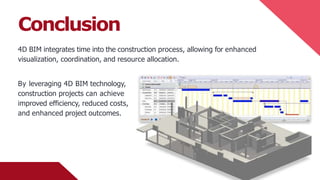
4D BIM integrates time into the construction process, allowing for enhanced
visualization, coordination, and resource allocation.
By leveraging 4D BIM technology,
construction projects can achieve
improved efficiency, reduced costs,
and enhanced project outcomes.
Connect with us.
Email
info@topbimcompany.com
Website
www.topbimcompany.com
Call us
(240)-899-7711

Construction Sequencing with 4D BIM Scheduling & Simulation

  • 1.
    Construction Sequencing with 4D BIM Scheduling& Simulation www.topbimcompany.com
  • 2.
    What is 4DBIM ? Building Information Modeling (BIM) is a digital representation of a construction project that encompasses its geometry, spatial relationships, quantities, and properties. The fourth dimension, time, adds a critical element to BIM, enabling project stakeholders to visualize and analyze the construction process over time. This integration of time into the virtual model is what we call 4D BIM.
  • 3.
  • 4.
    Construction Sequencing with4D BIM Construction sequencing determines the order in which activities are carried out to ensure a smooth and efficient construction process.
  • 5.
    1 Integration of 4DBIM into the scheduling process: 4D BIM integrates the construction sequence with the virtual model, creating a dynamic timeline that reflects the project's progress over time. 2 Creating a virtual construction timeline: Through 4D BIM software, project teams can develop a detailed construction timeline that incorporates all activities, dependencies, and constraints. 3 Incorporating dependencies and constraints: 4D BIM allows the visualization and analysis of dependencies between different construction activities, enabling better coordination and resource allocation. 4 Monitoring progress and identifying potential delays: By comparing the virtual construction timeline with the actual progress, project teams can identify potential delays and take corrective actions before they impact the project timeline. Key Points of 4D BIM Process
  • 6.
    2 Enhanced project planningand coordination: The integration of time enables precise scheduling and coordination of construction activities, reducing conflicts and delays. 4 Early identification of clashes and conflicts: By simulating the construction sequence, potential clashes and conflicts can be identified early, enabling proactive resolution and avoiding costly rework. Benefits of 4D BIM Scheduling and Simulation 3 Efficient resource allocation and cost optimization: 4D BIM helps optimize resource allocation by visualizing when and where resources are required, reducing idle time and optimizing costs. 5 Enhanced safety planning and risk management: By visualizing the construction sequence, potential safety risks can be identified and mitigated, ensuring a safer working environment. 1 Improved visualization and communication: 4D BIM allows stakeholders to visualize the entire construction process in a virtual environment, making it easier to understand and communicate project plans.
  • 7.
    Case Studies and Examples High-risebuilding construction It allows stakeholders to easily understand the sequencing of activities, helping to identify potential clashes, conflicts, or delays in the construction process. Enhance their decision-making process, mitigate risks, and achieve greater efficiency and productivity throughout the construction lifecycle. Flyover infrastructure project Enabling a better understanding of how different construction activities will unfold over time. This visualization helps identify potential clashes, conflicts, or inefficiencies early on. It provides visualization, clash detection, optimized scheduling, improved communication, site logistics planning, safety assessment, and progress monitoring. Let's look at a couple of case studies and examples that demonstrate the power of 4D BIM in construction sequencing:
  • 8.
    Conclusion 4D BIM integratestime into the construction process, allowing for enhanced visualization, coordination, and resource allocation. By leveraging 4D BIM technology, construction projects can achieve improved efficiency, reduced costs, and enhanced project outcomes.
  • 9.