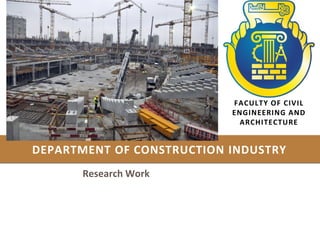
FACULTY OF CIVIL
ENGINEERING AND
ARCHITECTURE
Research Work
DEPARTMENT OF CONSTRUCTION INDUSTRY
About the Department
 Founded in 1969, since 1974 is part of
the Faculty of Civil Engineering (now the
Faculty of Civil Engineering and
Architecture).
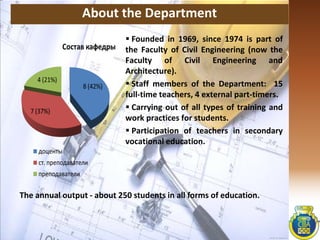
 Staff members of the Department: 15
full-time teachers, 4 external part-timers.
 Carrying out of all types of training and
work practices for students.
 Participation of teachers in secondary
vocational education.
The annual output - about 250 students in all forms of education.
About the Department
Training of engineers with a training period of 5 years on following
specialties:
•270102.65 «Industrial and Civil Construction».
Form of training - full-time, part-time, part-time reduced.
•270105.65 «Urban Construction and Management».
Form of training - full-time, part-time.
•270115.65 «Assessment and management of real estate».
Form of training - full-time, part-time, part-time reduced.
Bachelors on direction 270800.62 «Construction»:
• "Industrial and civil construction"
• "Expertise and Property Management"
• "Urban Construction and Management"
• "Highways"
Forms of training - full-time, part-time, part-time shortened,
second degree. Duration of training - 4 years
Laboratory facilities
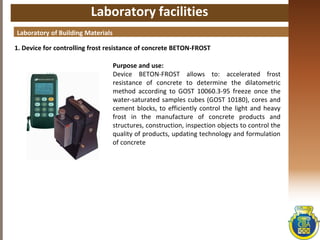
1. Device for controlling frost resistance of concrete BETON-FROST
Laboratory of Building Materials
Purpose and use:
Device BETON-FROST allows to: accelerated frost
resistance of concrete to determine the dilatometric
method according to GOST 10060.3-95 freeze once the
water-saturated samples cubes (GOST 10180), cores and
cement blocks, to efficiently control the light and heavy
frost in the manufacture of concrete products and
structures, construction, inspection objects to control the
quality of products, updating technology and formulation
of concrete
Laboratory facilities
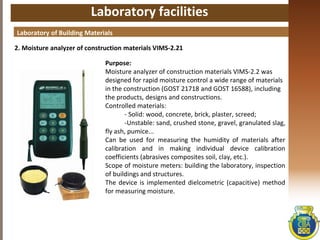
2. Moisture analyzer of construction materials VIMS-2.21
Laboratory of Building Materials
Purpose:
Moisture analyzer of construction materials VIMS-2.2 was
designed for rapid moisture control a wide range of materials
in the construction (GOST 21718 and GOST 16588), including
the products, designs and constructions.
Controlled materials:
- Solid: wood, concrete, brick, plaster, screed;
-Unstable: sand, crushed stone, gravel, granulated slag,
fly ash, pumice...
Can be used for measuring the humidity of materials after
calibration and in making individual device calibration
coefficients (abrasives composites soil, clay, etc.).
Scope of moisture meters: building the laboratory, inspection
of buildings and structures.
The device is implemented dielcometric (capacitive) method
for measuring moisture.
Laboratory facilities
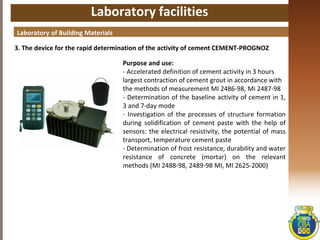
3. The device for the rapid determination of the activity of cement CEMENT-PROGNOZ
Laboratory of Building Materials
Purpose and use:
- Accelerated definition of cement activity in 3 hours
largest contraction of cement grout in accordance with
the methods of measurement MI 2486-98, Mi 2487-98
- Determination of the baseline activity of cement in 1,
3 and 7-day mode
- Investigation of the processes of structure formation
during solidification of cement paste with the help of
sensors: the electrical resistivity, the potential of mass
transport, temperature cement paste
- Determination of frost resistance, durability and water
resistance of concrete (mortar) on the relevant
methods (MI 2488-98, 2489-98 MI, MI 2625-2000)
Laboratory facilities
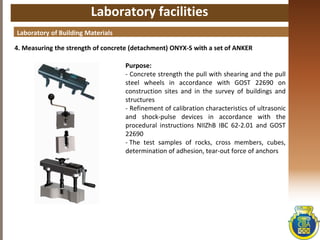
4. Measuring the strength of concrete (detachment) ONYX-S with a set of ANKER
Laboratory of Building Materials
Purpose:
- Concrete strength the pull with shearing and the pull
steel wheels in accordance with GOST 22690 on
construction sites and in the survey of buildings and
structures
- Refinement of calibration characteristics of ultrasonic
and shock-pulse devices in accordance with the
procedural instructions NIIZhB IBC 62-2.01 and GOST
22690
- The test samples of rocks, cross members, cubes,
determination of adhesion, tear-out force of anchors
Laboratory facilities
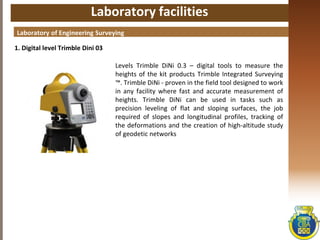
1. Digital level Trimble Dini 03
Laboratory of Engineering Surveying
Levels Trimble DiNi 0.3 – digital tools to measure the
heights of the kit products Trimble Integrated Surveying
™. Trimble DiNi - proven in the field tool designed to work
in any facility where fast and accurate measurement of
heights. Trimble DiNi can be used in tasks such as
precision leveling of flat and sloping surfaces, the job
required of slopes and longitudinal profiles, tracking of
the deformations and the creation of high-altitude study
of geodetic networks
Laboratory facilities
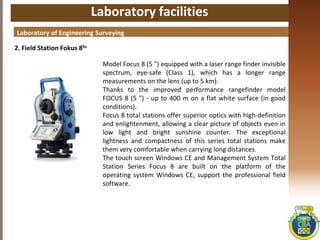
2. Field Station Fokus 85s
Laboratory of Engineering Surveying
Model Focus 8 (5 ") equipped with a laser range finder invisible
spectrum, eye-safe (Class 1), which has a longer range
measurements on the lens (up to 5 km).
Thanks to the improved performance rangefinder model
FOCUS 8 (5 ") - up to 400 m on a flat white surface (in good
conditions).
Focus 8 total stations offer superior optics with high-definition
and enlightenment, allowing a clear picture of objects even in
low light and bright sunshine counter. The exceptional
lightness and compactness of this series total stations make
them very comfortable when carrying long distances.
The touch screen Windows CE and Management System Total
Station Series Focus 8 are built on the platform of the
operating system Windows CE, support the professional field
software.
Main Partners
Engineered Systems Division:
Kodysh E.N., Doctor of Technical Sciences, Professor, Ch. engineer,
Trekin N.N. Doctor of Technical Sciences, Professor, Head of the Division
Institute “Kirovproekt”
http:// кировкоммунпроект.рф
e-mail: kirovkommunproekt@e-kirov.ru
Prozorov V. А., Director
Varankin G.А., Ch. engineer
JSC "Institute Kirovagropromproekt“
http://agroproekt43.ru
e-mail: agroproekt43@mail.ru
Podkopayevskiy К. V., Associate Professor, Technical Director
Scientific Directions
Study of modification of
traditional building materials
and various new nanoparticles
and other additives in a system
for testing modifiers
constructions certain
applications
Investigation of the
characteristics of Kirov region
eluvial soil
Development in cooperation
with leading universities in the
country STANDARDS National
Association of Builders
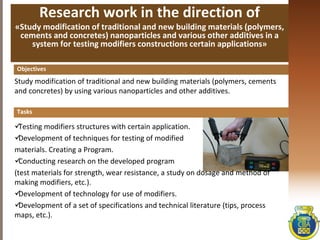
Research work in the direction of
«Study modification of traditional and new building materials (polymers,
cements and concretes) nanoparticles and various other additives in a
system for testing modifiers constructions certain applications»
Study modification of traditional and new building materials (polymers, cements
and concretes) by using various nanoparticles and other additives.
Objectives
Tasks
Testing modifiers structures with certain application.
Development of techniques for testing of modified
materials. Creating a Program.
Conducting research on the developed program
(test materials for strength, wear resistance, a study on dosage and method of
making modifiers, etc.).
Development of technology for use of modifiers.
Development of a set of specifications and technical literature (tips, process
maps, etc.).
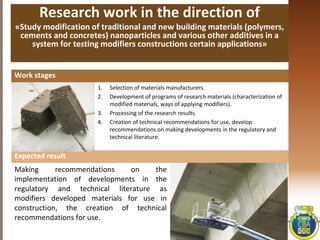
Research work in the direction of
«Study modification of traditional and new building materials (polymers,
cements and concretes) nanoparticles and various other additives in a
system for testing modifiers constructions certain applications»
1. Selection of materials manufacturers.
2. Development of programs of research materials (characterization of
modified materials, ways of applying modifiers).
3. Processing of the research results.
4. Creation of technical recommendations for use, develop
recommendations on making developments in the regulatory and
technical literature.
Work stages
Making recommendations on the
implementation of developments in the
regulatory and technical literature as
modifiers developed materials for use in
construction, the creation of technical
recommendations for use.
Expected result
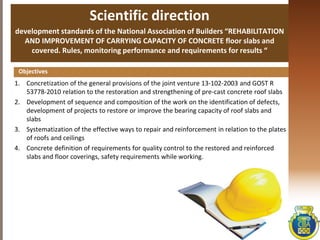
Scientific direction
development standards of the National Association of Builders “REHABILITATION
AND IMPROVEMENT OF CARRYING CAPACITY OF CONCRETE floor slabs and
covered. Rules, monitoring performance and requirements for results “
1. Concretization of the general provisions of the joint venture 13-102-2003 and GOST R
53778-2010 relation to the restoration and strengthening of pre-cast concrete roof slabs
2. Development of sequence and composition of the work on the identification of defects,
development of projects to restore or improve the bearing capacity of roof slabs and
slabs
3. Systematization of the effective ways to repair and reinforcement in relation to the plates
of roofs and ceilings
4. Concrete definition of requirements for quality control to the restored and reinforced
slabs and floor coverings, safety requirements while working.
Objectives
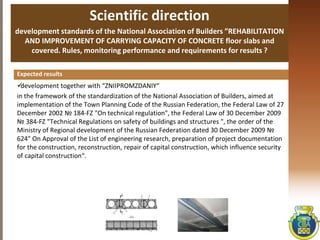
Scientific direction
development standards of the National Association of Builders ”REHABILITATION
AND IMPROVEMENT OF CARRYING CAPACITY OF CONCRETE floor slabs and
covered. Rules, monitoring performance and requirements for results ?
development together with “ZNIIPROMZDANIY“
in the framework of the standardization of the National Association of Builders, aimed at
implementation of the Town Planning Code of the Russian Federation, the Federal Law of 27
December 2002 № 184-FZ "On technical regulation", the Federal Law of 30 December 2009
№ 384-FZ "Technical Regulations on safety of buildings and structures ", the order of the
Ministry of Regional development of the Russian Federation dated 30 December 2009 №
624" On Approval of the List of engineering research, preparation of project documentation
for the construction, reconstruction, repair of capital construction, which influence security
of capital construction“.
Expected results
Research work in the direction of
«Investigation of the properties of Kirov
region eluvial soil»
Actuality:
Current regulations have increased the requirements for survey and design bases.
The need for immediate testing of soil at the sites of the buildings I and II levels of responsibility.
Meeting the requirements for accounting of specific soil properties - linearity anisotropy, etc.
Research in the study of the properties of eluvial soils are regional in nature and provided little in relation
to the ground of the Kirov region.
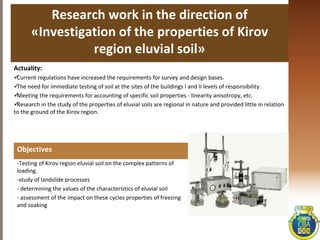
Objectives
-Testing of Kirov region eluvial soil on the complex patterns of
loading.
-study of landslide processes
- determining the values ​​of the characteristics of eluvial soil
- assessment of the impact on these cycles properties of freezing
and soaking
Research work in the direction of
«Investigation of the properties of Kirov
region eluvial soil»
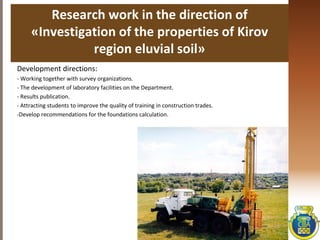
Development directions:
- Working together with survey organizations.
- The development of laboratory facilities on the Department.
- Results publication.
- Attracting students to improve the quality of training in construction trades.
-Develop recommendations for the foundations calculation.
Contacts
The department of construction industry:
Head of the Department - Chaganov Аlexey Borisovich
610033, Кirov, Studencheskiy proezd, 9
Ph: 8 (8332) 53-05-77
E-mail: kaf_sp@vyatsu.ru
Vice-Rector for Science and Innovation - Litvinets Sergey Gennadyevich
610000, Kirov, Moskovskaya str. 36
Ph: 8 (8332) 64-15-91
E-mail: litvinets@vyatsu.ru
Construction industry

  • 1.
    FACULTY OF CIVIL ENGINEERINGAND ARCHITECTURE Research Work DEPARTMENT OF CONSTRUCTION INDUSTRY
  • 2.
    About the Department Founded in 1969, since 1974 is part of the Faculty of Civil Engineering (now the Faculty of Civil Engineering and Architecture).  Staff members of the Department: 15 full-time teachers, 4 external part-timers.  Carrying out of all types of training and work practices for students.  Participation of teachers in secondary vocational education. The annual output - about 250 students in all forms of education.
  • 3.
    About the Department Trainingof engineers with a training period of 5 years on following specialties: •270102.65 «Industrial and Civil Construction». Form of training - full-time, part-time, part-time reduced. •270105.65 «Urban Construction and Management». Form of training - full-time, part-time. •270115.65 «Assessment and management of real estate». Form of training - full-time, part-time, part-time reduced. Bachelors on direction 270800.62 «Construction»: • "Industrial and civil construction" • "Expertise and Property Management" • "Urban Construction and Management" • "Highways" Forms of training - full-time, part-time, part-time shortened, second degree. Duration of training - 4 years
  • 4.
    Laboratory facilities 1. Devicefor controlling frost resistance of concrete BETON-FROST Laboratory of Building Materials Purpose and use: Device BETON-FROST allows to: accelerated frost resistance of concrete to determine the dilatometric method according to GOST 10060.3-95 freeze once the water-saturated samples cubes (GOST 10180), cores and cement blocks, to efficiently control the light and heavy frost in the manufacture of concrete products and structures, construction, inspection objects to control the quality of products, updating technology and formulation of concrete
  • 5.
    Laboratory facilities 2. Moistureanalyzer of construction materials VIMS-2.21 Laboratory of Building Materials Purpose: Moisture analyzer of construction materials VIMS-2.2 was designed for rapid moisture control a wide range of materials in the construction (GOST 21718 and GOST 16588), including the products, designs and constructions. Controlled materials: - Solid: wood, concrete, brick, plaster, screed; -Unstable: sand, crushed stone, gravel, granulated slag, fly ash, pumice... Can be used for measuring the humidity of materials after calibration and in making individual device calibration coefficients (abrasives composites soil, clay, etc.). Scope of moisture meters: building the laboratory, inspection of buildings and structures. The device is implemented dielcometric (capacitive) method for measuring moisture.
  • 6.
    Laboratory facilities 3. Thedevice for the rapid determination of the activity of cement CEMENT-PROGNOZ Laboratory of Building Materials Purpose and use: - Accelerated definition of cement activity in 3 hours largest contraction of cement grout in accordance with the methods of measurement MI 2486-98, Mi 2487-98 - Determination of the baseline activity of cement in 1, 3 and 7-day mode - Investigation of the processes of structure formation during solidification of cement paste with the help of sensors: the electrical resistivity, the potential of mass transport, temperature cement paste - Determination of frost resistance, durability and water resistance of concrete (mortar) on the relevant methods (MI 2488-98, 2489-98 MI, MI 2625-2000)
  • 7.
    Laboratory facilities 4. Measuringthe strength of concrete (detachment) ONYX-S with a set of ANKER Laboratory of Building Materials Purpose: - Concrete strength the pull with shearing and the pull steel wheels in accordance with GOST 22690 on construction sites and in the survey of buildings and structures - Refinement of calibration characteristics of ultrasonic and shock-pulse devices in accordance with the procedural instructions NIIZhB IBC 62-2.01 and GOST 22690 - The test samples of rocks, cross members, cubes, determination of adhesion, tear-out force of anchors
  • 8.
    Laboratory facilities 1. Digitallevel Trimble Dini 03 Laboratory of Engineering Surveying Levels Trimble DiNi 0.3 – digital tools to measure the heights of the kit products Trimble Integrated Surveying ™. Trimble DiNi - proven in the field tool designed to work in any facility where fast and accurate measurement of heights. Trimble DiNi can be used in tasks such as precision leveling of flat and sloping surfaces, the job required of slopes and longitudinal profiles, tracking of the deformations and the creation of high-altitude study of geodetic networks
  • 9.
    Laboratory facilities 2. FieldStation Fokus 85s Laboratory of Engineering Surveying Model Focus 8 (5 ") equipped with a laser range finder invisible spectrum, eye-safe (Class 1), which has a longer range measurements on the lens (up to 5 km). Thanks to the improved performance rangefinder model FOCUS 8 (5 ") - up to 400 m on a flat white surface (in good conditions). Focus 8 total stations offer superior optics with high-definition and enlightenment, allowing a clear picture of objects even in low light and bright sunshine counter. The exceptional lightness and compactness of this series total stations make them very comfortable when carrying long distances. The touch screen Windows CE and Management System Total Station Series Focus 8 are built on the platform of the operating system Windows CE, support the professional field software.
  • 10.
    Main Partners Engineered SystemsDivision: Kodysh E.N., Doctor of Technical Sciences, Professor, Ch. engineer, Trekin N.N. Doctor of Technical Sciences, Professor, Head of the Division Institute “Kirovproekt” http:// кировкоммунпроект.рф e-mail: kirovkommunproekt@e-kirov.ru Prozorov V. А., Director Varankin G.А., Ch. engineer JSC "Institute Kirovagropromproekt“ http://agroproekt43.ru e-mail: agroproekt43@mail.ru Podkopayevskiy К. V., Associate Professor, Technical Director
  • 11.
    Scientific Directions Study ofmodification of traditional building materials and various new nanoparticles and other additives in a system for testing modifiers constructions certain applications Investigation of the characteristics of Kirov region eluvial soil Development in cooperation with leading universities in the country STANDARDS National Association of Builders
  • 12.
    Research work inthe direction of «Study modification of traditional and new building materials (polymers, cements and concretes) nanoparticles and various other additives in a system for testing modifiers constructions certain applications» Study modification of traditional and new building materials (polymers, cements and concretes) by using various nanoparticles and other additives. Objectives Tasks Testing modifiers structures with certain application. Development of techniques for testing of modified materials. Creating a Program. Conducting research on the developed program (test materials for strength, wear resistance, a study on dosage and method of making modifiers, etc.). Development of technology for use of modifiers. Development of a set of specifications and technical literature (tips, process maps, etc.).
  • 13.
    Research work inthe direction of «Study modification of traditional and new building materials (polymers, cements and concretes) nanoparticles and various other additives in a system for testing modifiers constructions certain applications» 1. Selection of materials manufacturers. 2. Development of programs of research materials (characterization of modified materials, ways of applying modifiers). 3. Processing of the research results. 4. Creation of technical recommendations for use, develop recommendations on making developments in the regulatory and technical literature. Work stages Making recommendations on the implementation of developments in the regulatory and technical literature as modifiers developed materials for use in construction, the creation of technical recommendations for use. Expected result
  • 14.
    Scientific direction development standardsof the National Association of Builders “REHABILITATION AND IMPROVEMENT OF CARRYING CAPACITY OF CONCRETE floor slabs and covered. Rules, monitoring performance and requirements for results “ 1. Concretization of the general provisions of the joint venture 13-102-2003 and GOST R 53778-2010 relation to the restoration and strengthening of pre-cast concrete roof slabs 2. Development of sequence and composition of the work on the identification of defects, development of projects to restore or improve the bearing capacity of roof slabs and slabs 3. Systematization of the effective ways to repair and reinforcement in relation to the plates of roofs and ceilings 4. Concrete definition of requirements for quality control to the restored and reinforced slabs and floor coverings, safety requirements while working. Objectives
  • 15.
    Scientific direction development standardsof the National Association of Builders ”REHABILITATION AND IMPROVEMENT OF CARRYING CAPACITY OF CONCRETE floor slabs and covered. Rules, monitoring performance and requirements for results ? development together with “ZNIIPROMZDANIY“ in the framework of the standardization of the National Association of Builders, aimed at implementation of the Town Planning Code of the Russian Federation, the Federal Law of 27 December 2002 № 184-FZ "On technical regulation", the Federal Law of 30 December 2009 № 384-FZ "Technical Regulations on safety of buildings and structures ", the order of the Ministry of Regional development of the Russian Federation dated 30 December 2009 № 624" On Approval of the List of engineering research, preparation of project documentation for the construction, reconstruction, repair of capital construction, which influence security of capital construction“. Expected results
  • 16.
    Research work inthe direction of «Investigation of the properties of Kirov region eluvial soil» Actuality: Current regulations have increased the requirements for survey and design bases. The need for immediate testing of soil at the sites of the buildings I and II levels of responsibility. Meeting the requirements for accounting of specific soil properties - linearity anisotropy, etc. Research in the study of the properties of eluvial soils are regional in nature and provided little in relation to the ground of the Kirov region. Objectives -Testing of Kirov region eluvial soil on the complex patterns of loading. -study of landslide processes - determining the values ​​of the characteristics of eluvial soil - assessment of the impact on these cycles properties of freezing and soaking
  • 17.
    Research work inthe direction of «Investigation of the properties of Kirov region eluvial soil» Development directions: - Working together with survey organizations. - The development of laboratory facilities on the Department. - Results publication. - Attracting students to improve the quality of training in construction trades. -Develop recommendations for the foundations calculation.
  • 18.
    Contacts The department ofconstruction industry: Head of the Department - Chaganov Аlexey Borisovich 610033, Кirov, Studencheskiy proezd, 9 Ph: 8 (8332) 53-05-77 E-mail: kaf_sp@vyatsu.ru Vice-Rector for Science and Innovation - Litvinets Sergey Gennadyevich 610000, Kirov, Moskovskaya str. 36 Ph: 8 (8332) 64-15-91 E-mail: litvinets@vyatsu.ru