NADAR SARASWATHI COLLEGE
OF ARTS AND SCIENCE
By
P.JEYA SHRI NITHI
I M.Sc(CS)
Introduction to
SLR Parsing
SLR parsing is a bottom-up parsing
technique used in compiler construction
to analyze the syntax of a programming
language. It is a popular choice due to
its simplicity and efficiency.
JP
Context-Free Grafifiars
Context-free grammars (CFGs) are used to define the syntax of a
programming language. They specify the rules for constructing valid
sentences in the language. A CFG consists of a set of non-terminal
symbols, terminal symbols, a start symbol, and a set of production rules.
1 Non-terfiinal
Syfibols
Represent grammatical
categories or phrases,
such as "expression" or
"statement."
2 Terfiinal Syfibols
Represent the actual symbols
that appear in the input
string, such as keywords,
identifiers, and operators.
3 Production Rules
Describe how to derive a
string of terminal
symbols from the start
symbol.
fi Start Syfibol
Represents the root of the
parse tree and the starting
point for deriving
sentences.
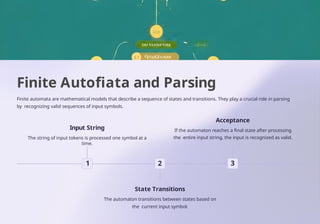
Finite Autofiata and Parsing
Finite automata are mathematical models that describe a sequence of states and transitions. They play a crucial role in parsing
by recognizing valid sequences of input symbols.
1
Input String
The string of input tokens is processed one symbol at a
time.
2
State Transitions
The automaton transitions between states based on
the current input symbol.
3
Acceptance
If the automaton reaches a final state after processing
the entire input string, the input is recognized as valid.
Constructing SLR Parsing Tables
SLR parsing tables are constructed using the information obtained from the CFG and the corresponding finite automaton. The
table guides the parser through the process of recognizing and constructing a parse tree for the input string.
State Input Symbol Action
0 id Shift 1
1 + Reduce by A -> id
2 $ Accept
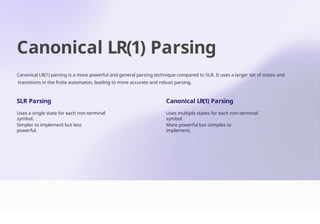
Canonical LR(1) Parsing
Canonical LR(1) parsing is a more powerful and general parsing technique compared to SLR. It uses a larger set of states and
transitions in the finite automaton, leading to more accurate and robust parsing.
SLR Parsing
Uses a single state for each non-terminal
symbol.
Simpler to implement but less
powerful.
Canonical LR(1) Parsing
Uses multiple states for each non-terminal
symbol.
More powerful but complex to
implement.
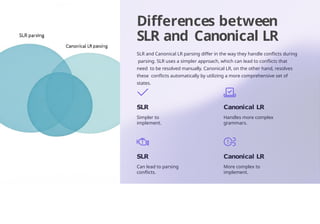
Differences between
SLR and Canonical LR
SLR and Canonical LR parsing differ in the way they handle conflicts during
parsing. SLR uses a simpler approach, which can lead to conflicts that
need to be resolved manually. Canonical LR, on the other hand, resolves
these conflicts automatically by utilizing a more comprehensive set of
states.
SLR
Simpler to
implement.
Canonical LR
Handles more complex
grammars.
SLR
Can lead to parsing
conflicts.
Canonical LR
More complex to
implement.
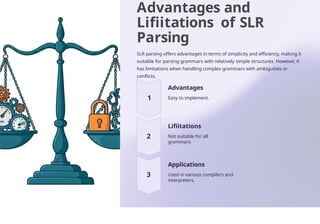
Advantages and
Lifiitations of SLR
Parsing
SLR parsing offers advantages in terms of simplicity and efficiency, making it
suitable for parsing grammars with relatively simple structures. However, it
has limitations when handling complex grammars with ambiguities or
conflicts.
1
Advantages
Easy to implement.
2
Lifiitations
Not suitable for all
grammars.
3
Applications
Used in various compilers and
interpreters.
Practical Considerations
and Applications
SLR parsing finds applications in various compiler construction scenarios. It
is particularly well-suited for parsing languages with simpler syntax and
fewer ambiguities. The choice between SLR and Canonical LR depends on
the specific requirements of the compiler.
Cofipiler Design
SLR parsing is used to analyze
and translate source code into
machine code.
Language
Processing
It is utilized in tools for
natural language
processing, such as parsers
and grammars.
Forfial Verification
SLR parsing is used to check the correctness and consistency of formal
specifications.
Introduction to
Canonical LR
Parsing
Canonical LR parsing is a powerful bottom-up parsing technique widely used
in compiler design. It's known for its efficiency and ability to handle a wide
range of programming language constructs. This presentation aims to
explore the fundamentals of canonical LR parsing, delving into its principles,
construction, and implementation.
JP
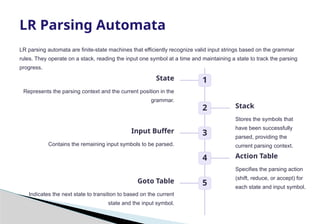
LR Parsing Automata
LR parsing automata are finite-state machines that efficiently recognize valid input strings based on the grammar
rules. They operate on a stack, reading the input one symbol at a time and maintaining a state to track the parsing
progress.
1
State
Represents the parsing context and the current position in the
grammar.
2 Stack
Stores the symbols that
have been successfully
parsed, providing the
current parsing context.
3
Input Buffer
Contains the remaining input symbols to be parsed.
4 Action Table
Specifies the parsing action
(shift, reduce, or accept) for
each state and input symbol.
5
Goto Table
Indicates the next state to transition to based on the current
state and the input symbol.
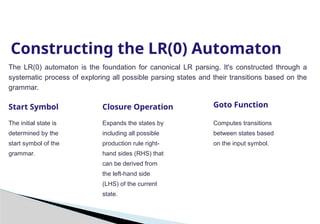
Constructing the LR(0) Automaton
The LR(0) automaton is the foundation for canonical LR parsing. It's constructed through a
systematic process of exploring all possible parsing states and their transitions based on the
grammar.
Start Symbol
The initial state is
determined by the
start symbol of the
grammar.
Closure Operation
Expands the states by
including all possible
production rule right-
hand sides (RHS) that
can be derived from
the left-hand side
(LHS) of the current
state.
Goto Function
Computes transitions
between states based
on the input symbol.
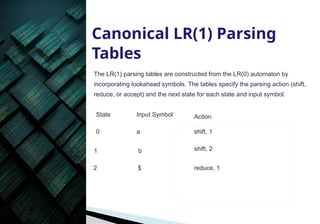
Canonical LR(1) Parsing
Tables
The LR(1) parsing tables are constructed from the LR(0) automaton by
incorporating lookahead symbols. The tables specify the parsing action (shift,
reduce, or accept) and the next state for each state and input symbol.
State Input Symbol Action
0 a shift, 1
1 b shift, 2
2 $ reduce, 1
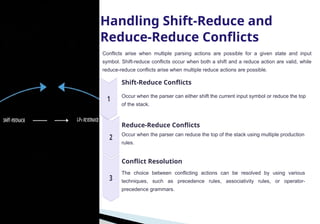
Handling Shift-Reduce and
Reduce-Reduce Conflicts
Conflicts arise when multiple parsing actions are possible for a given state and input
symbol. Shift-reduce conflicts occur when both a shift and a reduce action are valid, while
reduce-reduce conflicts arise when multiple reduce actions are possible.
Shift-Reduce Conflicts
Occur when the parser can either shift the current input symbol or reduce the top
of the stack.
Reduce-Reduce Conflicts
Occur when the parser can reduce the top of the stack using multiple production
rules.
Conflict Resolution
The choice between conflicting actions can be resolved by using various
techniques, such as precedence rules, associativity rules, or operator-
precedence grammars.
THANK YOU

Introduction-to-SLR-LR-parseParsing.pptx

  • 1.
    NADAR SARASWATHI COLLEGE OFARTS AND SCIENCE By P.JEYA SHRI NITHI I M.Sc(CS)
  • 2.
    Introduction to SLR Parsing SLRparsing is a bottom-up parsing technique used in compiler construction to analyze the syntax of a programming language. It is a popular choice due to its simplicity and efficiency. JP
  • 3.
    Context-Free Grafifiars Context-free grammars(CFGs) are used to define the syntax of a programming language. They specify the rules for constructing valid sentences in the language. A CFG consists of a set of non-terminal symbols, terminal symbols, a start symbol, and a set of production rules. 1 Non-terfiinal Syfibols Represent grammatical categories or phrases, such as "expression" or "statement." 2 Terfiinal Syfibols Represent the actual symbols that appear in the input string, such as keywords, identifiers, and operators. 3 Production Rules Describe how to derive a string of terminal symbols from the start symbol. fi Start Syfibol Represents the root of the parse tree and the starting point for deriving sentences.
  • 4.
    Finite Autofiata andParsing Finite automata are mathematical models that describe a sequence of states and transitions. They play a crucial role in parsing by recognizing valid sequences of input symbols. 1 Input String The string of input tokens is processed one symbol at a time. 2 State Transitions The automaton transitions between states based on the current input symbol. 3 Acceptance If the automaton reaches a final state after processing the entire input string, the input is recognized as valid.
  • 5.
    Constructing SLR ParsingTables SLR parsing tables are constructed using the information obtained from the CFG and the corresponding finite automaton. The table guides the parser through the process of recognizing and constructing a parse tree for the input string. State Input Symbol Action 0 id Shift 1 1 + Reduce by A -> id 2 $ Accept
  • 6.
    Canonical LR(1) Parsing CanonicalLR(1) parsing is a more powerful and general parsing technique compared to SLR. It uses a larger set of states and transitions in the finite automaton, leading to more accurate and robust parsing. SLR Parsing Uses a single state for each non-terminal symbol. Simpler to implement but less powerful. Canonical LR(1) Parsing Uses multiple states for each non-terminal symbol. More powerful but complex to implement.
  • 7.
    Differences between SLR andCanonical LR SLR and Canonical LR parsing differ in the way they handle conflicts during parsing. SLR uses a simpler approach, which can lead to conflicts that need to be resolved manually. Canonical LR, on the other hand, resolves these conflicts automatically by utilizing a more comprehensive set of states. SLR Simpler to implement. Canonical LR Handles more complex grammars. SLR Can lead to parsing conflicts. Canonical LR More complex to implement.
  • 8.
    Advantages and Lifiitations ofSLR Parsing SLR parsing offers advantages in terms of simplicity and efficiency, making it suitable for parsing grammars with relatively simple structures. However, it has limitations when handling complex grammars with ambiguities or conflicts. 1 Advantages Easy to implement. 2 Lifiitations Not suitable for all grammars. 3 Applications Used in various compilers and interpreters.
  • 9.
    Practical Considerations and Applications SLRparsing finds applications in various compiler construction scenarios. It is particularly well-suited for parsing languages with simpler syntax and fewer ambiguities. The choice between SLR and Canonical LR depends on the specific requirements of the compiler. Cofipiler Design SLR parsing is used to analyze and translate source code into machine code. Language Processing It is utilized in tools for natural language processing, such as parsers and grammars. Forfial Verification SLR parsing is used to check the correctness and consistency of formal specifications.
  • 10.
    Introduction to Canonical LR Parsing CanonicalLR parsing is a powerful bottom-up parsing technique widely used in compiler design. It's known for its efficiency and ability to handle a wide range of programming language constructs. This presentation aims to explore the fundamentals of canonical LR parsing, delving into its principles, construction, and implementation. JP
  • 11.
    LR Parsing Automata LRparsing automata are finite-state machines that efficiently recognize valid input strings based on the grammar rules. They operate on a stack, reading the input one symbol at a time and maintaining a state to track the parsing progress. 1 State Represents the parsing context and the current position in the grammar. 2 Stack Stores the symbols that have been successfully parsed, providing the current parsing context. 3 Input Buffer Contains the remaining input symbols to be parsed. 4 Action Table Specifies the parsing action (shift, reduce, or accept) for each state and input symbol. 5 Goto Table Indicates the next state to transition to based on the current state and the input symbol.
  • 12.
    Constructing the LR(0)Automaton The LR(0) automaton is the foundation for canonical LR parsing. It's constructed through a systematic process of exploring all possible parsing states and their transitions based on the grammar. Start Symbol The initial state is determined by the start symbol of the grammar. Closure Operation Expands the states by including all possible production rule right- hand sides (RHS) that can be derived from the left-hand side (LHS) of the current state. Goto Function Computes transitions between states based on the input symbol.
  • 13.
    Canonical LR(1) Parsing Tables TheLR(1) parsing tables are constructed from the LR(0) automaton by incorporating lookahead symbols. The tables specify the parsing action (shift, reduce, or accept) and the next state for each state and input symbol. State Input Symbol Action 0 a shift, 1 1 b shift, 2 2 $ reduce, 1
  • 14.
    Handling Shift-Reduce and Reduce-ReduceConflicts Conflicts arise when multiple parsing actions are possible for a given state and input symbol. Shift-reduce conflicts occur when both a shift and a reduce action are valid, while reduce-reduce conflicts arise when multiple reduce actions are possible. Shift-Reduce Conflicts Occur when the parser can either shift the current input symbol or reduce the top of the stack. Reduce-Reduce Conflicts Occur when the parser can reduce the top of the stack using multiple production rules. Conflict Resolution The choice between conflicting actions can be resolved by using various techniques, such as precedence rules, associativity rules, or operator- precedence grammars.
  • 15.