Constraint Satisfaction Problems
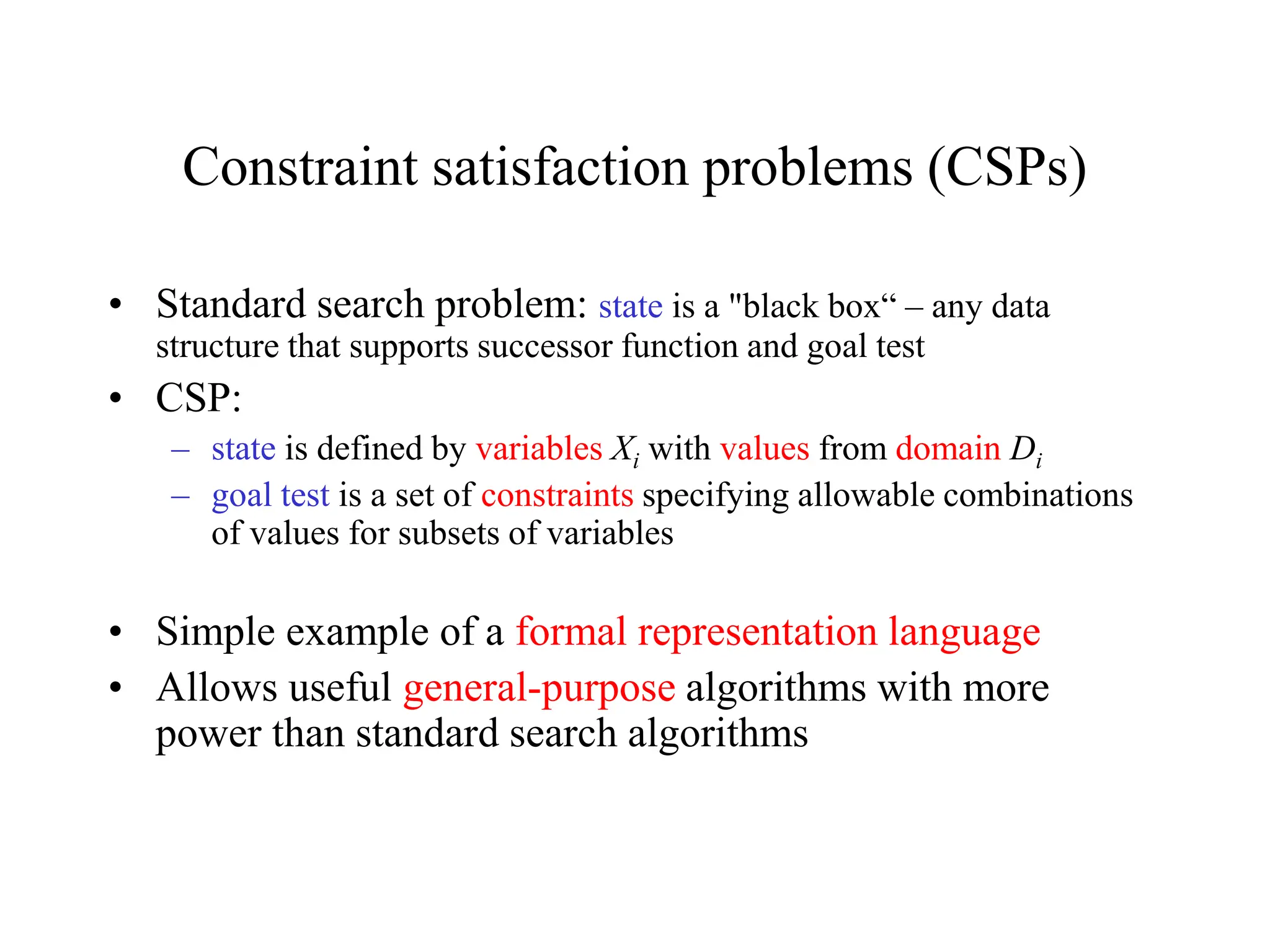
Constraint satisfaction problems (CSPs)
• Standard search problem: state is a "black box“ – any data
structure that supports successor function and goal test
• CSP:
– state is defined by variables Xi with values from domain Di
– goal test is a set of constraints specifying allowable combinations
of values for subsets of variables
• Simple example of a formal representation language
• Allows useful general-purpose algorithms with more
power than standard search algorithms
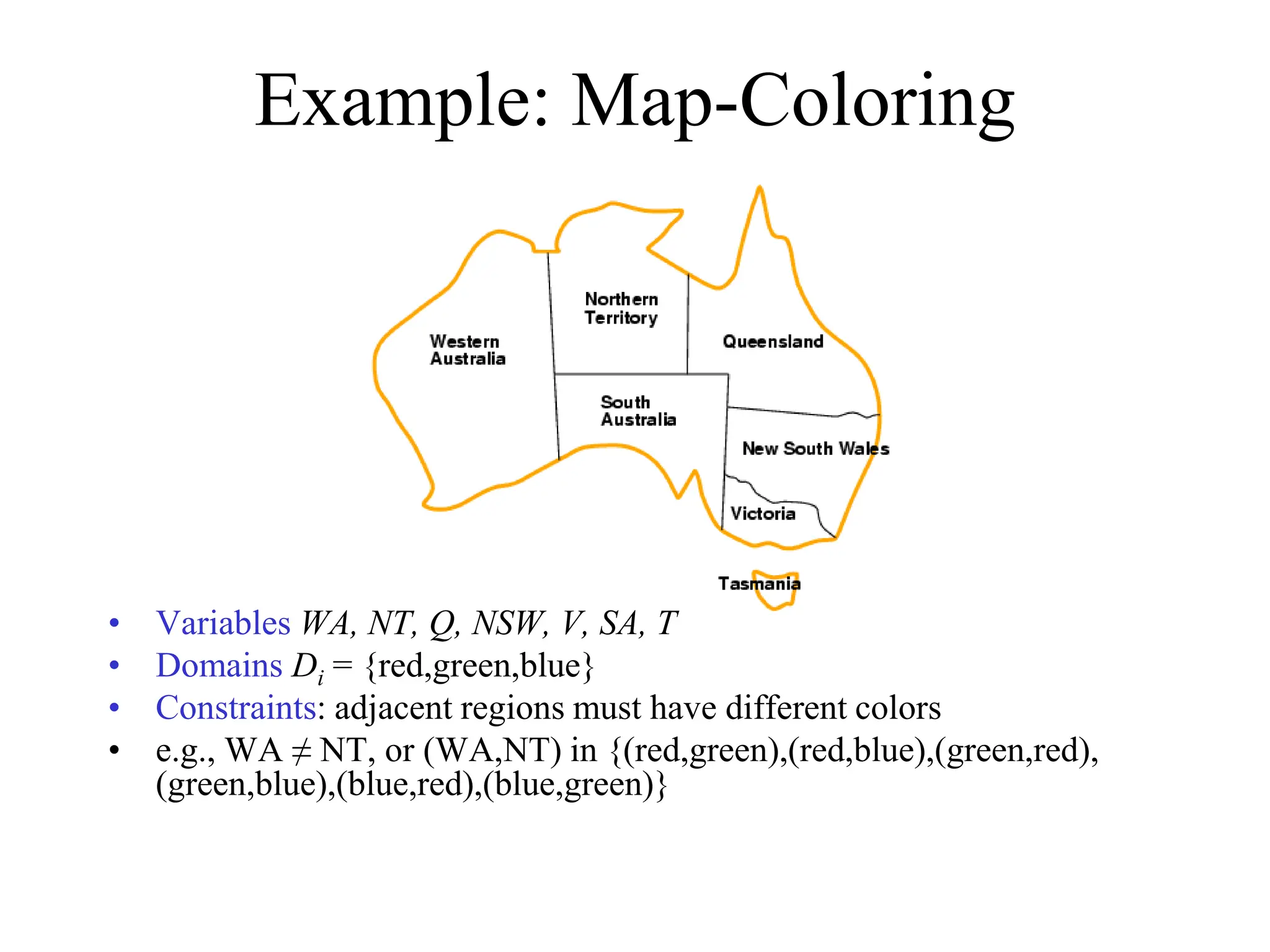
Example: Map-Coloring
• Variables WA, NT, Q, NSW, V, SA, T
• Domains Di = {red,green,blue}
• Constraints: adjacent regions must have different colors
• e.g., WA ≠ NT, or (WA,NT) in {(red,green),(red,blue),(green,red),
(green,blue),(blue,red),(blue,green)}
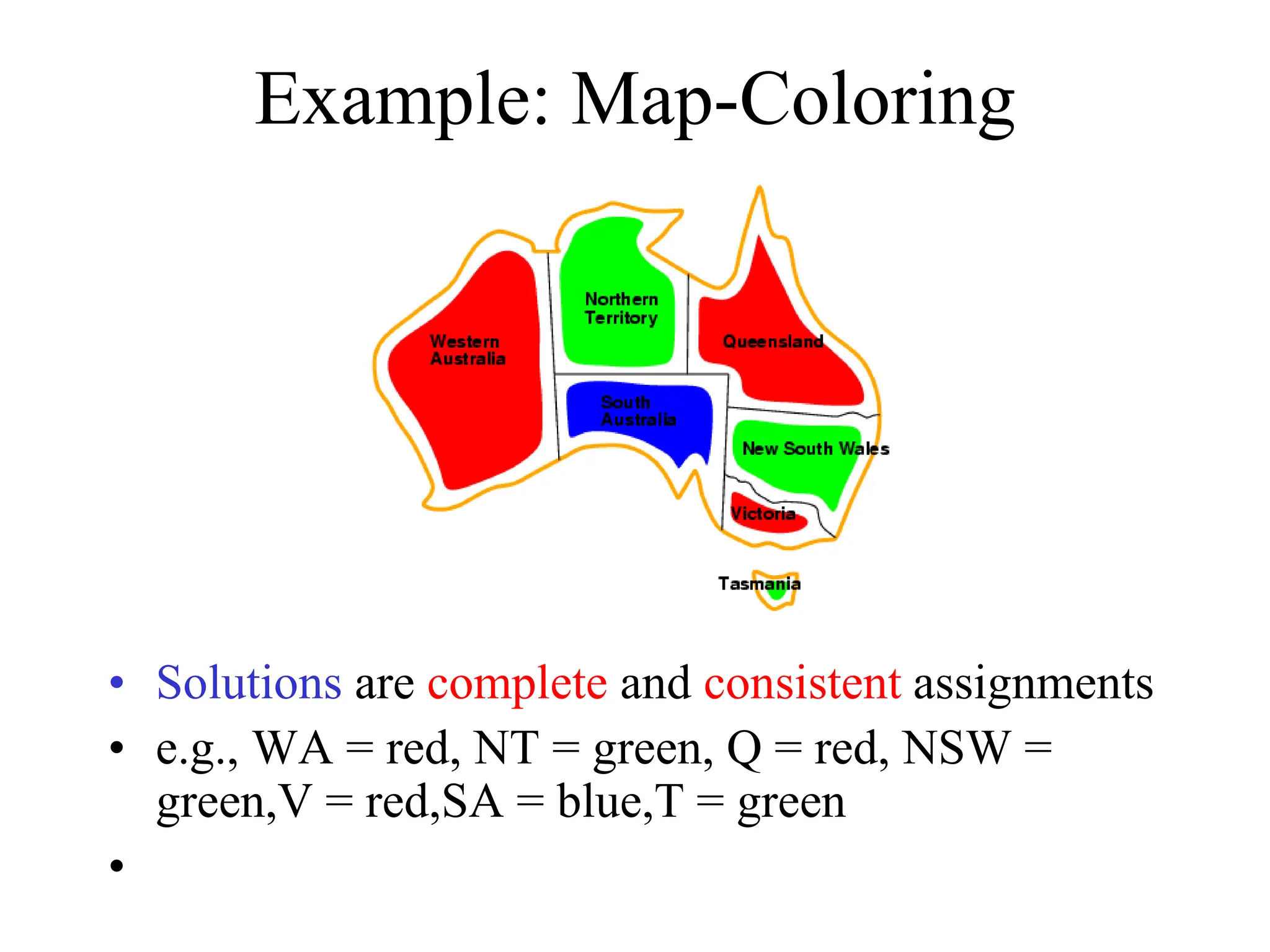
Example: Map-Coloring
• Solutions are complete and consistent assignments
• e.g., WA = red, NT = green, Q = red, NSW =
green,V = red,SA = blue,T = green
•
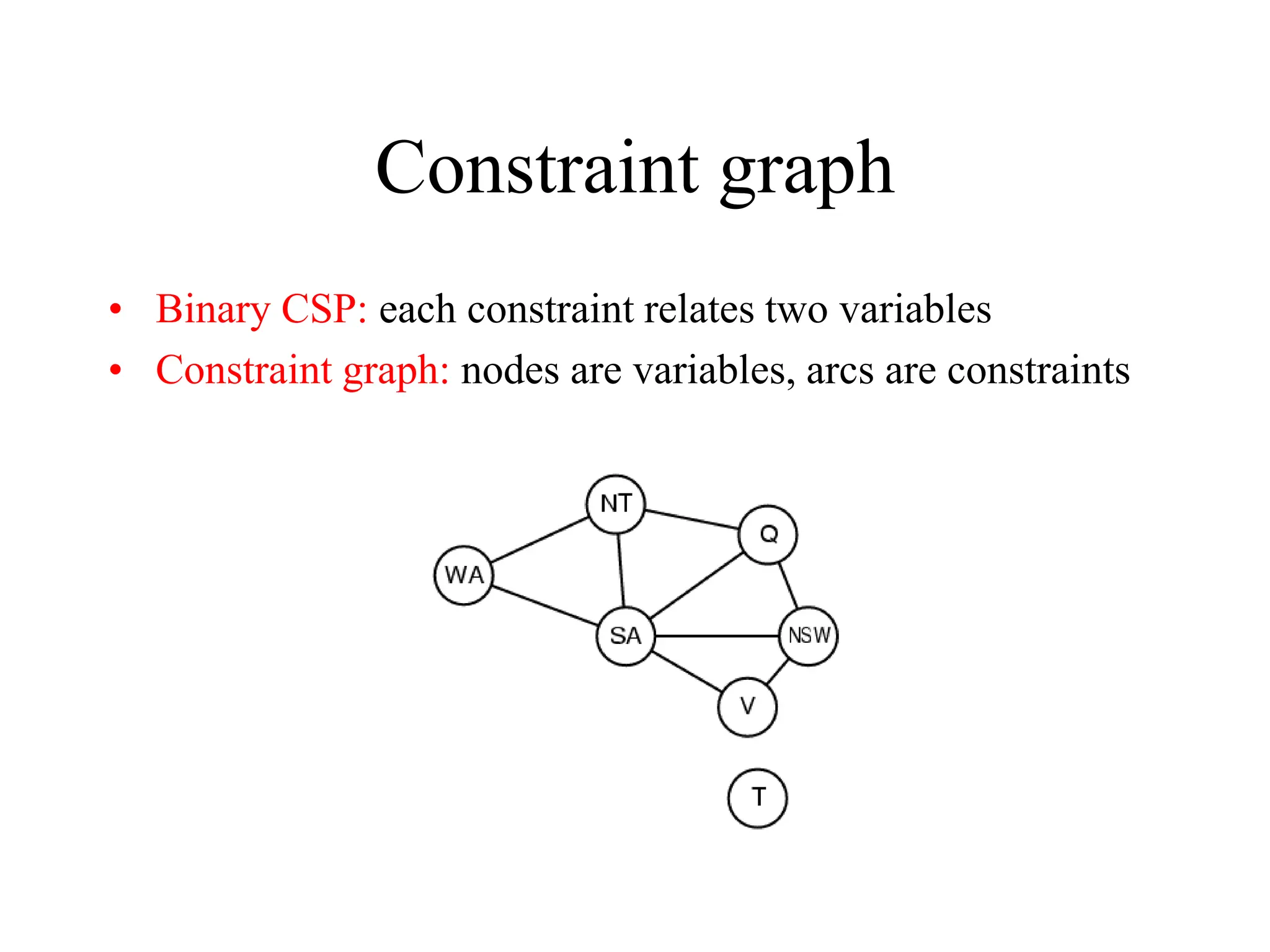
Constraint graph
• Binary CSP: each constraint relates two variables
• Constraint graph: nodes are variables, arcs are constraints
Varieties of CSPs
• Discrete variables
– finite domains:
• n variables, domain size d  O(dn) complete assignments
• e.g., Boolean CSPs, incl. Boolean satisfiability (NP-complete)
– infinite domains:
• integers, strings, etc.
• e.g., job scheduling, variables are start/end days for each job
• need a constraint language, e.g., StartJob1 + 5 ≤ StartJob3
• Continuous variables
– e.g., start/end times for Hubble Space Telescope observations
– linear constraints solvable in polynomial time by LP
Varieties of constraints
• Unary constraints involve a single variable,
– e.g., SA ≠ green
• Binary constraints involve pairs of variables,
– e.g., SA ≠ WA
• Higher-order constraints involve 3 or more
variables,
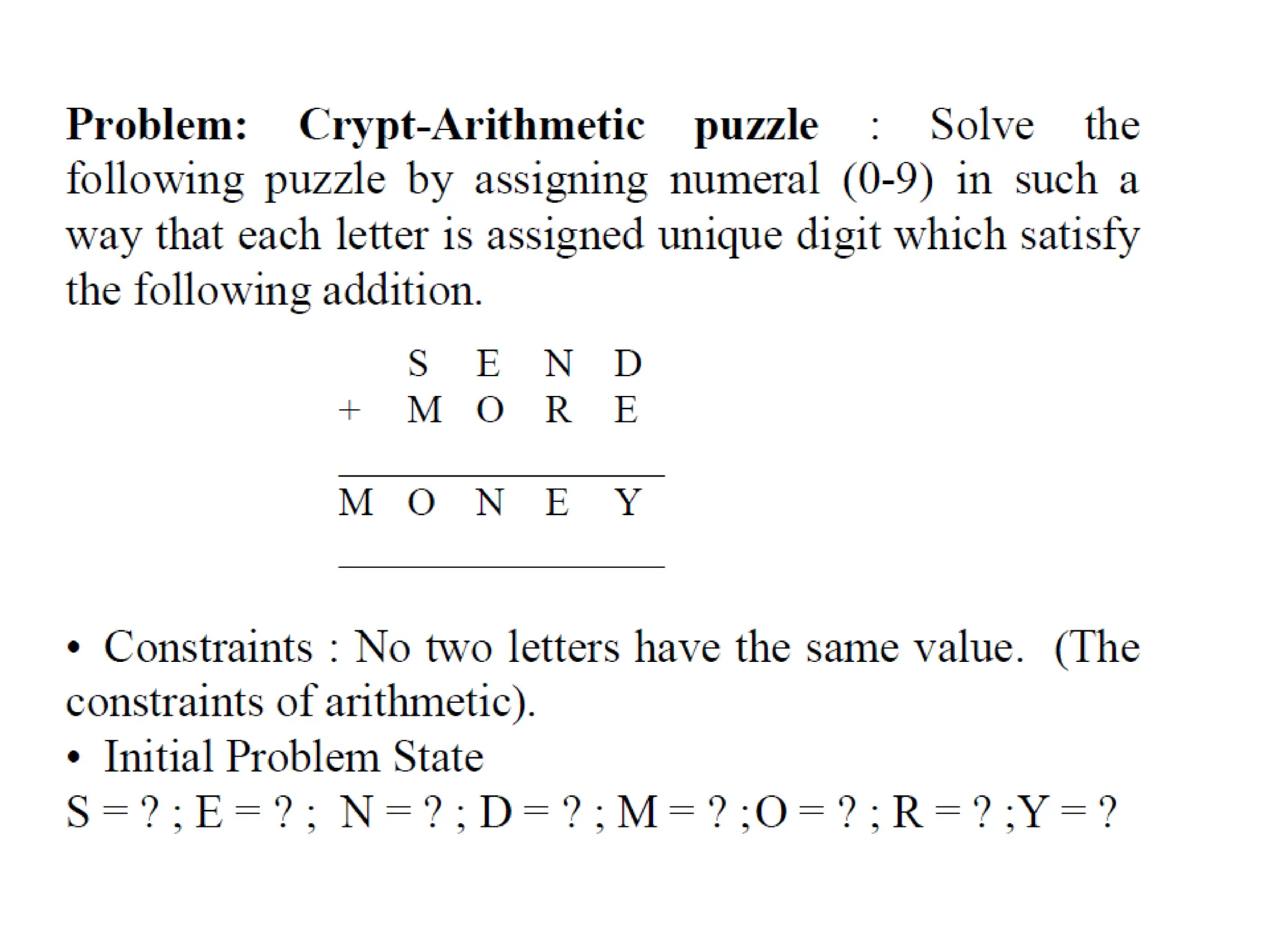
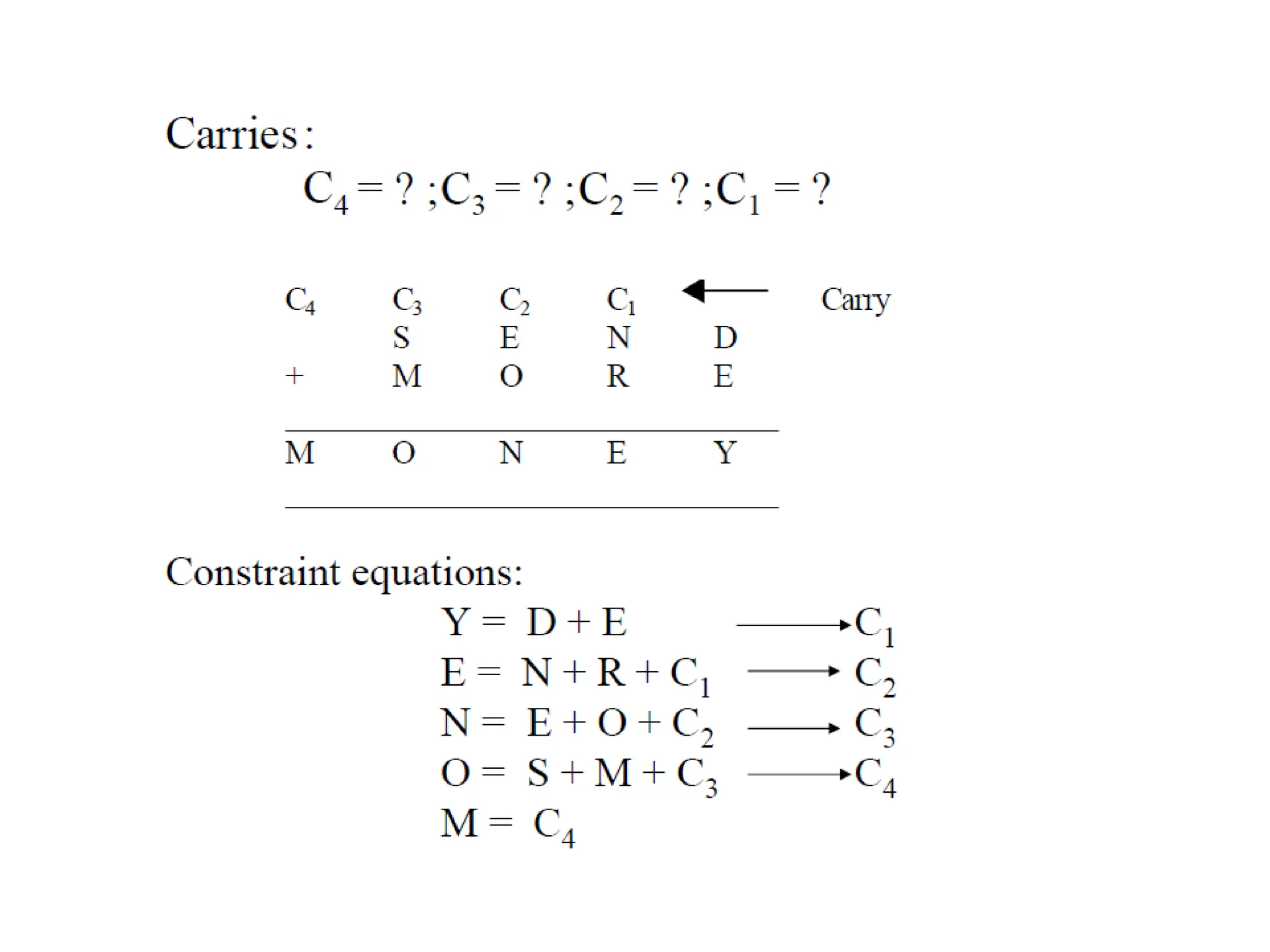
– e.g., cryptarithmetic column constraints
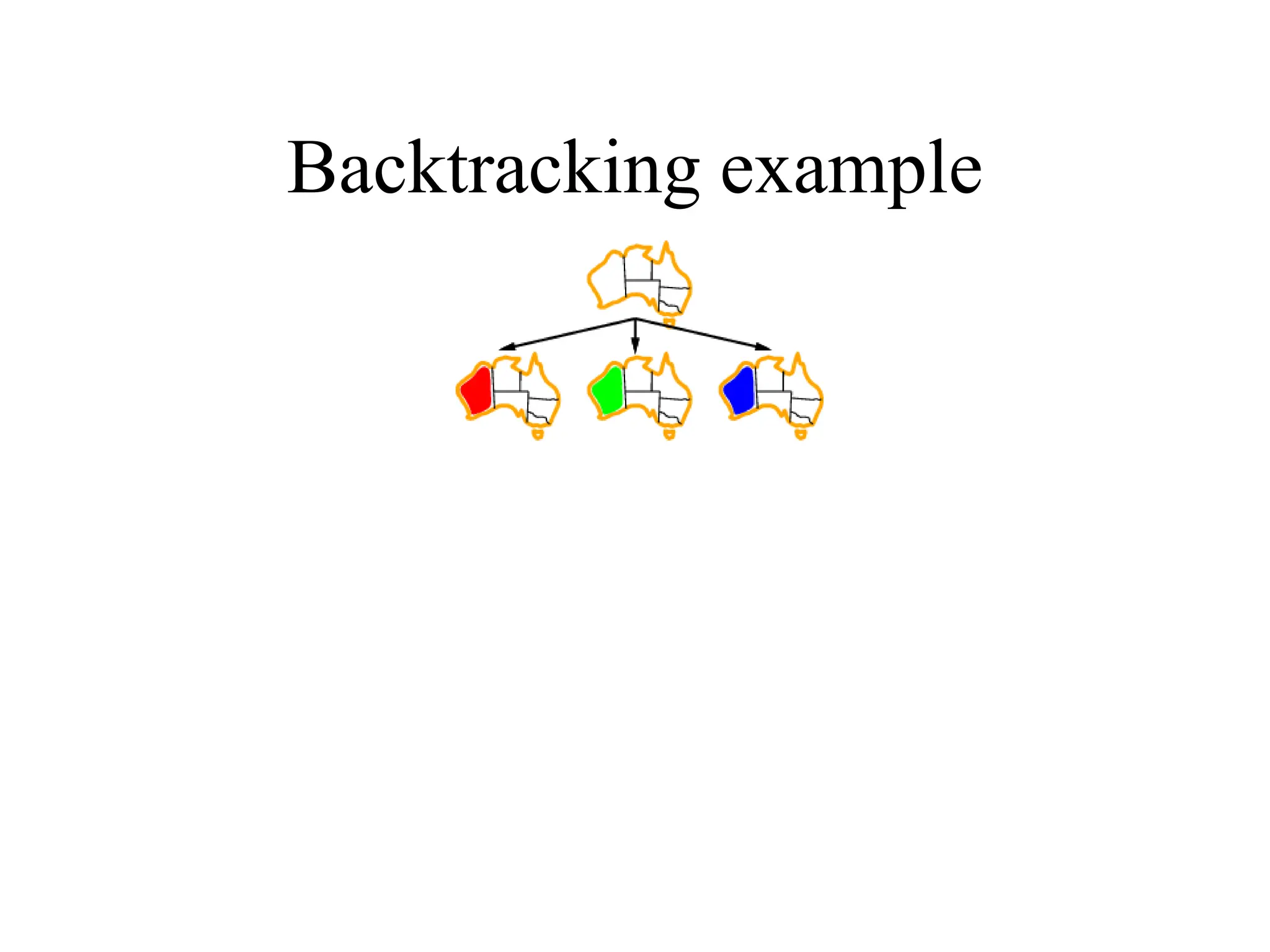
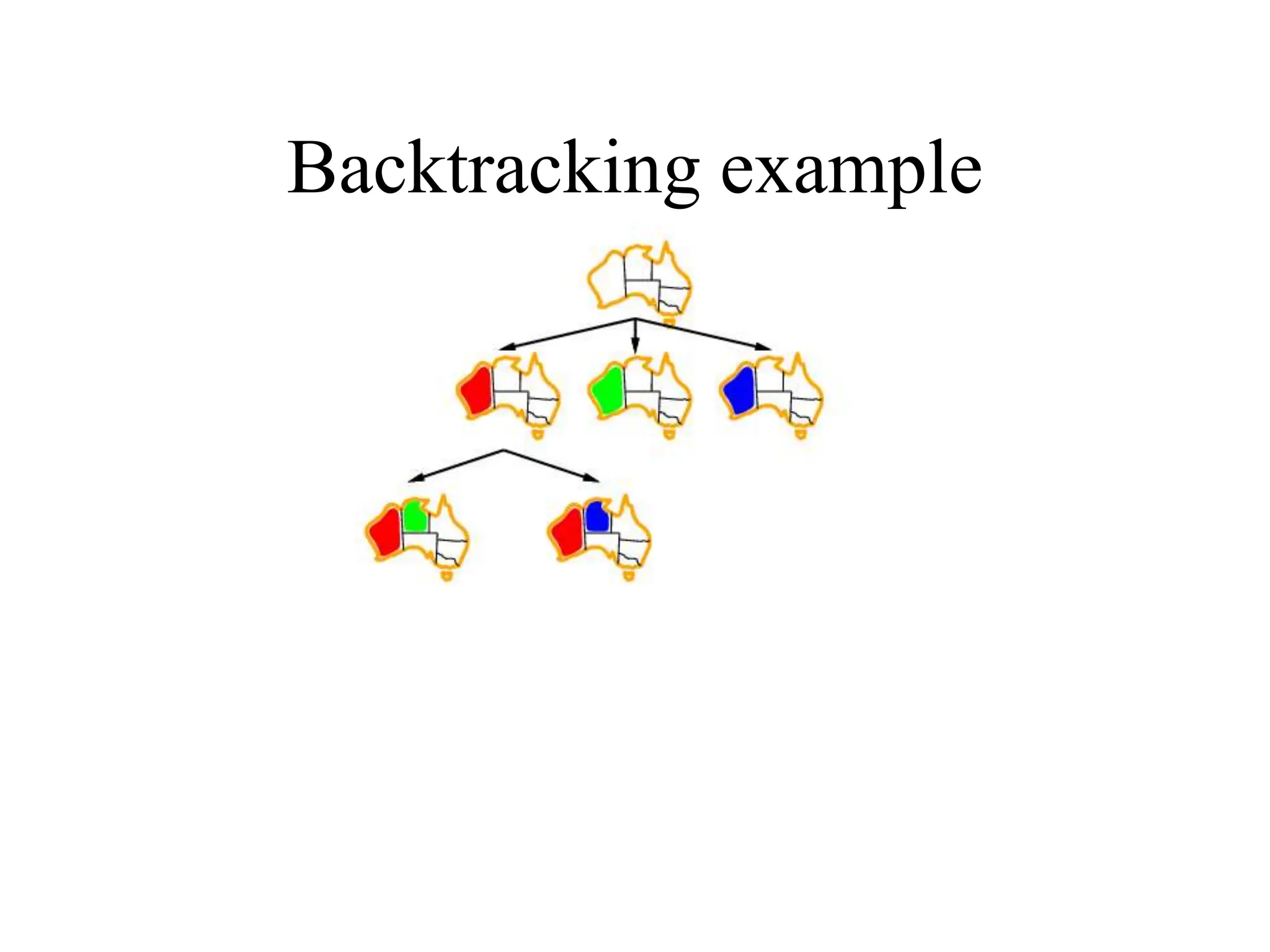
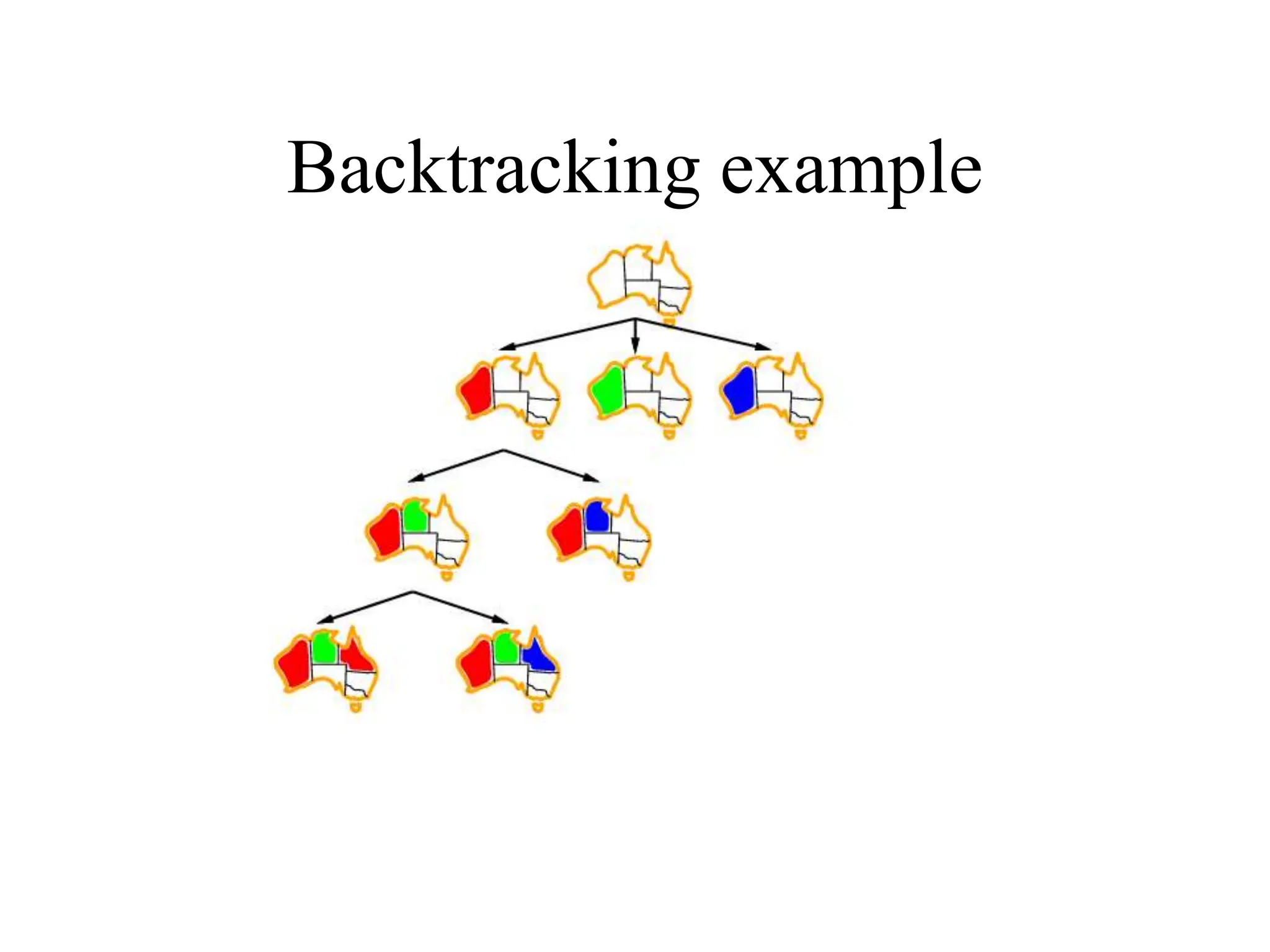
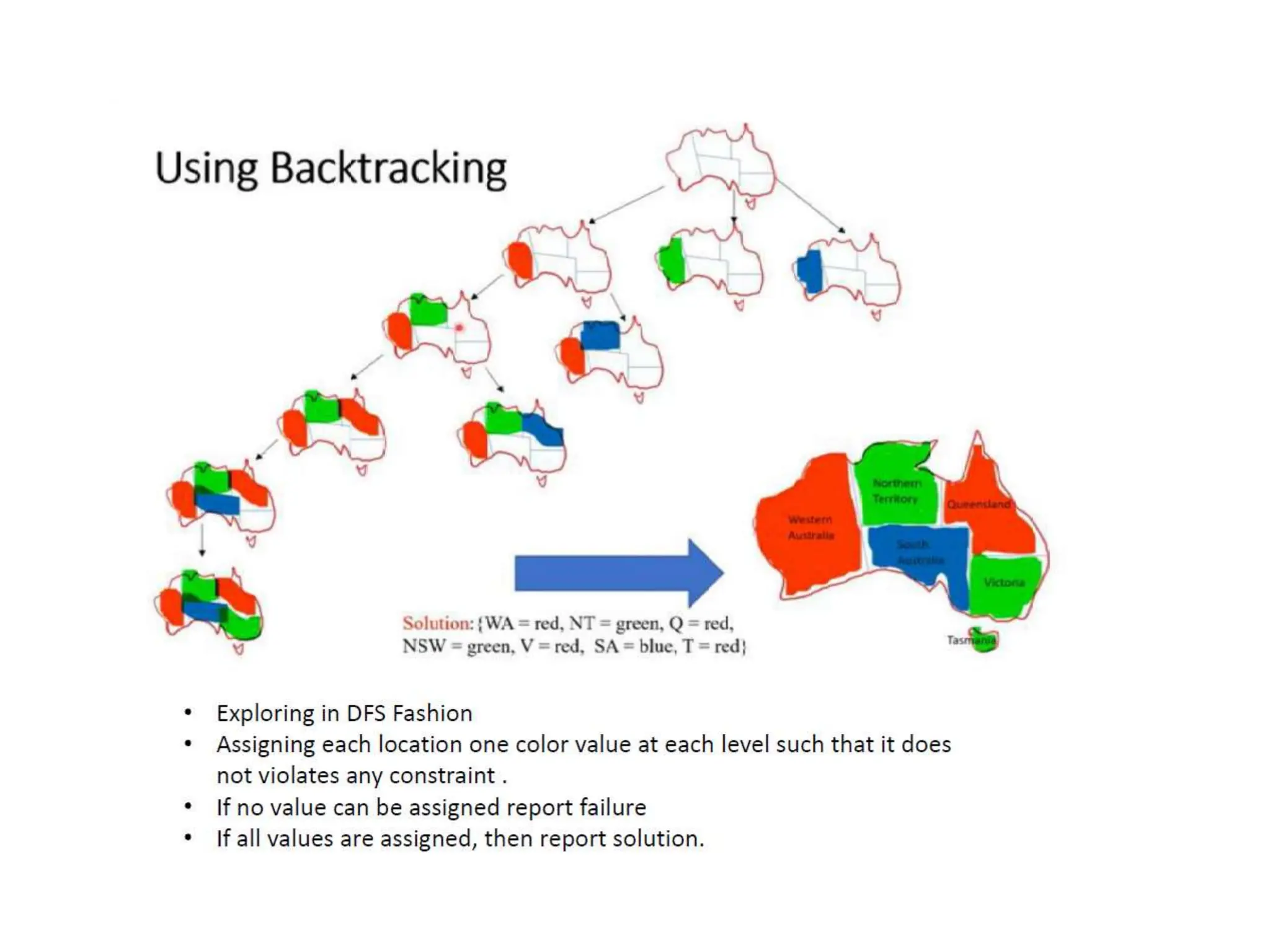
Backtracking search
• Variable assignments are commutative, i.e.,
[ WA = red then NT = green ] same as [ NT = green then WA = red ]
• => Only need to consider assignments to a single variable at
each node
• Depth-first search for CSPs with single-variable assignments
is called backtracking search
• Can solve n-queens for n ≈ 25
Backtracking example
Improving backtracking efficiency
• General-purpose methods can give huge
gains in speed:
– Which variable should be assigned next?
– In what order should its values be tried?
– Can we detect inevitable failure early?
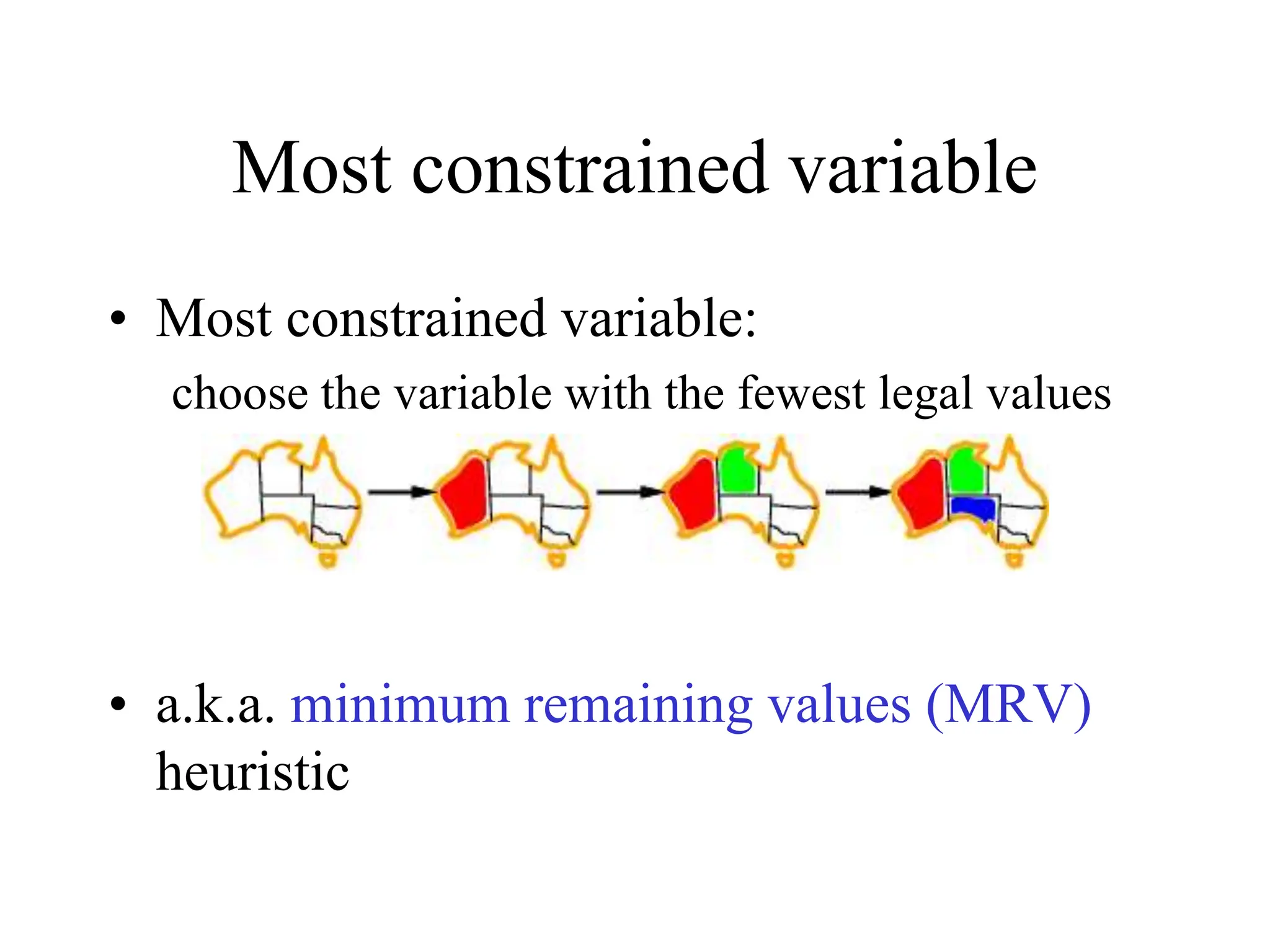
Most constrained variable
• Most constrained variable:
choose the variable with the fewest legal values
• a.k.a. minimum remaining values (MRV)
heuristic
Most constraining variable
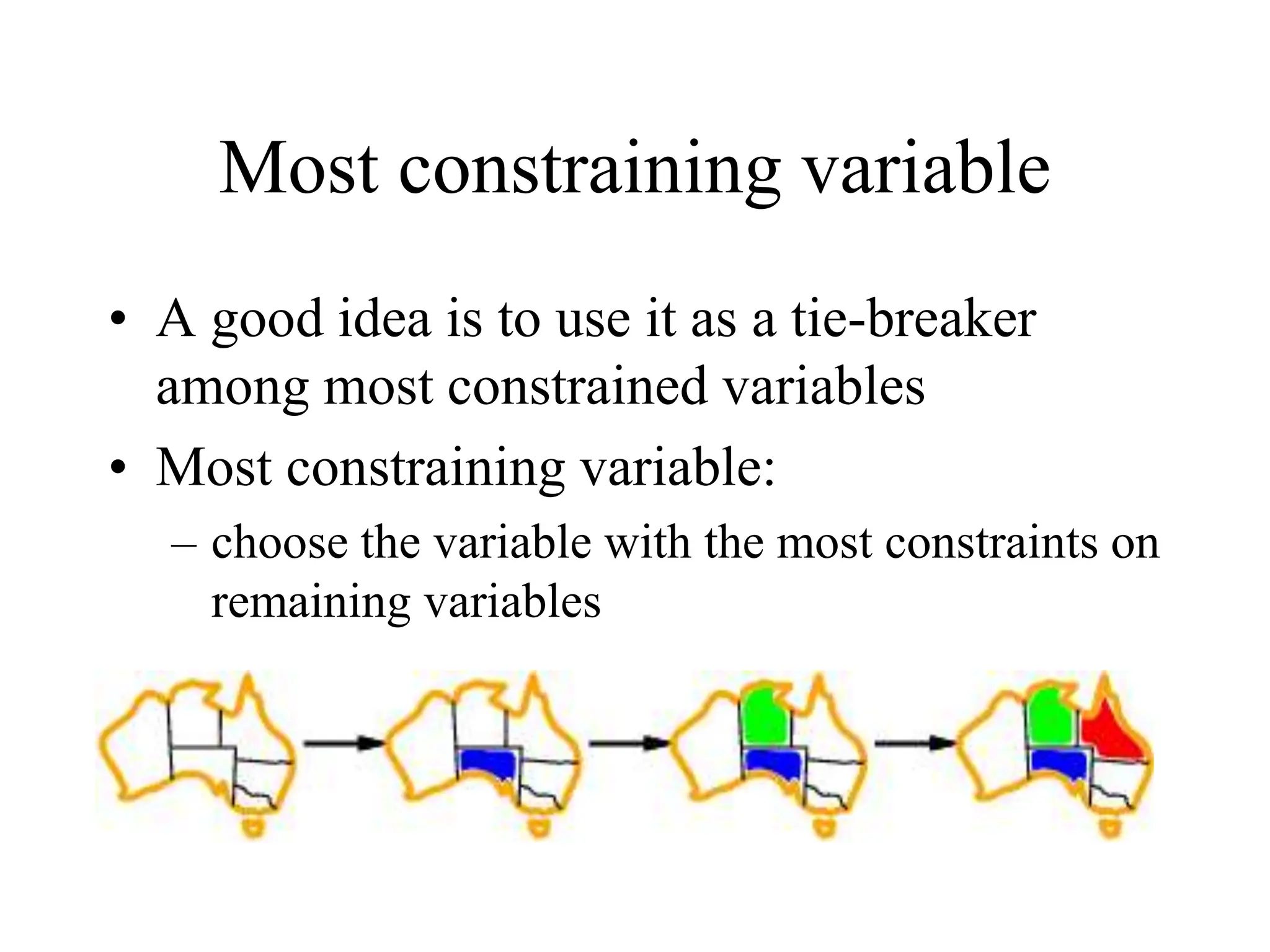
• A good idea is to use it as a tie-breaker
among most constrained variables
• Most constraining variable:
– choose the variable with the most constraints on
remaining variables
–
Least constraining value
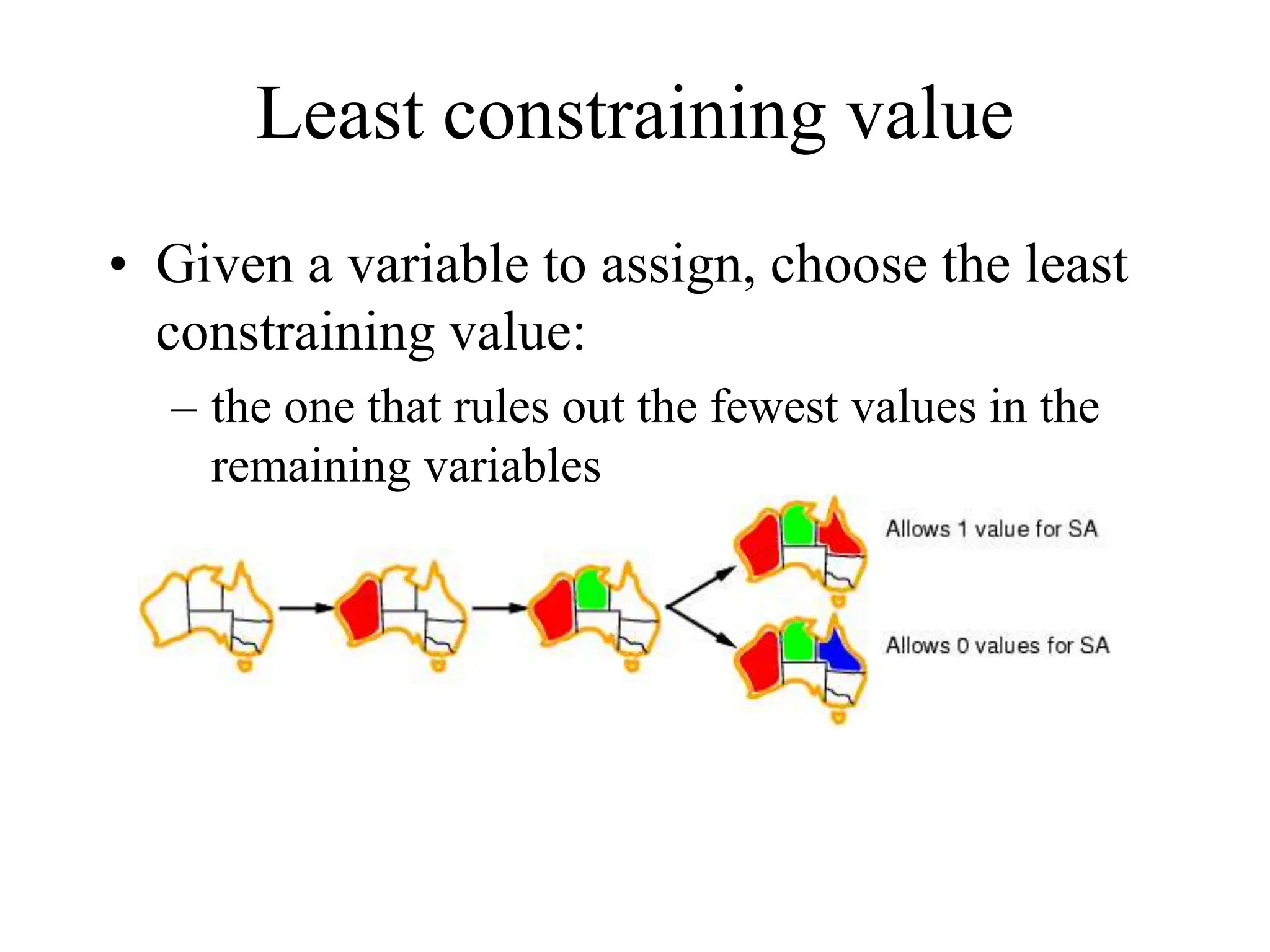
• Given a variable to assign, choose the least
constraining value:
– the one that rules out the fewest values in the
remaining variables
–
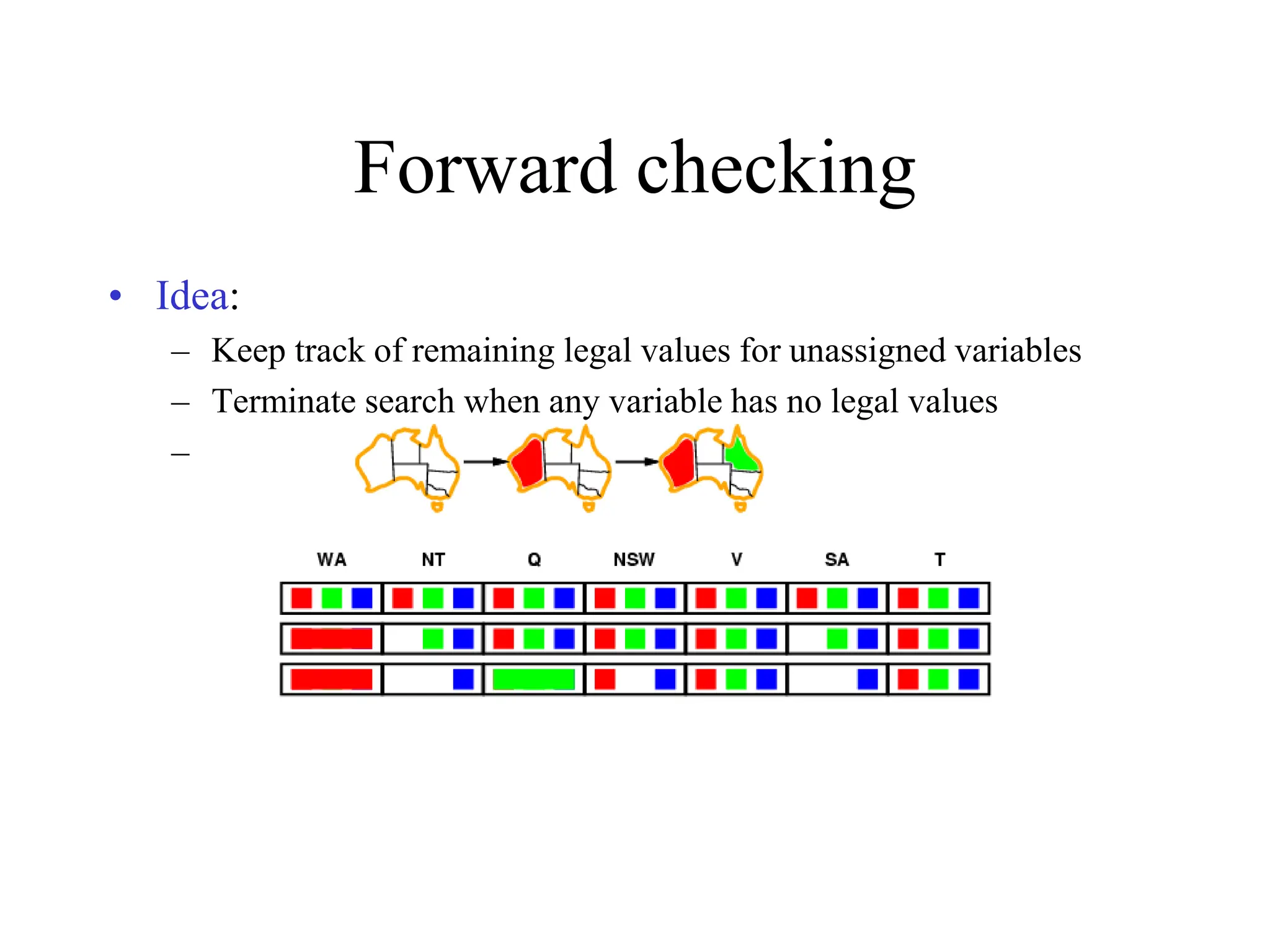
Forward checking
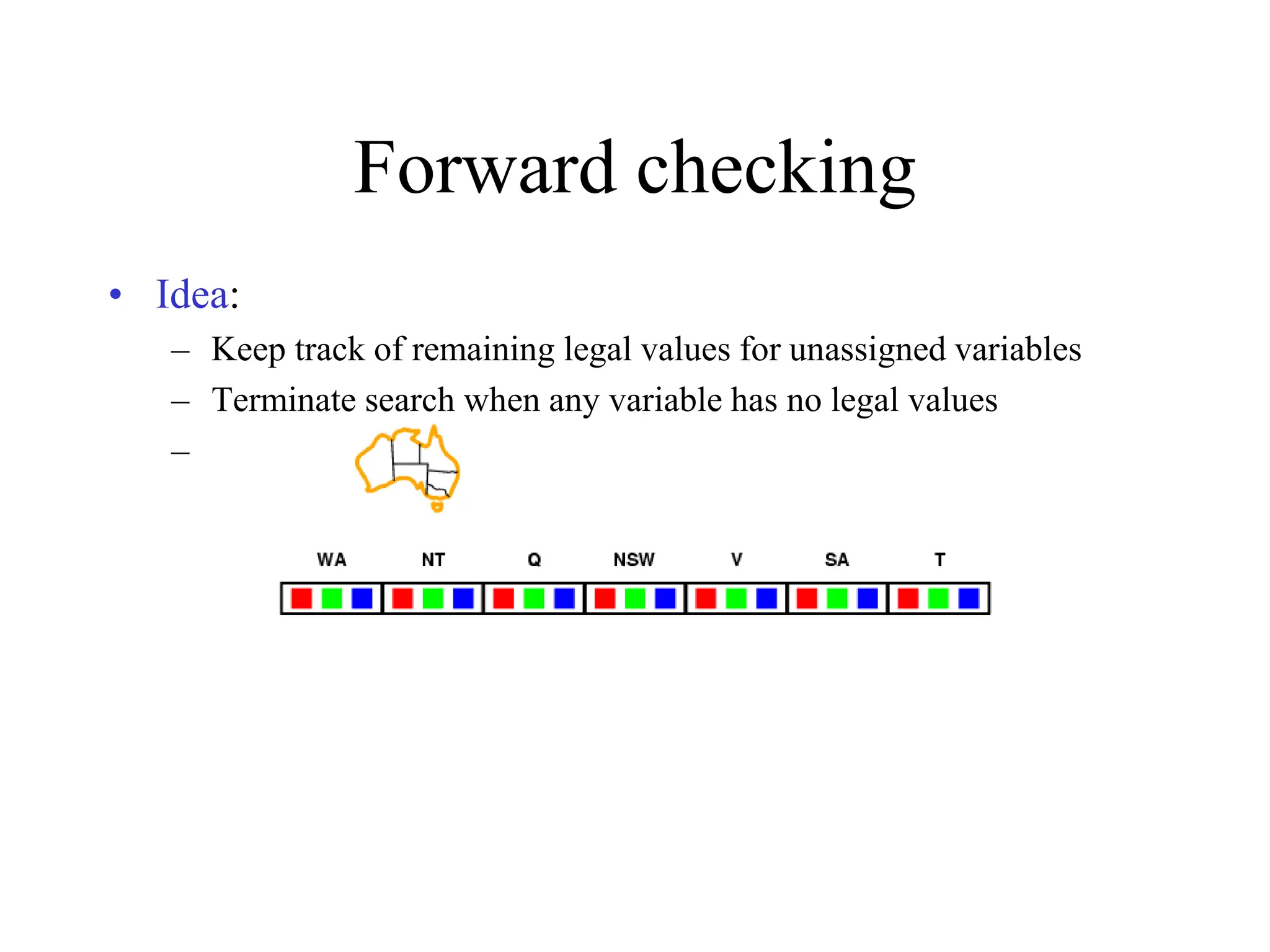
• Idea:
– Keep track of remaining legal values for unassigned variables
– Terminate search when any variable has no legal values
–
Forward checking
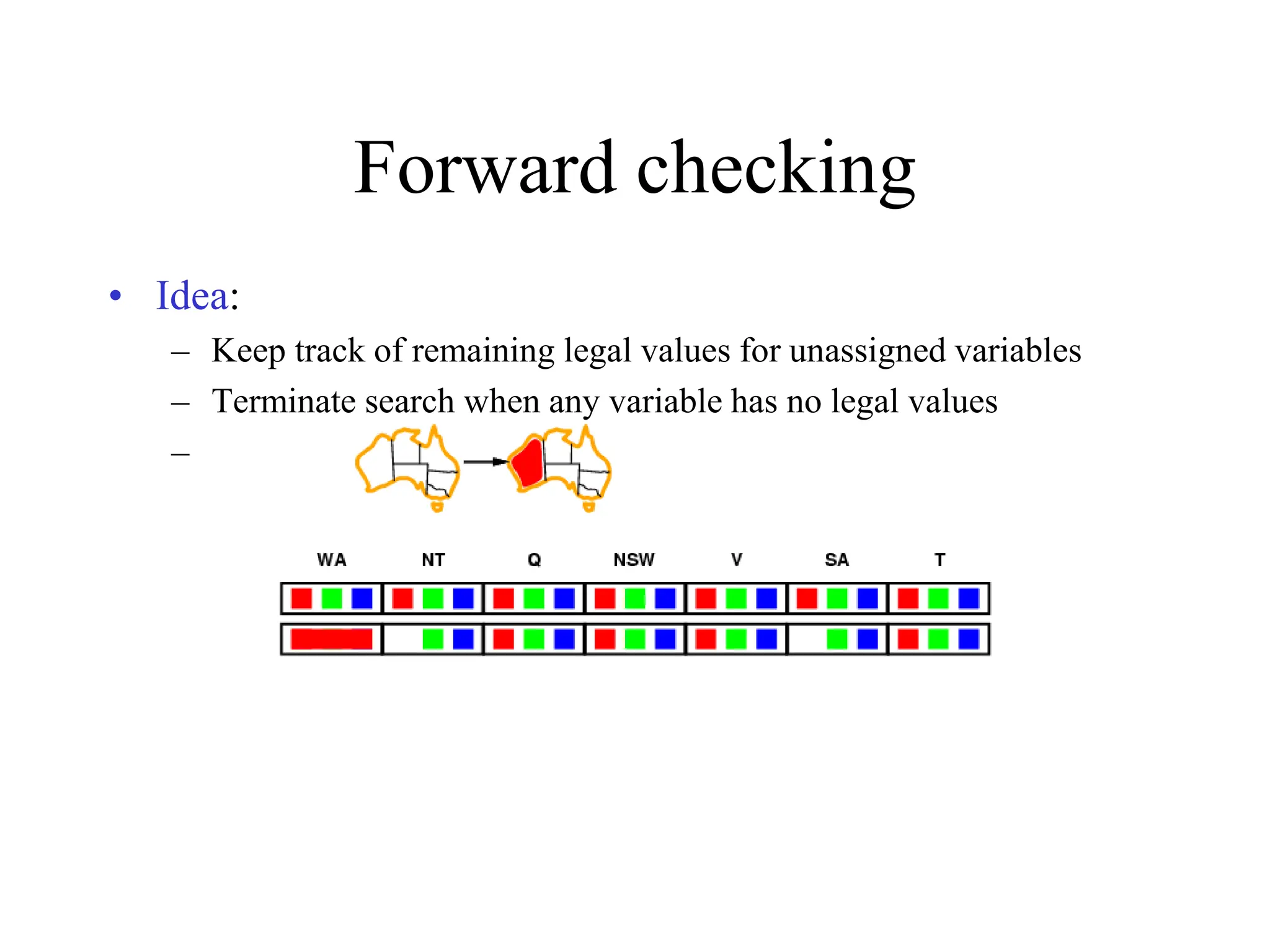
• Idea:
– Keep track of remaining legal values for unassigned variables
– Terminate search when any variable has no legal values
–
Forward checking
• Idea:
– Keep track of remaining legal values for unassigned variables
– Terminate search when any variable has no legal values
–
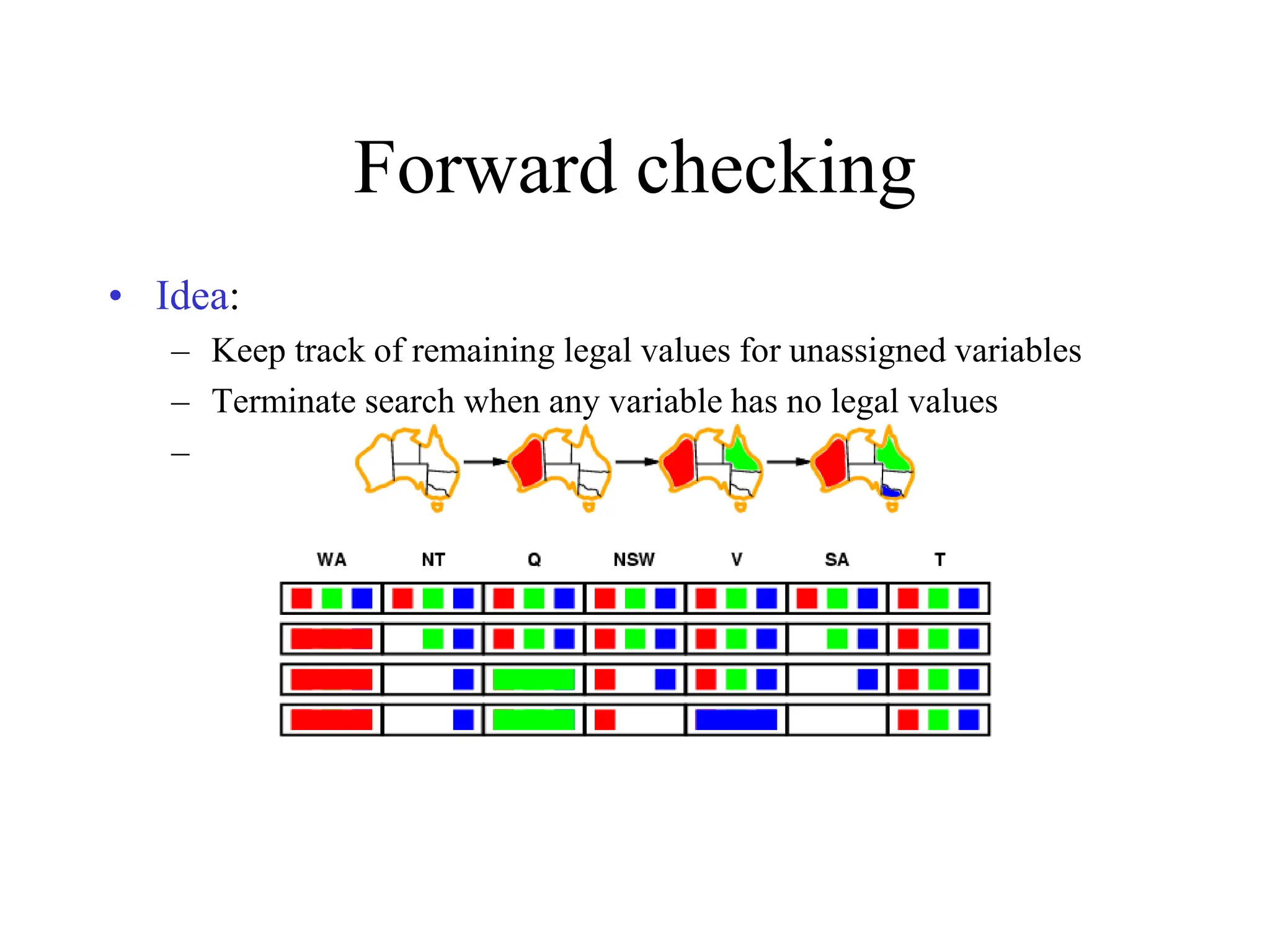
Forward checking
• Idea:
– Keep track of remaining legal values for unassigned variables
– Terminate search when any variable has no legal values
–
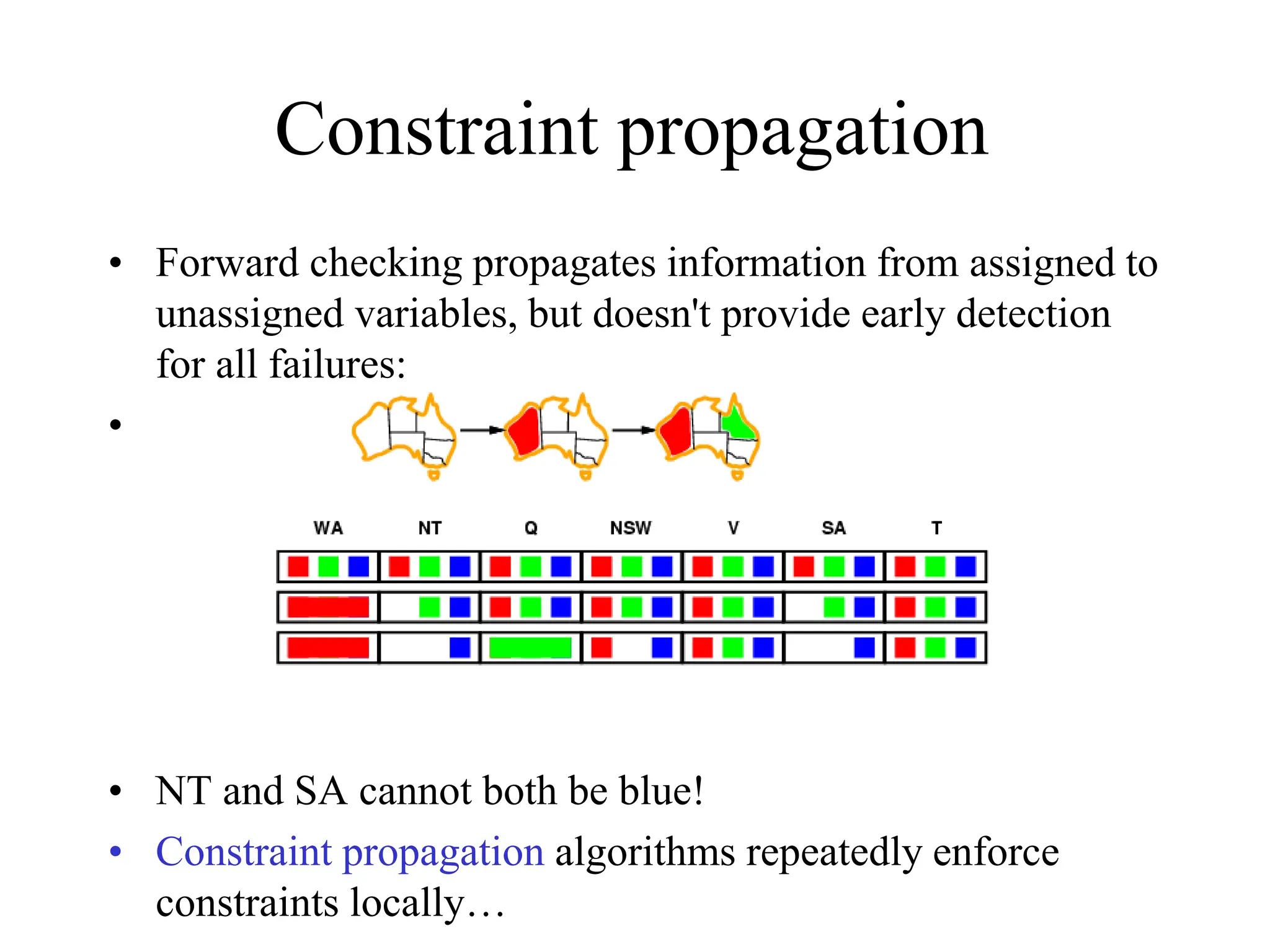
Constraint propagation
• Forward checking propagates information from assigned to
unassigned variables, but doesn't provide early detection
for all failures:
•
• NT and SA cannot both be blue!
• Constraint propagation algorithms repeatedly enforce
constraints locally…
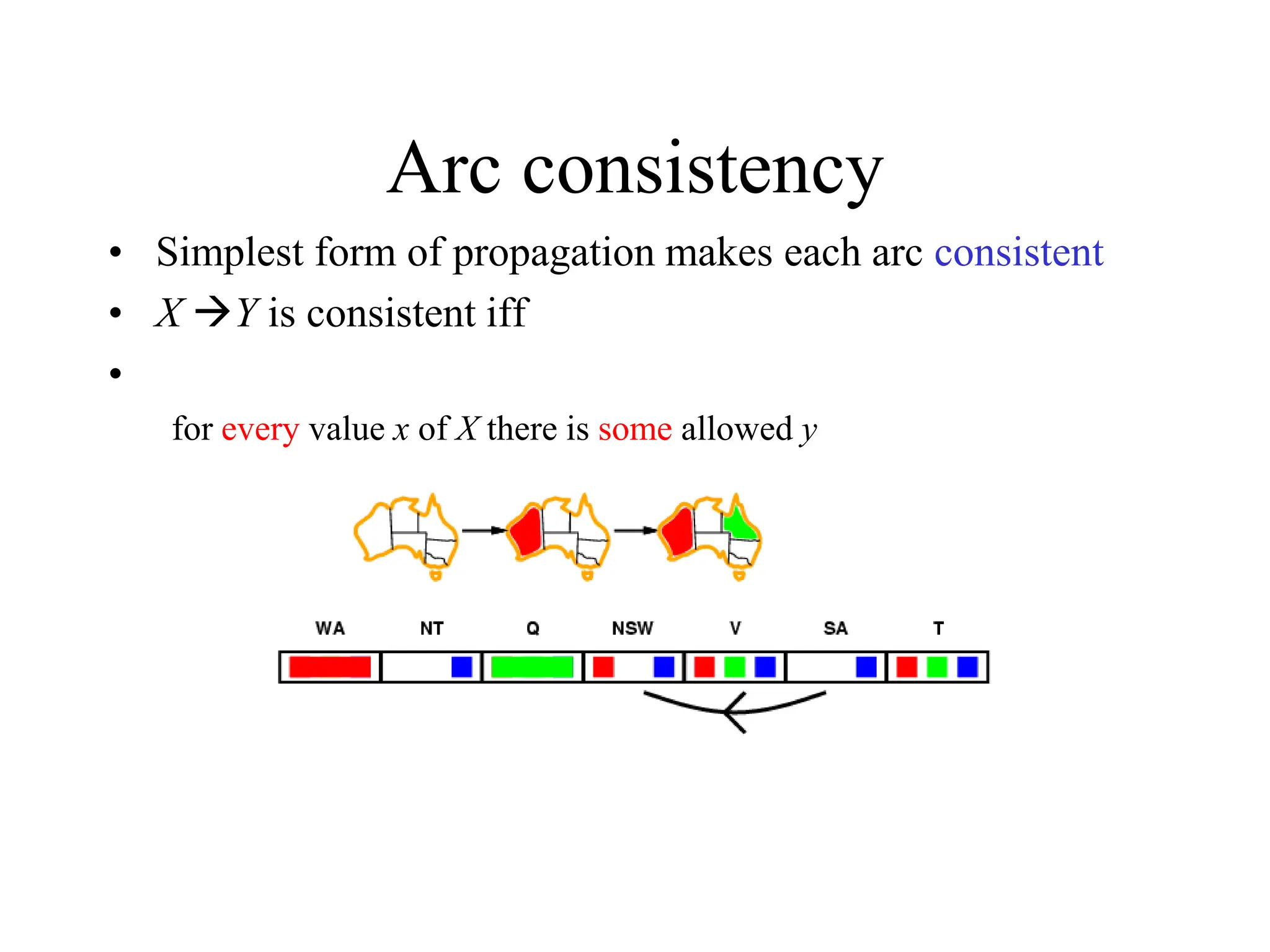
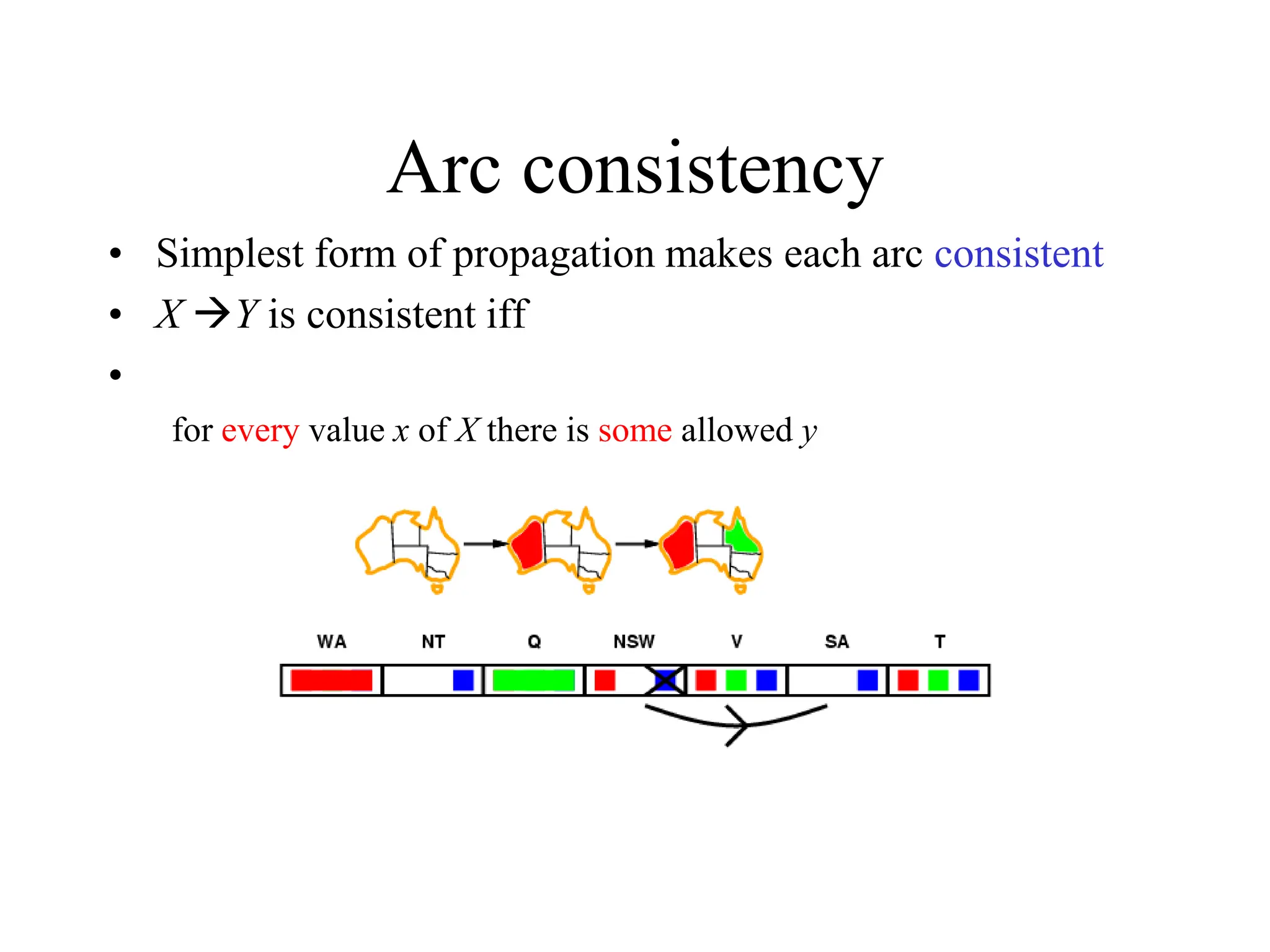
Arc consistency
• Simplest form of propagation makes each arc consistent
• X Y is consistent iff
•
for every value x of X there is some allowed y
Arc consistency
• Simplest form of propagation makes each arc consistent
• X Y is consistent iff
•
for every value x of X there is some allowed y
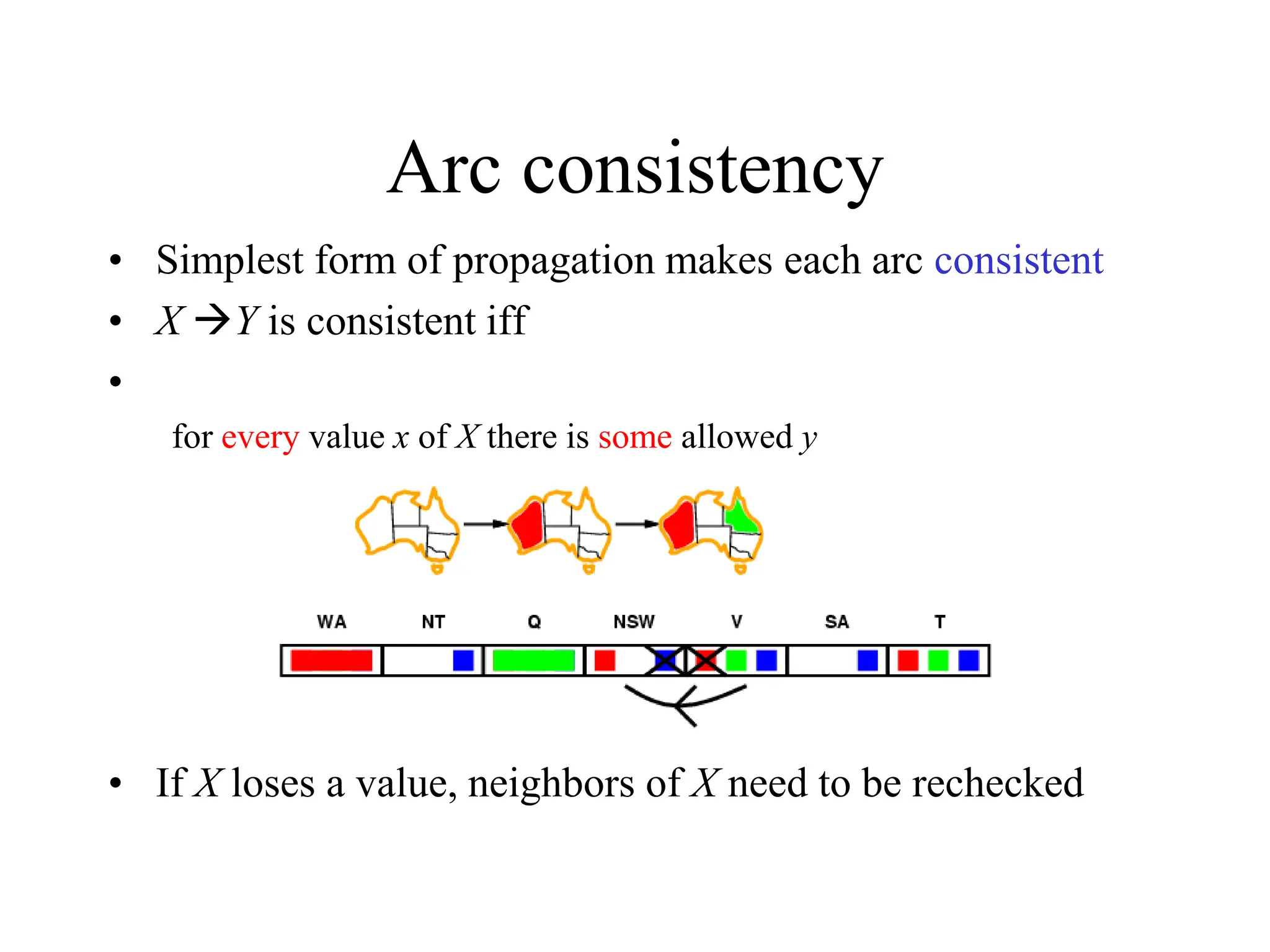
Arc consistency
• Simplest form of propagation makes each arc consistent
• X Y is consistent iff
•
for every value x of X there is some allowed y
• If X loses a value, neighbors of X need to be rechecked
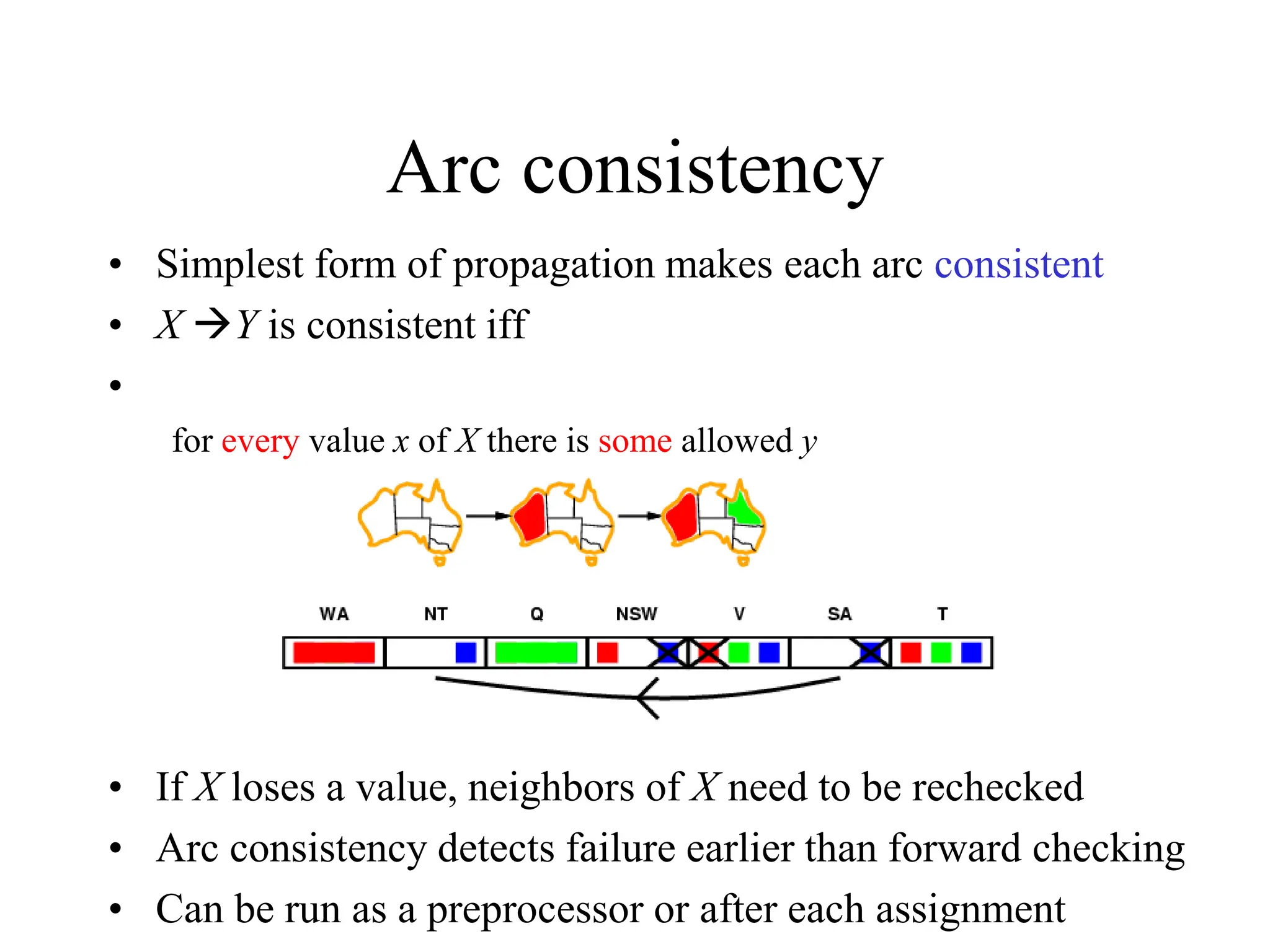
Arc consistency
• Simplest form of propagation makes each arc consistent
• X Y is consistent iff
•
for every value x of X there is some allowed y
• If X loses a value, neighbors of X need to be rechecked
• Arc consistency detects failure earlier than forward checking
• Can be run as a preprocessor or after each assignment
A PPT on Constraint Satisfaction problems

A PPT on Constraint Satisfaction problems

  • 1.
  • 2.
    Constraint satisfaction problems(CSPs) • Standard search problem: state is a "black box“ – any data structure that supports successor function and goal test • CSP: – state is defined by variables Xi with values from domain Di – goal test is a set of constraints specifying allowable combinations of values for subsets of variables • Simple example of a formal representation language • Allows useful general-purpose algorithms with more power than standard search algorithms
  • 3.
    Example: Map-Coloring • VariablesWA, NT, Q, NSW, V, SA, T • Domains Di = {red,green,blue} • Constraints: adjacent regions must have different colors • e.g., WA ≠ NT, or (WA,NT) in {(red,green),(red,blue),(green,red), (green,blue),(blue,red),(blue,green)}
  • 4.
    Example: Map-Coloring • Solutionsare complete and consistent assignments • e.g., WA = red, NT = green, Q = red, NSW = green,V = red,SA = blue,T = green •
  • 5.
    Constraint graph • BinaryCSP: each constraint relates two variables • Constraint graph: nodes are variables, arcs are constraints
  • 6.
    Varieties of CSPs •Discrete variables – finite domains: • n variables, domain size d  O(dn) complete assignments • e.g., Boolean CSPs, incl. Boolean satisfiability (NP-complete) – infinite domains: • integers, strings, etc. • e.g., job scheduling, variables are start/end days for each job • need a constraint language, e.g., StartJob1 + 5 ≤ StartJob3 • Continuous variables – e.g., start/end times for Hubble Space Telescope observations – linear constraints solvable in polynomial time by LP
  • 7.
    Varieties of constraints •Unary constraints involve a single variable, – e.g., SA ≠ green • Binary constraints involve pairs of variables, – e.g., SA ≠ WA • Higher-order constraints involve 3 or more variables, – e.g., cryptarithmetic column constraints
  • 8.
    Backtracking search • Variableassignments are commutative, i.e., [ WA = red then NT = green ] same as [ NT = green then WA = red ] • => Only need to consider assignments to a single variable at each node • Depth-first search for CSPs with single-variable assignments is called backtracking search • Can solve n-queens for n ≈ 25
  • 9.
  • 10.
  • 11.
  • 12.
  • 14.
    Improving backtracking efficiency •General-purpose methods can give huge gains in speed: – Which variable should be assigned next? – In what order should its values be tried? – Can we detect inevitable failure early?
  • 15.
    Most constrained variable •Most constrained variable: choose the variable with the fewest legal values • a.k.a. minimum remaining values (MRV) heuristic
  • 16.
    Most constraining variable •A good idea is to use it as a tie-breaker among most constrained variables • Most constraining variable: – choose the variable with the most constraints on remaining variables –
  • 17.
    Least constraining value •Given a variable to assign, choose the least constraining value: – the one that rules out the fewest values in the remaining variables –
  • 18.
    Forward checking • Idea: –Keep track of remaining legal values for unassigned variables – Terminate search when any variable has no legal values –
  • 19.
    Forward checking • Idea: –Keep track of remaining legal values for unassigned variables – Terminate search when any variable has no legal values –
  • 20.
    Forward checking • Idea: –Keep track of remaining legal values for unassigned variables – Terminate search when any variable has no legal values –
  • 21.
    Forward checking • Idea: –Keep track of remaining legal values for unassigned variables – Terminate search when any variable has no legal values –
  • 22.
    Constraint propagation • Forwardchecking propagates information from assigned to unassigned variables, but doesn't provide early detection for all failures: • • NT and SA cannot both be blue! • Constraint propagation algorithms repeatedly enforce constraints locally…
  • 23.
    Arc consistency • Simplestform of propagation makes each arc consistent • X Y is consistent iff • for every value x of X there is some allowed y
  • 24.
    Arc consistency • Simplestform of propagation makes each arc consistent • X Y is consistent iff • for every value x of X there is some allowed y
  • 25.
    Arc consistency • Simplestform of propagation makes each arc consistent • X Y is consistent iff • for every value x of X there is some allowed y • If X loses a value, neighbors of X need to be rechecked
  • 26.
    Arc consistency • Simplestform of propagation makes each arc consistent • X Y is consistent iff • for every value x of X there is some allowed y • If X loses a value, neighbors of X need to be rechecked • Arc consistency detects failure earlier than forward checking • Can be run as a preprocessor or after each assignment