CCoonnssttiittuuttiioonnaall 
AAmmeennddmmeenntt
Article 159 deals with constitutional 
amendment/power to amend the 
Constitution. 
In general the provision states that the 
Parliament can amend the Federal 
Constitution by passing a law 
(federal law).
AAmmeennaabbllee CCoonnssttiittuuttiioonn 
Suffian FJ: 
‘…there are many provisions showing that 
they realized that the Constitution should 
be a living document intended to be 
workable between the partners that 
constitute the Malayan (later Malaysian) 
polity, a living document that is reviewable 
from time to time in the light of 
experience and, if need be, amended.’ 
Teh Cheng Poh v Public Prosecutor 
[1979] 1 MLJ 50
The law, which is made in pursuant to the 
power given in article 159, will definitely 
be inconsistent with the existing provision 
in the constitution and be a law which is 
passed after Merdeka Day. 
Article 4 (1) declares that ‘any law passed 
after Merdeka Day which is inconsistent 
with the constitution shall, to the extent of 
the inconsistency, be void’. 
Will the law made under art 159 become 
void due to the inconsistency?
RRuullee ooff HHaarrmmoonniioouuss CCoonnssttrruuccttiioonn 
Phang Chin Hock v PP [1980] 1 MLJ 70 
The use of rule of harmonious construction in 
construing article 159 enables the Federal 
Court to hold that Acts of Parliament made 
in accordance with the conditions set out 
by article 159 are valid "even if inconsistent 
with the constitution ".
RRuullee ooff HHaarrmmoonniioouuss CCoonnssttrruuccttiioonn 
Mohammed Habibullah bin 
Mahmood v 
Faridah bte Dato Talib 
[1992] 2 MLJ 793
The MMeetthhooddss aanndd RReeqquuiirreemmeennttss ooff 
AAmmeennddiinngg tthhee FFeeddeerraall CCoonnssttiittuuttiioonn 
uunnddeerr AArrttiiccllee 115599 aanndd 116611EE 
Four methods of amendment as prescribed 
in the following provisions: 
1. Art. 159 (4) 
2. Art. 159 (5) - Art. 38 (2) (c); (4) & 6 
3. Art. 161E (2) – Art. 161E (4) 
4. Art. 159 (3)
The MMeetthhooddss aanndd RReeqquuiirreemmeennttss ooff 
AAmmeennddiinngg tthhee FFeeddeerraall CCoonnssttiittuuttiioonn 
uunnddeerr AArrttiiccllee 115599 aanndd 116611EE 
Raja Azlan Shah F.J stated in Loh 
Kooi Choon: 
‘Our Constitution prescribes four 
different methods for amendment of 
the different provisions of the 
Constitution.’
TThhee MMeetthhooddss aanndd RReeqquuiirreemmeennttss ooff 
AAmmeennddiinngg tthhee FFeeddeerraall CCoonnssttiittuuttiioonn 
uunnddeerr AArrttiiccllee 115599 aanndd 116611EE 
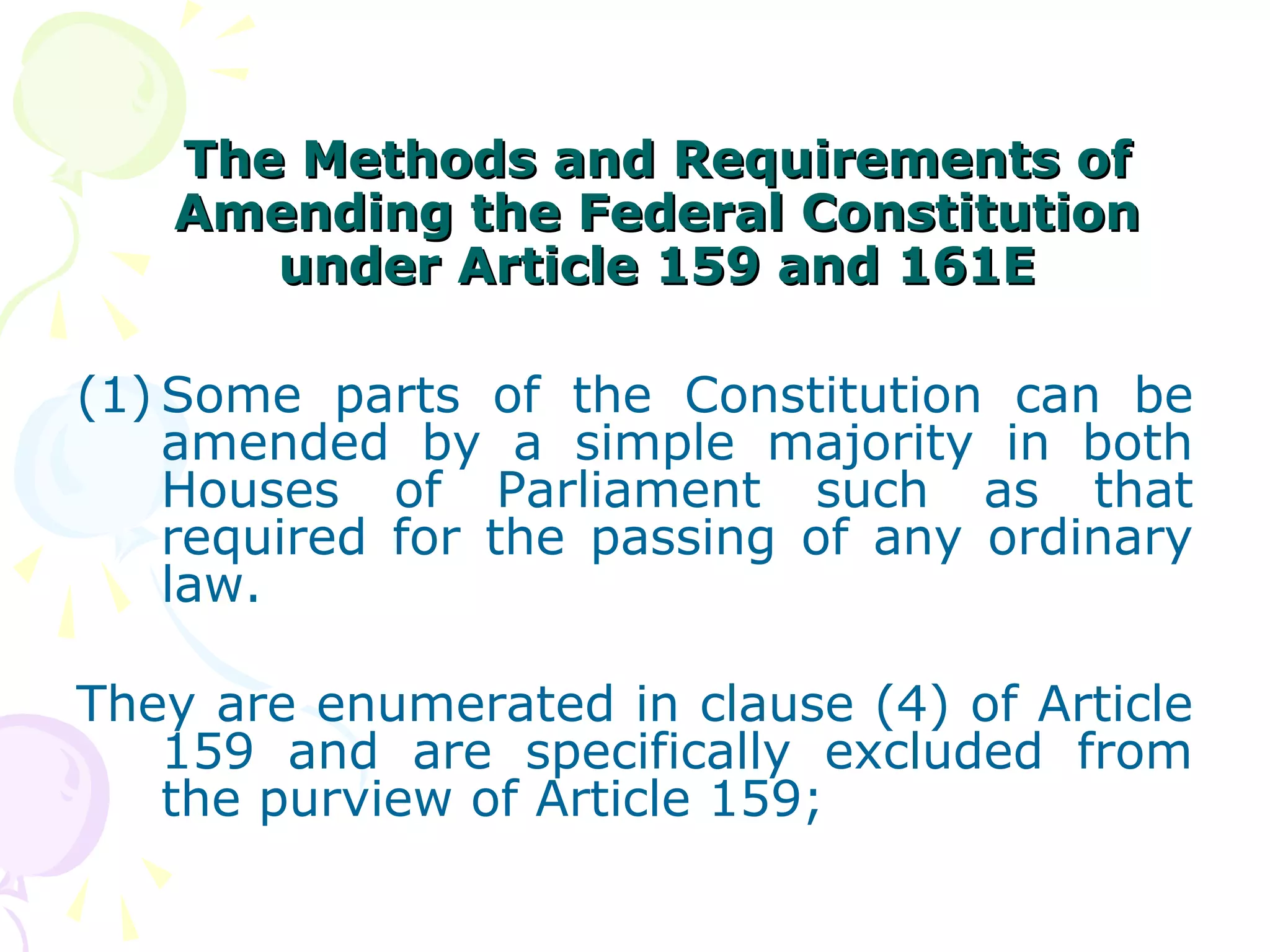
(1) Some parts of the Constitution can be 
amended by a simple majority in both 
Houses of Parliament such as that 
required for the passing of any ordinary 
law. 
They are enumerated in clause (4) of Article 
159 and are specifically excluded from 
the purview of Article 159;
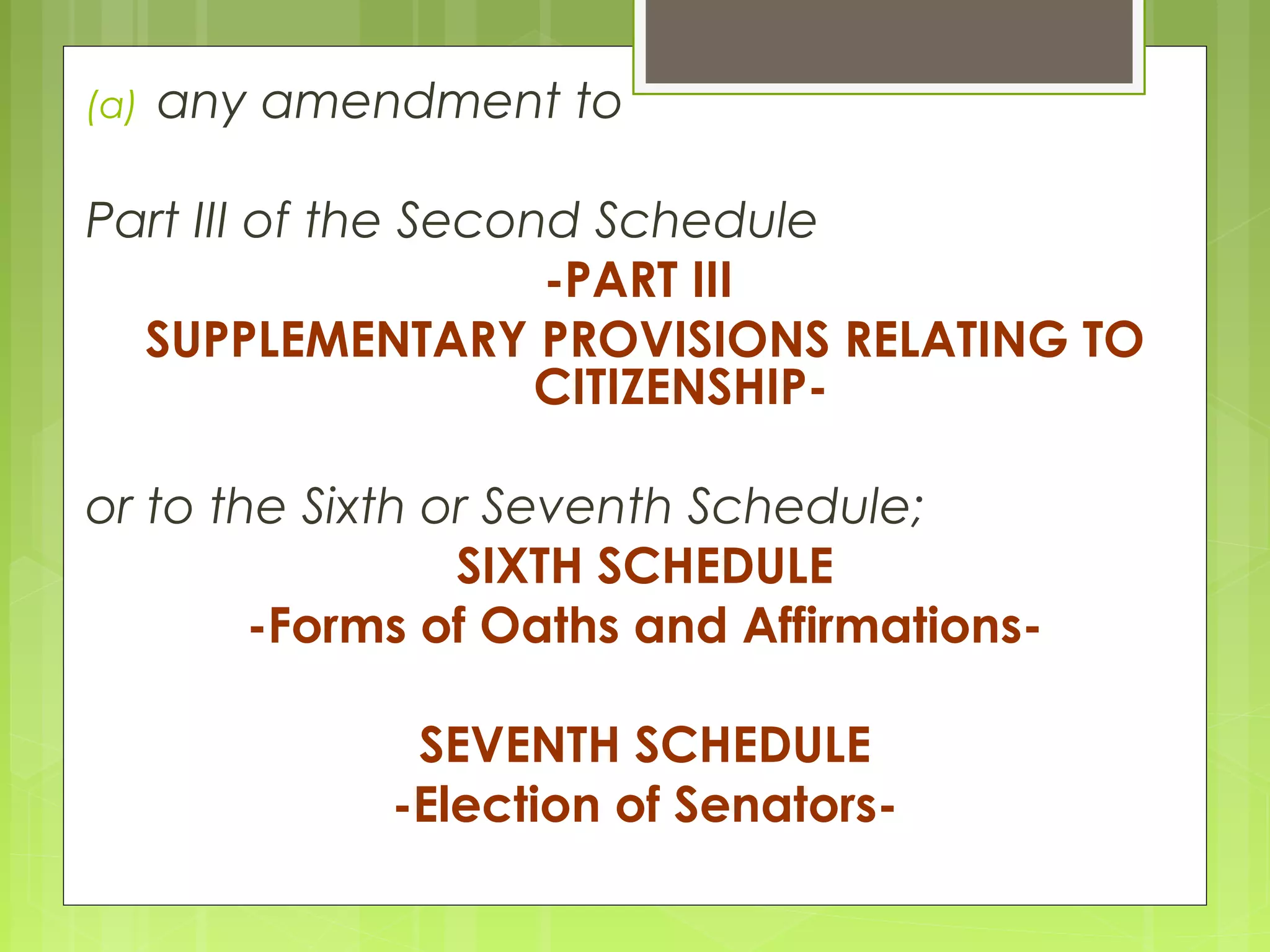
(a) any amendment to 
Part III of the Second Schedule 
-PART III 
SUPPLEMENTARY PROVISIONS RELATING TO 
CITIZENSHIP-or 
to the Sixth or Seventh Schedule; 
SIXTH SCHEDULE 
-Forms of Oaths and Affirmations- 
SEVENTH SCHEDULE 
-Election of Senators-
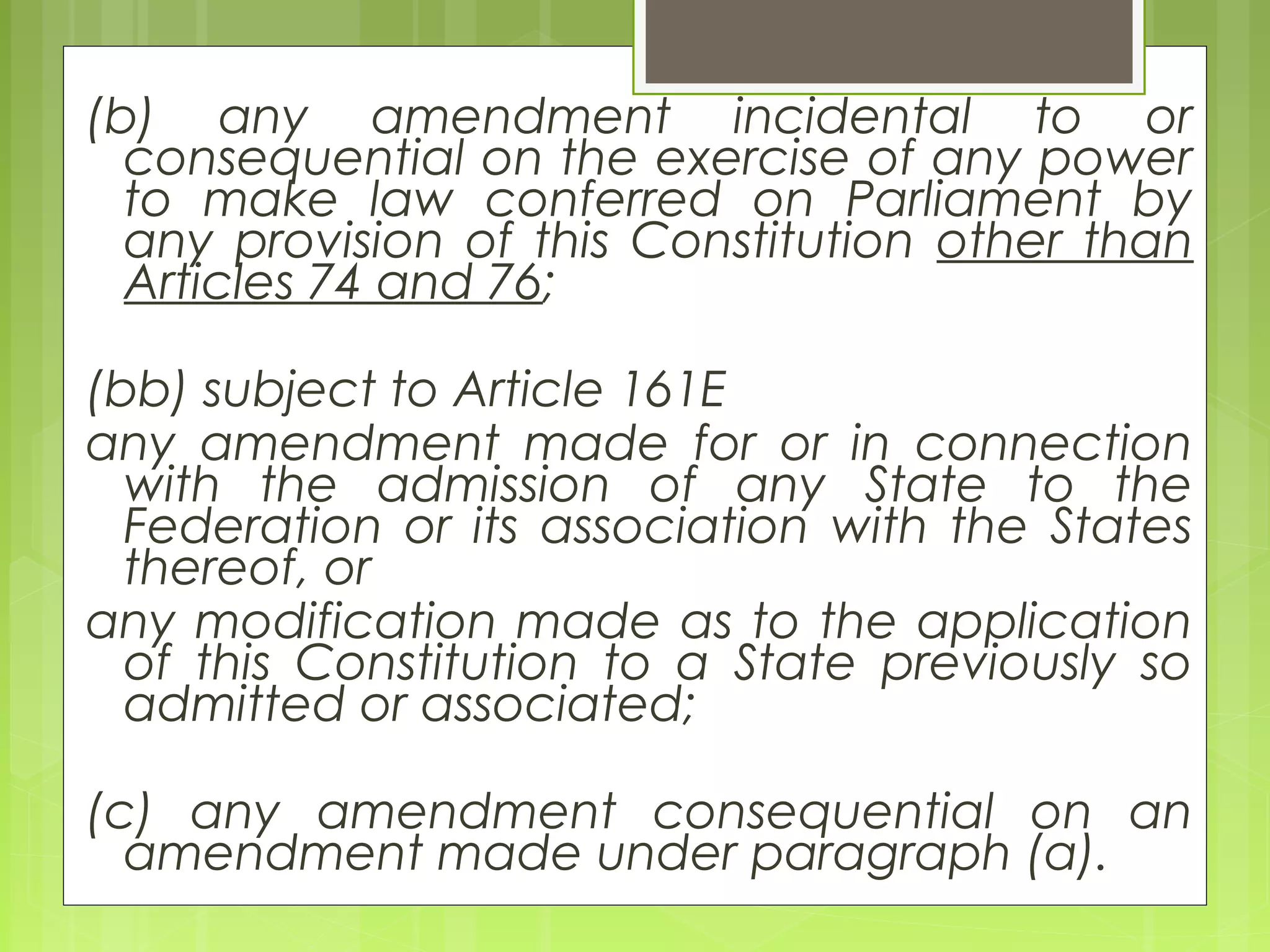
(b) any amendment incidental to or 
consequential on the exercise of any power 
to make law conferred on Parliament by 
any provision of this Constitution other than 
Articles 74 and 76; 
(bb) subject to Article 161E 
any amendment made for or in connection 
with the admission of any State to the 
Federation or its association with the States 
thereof, or 
any modification made as to the application 
of this Constitution to a State previously so 
admitted or associated; 
(c) any amendment consequential on an 
amendment made under paragraph (a).
THE GOVERNMENT OF THE STATE OF 
KELANTAN 
V 
THE GOVERNMENT OF THE FEDERATION OF 
MALAYA AND TUNKU ABDUL RAHMAN 
PUTRA AL-HAJ 
[1963] 1 MLJ 355
The MMeetthhooddss aanndd RReeqquuiirreemmeennttss ooff 
AAmmeennddiinngg tthhee FFeeddeerraall CCoonnssttiittuuttiioonn 
uunnddeerr AArrttiiccllee 115599 aanndd 116611EE 
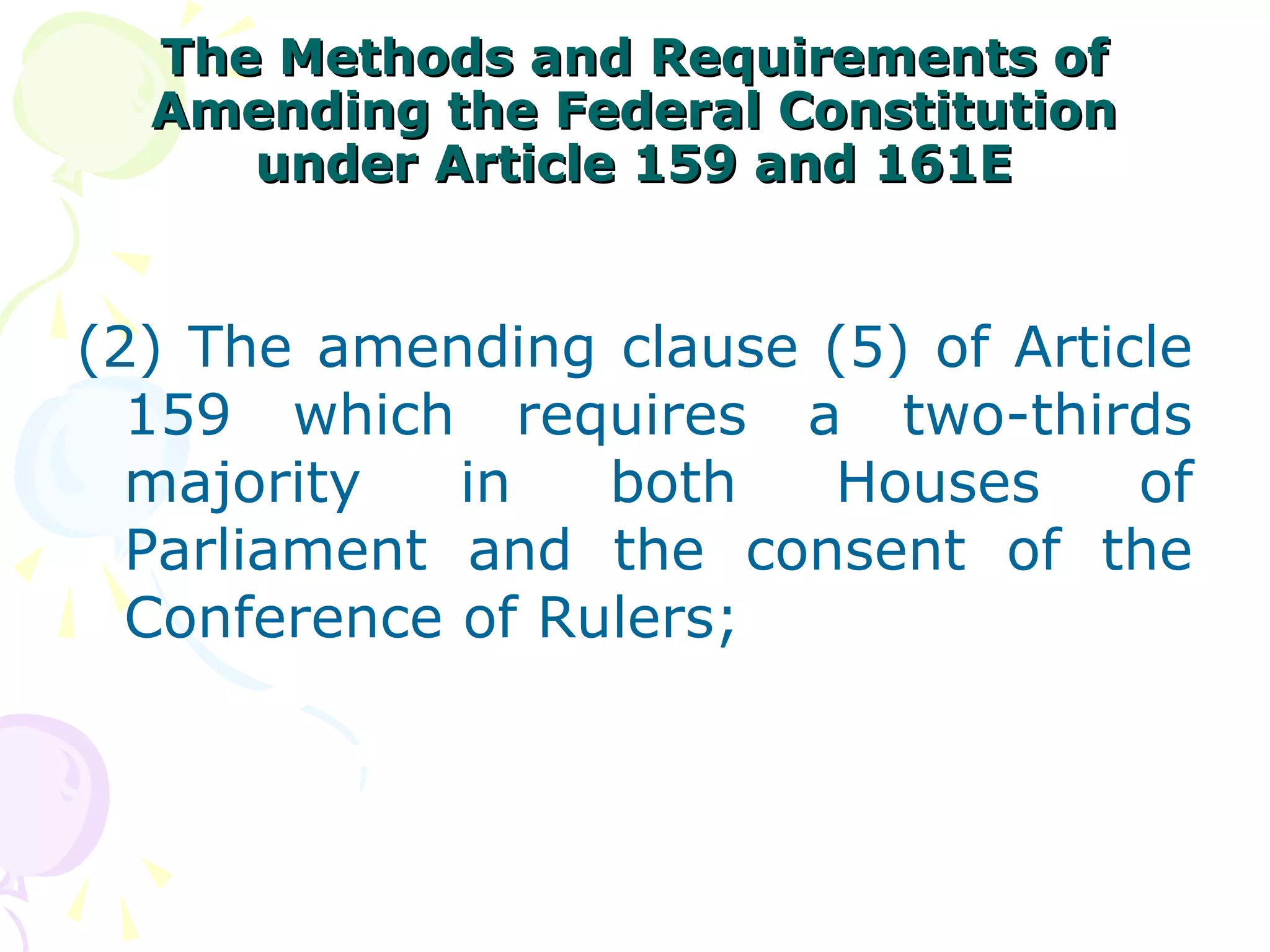
(2) The amending clause (5) of Article 
159 which requires a two-thirds 
majority in both Houses of 
Parliament and the consent of the 
Conference of Rulers;
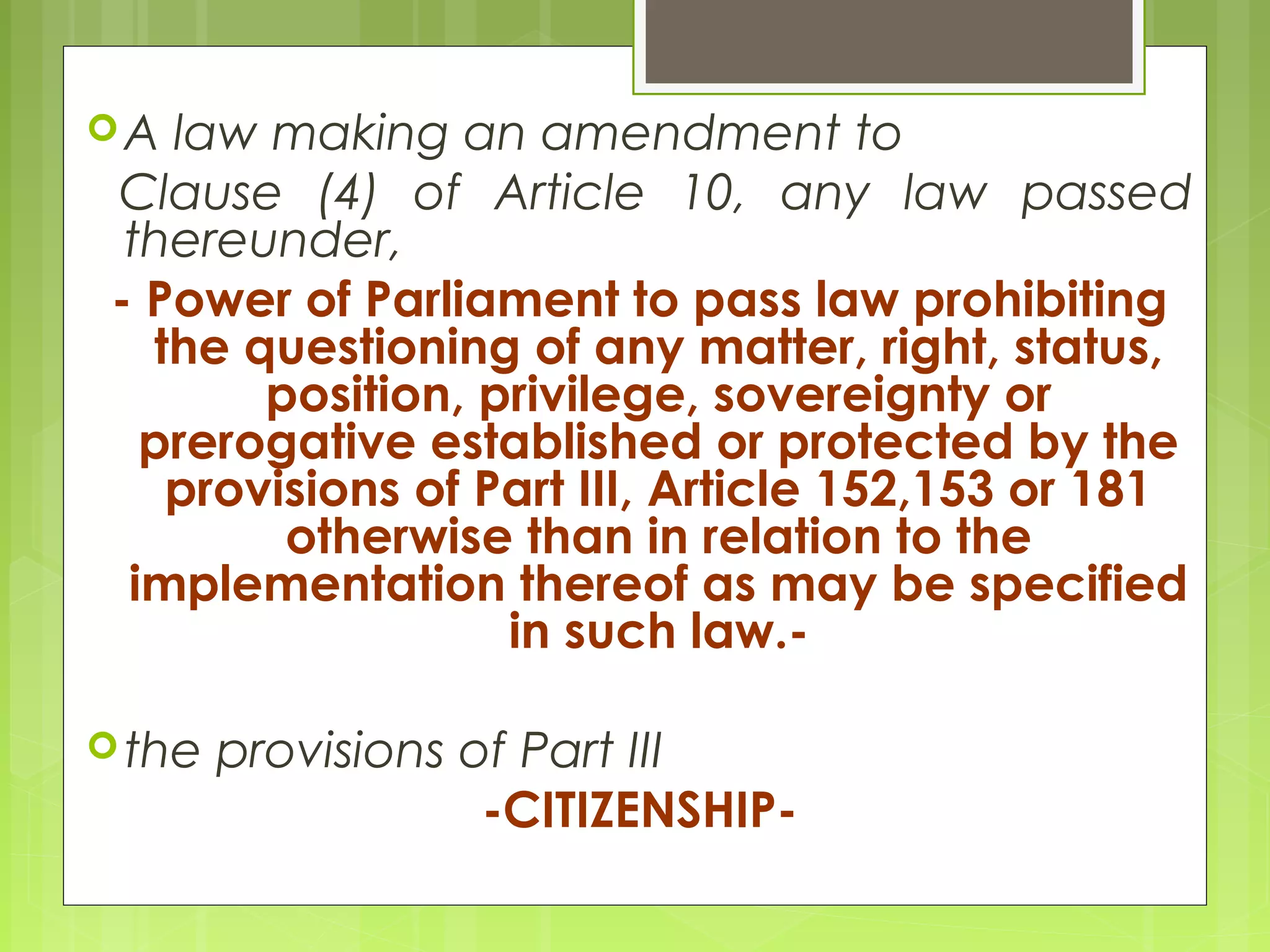
A law making an amendment to 
Clause (4) of Article 10, any law passed 
thereunder, 
- Power of Parliament to pass law prohibiting 
the questioning of any matter, right, status, 
position, privilege, sovereignty or 
prerogative established or protected by the 
provisions of Part III, Article 152,153 or 181 
otherwise than in relation to the 
implementation thereof as may be specified 
in such law.- 
the provisions of Part III 
-CITIZENSHIP-
Article 38 
-The Conference of Rulers- 
Article 63(4) 
- Immunity of MP shall not apply to any person 
charged with an offence under the law 
passed under Clause (4) of Article 10 or with 
an offence under the Sedition Act 1948 [Act 
15]- 
Article 70 
-Precedence of Rulers and Yang di-Pertua- 
Yang di-Pertua Negeri.-
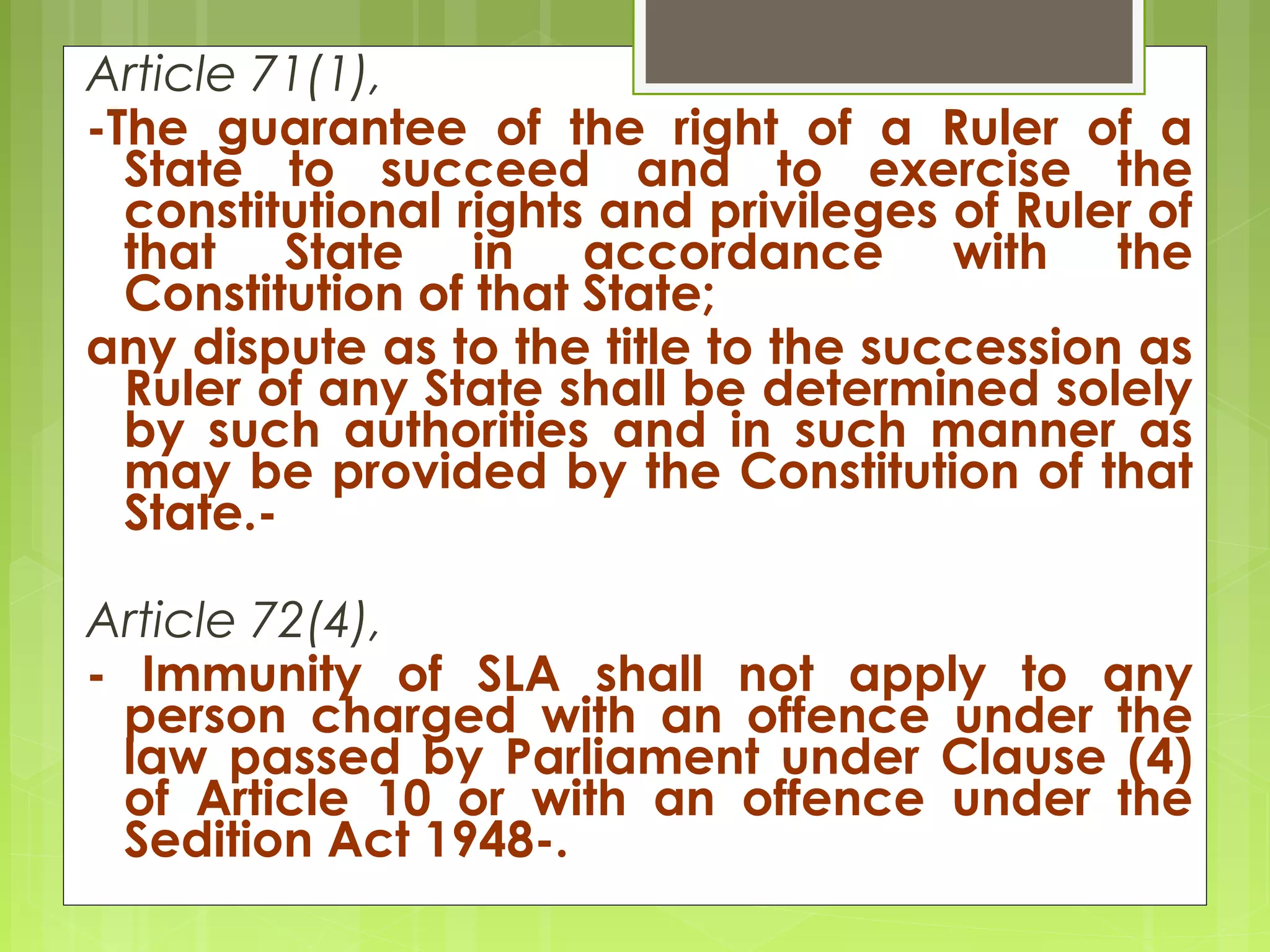
Article 71(1), 
-The guarantee of the right of a Ruler of a 
State to succeed and to exercise the 
constitutional rights and privileges of Ruler of 
that State in accordance with the 
Constitution of that State; 
any dispute as to the title to the succession as 
Ruler of any State shall be determined solely 
by such authorities and in such manner as 
may be provided by the Constitution of that 
State.- 
Article 72(4), 
- Immunity of SLA shall not apply to any 
person charged with an offence under the 
law passed by Parliament under Clause (4) 
of Article 10 or with an offence under the 
Sedition Act 1948-.
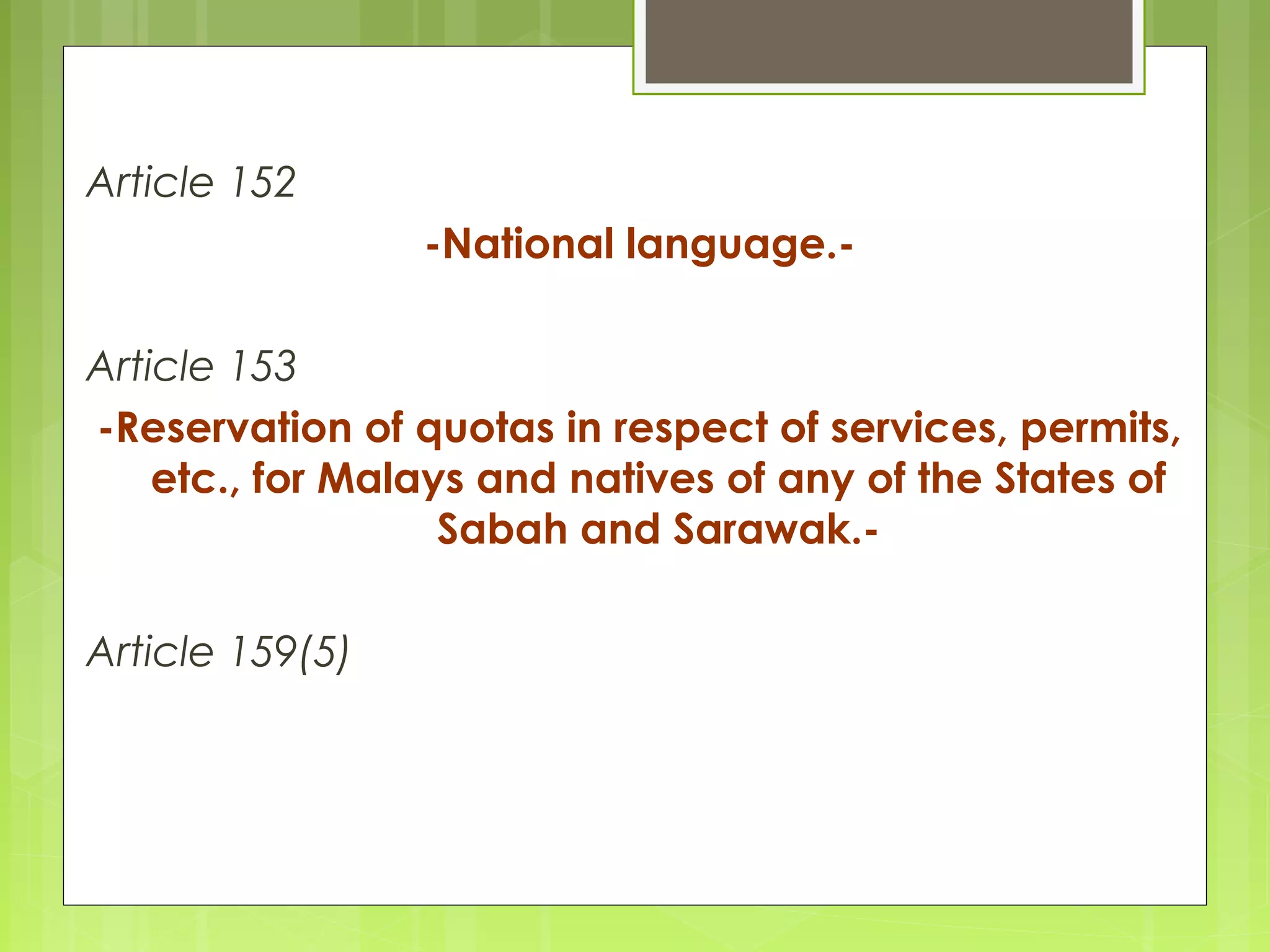
Article 152 
-National language.- 
Article 153 
-Reservation of quotas in respect of services, permits, 
etc., for Malays and natives of any of the States of 
Sabah and Sarawak.- 
Article 159(5)
The MMeetthhooddss aanndd RReeqquuiirreemmeennttss ooff 
AAmmeennddiinngg tthhee FFeeddeerraall CCoonnssttiittuuttiioonn 
uunnddeerr AArrttiiccllee 115599 aanndd 116611EE 
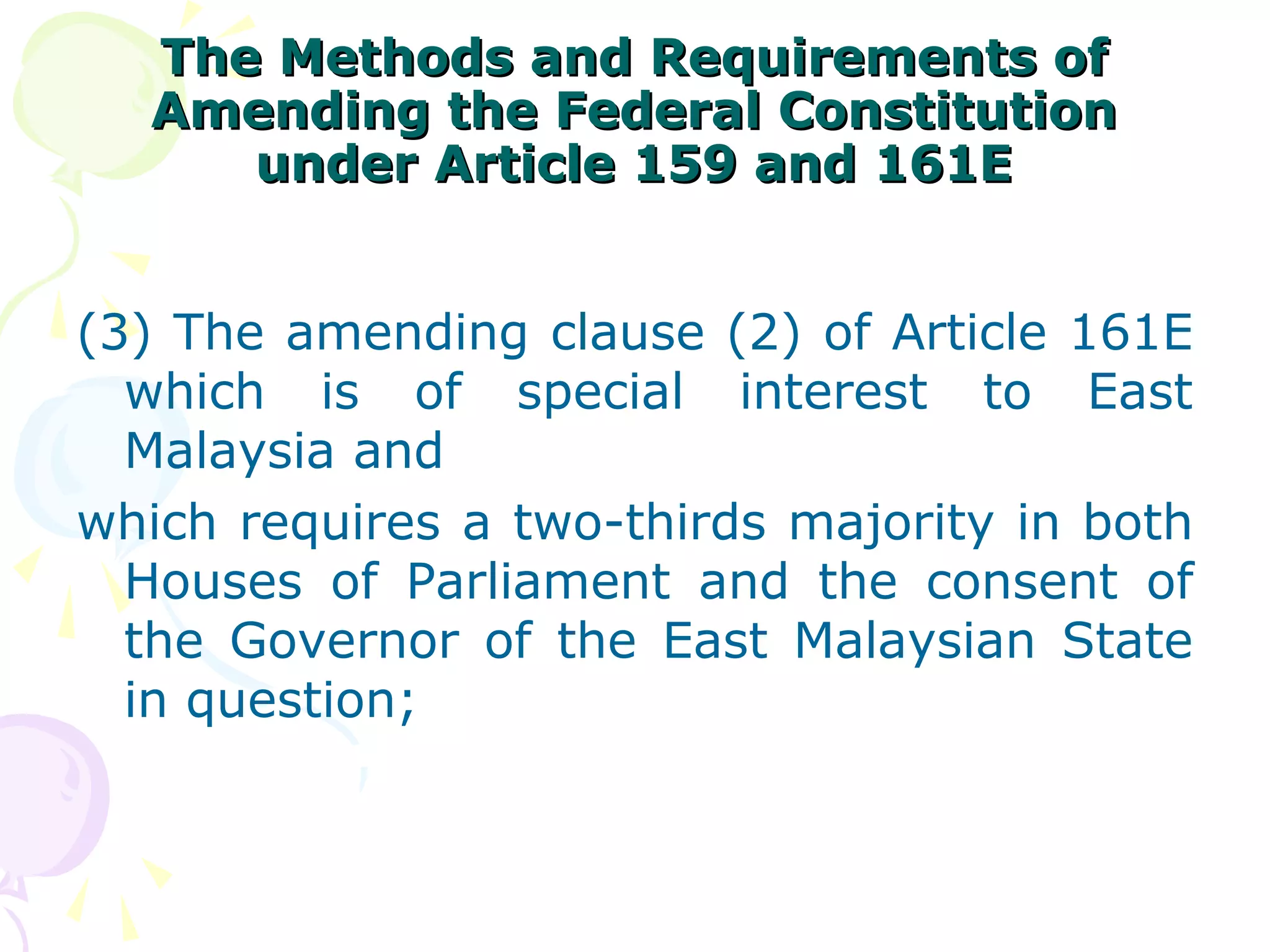
(3) The amending clause (2) of Article 161E 
which is of special interest to East 
Malaysia and 
which requires a two-thirds majority in both 
Houses of Parliament and the consent of 
the Governor of the East Malaysian State 
in question;
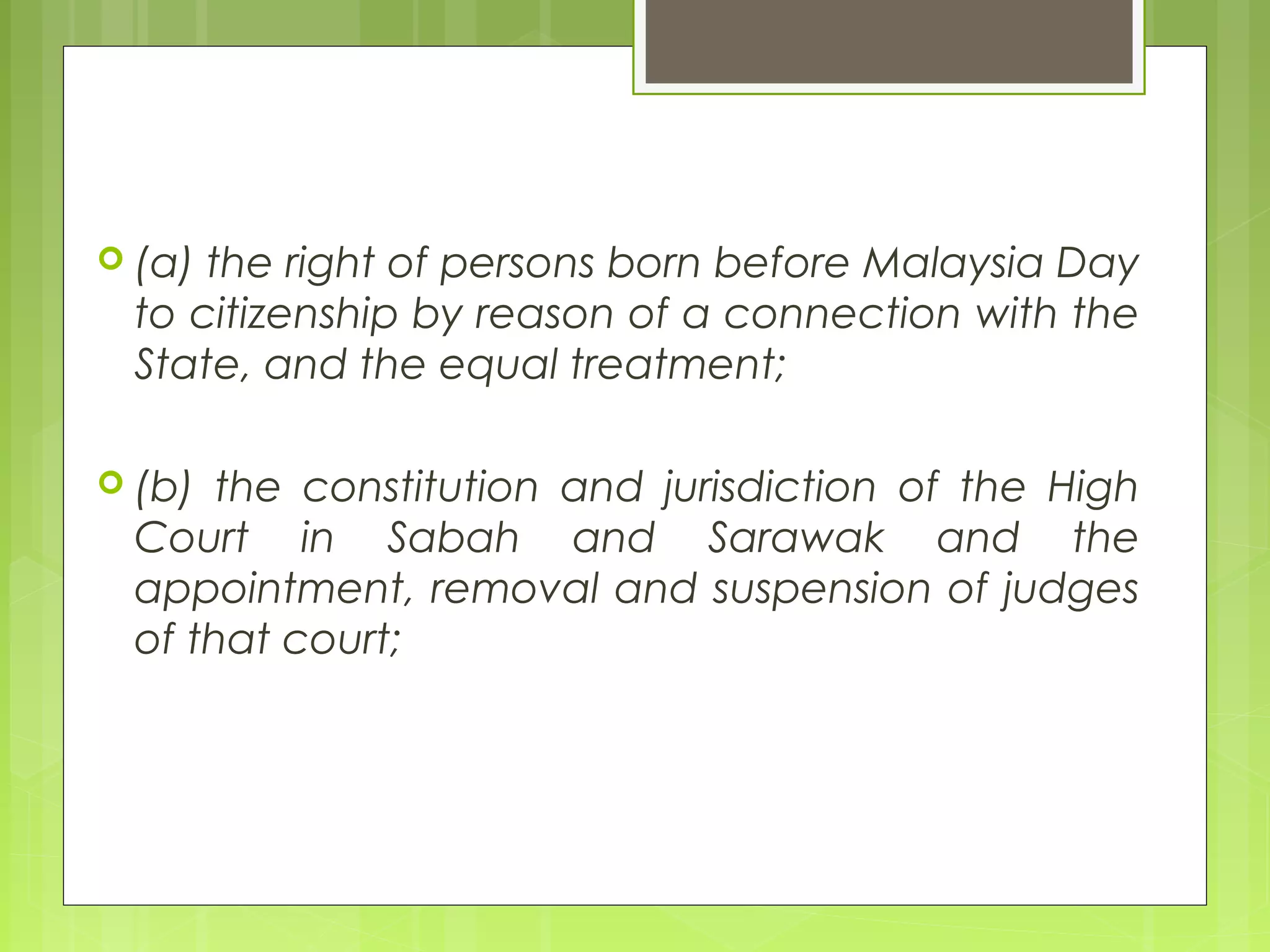
 (a) the right of persons born before Malaysia Day 
to citizenship by reason of a connection with the 
State, and the equal treatment; 
 (b) the constitution and jurisdiction of the High 
Court in Sabah and Sarawak and the 
appointment, removal and suspension of judges 
of that court;
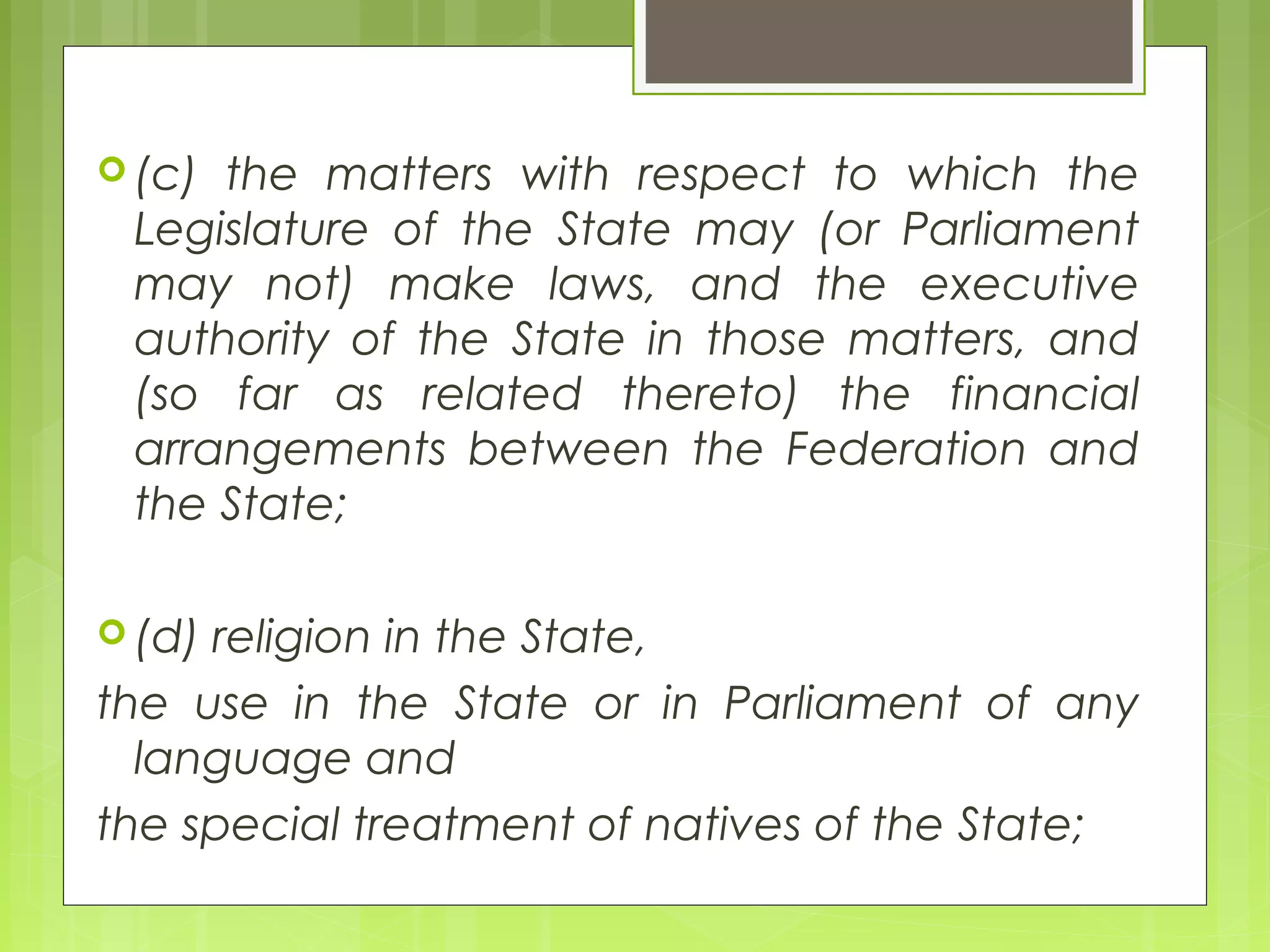
(c) the matters with respect to which the 
Legislature of the State may (or Parliament 
may not) make laws, and the executive 
authority of the State in those matters, and 
(so far as related thereto) the financial 
arrangements between the Federation and 
the State; 
(d) religion in the State, 
the use in the State or in Parliament of any 
language and 
the special treatment of natives of the State;
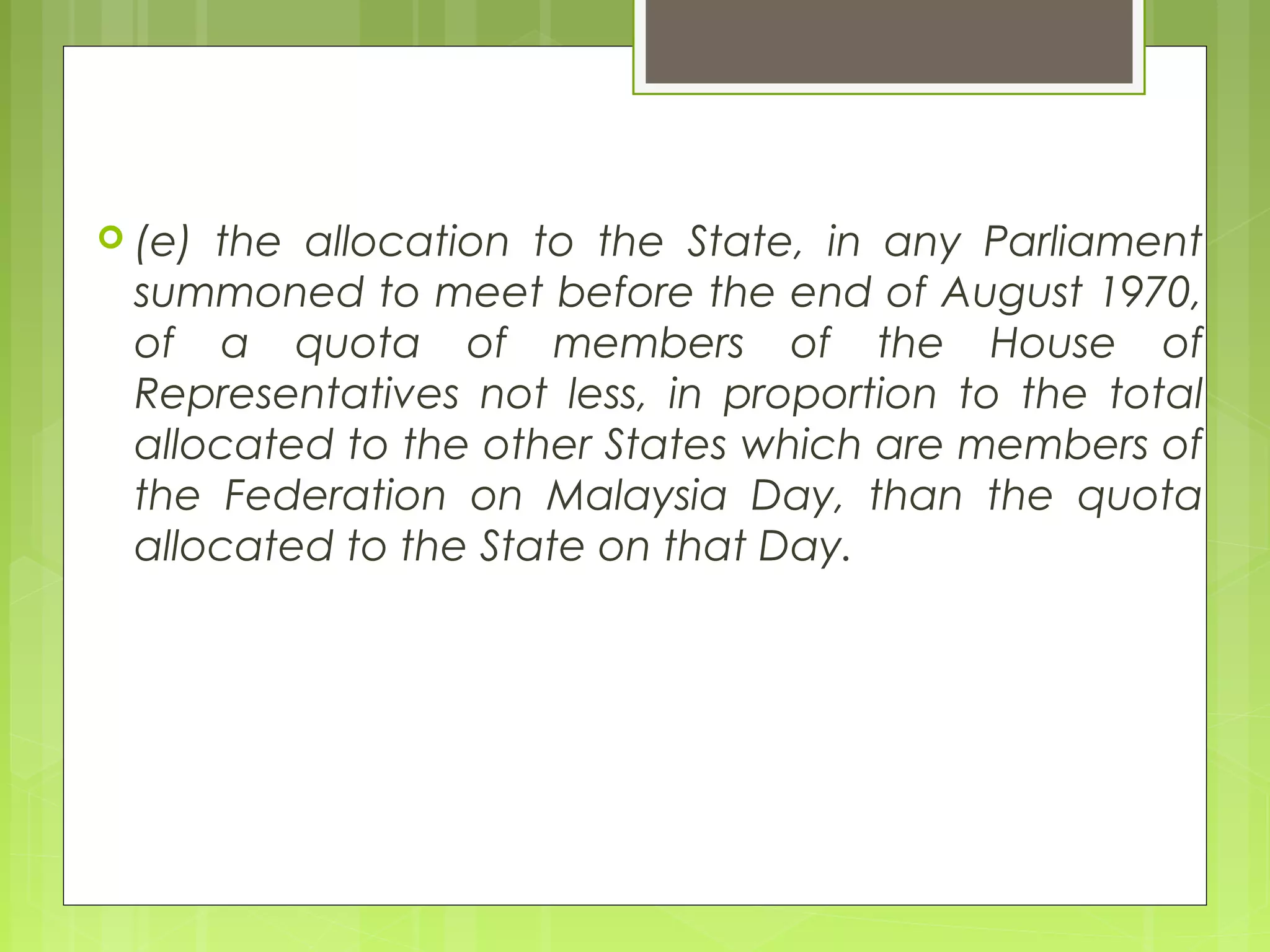
 (e) the allocation to the State, in any Parliament 
summoned to meet before the end of August 1970, 
of a quota of members of the House of 
Representatives not less, in proportion to the total 
allocated to the other States which are members of 
the Federation on Malaysia Day, than the quota 
allocated to the State on that Day.
TThhee MMeetthhooddss aanndd RReeqquuiirreemmeennttss ooff 
AAmmeennddiinngg tthhee FFeeddeerraall CCoonnssttiittuuttiioonn 
uunnddeerr AArrttiiccllee 115599 aanndd 116611EE 
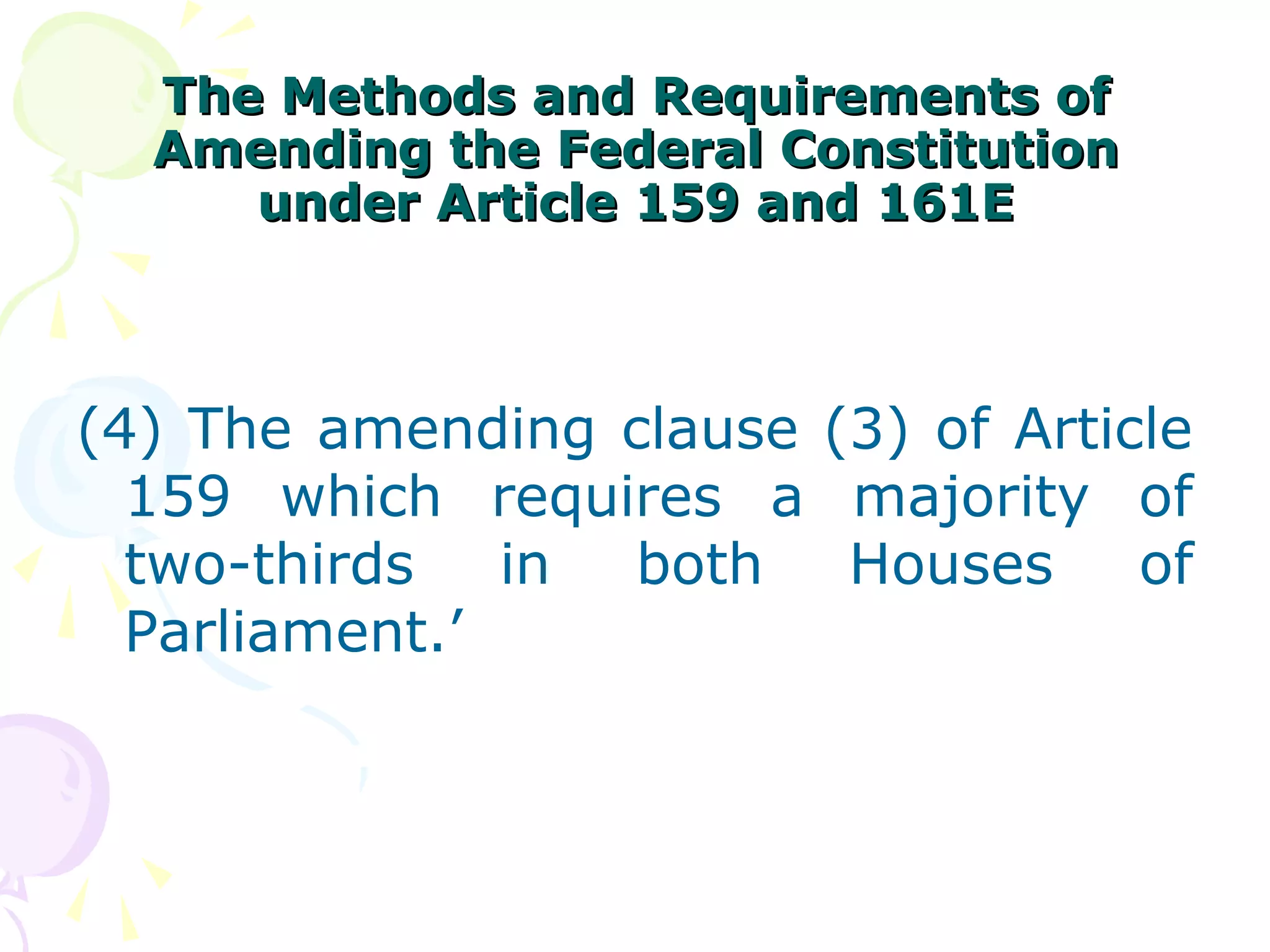
(4) The amending clause (3) of Article 
159 which requires a majority of 
two-thirds in both Houses of 
Parliament.’
1983/84 AMENDMENT 
CONSTITUTION (AMENDMENT) ACT 1983 
ACT A566 
CONSTITUTION (AMENDMENT) ACT 1984 
ACT A584
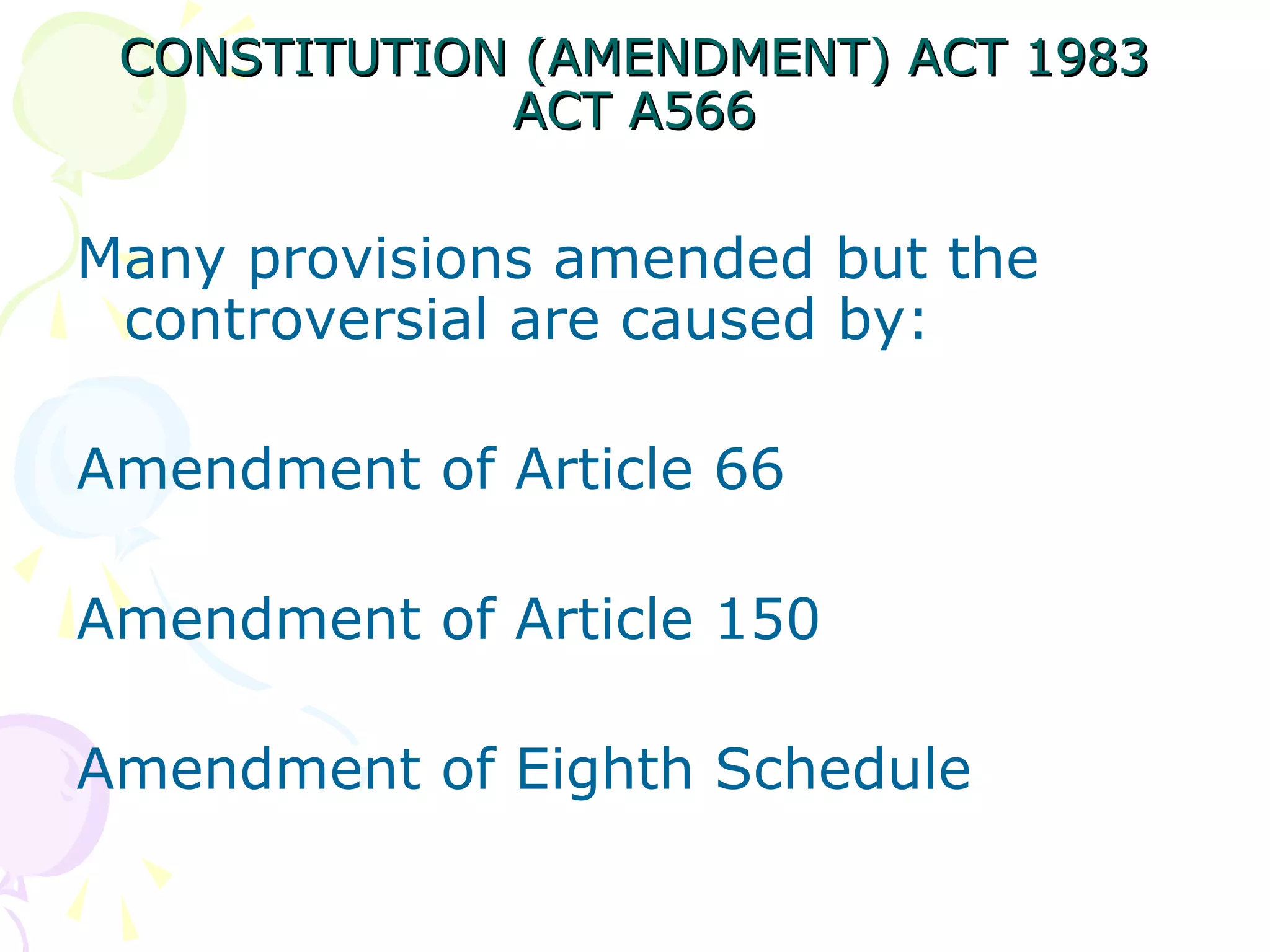
CONSTITUTION ((AAMMEENNDDMMEENNTT)) AACCTT 11998833 
AACCTT AA556666 
Many provisions amended but the 
controversial are caused by: 
Amendment of Article 66 
Amendment of Article 150 
Amendment of Eighth Schedule
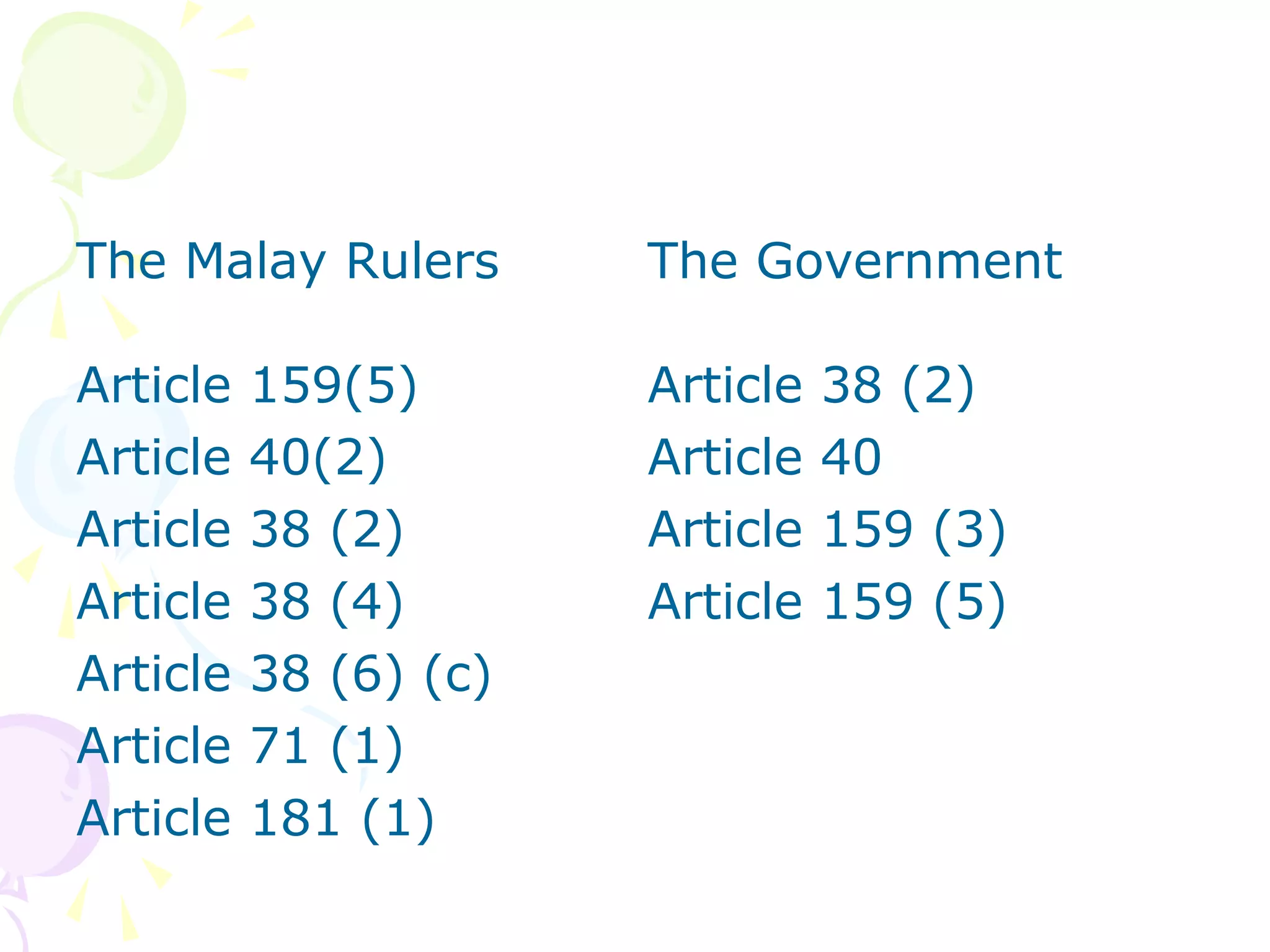
The Malay Rulers The Government 
Article 159(5) 
Article 40(2) 
Article 38 (2) 
Article 38 (4) 
Article 38 (6) (c) 
Article 71 (1) 
Article 181 (1) 
Article 38 (2) 
Article 40 
Article 159 (3) 
Article 159 (5)
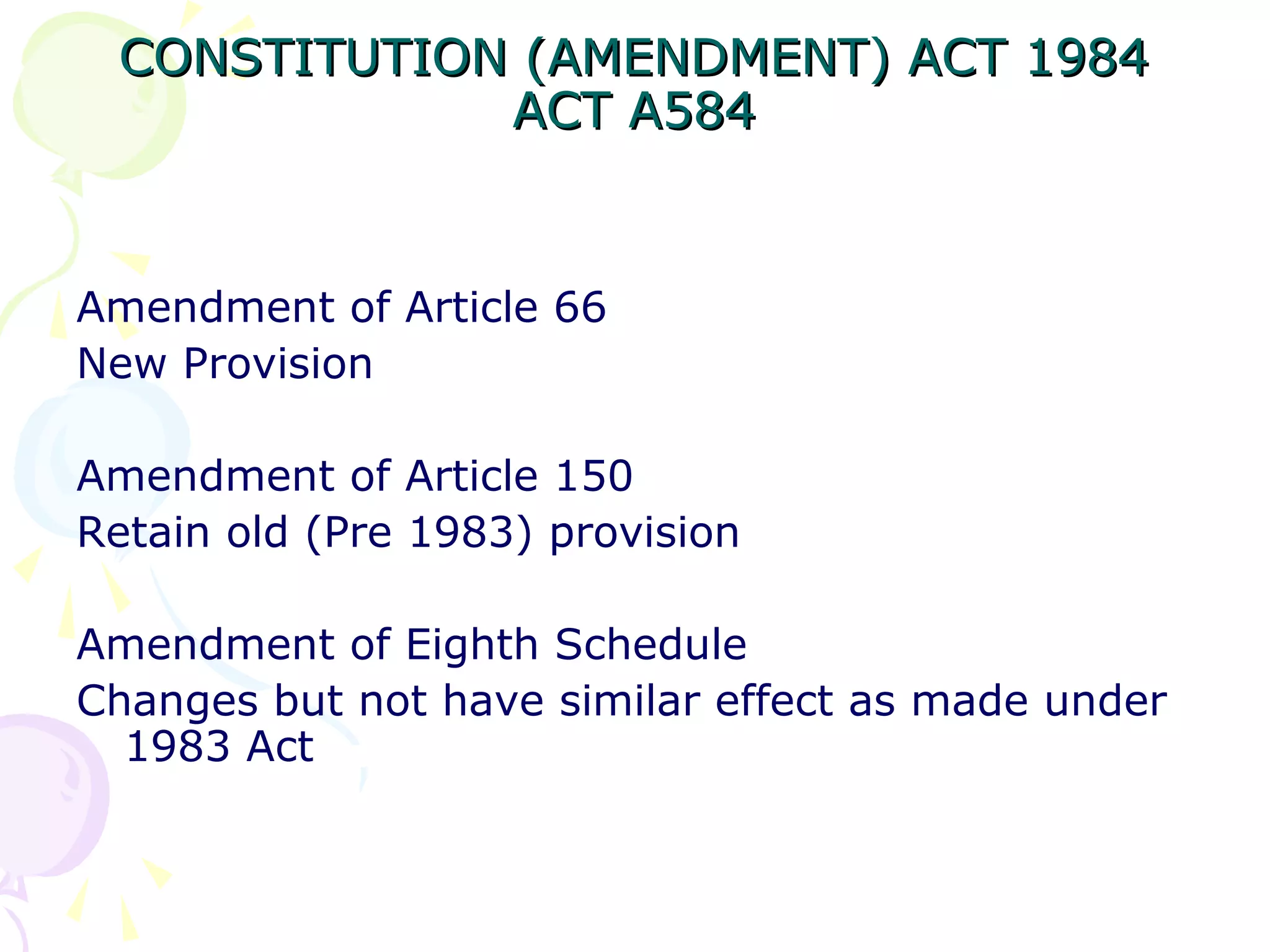
CONSTITUTION ((AAMMEENNDDMMEENNTT)) AACCTT 11998844 
AACCTT AA558844 
Amendment of Article 66 
New Provision 
Amendment of Article 150 
Retain old (Pre 1983) provision 
Amendment of Eighth Schedule 
Changes but not have similar effect as made under 
1983 Act
1993 CCoonnssttiittuuttiioonnaall AAmmeennddmmeenntt 
The Constitution Amendment Bill 1993 
passed by the two Houses between 18 and 
20 January proposes four main 
amendments to the sovereignty, 
prerogatives and immunities of the Rulers. 
Firstly, amendments to Articles 32 and 181 
seek to remove the immunity of the Yang 
di-Pertuan Agong and the State Rulers for 
non-official acts.
Secondly, a Special Court is proposed to try 
a Sultan who is facing civil or criminal 
proceedings. 
Thirdly, amendments to Article 42 remove 
the power of a Sultan to pardon himself 
and members of his immediate family. 
Fourthly, amendments to Articles 63 and 72 
seek to permit parliamentary discussion of 
royal misconduct.

Constitutional amendment

  • 1.
  • 2.
    Article 159 dealswith constitutional amendment/power to amend the Constitution. In general the provision states that the Parliament can amend the Federal Constitution by passing a law (federal law).
  • 3.
    AAmmeennaabbllee CCoonnssttiittuuttiioonn SuffianFJ: ‘…there are many provisions showing that they realized that the Constitution should be a living document intended to be workable between the partners that constitute the Malayan (later Malaysian) polity, a living document that is reviewable from time to time in the light of experience and, if need be, amended.’ Teh Cheng Poh v Public Prosecutor [1979] 1 MLJ 50
  • 4.
    The law, whichis made in pursuant to the power given in article 159, will definitely be inconsistent with the existing provision in the constitution and be a law which is passed after Merdeka Day. Article 4 (1) declares that ‘any law passed after Merdeka Day which is inconsistent with the constitution shall, to the extent of the inconsistency, be void’. Will the law made under art 159 become void due to the inconsistency?
  • 5.
    RRuullee ooff HHaarrmmoonniioouussCCoonnssttrruuccttiioonn Phang Chin Hock v PP [1980] 1 MLJ 70 The use of rule of harmonious construction in construing article 159 enables the Federal Court to hold that Acts of Parliament made in accordance with the conditions set out by article 159 are valid "even if inconsistent with the constitution ".
  • 6.
    RRuullee ooff HHaarrmmoonniioouussCCoonnssttrruuccttiioonn Mohammed Habibullah bin Mahmood v Faridah bte Dato Talib [1992] 2 MLJ 793
  • 7.
    The MMeetthhooddss aannddRReeqquuiirreemmeennttss ooff AAmmeennddiinngg tthhee FFeeddeerraall CCoonnssttiittuuttiioonn uunnddeerr AArrttiiccllee 115599 aanndd 116611EE Four methods of amendment as prescribed in the following provisions: 1. Art. 159 (4) 2. Art. 159 (5) - Art. 38 (2) (c); (4) & 6 3. Art. 161E (2) – Art. 161E (4) 4. Art. 159 (3)
  • 8.
    The MMeetthhooddss aannddRReeqquuiirreemmeennttss ooff AAmmeennddiinngg tthhee FFeeddeerraall CCoonnssttiittuuttiioonn uunnddeerr AArrttiiccllee 115599 aanndd 116611EE Raja Azlan Shah F.J stated in Loh Kooi Choon: ‘Our Constitution prescribes four different methods for amendment of the different provisions of the Constitution.’
  • 9.
    TThhee MMeetthhooddss aannddRReeqquuiirreemmeennttss ooff AAmmeennddiinngg tthhee FFeeddeerraall CCoonnssttiittuuttiioonn uunnddeerr AArrttiiccllee 115599 aanndd 116611EE (1) Some parts of the Constitution can be amended by a simple majority in both Houses of Parliament such as that required for the passing of any ordinary law. They are enumerated in clause (4) of Article 159 and are specifically excluded from the purview of Article 159;
  • 10.
    (a) any amendmentto Part III of the Second Schedule -PART III SUPPLEMENTARY PROVISIONS RELATING TO CITIZENSHIP-or to the Sixth or Seventh Schedule; SIXTH SCHEDULE -Forms of Oaths and Affirmations- SEVENTH SCHEDULE -Election of Senators-
  • 11.
    (b) any amendmentincidental to or consequential on the exercise of any power to make law conferred on Parliament by any provision of this Constitution other than Articles 74 and 76; (bb) subject to Article 161E any amendment made for or in connection with the admission of any State to the Federation or its association with the States thereof, or any modification made as to the application of this Constitution to a State previously so admitted or associated; (c) any amendment consequential on an amendment made under paragraph (a).
  • 12.
    THE GOVERNMENT OFTHE STATE OF KELANTAN V THE GOVERNMENT OF THE FEDERATION OF MALAYA AND TUNKU ABDUL RAHMAN PUTRA AL-HAJ [1963] 1 MLJ 355
  • 13.
    The MMeetthhooddss aannddRReeqquuiirreemmeennttss ooff AAmmeennddiinngg tthhee FFeeddeerraall CCoonnssttiittuuttiioonn uunnddeerr AArrttiiccllee 115599 aanndd 116611EE (2) The amending clause (5) of Article 159 which requires a two-thirds majority in both Houses of Parliament and the consent of the Conference of Rulers;
  • 14.
    A law makingan amendment to Clause (4) of Article 10, any law passed thereunder, - Power of Parliament to pass law prohibiting the questioning of any matter, right, status, position, privilege, sovereignty or prerogative established or protected by the provisions of Part III, Article 152,153 or 181 otherwise than in relation to the implementation thereof as may be specified in such law.- the provisions of Part III -CITIZENSHIP-
  • 15.
    Article 38 -TheConference of Rulers- Article 63(4) - Immunity of MP shall not apply to any person charged with an offence under the law passed under Clause (4) of Article 10 or with an offence under the Sedition Act 1948 [Act 15]- Article 70 -Precedence of Rulers and Yang di-Pertua- Yang di-Pertua Negeri.-
  • 16.
    Article 71(1), -Theguarantee of the right of a Ruler of a State to succeed and to exercise the constitutional rights and privileges of Ruler of that State in accordance with the Constitution of that State; any dispute as to the title to the succession as Ruler of any State shall be determined solely by such authorities and in such manner as may be provided by the Constitution of that State.- Article 72(4), - Immunity of SLA shall not apply to any person charged with an offence under the law passed by Parliament under Clause (4) of Article 10 or with an offence under the Sedition Act 1948-.
  • 17.
    Article 152 -Nationallanguage.- Article 153 -Reservation of quotas in respect of services, permits, etc., for Malays and natives of any of the States of Sabah and Sarawak.- Article 159(5)
  • 18.
    The MMeetthhooddss aannddRReeqquuiirreemmeennttss ooff AAmmeennddiinngg tthhee FFeeddeerraall CCoonnssttiittuuttiioonn uunnddeerr AArrttiiccllee 115599 aanndd 116611EE (3) The amending clause (2) of Article 161E which is of special interest to East Malaysia and which requires a two-thirds majority in both Houses of Parliament and the consent of the Governor of the East Malaysian State in question;
  • 19.
     (a) theright of persons born before Malaysia Day to citizenship by reason of a connection with the State, and the equal treatment;  (b) the constitution and jurisdiction of the High Court in Sabah and Sarawak and the appointment, removal and suspension of judges of that court;
  • 20.
    (c) the matterswith respect to which the Legislature of the State may (or Parliament may not) make laws, and the executive authority of the State in those matters, and (so far as related thereto) the financial arrangements between the Federation and the State; (d) religion in the State, the use in the State or in Parliament of any language and the special treatment of natives of the State;
  • 21.
     (e) theallocation to the State, in any Parliament summoned to meet before the end of August 1970, of a quota of members of the House of Representatives not less, in proportion to the total allocated to the other States which are members of the Federation on Malaysia Day, than the quota allocated to the State on that Day.
  • 22.
    TThhee MMeetthhooddss aannddRReeqquuiirreemmeennttss ooff AAmmeennddiinngg tthhee FFeeddeerraall CCoonnssttiittuuttiioonn uunnddeerr AArrttiiccllee 115599 aanndd 116611EE (4) The amending clause (3) of Article 159 which requires a majority of two-thirds in both Houses of Parliament.’
  • 23.
    1983/84 AMENDMENT CONSTITUTION(AMENDMENT) ACT 1983 ACT A566 CONSTITUTION (AMENDMENT) ACT 1984 ACT A584
  • 24.
    CONSTITUTION ((AAMMEENNDDMMEENNTT)) AACCTT11998833 AACCTT AA556666 Many provisions amended but the controversial are caused by: Amendment of Article 66 Amendment of Article 150 Amendment of Eighth Schedule
  • 25.
    The Malay RulersThe Government Article 159(5) Article 40(2) Article 38 (2) Article 38 (4) Article 38 (6) (c) Article 71 (1) Article 181 (1) Article 38 (2) Article 40 Article 159 (3) Article 159 (5)
  • 26.
    CONSTITUTION ((AAMMEENNDDMMEENNTT)) AACCTT11998844 AACCTT AA558844 Amendment of Article 66 New Provision Amendment of Article 150 Retain old (Pre 1983) provision Amendment of Eighth Schedule Changes but not have similar effect as made under 1983 Act
  • 27.
    1993 CCoonnssttiittuuttiioonnaall AAmmeennddmmeenntt The Constitution Amendment Bill 1993 passed by the two Houses between 18 and 20 January proposes four main amendments to the sovereignty, prerogatives and immunities of the Rulers. Firstly, amendments to Articles 32 and 181 seek to remove the immunity of the Yang di-Pertuan Agong and the State Rulers for non-official acts.
  • 28.
    Secondly, a SpecialCourt is proposed to try a Sultan who is facing civil or criminal proceedings. Thirdly, amendments to Article 42 remove the power of a Sultan to pardon himself and members of his immediate family. Fourthly, amendments to Articles 63 and 72 seek to permit parliamentary discussion of royal misconduct.