
Rights Under 
Art. 5 (3) & (4) 
The Rights of 
an Arrested Person
Arrest 
Shabaan & Ors v. Chong Fook Kam & Anor [1969] 1 LNS 
170. 
Lord Devlin : 
"An arrest occurs when a police officer states in terms that he 
is arresting or when he uses force to restrain the individual 
concerned. 
It occurs also when by words or conduct he makes it clear 
that he will, if necessary, use force to prevent the 
individual from going where he may want to go. 
It does not occur when he stops an individual to make 
inquiries."
¨When one is under arrest, he is not a free 
man who is in the lawful custody of a police 
or other law enforcement officers. 
¨Attempt to escape from or interfere with an 
arrest may become an offence.
S. 15(1) of the Criminal Procedure Code 
(a) In making an arrest the police officer or other 
person making the same shall actually touch or 
confine the body of the person to be arrested 
unless there is a submission to the custody by 
word or action. 
(b) If such person forcibly resists the endeavour to 
arrest him or attempts to evade the arrest such 
officer or other person may use all means 
necessary to effect the arrest
Power to Arrest 
A. Ordinary Laws 
1. The Criminal Procedure Code 
¨ S 23 - Police or Penghulu. 
¨ Section 27 - Arrest by private persons. 
¨ Section 31 - Arrest by or in presence of Magistrate. 
2. Immigration Act 1959/63 (REVISED - 1975) 
¨ Section 35- Power to arrest person liable to removal. 
Immigration officer 
3. Road Transport Act 1987 
¨ Section 112- Powers of arrest, stopping and detention. 
A police officer or traffic warden
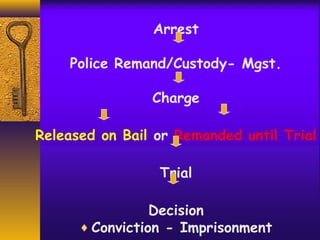
Arrest 
Police Remand/Custody- Mgst. 
Charge 
Released on Bail or Remanded until Trial 
Trial 
Decision 
¨Conviction - Imprisonment
Power to Arrest 
B. Special Laws/Preventive Detention Laws 
1. The Emergency (Public Order and Prevention of 
Crime) Ordinance 1969 
¨ Section 3. 
2. INTERNAL SECURITY ACT 1960 
¨ Section 73. 
3. DANGEROUS DRUGS (SPECIAL PREVENTIVE 
MEASURES) ACT 1985 
¨ Section 3.
Arrest 
Detained or Released 
¨ISA-S. 8 
¨EO-S. 4 
¨DDA- S. 6
Article 5 (3) 
‘Where a person is arrested he shall 
be informed as soon as may be of the grounds 
of his arrest and 
shall be allowed to consult and 
be defended by a legal practitioner of his 
choice.’
Rights of an Arrested Person in Art 5(3) 
Article 5 (3) contains three distinct rights 
that are related namely: 
1. The right to be informed of the grounds 
of one's arrest. 
2. The right to consult counsel. 
3. The right to be defended by a legal 
practitioner of one's choice.
Exception to the Rights in Art 
5(3) 
Exception to the three rights stated in 
Article 5 (3) is mentioned in 5 (5). 
‘ Clauses (3) and (4) do not apply to an 
enemy alien.’
5(3): The right to be informed of the 
grounds of arrest 
The arrested person may be informed 
orally of the grounds of his arrest. 
Re P.E. Long @ Jimmy [1976] 2 MLJ 133
5(3): The right to be informed 
‘Where a person is arrested he shall be 
informed as soon as may be of the 
grounds of his arrest.’ 
Abdul Rahman v Tan Jo Koh 
[1968] 1 MLJ 205 
cited 
Christie v Leachinsky [1947] AC 573. 
Immediately
5(3): The right to be informed 
Aminah v Superintendent of Prison, 
Pengkalan Chepa, Kelantan [1968] 1 
MLJ 92 
cited 
Tarapade v State of West Bengal [1959] 
SCR 212 
" ...the words 'as soon as may be' … 
means as nearly as is reasonable in 
the circumstances of the particular 
case".
5(3): The right to be informed 
The rights stated in article 5 (3) should be applied 
whenever a person is arrested under any law. 
The Emergency (Public Order and Prevention of 
Crime) Ordinance, 1969 
IGP v Lee Kim Hoong [1979] 2 MLJ 291 
KAM TECK SOON V TIMBALAN MENTERI 
DALAM NEGERI MALAYSIA & ORS AND 
OTHER APPEALS [2003] 1 MLJ 321
Existing Law 
Assa Singh v MB of Johore 
[1969] 2 MLJ 31
5(3): The Right To Consult Counsel 
‘ Where a person is arrested he shall… 
as soon as may be … 
allowed to consult … 
a legal practitioner of his choice.’
5(3): The Right To Consult Counsel 
CRIMINAL PROCEDURE CODE 
Section 28A (2) (b) 
A police officer shall 
before commencing any form of questioning or 
recording of any statement from the person 
arrested, 
inform the person that he may communicate or 
attempt to communicate and consult with a legal 
practitioner of his choice.
5(3): The Right To Consult Counsel 
CRIMINAL PROCEDURE CODE 
Section 28A(3) 
Where the person arrested wishes to 
communicate or attempt to communicate 
with a legal practitioner of his choice, the 
police officer shall, as soon as may be, 
allow the arrested person to do so.
5(3): The Right To Consult Counsel 
Ramli bin Salleh [1973] 1 MLJ 54 
Syed Agil Barakbah J.: 
(1) The right of begins right from the day of his arrest even 
though police investigation has not yet been completed. 
(2) The right should be subject to certain legitimate 
restrictions which necessarily arise in the course of police 
investigation, the main object being be ensure a proper and 
speedy trial in the Court of law. 
(3) Such restrictions may relate to time and convenience of 
both the police and the person seeking the interview and 
should not be subject to any abuse by either party.
Ramli bin Salleh [1973] 1 MLJ 54 
Held: 
The action of the respondent in this case in 
restricting the learned counsel's application to 
interview his client on the expiry of the detention 
period is unreasonable. 
It should therefore be understood that the police 
must not in any way delay or obstruct such 
interviews on arbitrary or fanciful grounds with a 
view to deprive the accused of his fundamental 
right.
5(3): The Right To Consult Counsel 
Ooi Ah Phua [1975] 2 MLJ 198 
Suffian LP 
“ the right…begins from the moment of arrest 
but…cannot be exercised immediately after 
arrest. 
A balance has to be struck between 
the right of the arrested person to consult his 
lawyer on the one hand and 
on the other the duty of the police to protect the 
public from wrong-doers by apprehending 
them and collecting whatever evidence exists 
against them.”
Ooi Ah Phua v Officer in Charge, Criminal 
Investigations, Kedah/Perlis 
[1975] 2 MLJ 198 
The Federal Court held that 
a delay of ten days 
between arrest and access to counsel 
was lawful.
Hashim bin Saud [1977] 2 MLJ 116 
The appellant had been arrested on suspicion of 
being involved in the theft of an electric generator. 
After being questioned he was produced before a 
magistrate and ordered to be detained under 
section 117 of the CPC. 
An application was made for a lawyer to visit the 
appellant but this was not immediately granted. 
He could only see the appellant on a subsequent date 
when the investigations were expected to be 
completed.
The appellant argued the refusal to consult his 
counsel was a breach of his constitutional right 
and rendered the order of the magistrate unlawful. 
Held: 
The onus of proving to the satisfaction of the court 
that giving effect to the right to counsel would 
impede police investigation or the administration 
of justice falls on the police. 
On the facts of this case the police had given good 
and sufficient reasons why such right could only 
be exercised after the period of police 
investigation was completed.
5(3): The Right To Consult Counsel 
CRIMINAL PROCEDURE CODE 
Section 28A (4) 
Where the person arrested has requested for a legal 
practitioner to be consulted 
the police officer shall allow a reasonable time 
(a) for the legal practitioner to be present to meet 
the person arrested at his place of detention; and 
(b) for the consultation to take place.
CRIMINAL PROCEDURE CODE. ACT 593 
The consultation shall be within the sight of a police 
officer and in circumstances, in so far as 
practicable, where their communication will not be 
over heard. 
Section 28A (5) 
The police officer shall provide reasonable facilities for 
the communication and consultation under this 
section and all such facilities provided shall be free 
of charge. 
Section 28A (7)
CRIMINAL PROCEDURE CODE. ACT 593 
Section 28A(8) (a) 
The requirements under subsections (5) and (7) 
shall not apply where the police officer reasonably 
believes that compliance with any of the 
requirements is likely to result in 
(i) an accomplice of the person arrested taking 
steps to avoid apprehension; or 
(ii) the concealment, fabrication or destruction of 
evidence or the intimidation of a witness.
CRIMINAL PROCEDURE CODE. ACT 593 
Section 28A(8) (b) 
The requirements under subsections (5) and (7) 
shall not apply 
where the police officer reasonably believes that 
compliance with any of the requirements is likely 
to result in 
having regard to the safety of other persons the 
questioning or recording of any statement is so 
urgent that it should not be delayed.
5(3): The Right To Consult Counsel 
The effect of unlawful denial of the right under article 5 (3). 
Ooi Ah Phua 
[1975] 2 MLJ 198 
NASHARUDDIN BIN NASIR V KERAJAAN MALAYSIA 
& ORS 
[2002] 6 MLJ 65 
Mohamad Ezam bin Mohd Noor v Ketua Polis Negara & 
other appeals 
[2002] 4 MLJ 449
5(3): The Right to be Defended by a Legal 
Practitioner of One’s Choice 
Where a person is arrested 
he shall be informed as soon as may be of the 
grounds of his arrest and 
shall be allowed to consult and be defended by 
a legal practitioner of his choice.
Re. GG Ponnambalam [1969] 2 
MLJ 263 
It is argued that the article gave the accused 
person the right to be defended by a legal 
practitioner of his choice. 
The learned CJ rejected the argument. 
Until the person is admitted, no qualified person 
is a legal practitioner under Art. 5.
D’Cruz v AG, Malaysia & Anor 
[1971] 2 MLJ 130 
The right given under Art. 5 cannot be read as 
extending to any legal practitioner anywhere in the 
world regardless whether or not he is qualified to 
practise here. 
The right given to the arrested person in the article 
must be limited to the choice of legal practitioners 
who are qualified to practise under our law.
LEGAL PROFESSION ACT 1976 
Qualified Persons 
• Section 10. Admission of advocates and solicitors. 
• Section 11. Qualifications for admission. 
• Section 18. Admission in special cases. 
PART IIA - SPECIAL PROVISIONS RELATING TO 
ADMISSION OF ADVOCATES AND SOLICITORS 
Section 28A. Attorney General's power to issue Special 
Admission Certificates. 
Section 28B. Admission and enrolment as an advocate and 
solicitor of a person issued with a Special Admission 
Certificate.
CHERIE BOOTH QC V. ATTORNEY 
GENERAL, MALAYSIA & ORS [2006] 4 
CLJ 224 
PEGUAM NEGARA & ORS v. GEOFFREY 
ROBERTSON [2002] 2 CLJ 493
5(3): Legal Practitioner of One’s Choice 
Mohamed bin Abdullah v PP [1980] 2 MLJ 201 
The question is whether the Court could proceed with 
the trial in the absence of Counsel and if not whether 
the trial was a nullity. 
Held: 
It is wrong to say that a litigant is entitled to be 
represented by the Counsel of his choice. 
The true statement is that he is entitled to be 
represented by the Counsel of his choice if that 
Counsel is willing and able to represent him.
Article 5(4) 
Where a person is arrested and not released he shall 
without unreasonable delay, and in any case within 
twenty-four hours (excluding the time of any 
necessary journey) be produced before a 
magistrate and 
shall not be further detained in custody without the 
magistrate's authority. 
In the case of an arrest for an offence which is triable 
by a Syariah court, references in this Clause to a 
magistrate shall be construed as including 
references to a judge of a Syariah court.
Rights of an Arrested Person Art 5(4) 
Clause (4) of article 5 
-requires the detaining authority to produce the 
arrested person before a magistrate, or as the 
case may be a shariah court judge, 
without unreasonable delay within 24 hours of 
his arrest, and 
-prohibits further detention of the accused 
without the magistrate’s / shariah court judge’s 
authority.
Exception to the Rights in Art 
5(3) and Art 5(4) 
Exception to the three rights stated in 
Article 5 (3) is mentioned in 5 (5). 
Exceptions to the rights stated in Article 5 
(4) are stated in 
paras 2 and 3 of the clause, and 
(5) of the Article.
5(4) : The right to be Produced Before a Magistrate 
Aminah v Superintendent of Pudu Prison, 
Pengkalan Chepa, Kelantan [1968] 1 
MLJ 92 
“Article 5 clearly meant to apply to arrests 
under any law whatsoever in this 
country”. 
The Federal Court agreed to “read into” the 
RRE Article 5 (3) and (4) as permitted 
by article 162(6)
5(4) : The right to be Produced Before a Magistrate 
The position later changed after the clause 
was amended. 
Para 2 of (4) in Article 5. 
Loh Kooi Choon v Govt of Malaysia [1977] 2 
MLJ 187
5(4) : The right to be Produced Before a Magistrate 
Exception 
Chong Kim Loy v The Menteri Dalam Negeri, 
Malaysia [1989] 3 MLJ 121 
He was arrested under S. 3 of the Dangerous Drugs (Special 
Preventive Measures) Act 1965 and later detained under 
the law. 
It was argued that there had been a contravention of Article 
5(4) of the Constitution as the applicant had not been 
produced before a Magistrate within 24 hours after his 
arrest and detention at the police station.
Held: 
The DDA is a legislation made under article 149. 
Legislation under Article 149 may restrict or be 
inconsistent with the right conferred by Article 
5(4) but any such restriction must be clear in the 
legislation. 
The powers spelt out s. 3(2) do make such restriction 
manifestly clear and is therefore valid 
notwithstanding that it is inconsistent with Article 
5(4) of the Federal Constitution.

Article 5 rights under article 5 (3) (4)

  • 1.
    Rights Under Art.5 (3) & (4) The Rights of an Arrested Person
  • 2.
    Arrest Shabaan &Ors v. Chong Fook Kam & Anor [1969] 1 LNS 170. Lord Devlin : "An arrest occurs when a police officer states in terms that he is arresting or when he uses force to restrain the individual concerned. It occurs also when by words or conduct he makes it clear that he will, if necessary, use force to prevent the individual from going where he may want to go. It does not occur when he stops an individual to make inquiries."
  • 3.
    ¨When one isunder arrest, he is not a free man who is in the lawful custody of a police or other law enforcement officers. ¨Attempt to escape from or interfere with an arrest may become an offence.
  • 4.
    S. 15(1) ofthe Criminal Procedure Code (a) In making an arrest the police officer or other person making the same shall actually touch or confine the body of the person to be arrested unless there is a submission to the custody by word or action. (b) If such person forcibly resists the endeavour to arrest him or attempts to evade the arrest such officer or other person may use all means necessary to effect the arrest
  • 5.
    Power to Arrest A. Ordinary Laws 1. The Criminal Procedure Code ¨ S 23 - Police or Penghulu. ¨ Section 27 - Arrest by private persons. ¨ Section 31 - Arrest by or in presence of Magistrate. 2. Immigration Act 1959/63 (REVISED - 1975) ¨ Section 35- Power to arrest person liable to removal. Immigration officer 3. Road Transport Act 1987 ¨ Section 112- Powers of arrest, stopping and detention. A police officer or traffic warden
  • 6.
    Arrest Police Remand/Custody-Mgst. Charge Released on Bail or Remanded until Trial Trial Decision ¨Conviction - Imprisonment
  • 7.
    Power to Arrest B. Special Laws/Preventive Detention Laws 1. The Emergency (Public Order and Prevention of Crime) Ordinance 1969 ¨ Section 3. 2. INTERNAL SECURITY ACT 1960 ¨ Section 73. 3. DANGEROUS DRUGS (SPECIAL PREVENTIVE MEASURES) ACT 1985 ¨ Section 3.
  • 8.
    Arrest Detained orReleased ¨ISA-S. 8 ¨EO-S. 4 ¨DDA- S. 6
  • 9.
    Article 5 (3) ‘Where a person is arrested he shall be informed as soon as may be of the grounds of his arrest and shall be allowed to consult and be defended by a legal practitioner of his choice.’
  • 10.
    Rights of anArrested Person in Art 5(3) Article 5 (3) contains three distinct rights that are related namely: 1. The right to be informed of the grounds of one's arrest. 2. The right to consult counsel. 3. The right to be defended by a legal practitioner of one's choice.
  • 11.
    Exception to theRights in Art 5(3) Exception to the three rights stated in Article 5 (3) is mentioned in 5 (5). ‘ Clauses (3) and (4) do not apply to an enemy alien.’
  • 12.
    5(3): The rightto be informed of the grounds of arrest The arrested person may be informed orally of the grounds of his arrest. Re P.E. Long @ Jimmy [1976] 2 MLJ 133
  • 13.
    5(3): The rightto be informed ‘Where a person is arrested he shall be informed as soon as may be of the grounds of his arrest.’ Abdul Rahman v Tan Jo Koh [1968] 1 MLJ 205 cited Christie v Leachinsky [1947] AC 573. Immediately
  • 14.
    5(3): The rightto be informed Aminah v Superintendent of Prison, Pengkalan Chepa, Kelantan [1968] 1 MLJ 92 cited Tarapade v State of West Bengal [1959] SCR 212 " ...the words 'as soon as may be' … means as nearly as is reasonable in the circumstances of the particular case".
  • 15.
    5(3): The rightto be informed The rights stated in article 5 (3) should be applied whenever a person is arrested under any law. The Emergency (Public Order and Prevention of Crime) Ordinance, 1969 IGP v Lee Kim Hoong [1979] 2 MLJ 291 KAM TECK SOON V TIMBALAN MENTERI DALAM NEGERI MALAYSIA & ORS AND OTHER APPEALS [2003] 1 MLJ 321
  • 16.
    Existing Law AssaSingh v MB of Johore [1969] 2 MLJ 31
  • 17.
    5(3): The RightTo Consult Counsel ‘ Where a person is arrested he shall… as soon as may be … allowed to consult … a legal practitioner of his choice.’
  • 18.
    5(3): The RightTo Consult Counsel CRIMINAL PROCEDURE CODE Section 28A (2) (b) A police officer shall before commencing any form of questioning or recording of any statement from the person arrested, inform the person that he may communicate or attempt to communicate and consult with a legal practitioner of his choice.
  • 19.
    5(3): The RightTo Consult Counsel CRIMINAL PROCEDURE CODE Section 28A(3) Where the person arrested wishes to communicate or attempt to communicate with a legal practitioner of his choice, the police officer shall, as soon as may be, allow the arrested person to do so.
  • 20.
    5(3): The RightTo Consult Counsel Ramli bin Salleh [1973] 1 MLJ 54 Syed Agil Barakbah J.: (1) The right of begins right from the day of his arrest even though police investigation has not yet been completed. (2) The right should be subject to certain legitimate restrictions which necessarily arise in the course of police investigation, the main object being be ensure a proper and speedy trial in the Court of law. (3) Such restrictions may relate to time and convenience of both the police and the person seeking the interview and should not be subject to any abuse by either party.
  • 21.
    Ramli bin Salleh[1973] 1 MLJ 54 Held: The action of the respondent in this case in restricting the learned counsel's application to interview his client on the expiry of the detention period is unreasonable. It should therefore be understood that the police must not in any way delay or obstruct such interviews on arbitrary or fanciful grounds with a view to deprive the accused of his fundamental right.
  • 22.
    5(3): The RightTo Consult Counsel Ooi Ah Phua [1975] 2 MLJ 198 Suffian LP “ the right…begins from the moment of arrest but…cannot be exercised immediately after arrest. A balance has to be struck between the right of the arrested person to consult his lawyer on the one hand and on the other the duty of the police to protect the public from wrong-doers by apprehending them and collecting whatever evidence exists against them.”
  • 23.
    Ooi Ah Phuav Officer in Charge, Criminal Investigations, Kedah/Perlis [1975] 2 MLJ 198 The Federal Court held that a delay of ten days between arrest and access to counsel was lawful.
  • 24.
    Hashim bin Saud[1977] 2 MLJ 116 The appellant had been arrested on suspicion of being involved in the theft of an electric generator. After being questioned he was produced before a magistrate and ordered to be detained under section 117 of the CPC. An application was made for a lawyer to visit the appellant but this was not immediately granted. He could only see the appellant on a subsequent date when the investigations were expected to be completed.
  • 25.
    The appellant arguedthe refusal to consult his counsel was a breach of his constitutional right and rendered the order of the magistrate unlawful. Held: The onus of proving to the satisfaction of the court that giving effect to the right to counsel would impede police investigation or the administration of justice falls on the police. On the facts of this case the police had given good and sufficient reasons why such right could only be exercised after the period of police investigation was completed.
  • 26.
    5(3): The RightTo Consult Counsel CRIMINAL PROCEDURE CODE Section 28A (4) Where the person arrested has requested for a legal practitioner to be consulted the police officer shall allow a reasonable time (a) for the legal practitioner to be present to meet the person arrested at his place of detention; and (b) for the consultation to take place.
  • 27.
    CRIMINAL PROCEDURE CODE.ACT 593 The consultation shall be within the sight of a police officer and in circumstances, in so far as practicable, where their communication will not be over heard. Section 28A (5) The police officer shall provide reasonable facilities for the communication and consultation under this section and all such facilities provided shall be free of charge. Section 28A (7)
  • 28.
    CRIMINAL PROCEDURE CODE.ACT 593 Section 28A(8) (a) The requirements under subsections (5) and (7) shall not apply where the police officer reasonably believes that compliance with any of the requirements is likely to result in (i) an accomplice of the person arrested taking steps to avoid apprehension; or (ii) the concealment, fabrication or destruction of evidence or the intimidation of a witness.
  • 29.
    CRIMINAL PROCEDURE CODE.ACT 593 Section 28A(8) (b) The requirements under subsections (5) and (7) shall not apply where the police officer reasonably believes that compliance with any of the requirements is likely to result in having regard to the safety of other persons the questioning or recording of any statement is so urgent that it should not be delayed.
  • 30.
    5(3): The RightTo Consult Counsel The effect of unlawful denial of the right under article 5 (3). Ooi Ah Phua [1975] 2 MLJ 198 NASHARUDDIN BIN NASIR V KERAJAAN MALAYSIA & ORS [2002] 6 MLJ 65 Mohamad Ezam bin Mohd Noor v Ketua Polis Negara & other appeals [2002] 4 MLJ 449
  • 31.
    5(3): The Rightto be Defended by a Legal Practitioner of One’s Choice Where a person is arrested he shall be informed as soon as may be of the grounds of his arrest and shall be allowed to consult and be defended by a legal practitioner of his choice.
  • 32.
    Re. GG Ponnambalam[1969] 2 MLJ 263 It is argued that the article gave the accused person the right to be defended by a legal practitioner of his choice. The learned CJ rejected the argument. Until the person is admitted, no qualified person is a legal practitioner under Art. 5.
  • 33.
    D’Cruz v AG,Malaysia & Anor [1971] 2 MLJ 130 The right given under Art. 5 cannot be read as extending to any legal practitioner anywhere in the world regardless whether or not he is qualified to practise here. The right given to the arrested person in the article must be limited to the choice of legal practitioners who are qualified to practise under our law.
  • 34.
    LEGAL PROFESSION ACT1976 Qualified Persons • Section 10. Admission of advocates and solicitors. • Section 11. Qualifications for admission. • Section 18. Admission in special cases. PART IIA - SPECIAL PROVISIONS RELATING TO ADMISSION OF ADVOCATES AND SOLICITORS Section 28A. Attorney General's power to issue Special Admission Certificates. Section 28B. Admission and enrolment as an advocate and solicitor of a person issued with a Special Admission Certificate.
  • 35.
    CHERIE BOOTH QCV. ATTORNEY GENERAL, MALAYSIA & ORS [2006] 4 CLJ 224 PEGUAM NEGARA & ORS v. GEOFFREY ROBERTSON [2002] 2 CLJ 493
  • 36.
    5(3): Legal Practitionerof One’s Choice Mohamed bin Abdullah v PP [1980] 2 MLJ 201 The question is whether the Court could proceed with the trial in the absence of Counsel and if not whether the trial was a nullity. Held: It is wrong to say that a litigant is entitled to be represented by the Counsel of his choice. The true statement is that he is entitled to be represented by the Counsel of his choice if that Counsel is willing and able to represent him.
  • 37.
    Article 5(4) Wherea person is arrested and not released he shall without unreasonable delay, and in any case within twenty-four hours (excluding the time of any necessary journey) be produced before a magistrate and shall not be further detained in custody without the magistrate's authority. In the case of an arrest for an offence which is triable by a Syariah court, references in this Clause to a magistrate shall be construed as including references to a judge of a Syariah court.
  • 38.
    Rights of anArrested Person Art 5(4) Clause (4) of article 5 -requires the detaining authority to produce the arrested person before a magistrate, or as the case may be a shariah court judge, without unreasonable delay within 24 hours of his arrest, and -prohibits further detention of the accused without the magistrate’s / shariah court judge’s authority.
  • 39.
    Exception to theRights in Art 5(3) and Art 5(4) Exception to the three rights stated in Article 5 (3) is mentioned in 5 (5). Exceptions to the rights stated in Article 5 (4) are stated in paras 2 and 3 of the clause, and (5) of the Article.
  • 40.
    5(4) : Theright to be Produced Before a Magistrate Aminah v Superintendent of Pudu Prison, Pengkalan Chepa, Kelantan [1968] 1 MLJ 92 “Article 5 clearly meant to apply to arrests under any law whatsoever in this country”. The Federal Court agreed to “read into” the RRE Article 5 (3) and (4) as permitted by article 162(6)
  • 41.
    5(4) : Theright to be Produced Before a Magistrate The position later changed after the clause was amended. Para 2 of (4) in Article 5. Loh Kooi Choon v Govt of Malaysia [1977] 2 MLJ 187
  • 42.
    5(4) : Theright to be Produced Before a Magistrate Exception Chong Kim Loy v The Menteri Dalam Negeri, Malaysia [1989] 3 MLJ 121 He was arrested under S. 3 of the Dangerous Drugs (Special Preventive Measures) Act 1965 and later detained under the law. It was argued that there had been a contravention of Article 5(4) of the Constitution as the applicant had not been produced before a Magistrate within 24 hours after his arrest and detention at the police station.
  • 43.
    Held: The DDAis a legislation made under article 149. Legislation under Article 149 may restrict or be inconsistent with the right conferred by Article 5(4) but any such restriction must be clear in the legislation. The powers spelt out s. 3(2) do make such restriction manifestly clear and is therefore valid notwithstanding that it is inconsistent with Article 5(4) of the Federal Constitution.

Editor's Notes

  • #7 Criminal Suspects Have Rights, Even Criminal Have Rights!
  • #14 What is the precise time to inform the grounds of the arrest in this context depends upon the interpretation and application of the wordings " as soon as may be “ ? The Federal Court in Abdul Rahman v Tan Jo Koh [1968] 1 MLJ 205 had cited with approval the proposition in Christie v Leachinsky [1947] AC 573. An accused person is entitled to know, immediately upon arrest, what offence he is alleged to have committed.
  • #15 The application of "as soon as may be" is determined upon the facts of that particular case and the court's conclusion of reasonableness in reference to them.
  • #16 In IGP v Lee Kim Hoong [1979] 2 MLJ 291 the judge opined that article 5 (3) required the police to disclose the grounds of arrest after making an arrest under the Emergency (Public Order and Prevention of Crime) Ordinance, 1969. In relation to "existing law" or law passed before Merdeka Day, the issue was discussed in Chia Kin Sze v MB , State of Selangor [1958] MLJ 105 and later was overruled by subsequent cases, such as Assa Singh v MB of Johore [1969] 2 MLJ 31.
  • #21 It should be noted that this decision however is considered to be only an obiter since on the reference by the learned Judge, the Federal Court refused to give an opinion in the matter as the judge had become “functus officio”, as on the day of the judgment the accused was already released.
  • #31 Suffian L.P. in this case stated that “it is possible for a person to be lawfully detained and yet unlawfully denied communication with his lawyer”.
  • #32 The right of an arrested person to consult and be defended by a legal practitioner of his choice cannot be extended to choosing one who is not a qualified legal practitioner or has not been admitted as an Advocate and Solicitor in the States of Malaysia or to have a legal practitioner from anywhere regardless whether or not he is qualified to practice in Malaysia.
  • #37 In this case the trial of the accused in the absence of his counsel who was away on urgent business was held to be proper and not vitiated. In Mohamed bin Abdullah v PP [1980] 2 MLJ 201 Harun J. stated: “Article 5(3) of the Constitution does not in any way restrict the power of the court to fix any date for the hearing of a case nor does it prohibit the court from hearing the case in the absence of counsel who has been retained”. It does not confer a right to Counsel in every case, that is to say, it does not mean that an accused person cannot be tried unless he is represented by Counsel. Article 5(3) does not restrict the power of the Court to fix any date for the hearing of a case nor does it prohibit the Court from hearing the case in the absence of Counsel who has been retained. It is the duty of an accused person to attend Court when called upon and any obligation on Counsel arises by reason of the contract between himself and his client. If Counsel is absent on the date of the trial that is a matter between client and Counsel.
  • #41 However this decision was dissented from in Aminah v Superintendent of Pudu Prison, Pengkalan Chepa, Kelantan [1968] 1 MLJ 92 wherein Wan Suleiman J held that “Article 5 clearly meant to apply to arrests under any law whatsoever in this country”. The Federal Court agreed with Wan Suleiman view and had “read into” the provisions of the RRE the appropriate requirements contemplated by Article 5(3) and (4) as permitted by article 162(6). The position of the right as stated in Aminah however changed after the clause was amended. See para 2 of (4) in Article 5. Chong Kim Loy v The Menteri Dalam Negeri, Malaysia [1989] 3 MLJ 121 seems to be in conflict with Siti Norma FCJ in Ezam Mohamad Ezam bin Mohd Noor v Ketua Polis Negara & other appeals [2002] 4 MLJ 449. The Federal Court in Loh Kooi Choon v Govt of Malaysia [1977] 2 MLJ 187 upheld the validity of the amendment effected in Article 5 by the insertion of the proviso to clause (4), which excepted the provision relating to production before a magistrate to the case of any person arrested under the RRE, with retrospective effect from Merdeka Day.