
Constitutional Law II
Prepared by:
Nur Afiqah Norman 1070856
Nursyuhada Matwi 1070852
Ma Kalthum Ishak 1070850
Instructor- Mdm. Intan Nadia Ghulam Khan
Question 2
‘there have been occasions where detainees have not been
conferred the basic fundamental right that are contained within the
framework of the constitution which include the non-conferment of
the fundamental right to be informed of ground of arrest and the
right to be produced promptly before the Magistrate. This appears
to be either because of legal provisions which specifically oust such
right or the different interpretation of the law or as a result of the
occasional imperfect implementation of the law by the detaining
authorities.’
HUMAN RIGHTS COMMISSION OF MALAYSIA,REVIEW OF THE
INTERNAL SECURITY ACT, SUHAKAM
Explain the above quatation by referring to relevant legal and
constitutional provision
What is SUHAKAM????
• Human Rights Commission of Malaysia
(Malay: Suruhanjaya Hak Asasi
Malaysia)
• Suhakam is a human rights watchdog in
Malaysia
• It was established by the
Malaysian Parliament using the Human
Rights Commission of Malaysia Act
1999, Act 597
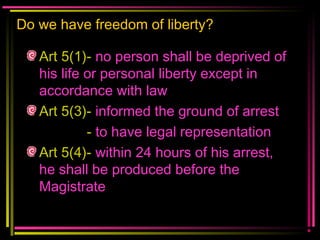
Do we have freedom of liberty?
Art 5(1)- no person shall be deprived of
his life or personal liberty except in
accordance with law
Art 5(3)- informed the ground of arrest
- to have legal representation
Art 5(4)- within 24 hours of his arrest,
he shall be produced before the
Magistrate
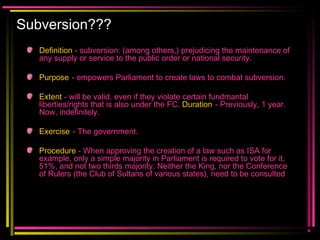
Subversion???
Definition - subversion: (among others,) prejudicing the maintenance of
any supply or service to the public order or national security.
Purpose - empowers Parliament to create laws to combat subversion.
Extent - will be valid, even if they violate certain fundmantal
liberties/rights that is also under the FC. Duration - Previously, 1 year.
Now, indefinitely.
Exercise - The government.
Procedure - When approving the creation of a law such as ISA for
example, only a simple majority in Parliament is required to vote for it.
51%, and not two thirds majority. Neither the King, nor the Conference
of Rulers (the Club of Sultans of various states), need to be consulted
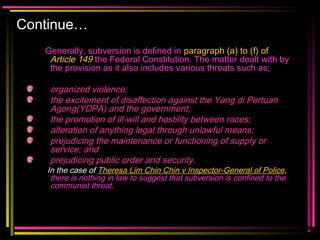
Continue…
Generally, subversion is defined in paragraph (a) to (f) of
Article 149 the Federal Constitution. The matter dealt with by
the provision as it also includes various threats such as;
organized violence;
the excitement of disaffection against the Yang di Pertuan
Agong(YDPA) and the government;
the promotion of ill-will and hostility between races;
alteration of anything legal through unlawful means;
prejudicing the maintenance or functioning of supply or
service; and
prejudicing public order and security.
In the case of Theresa Lim Chin Chin v Inspector-General of Police,
there is nothing in law to suggest that subversion is confined to the
communist threat.
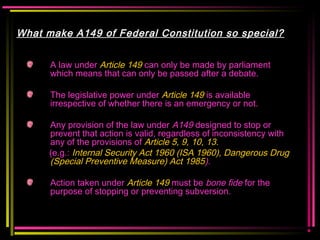
What make A149 of Federal Constitution so special?
A law under Article 149 can only be made by parliament
which means that can only be passed after a debate.
The legislative power under Article 149 is available
irrespective of whether there is an emergency or not.
Any provision of the law under A149 designed to stop or
prevent that action is valid, regardless of inconsistency with
any of the provisions of Article 5, 9, 10, 13.
(e.g.: Internal Security Act 1960 (ISA 1960), Dangerous Drug
(Special Preventive Measure) Act 1985).
Action taken under Article 149 must be bone fide for the
purpose of stopping or preventing subversion.
Continue…
Laws enacted to combat subversion have no time limits and do
not cease to operate even if the threat ceases to exist.
Article 149 powers are independent of Article 150
(Teh Cheng Poh, Privy Council noted that Article 149 is quite
independent of the existence of a state of emergency; indeed it
is not even a requirement that such action should be continuing
at the time the Act of Parliament is passed; all that is required is
the recital referred to in Clause (1); and the power includes
power to make laws providing not only for suppressing
subversion but also for preventing its recurrence).
Continue…
Violation of rights must be explicitly authorized
Lee Mau Seng v Minister for Home Affairs, the guarantees
of Article 5, 9, 10, 13 continue to apply unless explicitly
excluded by the anti subversion law.
Abdul Ghani Haroon v Ketua Polis, nothing in the ISA
explicitly excludes a detainee’s right in Article 5 (3) to
consult & be defended by a legal practitioner of his choice.
Legislation under Article 149 and Article 150 must not
violate the safeguards to preventive detainees entrenched
in A151.
Do the court has the jurisdiction to review
article 149?
Malaysia apply subjective test and
procedural review’s approach.
Subjective test- other person cannot
evaluate or question the decision.
Procedural review- referred to the
procedure of the case.
Case: Karam Singh v Menteri Hal
Ehwal Dalam Negeri Malaysia
Karam Singh’s case
Held: The burden of proof is on the detainee to
show that the detention is illegal. The
detention is not illegal just because the
allegation of fact is insufficient.
In fact, although the detainers has to prove the
legality of the detention, but they simply
would be able to discharge that by simply
producing the order of the detention with
good faith and it is sufficient.
Continue….
The truth is, it is hard to prove the bad
faith or mala fide on the part of the
government when they detained
someone.
Other case: Theresa Lim Chin Chin &
ors v Inspector General of Office
ISA????
Is derived from article 149
arbitrary powers to detain without trial
available to the Executive.
Depends on the discretion of the
detaining authority.
ISA is contrary to fundamental
principles including the right to liberty of
the person.
Continue…
The ISA has been used to suppress
peaceful political, academic and social
activities, and legitimate constructive
criticism by NGOs and other social
pressure groups.
Although the legality of the ISA had
been challenged in the court, but the
court agreed that the law is valid by
virtue of article 149.
continue…
Court cannot review the ministerial
discretion.
Except:
Male fide of the minister.
Procedural requirement in ISA.
Case: PP v Musa
Noor Ashid bin Sakib v Ketua
Polis Negara.
PP v Musa
A minister order a person to be
restricted.
Subsequent to that restriction, that
person had been detained.
The minister could extend the detention
period up to 2 years and don’t have to
make a fresh detention order.
Noor Ashid bin Sakib v Ketua Polis
Negara.
The court’s jurisdiction to review only
with regard to the question relating to
the procedural requirement in the ISA.
Legitimacy of the minister’s order.
The minister’s order is illegitimate if it
fall on the ground of mala fide of the
detaining authority.
Karpal Singh v Menteri
this case had made an outstanding
contribution on the question of mala fide
or bad faith on the part of the
government.
Continue….
Held: mala fide does not mean at all
malicious intention. It normally means
that a power is exercised for a collateral
or ulterior purpose or for a purpose
other than for which it is professed to
have been exercised.
Other case? Tan Sri Khalid Raja Harun
Conclusion…
We do have our fundamental right.
But we must not exceed the limit.
We must not take advantage on the
freedom that had been given to us.
It is because, there is legal provision
that will oust such right.
“thank for lending your ears”
Do your best, let Allah do
the rest
Good luck for your final
examination

Art 149

  • 1.
    Constitutional Law II Preparedby: Nur Afiqah Norman 1070856 Nursyuhada Matwi 1070852 Ma Kalthum Ishak 1070850 Instructor- Mdm. Intan Nadia Ghulam Khan
  • 2.
    Question 2 ‘there havebeen occasions where detainees have not been conferred the basic fundamental right that are contained within the framework of the constitution which include the non-conferment of the fundamental right to be informed of ground of arrest and the right to be produced promptly before the Magistrate. This appears to be either because of legal provisions which specifically oust such right or the different interpretation of the law or as a result of the occasional imperfect implementation of the law by the detaining authorities.’ HUMAN RIGHTS COMMISSION OF MALAYSIA,REVIEW OF THE INTERNAL SECURITY ACT, SUHAKAM Explain the above quatation by referring to relevant legal and constitutional provision
  • 3.
    What is SUHAKAM???? •Human Rights Commission of Malaysia (Malay: Suruhanjaya Hak Asasi Malaysia) • Suhakam is a human rights watchdog in Malaysia • It was established by the Malaysian Parliament using the Human Rights Commission of Malaysia Act 1999, Act 597
  • 4.
    Do we havefreedom of liberty? Art 5(1)- no person shall be deprived of his life or personal liberty except in accordance with law Art 5(3)- informed the ground of arrest - to have legal representation Art 5(4)- within 24 hours of his arrest, he shall be produced before the Magistrate
  • 5.
    Subversion??? Definition - subversion:(among others,) prejudicing the maintenance of any supply or service to the public order or national security. Purpose - empowers Parliament to create laws to combat subversion. Extent - will be valid, even if they violate certain fundmantal liberties/rights that is also under the FC. Duration - Previously, 1 year. Now, indefinitely. Exercise - The government. Procedure - When approving the creation of a law such as ISA for example, only a simple majority in Parliament is required to vote for it. 51%, and not two thirds majority. Neither the King, nor the Conference of Rulers (the Club of Sultans of various states), need to be consulted
  • 6.
    Continue… Generally, subversion isdefined in paragraph (a) to (f) of Article 149 the Federal Constitution. The matter dealt with by the provision as it also includes various threats such as; organized violence; the excitement of disaffection against the Yang di Pertuan Agong(YDPA) and the government; the promotion of ill-will and hostility between races; alteration of anything legal through unlawful means; prejudicing the maintenance or functioning of supply or service; and prejudicing public order and security. In the case of Theresa Lim Chin Chin v Inspector-General of Police, there is nothing in law to suggest that subversion is confined to the communist threat.
  • 7.
    What make A149of Federal Constitution so special? A law under Article 149 can only be made by parliament which means that can only be passed after a debate. The legislative power under Article 149 is available irrespective of whether there is an emergency or not. Any provision of the law under A149 designed to stop or prevent that action is valid, regardless of inconsistency with any of the provisions of Article 5, 9, 10, 13. (e.g.: Internal Security Act 1960 (ISA 1960), Dangerous Drug (Special Preventive Measure) Act 1985). Action taken under Article 149 must be bone fide for the purpose of stopping or preventing subversion.
  • 8.
    Continue… Laws enacted tocombat subversion have no time limits and do not cease to operate even if the threat ceases to exist. Article 149 powers are independent of Article 150 (Teh Cheng Poh, Privy Council noted that Article 149 is quite independent of the existence of a state of emergency; indeed it is not even a requirement that such action should be continuing at the time the Act of Parliament is passed; all that is required is the recital referred to in Clause (1); and the power includes power to make laws providing not only for suppressing subversion but also for preventing its recurrence).
  • 9.
    Continue… Violation of rightsmust be explicitly authorized Lee Mau Seng v Minister for Home Affairs, the guarantees of Article 5, 9, 10, 13 continue to apply unless explicitly excluded by the anti subversion law. Abdul Ghani Haroon v Ketua Polis, nothing in the ISA explicitly excludes a detainee’s right in Article 5 (3) to consult & be defended by a legal practitioner of his choice. Legislation under Article 149 and Article 150 must not violate the safeguards to preventive detainees entrenched in A151.
  • 10.
    Do the courthas the jurisdiction to review article 149? Malaysia apply subjective test and procedural review’s approach. Subjective test- other person cannot evaluate or question the decision. Procedural review- referred to the procedure of the case. Case: Karam Singh v Menteri Hal Ehwal Dalam Negeri Malaysia
  • 11.
    Karam Singh’s case Held:The burden of proof is on the detainee to show that the detention is illegal. The detention is not illegal just because the allegation of fact is insufficient. In fact, although the detainers has to prove the legality of the detention, but they simply would be able to discharge that by simply producing the order of the detention with good faith and it is sufficient.
  • 12.
    Continue…. The truth is,it is hard to prove the bad faith or mala fide on the part of the government when they detained someone. Other case: Theresa Lim Chin Chin & ors v Inspector General of Office
  • 13.
    ISA???? Is derived fromarticle 149 arbitrary powers to detain without trial available to the Executive. Depends on the discretion of the detaining authority. ISA is contrary to fundamental principles including the right to liberty of the person.
  • 14.
    Continue… The ISA hasbeen used to suppress peaceful political, academic and social activities, and legitimate constructive criticism by NGOs and other social pressure groups. Although the legality of the ISA had been challenged in the court, but the court agreed that the law is valid by virtue of article 149.
  • 15.
    continue… Court cannot reviewthe ministerial discretion. Except: Male fide of the minister. Procedural requirement in ISA. Case: PP v Musa Noor Ashid bin Sakib v Ketua Polis Negara.
  • 16.
    PP v Musa Aminister order a person to be restricted. Subsequent to that restriction, that person had been detained. The minister could extend the detention period up to 2 years and don’t have to make a fresh detention order.
  • 17.
    Noor Ashid binSakib v Ketua Polis Negara. The court’s jurisdiction to review only with regard to the question relating to the procedural requirement in the ISA.
  • 18.
    Legitimacy of theminister’s order. The minister’s order is illegitimate if it fall on the ground of mala fide of the detaining authority. Karpal Singh v Menteri this case had made an outstanding contribution on the question of mala fide or bad faith on the part of the government.
  • 19.
    Continue…. Held: mala fidedoes not mean at all malicious intention. It normally means that a power is exercised for a collateral or ulterior purpose or for a purpose other than for which it is professed to have been exercised. Other case? Tan Sri Khalid Raja Harun
  • 20.
    Conclusion… We do haveour fundamental right. But we must not exceed the limit. We must not take advantage on the freedom that had been given to us. It is because, there is legal provision that will oust such right.
  • 21.
    “thank for lendingyour ears” Do your best, let Allah do the rest Good luck for your final examination