 “law”
 “legal system”
 ‘legal pluralism”
 “written law”, “unwritten law” etc etc
 Just refer to your tutorial presentation
1. Straits Settlements
2. Malay States
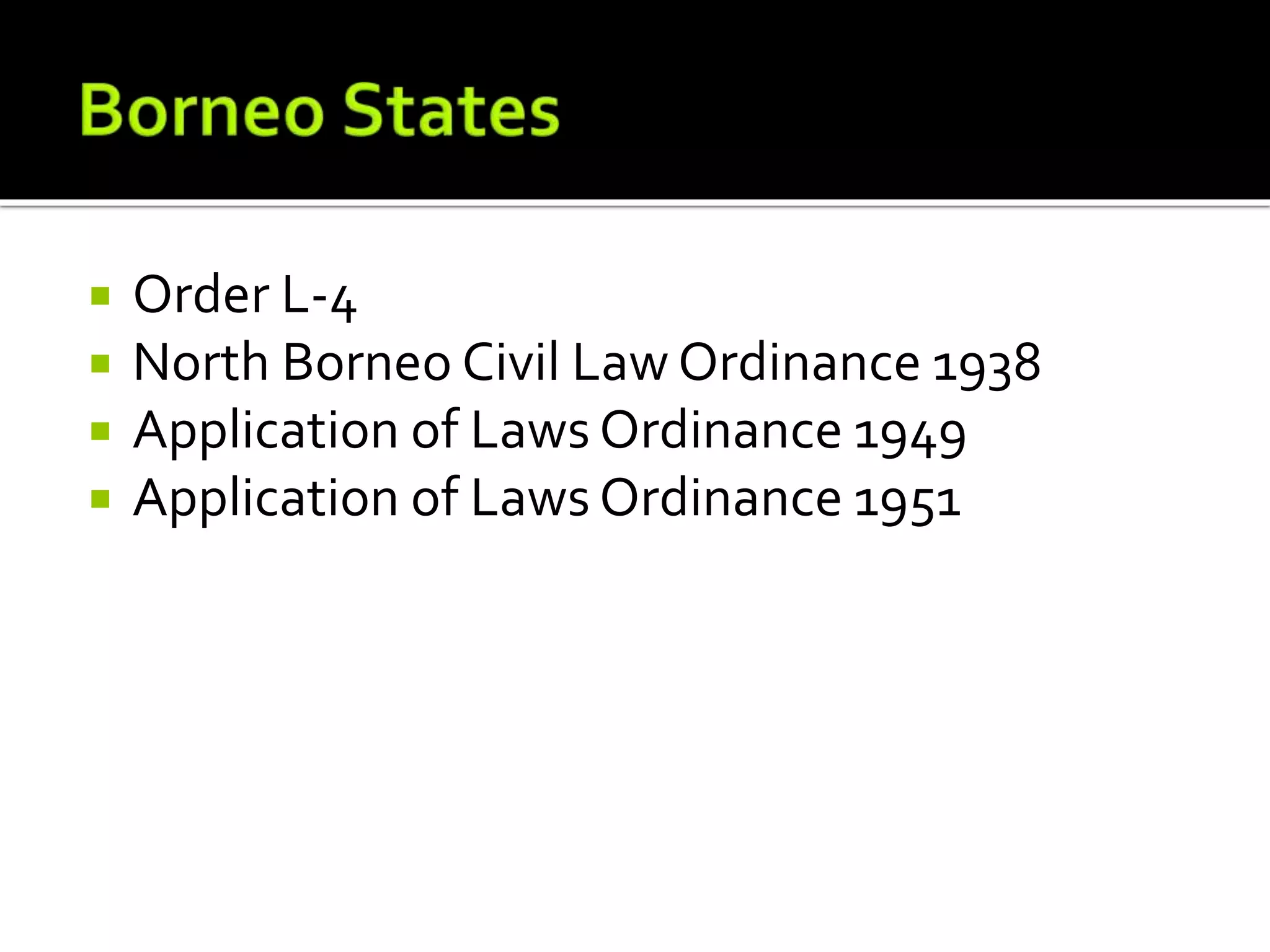
3. Borneo States
 Doctrine of imposition/reception -- Penang
 Whether Penang was a ceded or a settled
territory.
 Regina vWillans
 Fatimah v Logan
 InThe Goods of Abdullah
 Ong Cheng Neo
 Period of legal chaos
 Describe the legal system
 Ahpoe v Kehin
 Imposition of English Law: Royal Charter of
Justice
 Contents: law, jurisdiction, courts
 Proviso
 Effect on local law
 2nd RCJ: English law was extended to Malacca
and Singapore
 Identify cases where local custom was
recognised
 Identify cases where local custom was not
recognised
 3rd RCJ
 The Malay States were sovereign states
 Differentiate between SS and Malay States.
 SS – British colonies, Malay State – mere
protectorates, retained sovereignty.
 Cases to show sovereignty of Malay States
 Informal reception of English law: How?
 British Residents in FMS, Advisors in UFMS
 Importation of British Indian statues
 English court system, English trained judges
 The effect on the lex loci of the Malay States i.e., Islamic
law and local customs.
 The following cases need to be discussed:
 Mighell v Sultan of Johor (1894)
 Pahang Consolidated Co. Ltd.VThe State of Pahang (1933);
 Shaik Abdul Latif & Ors v Shaik Elias Bux (1915)
 Ramah v Laton (1927);
 Government of Perak v AR Adam (1914);
 Mohamed Gunny vVadvang Kuti (1930);
 Motor Emporium v Arumugam (1933);
 Leornard v Nachiappa Chetty (1923); and
 Haji Abdul Rahman v Mohamed Hassan (1917)
 Formal reception
 Civil Law Enactment 1937
 Civil Law Extension Ordinance 1951
 Order L-4
 North Borneo Civil Law Ordinance 1938
 Application of Laws Ordinance 1949
 Application of Laws Ordinance 1951
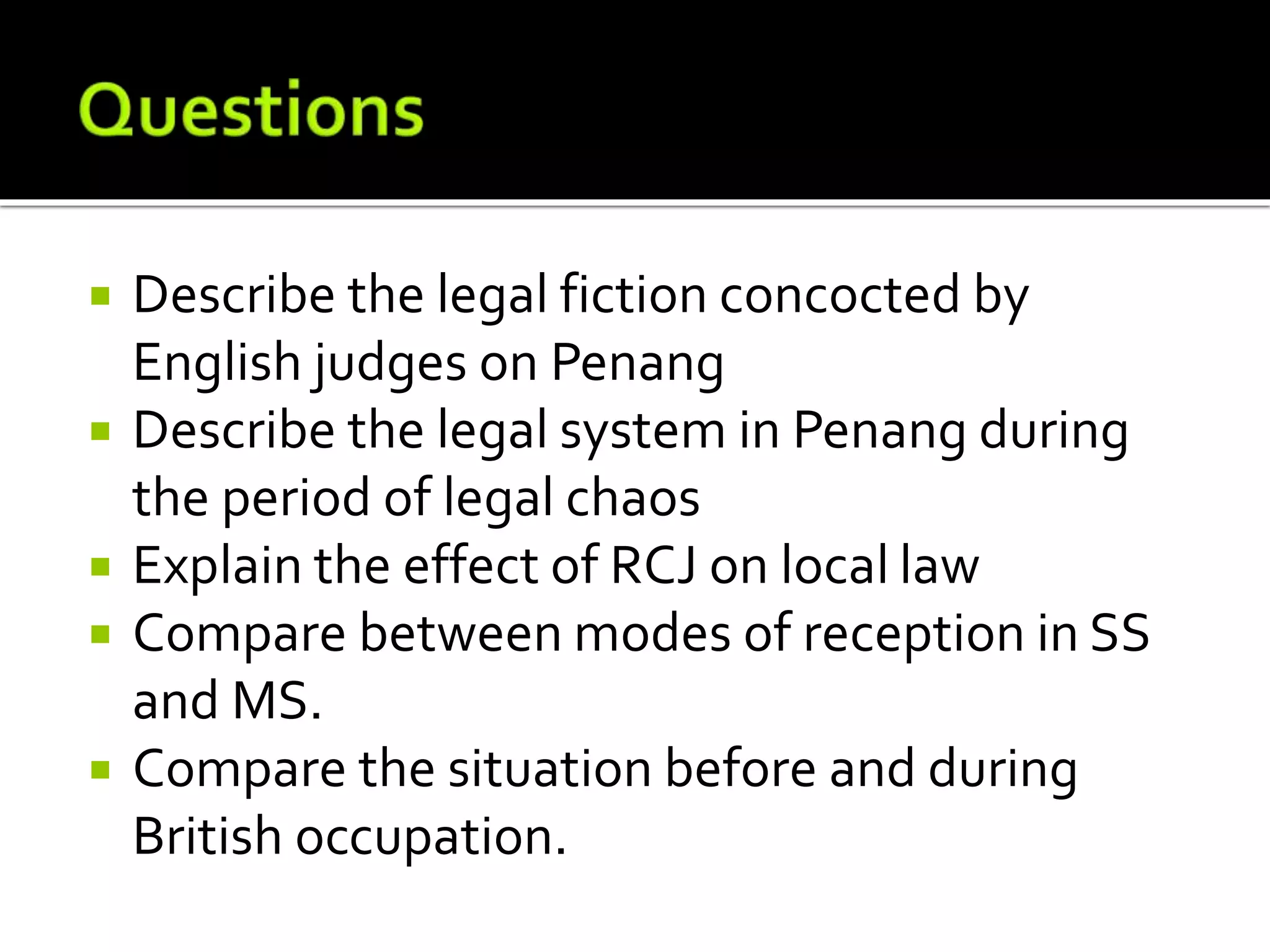
 Describe the legal fiction concocted by
English judges on Penang
 Describe the legal system in Penang during
the period of legal chaos
 Explain the effect of RCJ on local law
 Compare between modes of reception in SS
and MS.
 Compare the situation before and during
British occupation.
1. Legislation
2. Islamic law
3. Custom
4. English law
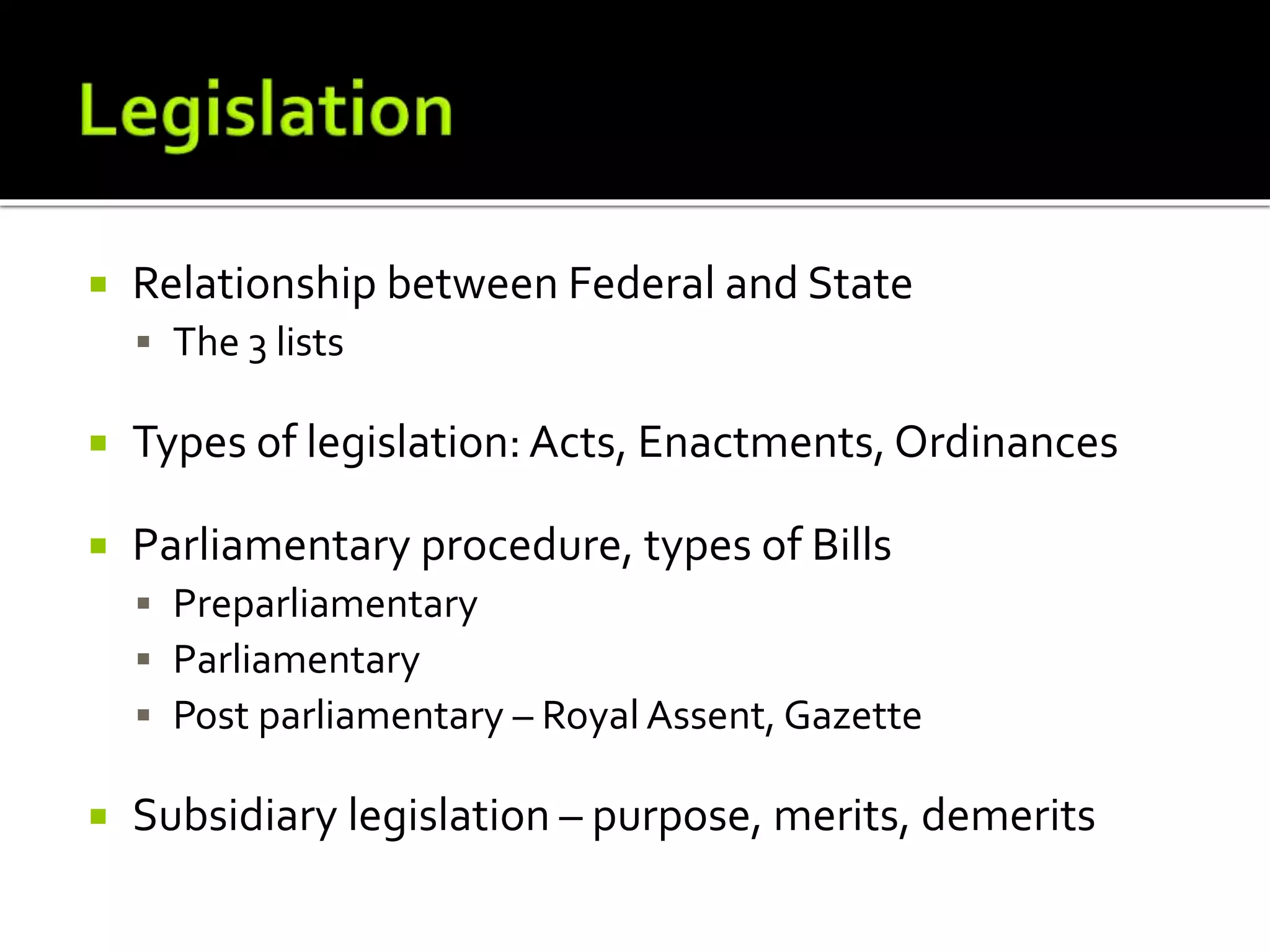
 Relationship between Federal and State
 The 3 lists
 Types of legislation: Acts, Enactments, Ordinances
 Parliamentary procedure, types of Bills
 Preparliamentary
 Parliamentary
 Post parliamentary – Royal Assent, Gazette
 Subsidiary legislation – purpose, merits, demerits
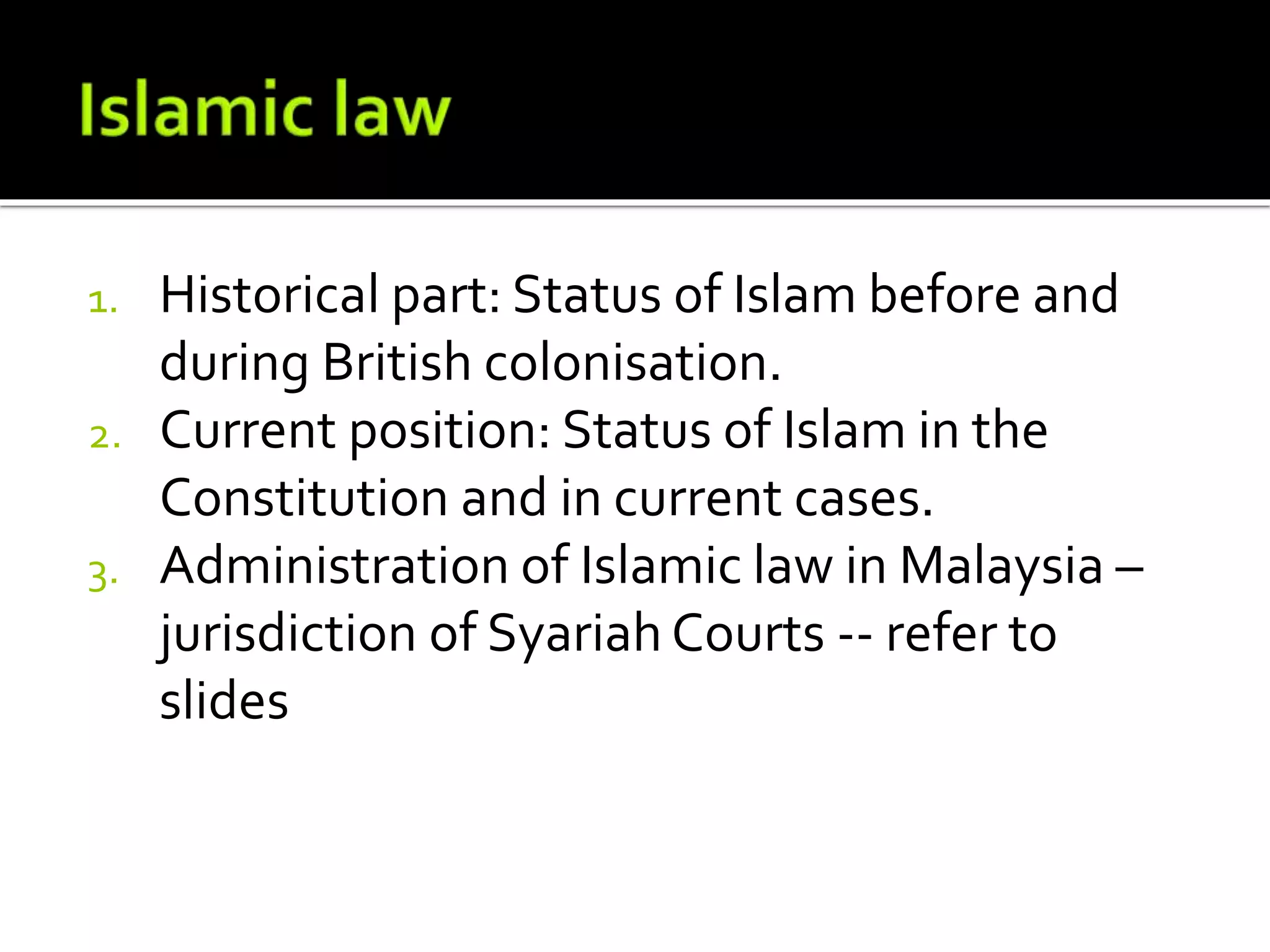
1. Historical part: Status of Islam before and
during British colonisation.
2. Current position: Status of Islam in the
Constitution and in current cases.
3. Administration of Islamic law in Malaysia –
jurisdiction of Syariah Courts -- refer to
slides
 Before the British came
 Shaik Abdul Latif v Shaik Elias Bux, Ramah v Laton
 During British occupation
 Islamic law was recognised in some cases and was not recognised
in others.
 In the Goods of Abdullah
 Fatimah v Logan
 Chulas v Kolson
 Sahrip v Mitchell
 Ainan v Syed Abu Bakar [1939] MLJ 209
 PP vWhite [1940] MLJ 214
 Attorney General of Ceylon v Reid [1965] 2 MLJ 34 (PC)
 Martin v Umi Kelsom [1963] MLJ 1
 Re Maria Hertogh [1950] MLJ 214
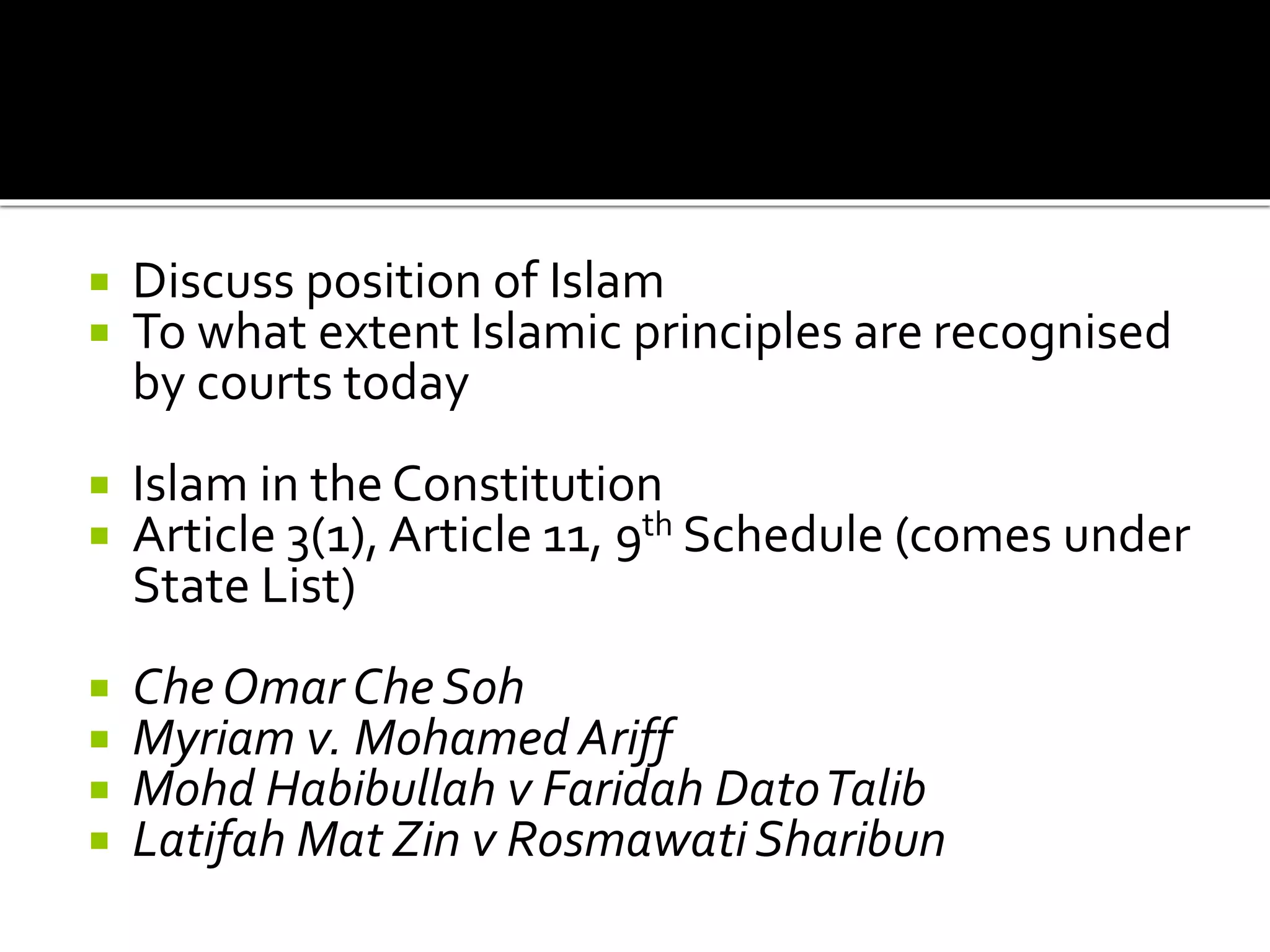
 Discuss position of Islam
 To what extent Islamic principles are recognised
by courts today
 Islam in the Constitution
 Article 3(1), Article 11, 9th Schedule (comes under
State List)
 Che Omar Che Soh
 Myriam v. Mohamed Ariff
 Mohd Habibullah v Faridah DatoTalib
 Latifah Mat Zin v Rosmawati Sharibun
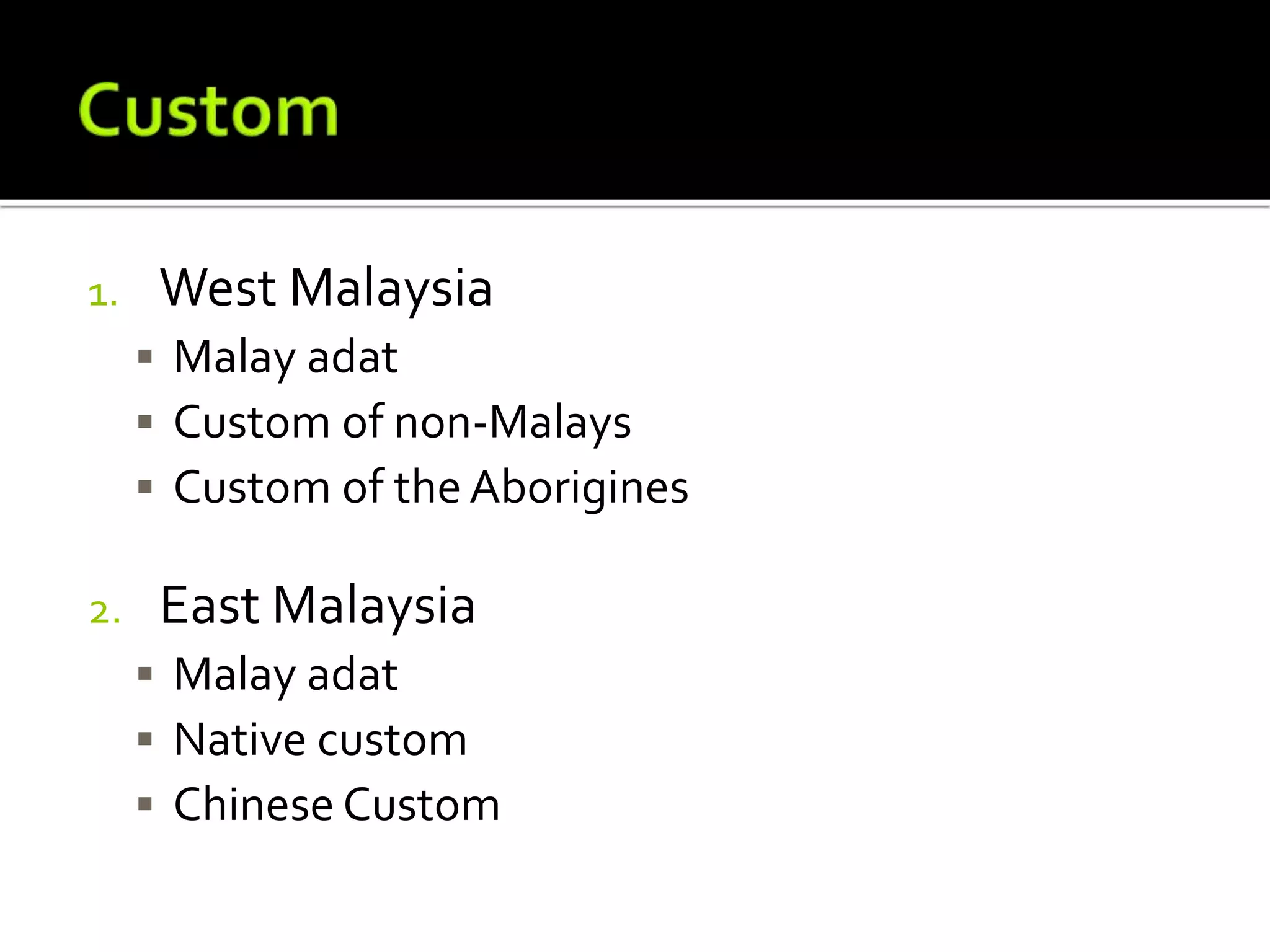
1. West Malaysia
 Malay adat
 Custom of non-Malays
 Custom of the Aborigines
2. East Malaysia
 Malay adat
 Native custom
 Chinese Custom
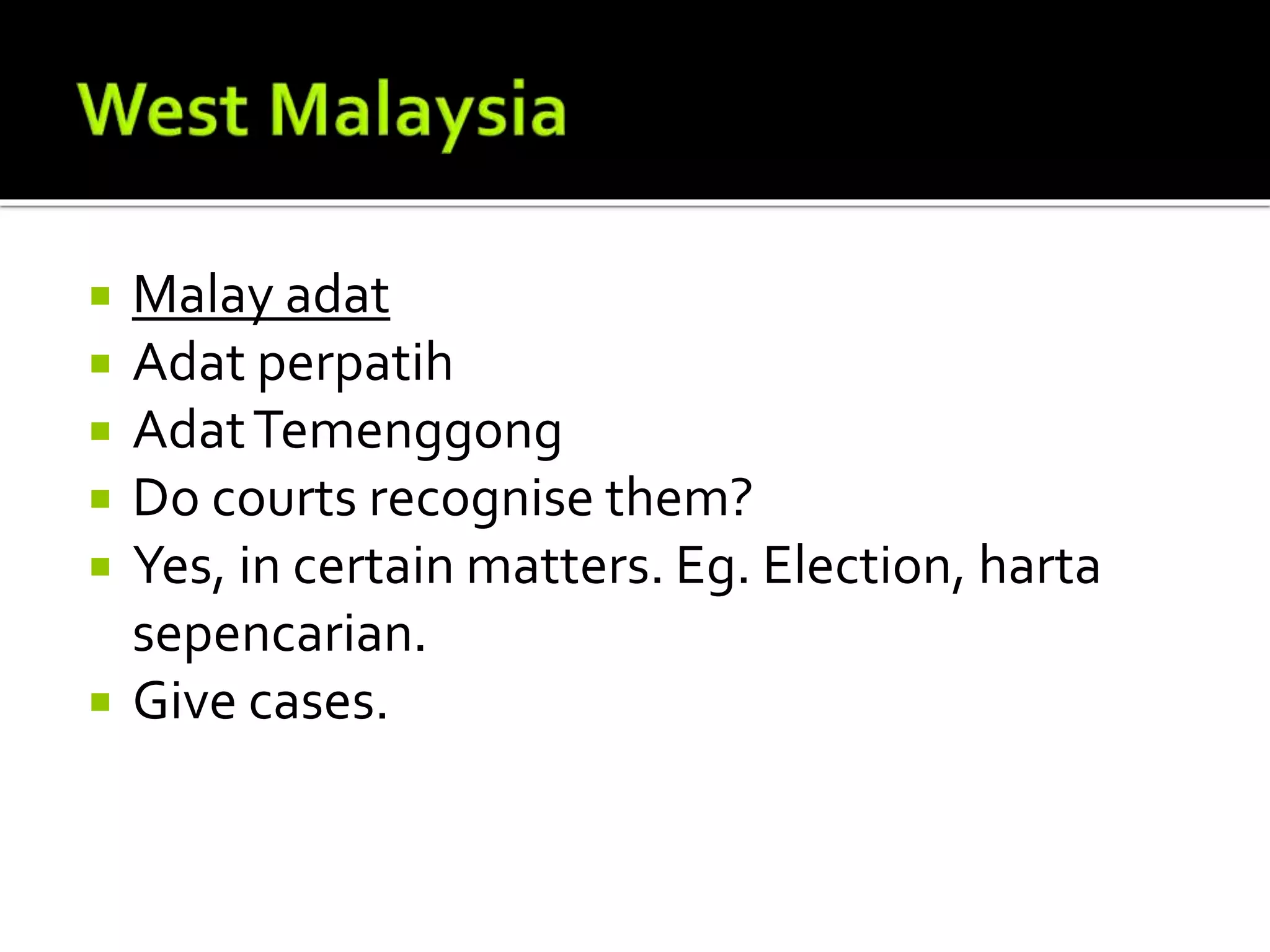
 Malay adat
 Adat perpatih
 AdatTemenggong
 Do courts recognise them?
 Yes, in certain matters. Eg. Election, harta
sepencarian.
 Give cases.
 Custom of non-Malays
 Do courts recognise them?
1. During British occupation
2. After Law reform (M&D) Act 1976 came into force
1. During British occupation?
 Yes, in certain matters (polygamous union,
legitimacy)
 SixWidows case, Re Ding Do Ca, DorothyYeeYeng
Nam
 No, in others (eg charitable trust)
 Ong Cheng Neo
2. After Law Reform (M&D) Act?
 Relevance of custom of non-Malays were
substantially reduced.
 Discuss the Act.
 Purpose, application, all the important
provisions e.g. registration, no retrospective
effect, polygamous marriage not
recognised,divorce.
 Custom of the Aborigines
 Most relevant in matters involving customary land
of the aborigines
 Governed by the Aboriginal Peoples Act 1954 which
enables aborigines to dwell in land areas designated
for their exclusive use.
 Referred to as “aboriginal areas” (section 6) or
“aboriginal reserves” (section 7).
 Adong bin Kuwau & Ord v Kerajaan Negeri Johor
 SagongTasi v Kerajaan Negeri Selangor
 Malay custom
 A mixture of Malay adat and Islamic law.
 In Sarawak, it is codified in the Undang-
Undang Mahkamah Melayu (Laws of the
Malay Courts)
 Comes under the administration of the
Islamic Council of Sarawak and theSyariah
Courts
 Native custom
 Courts have enforced native customary law,
recognised native customary rights.
 Cases
 Non-native custom (Chinese custom)
 Not recognised unless it is found in
legislation.
 Chan Bee Neo v Ee Siok Choo
 The applicability of English law in Malaysia in light of S 3 CLA 1956.
 -very general question.You are required to discuss everything.
 The contents of S 3:
 Where there is no written law, apply English law.
 West Malaysia – common law & equity; the cutoff date
 East Malaysia – common law , equity & statutes of general application
; the cutoff dates.
 The proviso
 Effect: English law at the cutoff date is binding.
 Any development after the cutoff date is not binding, merely
persuasive
 But we have the proviso
 Only apply to civil cases.
 Common law which is no longer good law is not binding.
 Don’t forget cases!
 More specific questions:
 Discuss the significance of the cut-off dates.
 With reference to the Nepline case, discuss
the steps to be taken in determining whether
to apply English law to local cases.
 Question on Malaysian common law.
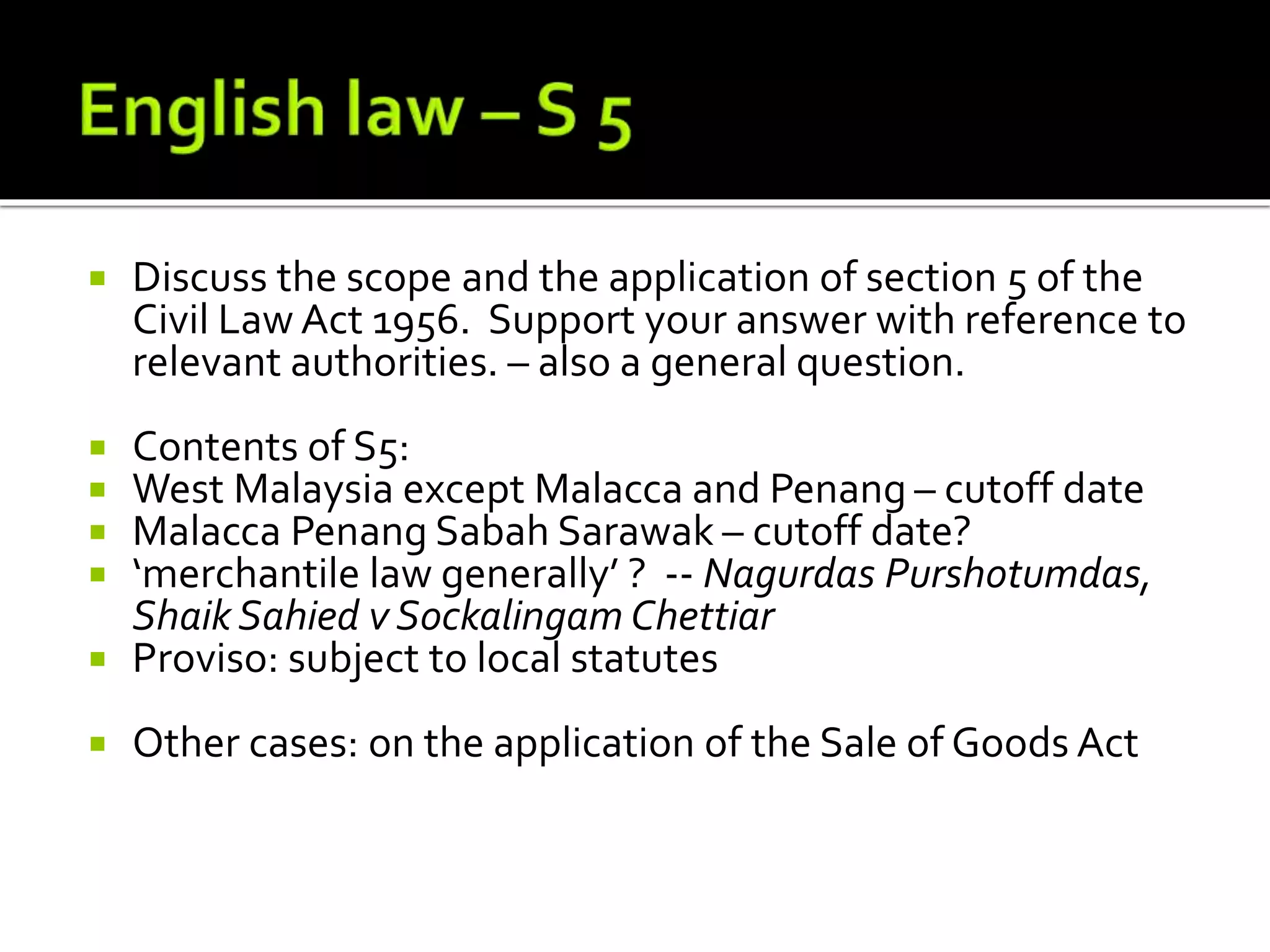
 Discuss the scope and the application of section 5 of the
Civil Law Act 1956. Support your answer with reference to
relevant authorities. – also a general question.
 Contents of S5:
 West Malaysia except Malacca and Penang – cutoff date
 Malacca Penang Sabah Sarawak – cutoff date?
 ‘merchantile law generally’ ? -- Nagurdas Purshotumdas,
Shaik Sahied v Sockalingam Chettiar
 Proviso: subject to local statutes
 Other cases: on the application of the Sale of Goods Act
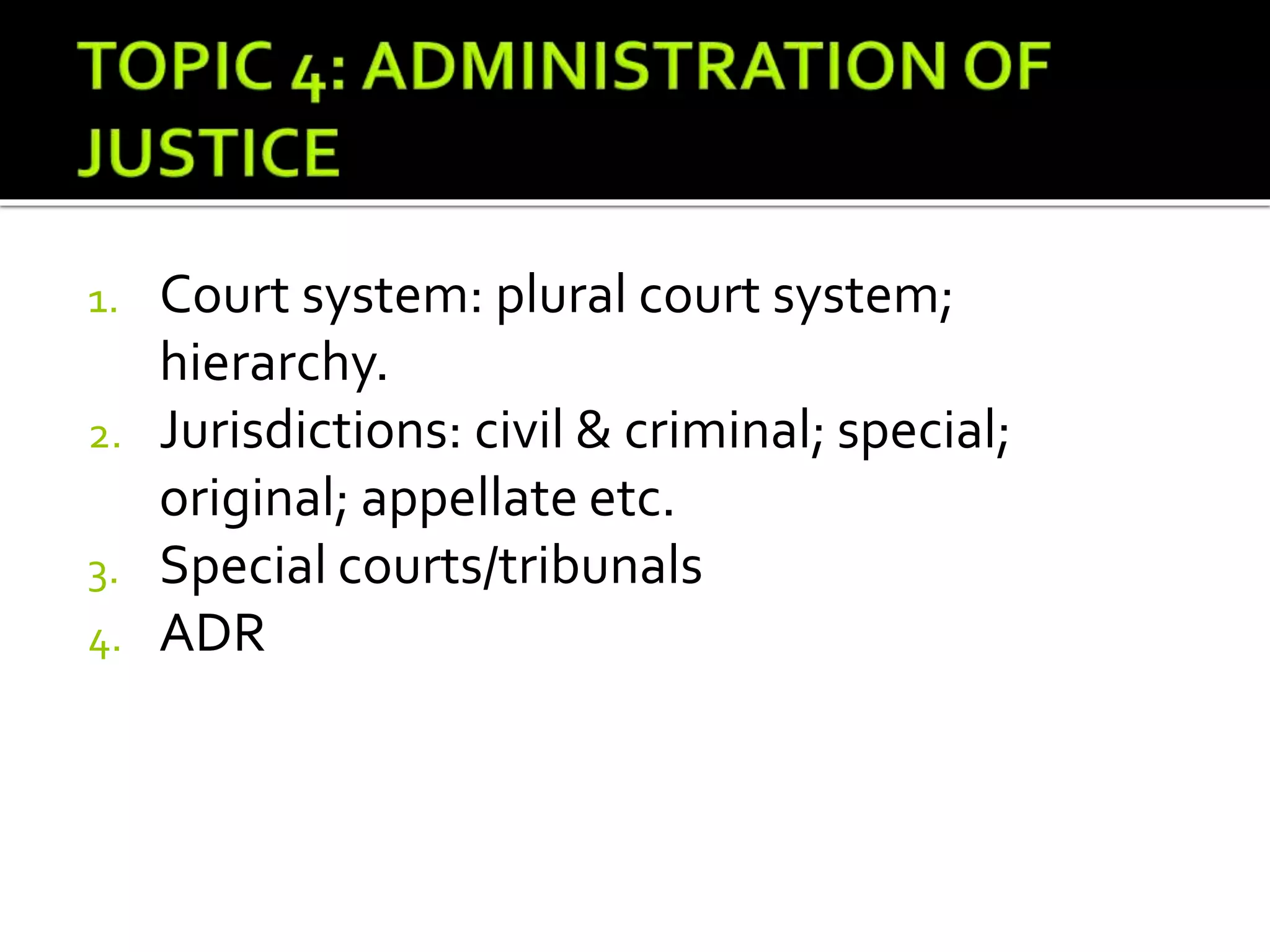
1. Court system: plural court system;
hierarchy.
2. Jurisdictions: civil & criminal; special;
original; appellate etc.
3. Special courts/tribunals
4. ADR
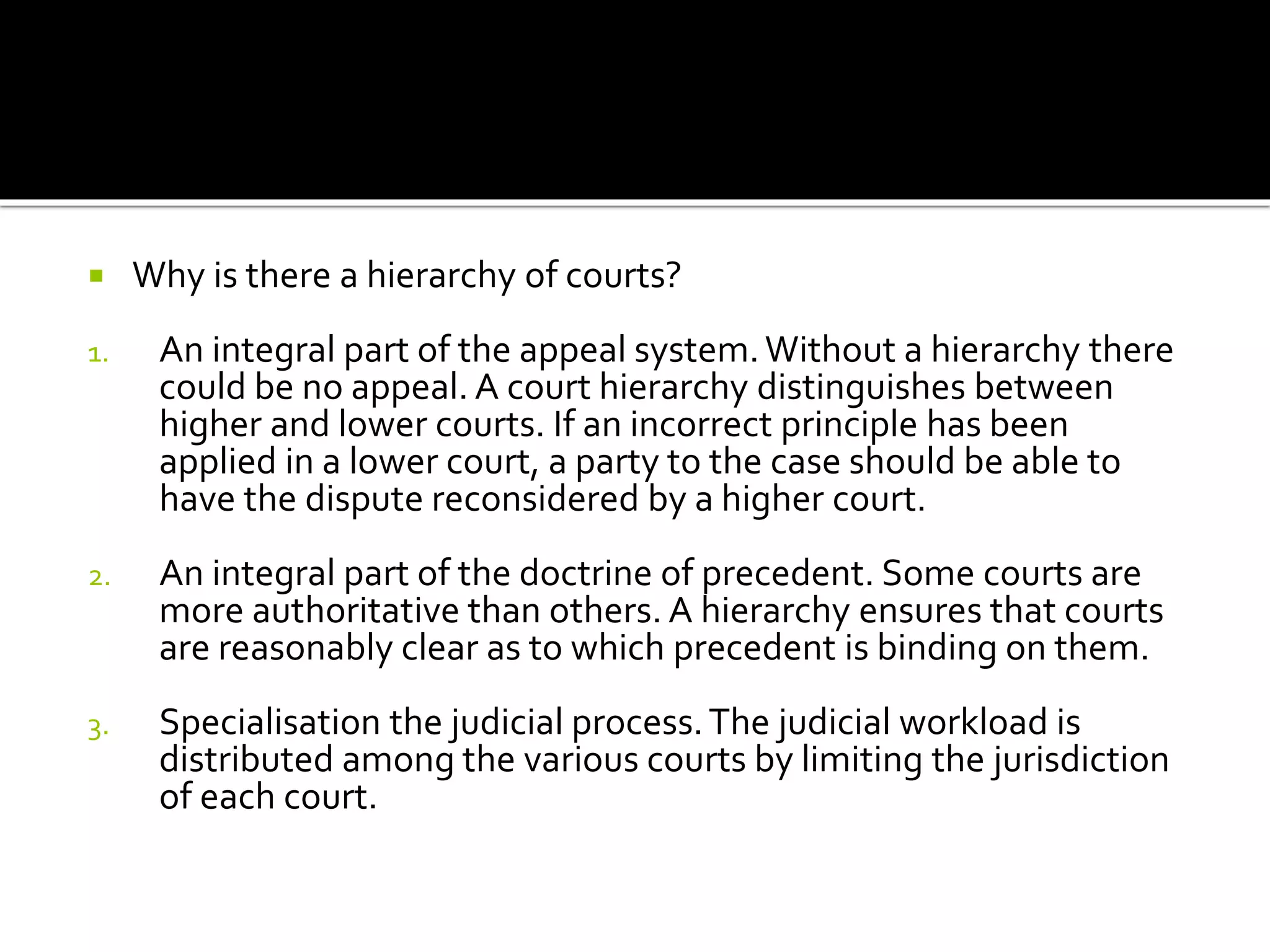
 Why is there a hierarchy of courts?
1. An integral part of the appeal system.Without a hierarchy there
could be no appeal. A court hierarchy distinguishes between
higher and lower courts. If an incorrect principle has been
applied in a lower court, a party to the case should be able to
have the dispute reconsidered by a higher court.
2. An integral part of the doctrine of precedent. Some courts are
more authoritative than others. A hierarchy ensures that courts
are reasonably clear as to which precedent is binding on them.
3. Specialisation the judicial process.The judicial workload is
distributed among the various courts by limiting the jurisdiction
of each court.
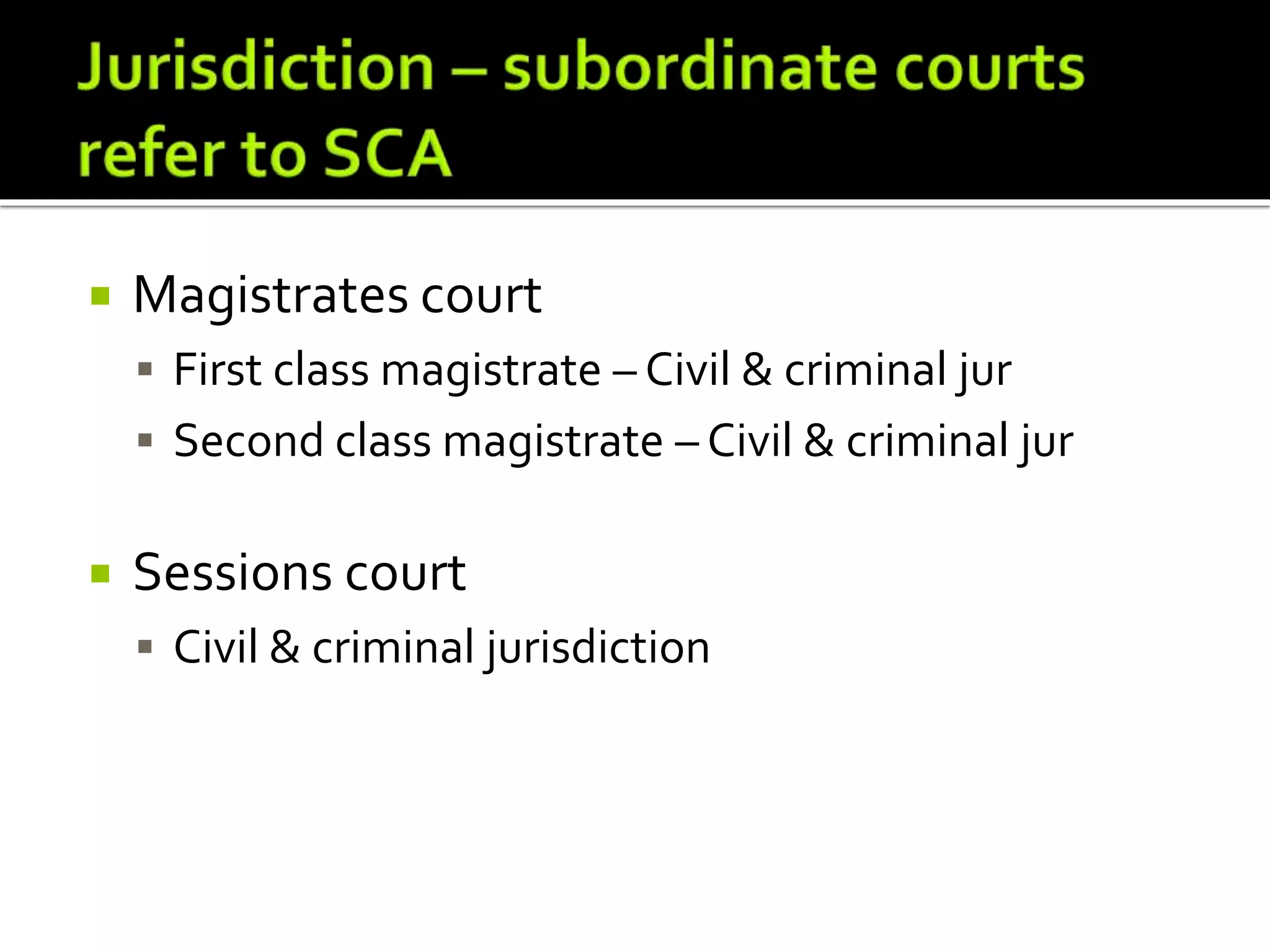
 Magistrates court
 First class magistrate – Civil & criminal jur
 Second class magistrate – Civil & criminal jur
 Sessions court
 Civil & criminal jurisdiction
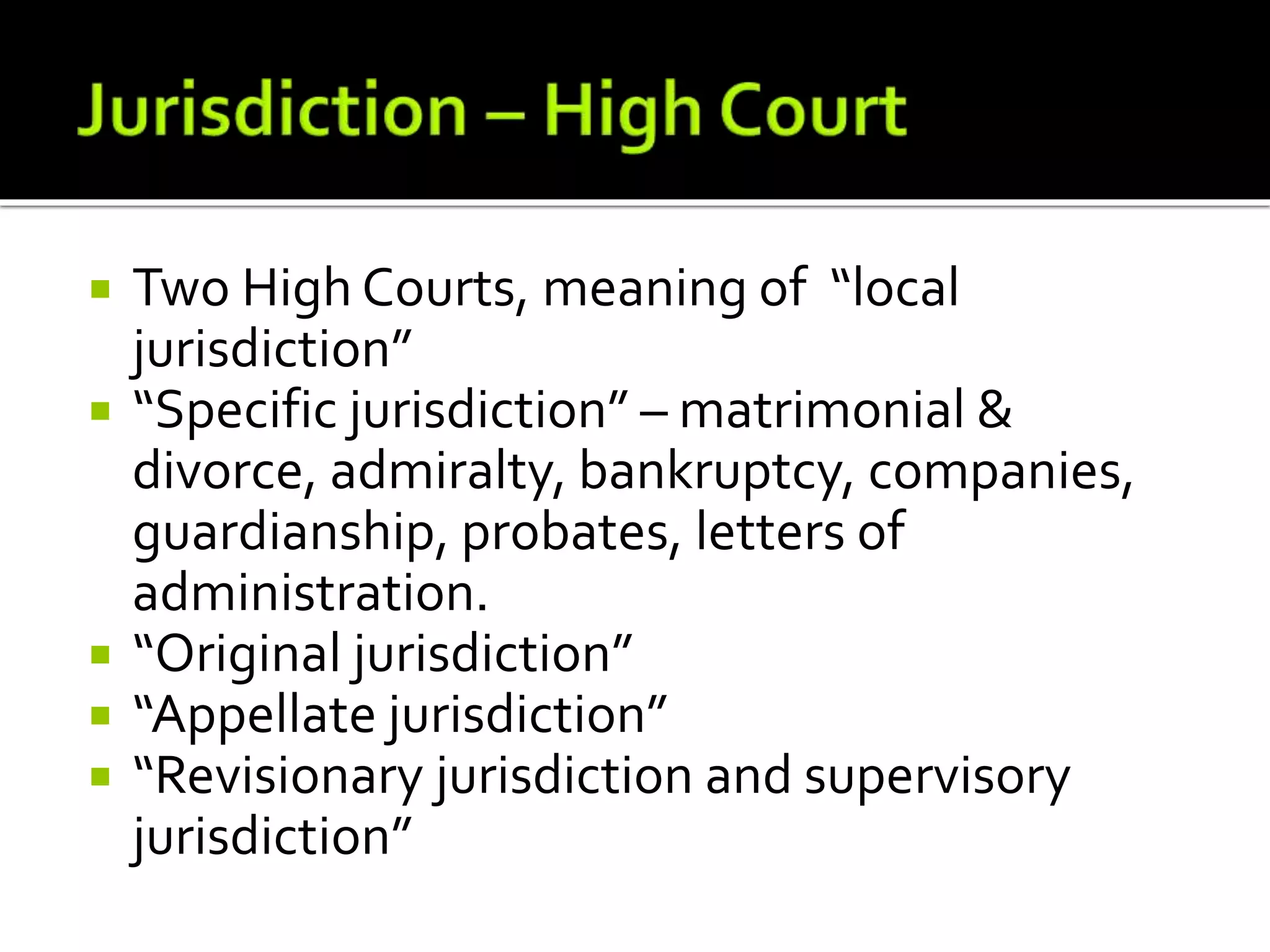
 Two High Courts, meaning of “local
jurisdiction”
 “Specific jurisdiction” – matrimonial &
divorce, admiralty, bankruptcy, companies,
guardianship, probates, letters of
administration.
 “Original jurisdiction”
 “Appellate jurisdiction”
 “Revisionary jurisdiction and supervisory
jurisdiction”
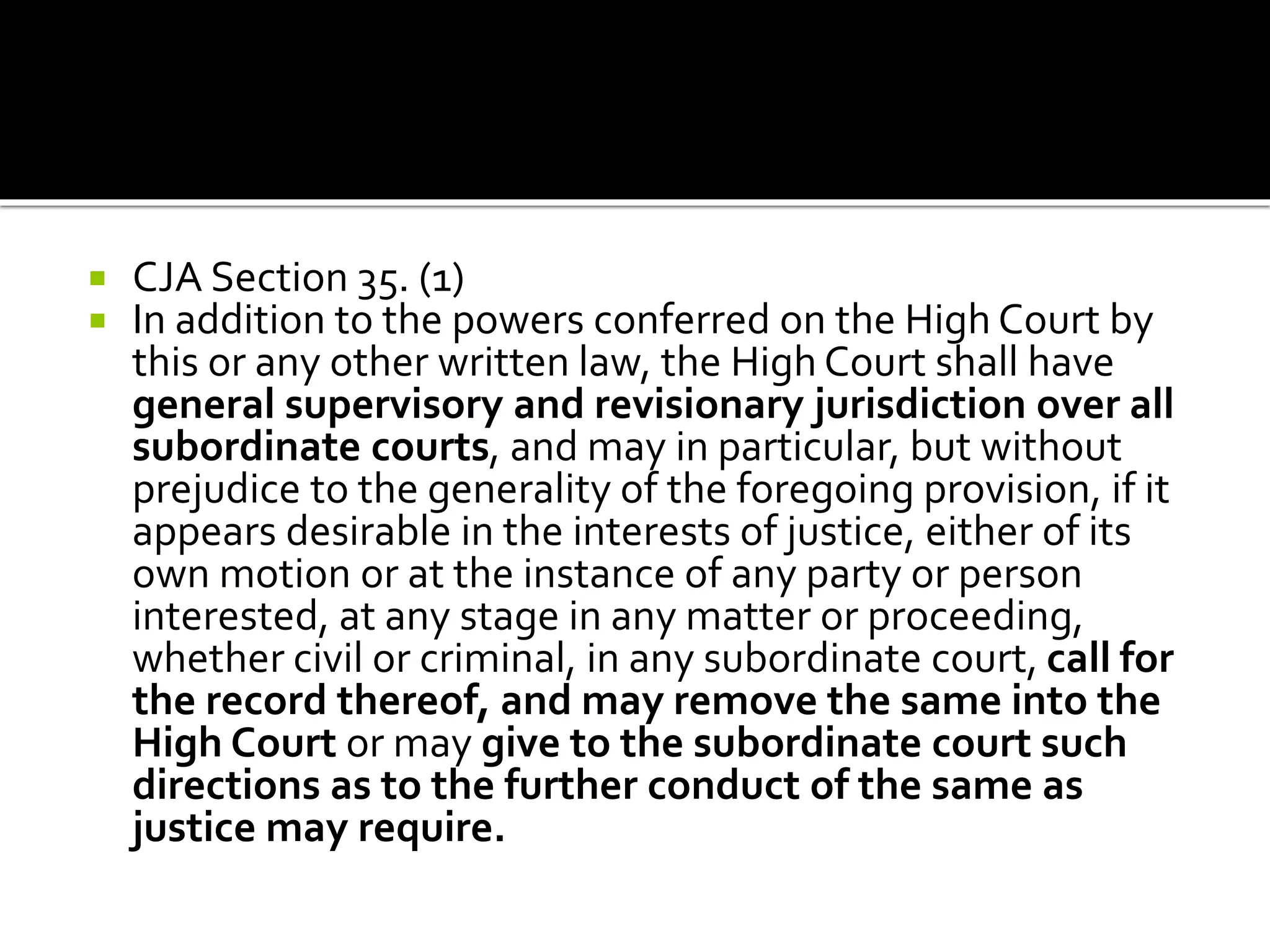
 CJA Section 35. (1)
 In addition to the powers conferred on the High Court by
this or any other written law, the High Court shall have
general supervisory and revisionary jurisdiction over all
subordinate courts, and may in particular, but without
prejudice to the generality of the foregoing provision, if it
appears desirable in the interests of justice, either of its
own motion or at the instance of any party or person
interested, at any stage in any matter or proceeding,
whether civil or criminal, in any subordinate court, call for
the record thereof, and may remove the same into the
High Court or may give to the subordinate court such
directions as to the further conduct of the same as
justice may require.
 Appellate jurisdiction only
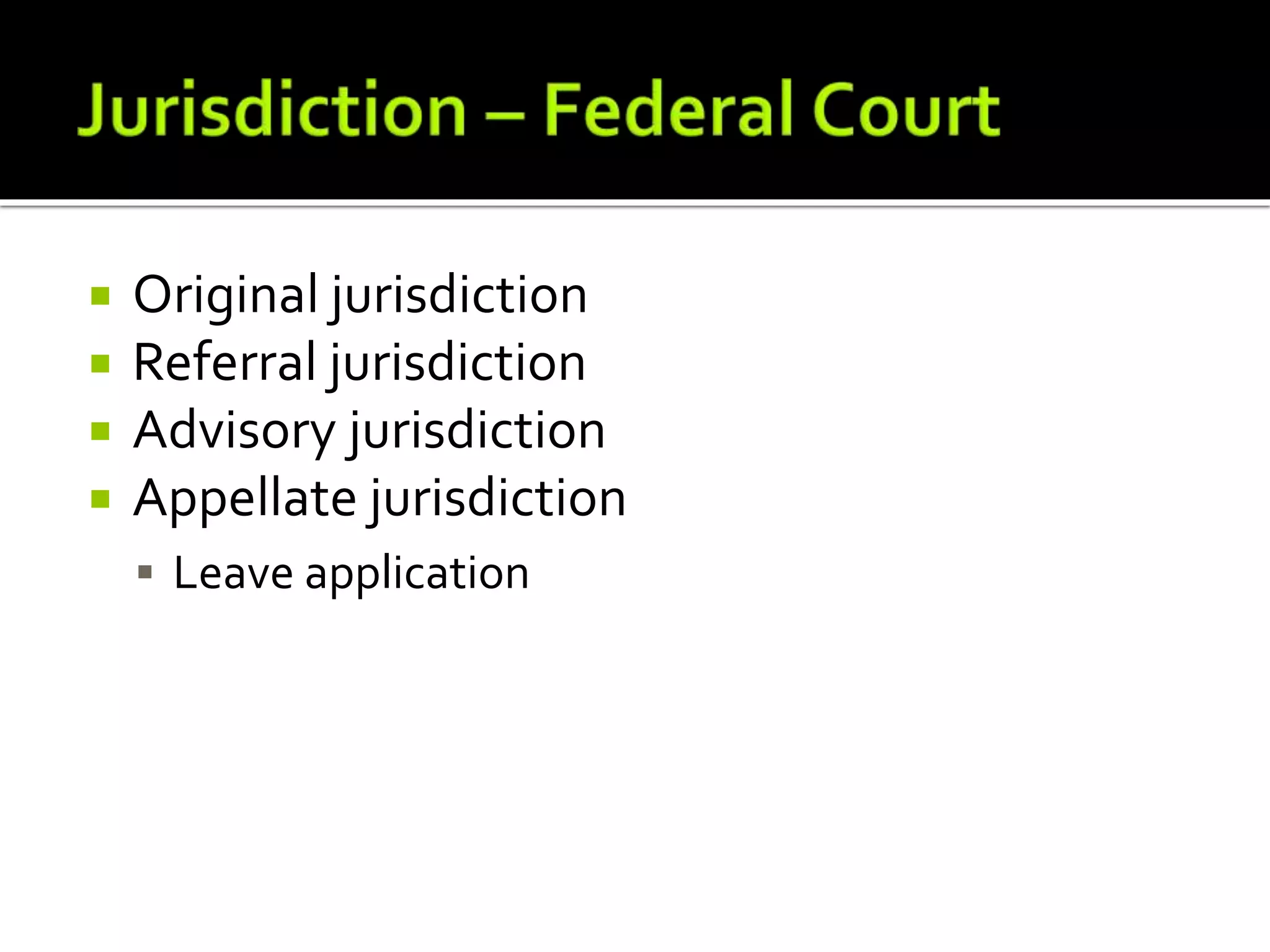
 Original jurisdiction
 Referral jurisdiction
 Advisory jurisdiction
 Appellate jurisdiction
 Leave application
 SpecialCourt for Rulers
 Court for Children
 Industrial Court
 Tribunal for Consumer Claims
 What is ADR?
 Merits and demerits of ADR
 Who is the AG?
 Who is the PP?
 Qualifications for Advocate & Solicitor
 Exclusive right to appear and plead in all the
courts of justice; name on the Roll, practising
certificate.
 Qualifications for Peguam Syarie
 LegalAid, qualification – the MeansTest.

MALAYSIAN LEGAL SYSTEM Revision

  • 2.
     “law”  “legalsystem”  ‘legal pluralism”  “written law”, “unwritten law” etc etc  Just refer to your tutorial presentation
  • 3.
    1. Straits Settlements 2.Malay States 3. Borneo States
  • 4.
     Doctrine ofimposition/reception -- Penang  Whether Penang was a ceded or a settled territory.  Regina vWillans  Fatimah v Logan  InThe Goods of Abdullah  Ong Cheng Neo
  • 5.
     Period oflegal chaos  Describe the legal system  Ahpoe v Kehin
  • 6.
     Imposition ofEnglish Law: Royal Charter of Justice  Contents: law, jurisdiction, courts  Proviso  Effect on local law
  • 7.
     2nd RCJ:English law was extended to Malacca and Singapore  Identify cases where local custom was recognised  Identify cases where local custom was not recognised  3rd RCJ
  • 8.
     The MalayStates were sovereign states  Differentiate between SS and Malay States.  SS – British colonies, Malay State – mere protectorates, retained sovereignty.  Cases to show sovereignty of Malay States  Informal reception of English law: How?  British Residents in FMS, Advisors in UFMS  Importation of British Indian statues  English court system, English trained judges
  • 9.
     The effecton the lex loci of the Malay States i.e., Islamic law and local customs.  The following cases need to be discussed:  Mighell v Sultan of Johor (1894)  Pahang Consolidated Co. Ltd.VThe State of Pahang (1933);  Shaik Abdul Latif & Ors v Shaik Elias Bux (1915)  Ramah v Laton (1927);  Government of Perak v AR Adam (1914);  Mohamed Gunny vVadvang Kuti (1930);  Motor Emporium v Arumugam (1933);  Leornard v Nachiappa Chetty (1923); and  Haji Abdul Rahman v Mohamed Hassan (1917)
  • 10.
     Formal reception Civil Law Enactment 1937  Civil Law Extension Ordinance 1951
  • 11.
     Order L-4 North Borneo Civil Law Ordinance 1938  Application of Laws Ordinance 1949  Application of Laws Ordinance 1951
  • 12.
     Describe thelegal fiction concocted by English judges on Penang  Describe the legal system in Penang during the period of legal chaos  Explain the effect of RCJ on local law  Compare between modes of reception in SS and MS.  Compare the situation before and during British occupation.
  • 13.
    1. Legislation 2. Islamiclaw 3. Custom 4. English law
  • 14.
     Relationship betweenFederal and State  The 3 lists  Types of legislation: Acts, Enactments, Ordinances  Parliamentary procedure, types of Bills  Preparliamentary  Parliamentary  Post parliamentary – Royal Assent, Gazette  Subsidiary legislation – purpose, merits, demerits
  • 15.
    1. Historical part:Status of Islam before and during British colonisation. 2. Current position: Status of Islam in the Constitution and in current cases. 3. Administration of Islamic law in Malaysia – jurisdiction of Syariah Courts -- refer to slides
  • 16.
     Before theBritish came  Shaik Abdul Latif v Shaik Elias Bux, Ramah v Laton  During British occupation  Islamic law was recognised in some cases and was not recognised in others.  In the Goods of Abdullah  Fatimah v Logan  Chulas v Kolson  Sahrip v Mitchell  Ainan v Syed Abu Bakar [1939] MLJ 209  PP vWhite [1940] MLJ 214  Attorney General of Ceylon v Reid [1965] 2 MLJ 34 (PC)  Martin v Umi Kelsom [1963] MLJ 1  Re Maria Hertogh [1950] MLJ 214
  • 17.
     Discuss positionof Islam  To what extent Islamic principles are recognised by courts today  Islam in the Constitution  Article 3(1), Article 11, 9th Schedule (comes under State List)  Che Omar Che Soh  Myriam v. Mohamed Ariff  Mohd Habibullah v Faridah DatoTalib  Latifah Mat Zin v Rosmawati Sharibun
  • 18.
    1. West Malaysia Malay adat  Custom of non-Malays  Custom of the Aborigines 2. East Malaysia  Malay adat  Native custom  Chinese Custom
  • 19.
     Malay adat Adat perpatih  AdatTemenggong  Do courts recognise them?  Yes, in certain matters. Eg. Election, harta sepencarian.  Give cases.
  • 20.
     Custom ofnon-Malays  Do courts recognise them? 1. During British occupation 2. After Law reform (M&D) Act 1976 came into force 1. During British occupation?  Yes, in certain matters (polygamous union, legitimacy)  SixWidows case, Re Ding Do Ca, DorothyYeeYeng Nam  No, in others (eg charitable trust)  Ong Cheng Neo
  • 21.
    2. After LawReform (M&D) Act?  Relevance of custom of non-Malays were substantially reduced.  Discuss the Act.  Purpose, application, all the important provisions e.g. registration, no retrospective effect, polygamous marriage not recognised,divorce.
  • 22.
     Custom ofthe Aborigines  Most relevant in matters involving customary land of the aborigines  Governed by the Aboriginal Peoples Act 1954 which enables aborigines to dwell in land areas designated for their exclusive use.  Referred to as “aboriginal areas” (section 6) or “aboriginal reserves” (section 7).  Adong bin Kuwau & Ord v Kerajaan Negeri Johor  SagongTasi v Kerajaan Negeri Selangor
  • 23.
     Malay custom A mixture of Malay adat and Islamic law.  In Sarawak, it is codified in the Undang- Undang Mahkamah Melayu (Laws of the Malay Courts)  Comes under the administration of the Islamic Council of Sarawak and theSyariah Courts
  • 24.
     Native custom Courts have enforced native customary law, recognised native customary rights.  Cases
  • 25.
     Non-native custom(Chinese custom)  Not recognised unless it is found in legislation.  Chan Bee Neo v Ee Siok Choo
  • 26.
     The applicabilityof English law in Malaysia in light of S 3 CLA 1956.  -very general question.You are required to discuss everything.  The contents of S 3:  Where there is no written law, apply English law.  West Malaysia – common law & equity; the cutoff date  East Malaysia – common law , equity & statutes of general application ; the cutoff dates.  The proviso  Effect: English law at the cutoff date is binding.  Any development after the cutoff date is not binding, merely persuasive  But we have the proviso  Only apply to civil cases.  Common law which is no longer good law is not binding.  Don’t forget cases!
  • 27.
     More specificquestions:  Discuss the significance of the cut-off dates.  With reference to the Nepline case, discuss the steps to be taken in determining whether to apply English law to local cases.  Question on Malaysian common law.
  • 28.
     Discuss thescope and the application of section 5 of the Civil Law Act 1956. Support your answer with reference to relevant authorities. – also a general question.  Contents of S5:  West Malaysia except Malacca and Penang – cutoff date  Malacca Penang Sabah Sarawak – cutoff date?  ‘merchantile law generally’ ? -- Nagurdas Purshotumdas, Shaik Sahied v Sockalingam Chettiar  Proviso: subject to local statutes  Other cases: on the application of the Sale of Goods Act
  • 29.
    1. Court system:plural court system; hierarchy. 2. Jurisdictions: civil & criminal; special; original; appellate etc. 3. Special courts/tribunals 4. ADR
  • 30.
     Why isthere a hierarchy of courts? 1. An integral part of the appeal system.Without a hierarchy there could be no appeal. A court hierarchy distinguishes between higher and lower courts. If an incorrect principle has been applied in a lower court, a party to the case should be able to have the dispute reconsidered by a higher court. 2. An integral part of the doctrine of precedent. Some courts are more authoritative than others. A hierarchy ensures that courts are reasonably clear as to which precedent is binding on them. 3. Specialisation the judicial process.The judicial workload is distributed among the various courts by limiting the jurisdiction of each court.
  • 31.
     Magistrates court First class magistrate – Civil & criminal jur  Second class magistrate – Civil & criminal jur  Sessions court  Civil & criminal jurisdiction
  • 32.
     Two HighCourts, meaning of “local jurisdiction”  “Specific jurisdiction” – matrimonial & divorce, admiralty, bankruptcy, companies, guardianship, probates, letters of administration.  “Original jurisdiction”  “Appellate jurisdiction”  “Revisionary jurisdiction and supervisory jurisdiction”
  • 33.
     CJA Section35. (1)  In addition to the powers conferred on the High Court by this or any other written law, the High Court shall have general supervisory and revisionary jurisdiction over all subordinate courts, and may in particular, but without prejudice to the generality of the foregoing provision, if it appears desirable in the interests of justice, either of its own motion or at the instance of any party or person interested, at any stage in any matter or proceeding, whether civil or criminal, in any subordinate court, call for the record thereof, and may remove the same into the High Court or may give to the subordinate court such directions as to the further conduct of the same as justice may require.
  • 34.
  • 35.
     Original jurisdiction Referral jurisdiction  Advisory jurisdiction  Appellate jurisdiction  Leave application
  • 36.
     SpecialCourt forRulers  Court for Children  Industrial Court  Tribunal for Consumer Claims
  • 37.
     What isADR?  Merits and demerits of ADR
  • 38.
     Who isthe AG?  Who is the PP?  Qualifications for Advocate & Solicitor  Exclusive right to appear and plead in all the courts of justice; name on the Roll, practising certificate.  Qualifications for Peguam Syarie  LegalAid, qualification – the MeansTest.