Constantly risking absurdity
     a poem by Lawrence Ferlinghetti (b. 1919)


                   Critiqued by:

                  Sarah Maguire
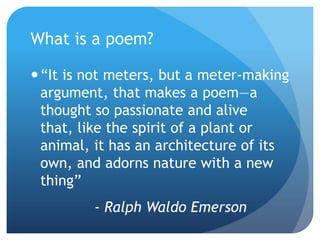
What is a poem?

 ―It is not meters, but a meter-making
  argument, that makes a poem—a
  thought so passionate and alive
  that, like the spirit of a plant or
  animal, it has an architecture of its
  own, and adorns nature with a new
  thing‖
         - Ralph Waldo Emerson
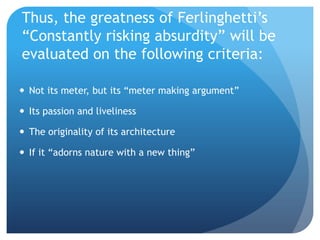
Thus, the greatness of Ferlinghetti’s
―Constantly risking absurdity‖ will be
evaluated on the following criteria:

 Not its meter, but its ―meter making argument‖

 Its passion and liveliness

 The originality of its architecture

 If it ―adorns nature with a new thing‖
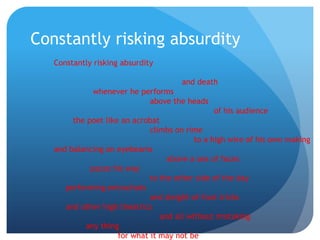
Constantly risking absurdity
   Constantly risking absurdity

                                      and death
              whenever he performs
                            above the heads
                                               of his audience
        the poet like an acrobat
                              climbs on rime
                                           to a high wire of his own making
   and balancing on eyebeams
                                   above a sea of faces
             paces his way
                              to the other side of the day
      performing entrachats
                              and sleight-of-foot tricks
      and other high theatrics
                                 and all without mistaking
           any thing
                     for what it may not be
Originality
 Unconventional meter

 Unconventional structure

 No rhyme

 Yet, appropriate for the poem’s message
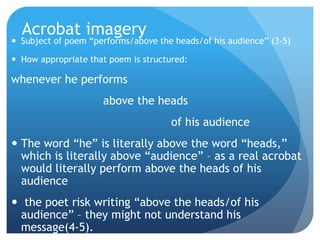
Acrobat imagery
 Subject of poem ―performs/above the heads/of his audience‖ (3-5)

 How appropriate that poem is structured:

whenever he performs
                     above the heads
                                      of his audience
 The word ―he‖ is literally above the word ―heads,‖
  which is literally above ―audience‖ – as a real acrobat
  would literally perform above the heads of his
  audience
 the poet risk writing ―above the heads/of his
 audience‖ – they might not understand his
 message(4-5).
 The unique indentation and choppy spacing on
  the poem contributes to Ferlinghetti’s attempt
  to convey that, like an acrobat, the poet
  is, ―balancing on eyebeams/above a sea of
  faces‖ (9-10).
 As an audience follows the ―entrechats/and
  sleight-of-foot tricks/and other high theatrics‖
  of an acrobat, the poem’s reader’s eyes follow
  its staggered phrases unconventionally spaced
  across the page and his written ―sleight-of-foot
  tricks‖ (14-16).
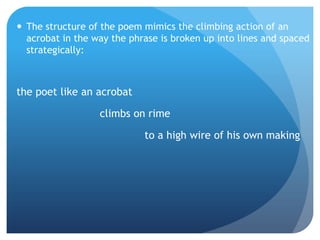
 The structure of the poem mimics the climbing action of an
  acrobat in the way the phrase is broken up into lines and spaced
  strategically:


the poet like an acrobat

                  climbs on rime

                            to a high wire of his own making
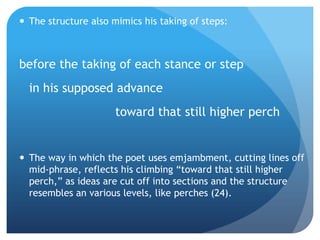
 The structure also mimics his taking of steps:


before the taking of each stance or step
  in his supposed advance
                      toward that still higher perch


 The way in which the poet uses emjambment, cutting lines off
  mid-phrase, reflects his climbing ―toward that still higher
  perch,‖ as ideas are cut off into sections and the structure
  resembles an various levels, like perches (24).
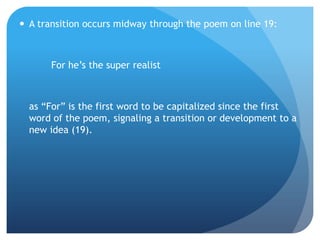
 A transition occurs midway through the poem on line 19:


       For he’s the super realist


  as ―For‖ is the first word to be capitalized since the first
  word of the poem, signaling a transition or development to a
  new idea (19).
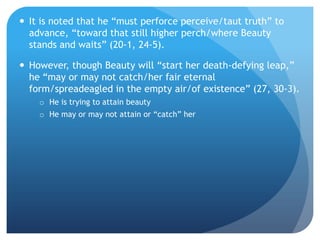
 It is noted that he ―must perforce perceive/taut truth‖ to
  advance, ―toward that still higher perch/where Beauty
  stands and waits‖ (20-1, 24-5).

 However, though Beauty will ―start her death-defying leap,‖
  he ―may or may not catch/her fair eternal
  form/spreadeagled in the empty air/of existence‖ (27, 30-3).
    o He is trying to attain beauty
    o He may or may not attain or ―catch‖ her
Yes, ―Constantly risking absurdity‖ is
a great poem

 No conventional structure or meter, but present
  structure and meter best emphasize poem’s point

 Passion and liveliness in the thrill of risky theatrics and
  death-defying stunts

 Ideas and ―architecture‖ of poem are truly
  different, original, and suiting to its idea

 Throws out new idea:
To think about…
 Taking the ―next step‖ can be risky, but such risks are
  often necessary to get to ―that still higher perch‖

 One ―may or may not catch‖ the ―fair eternal form‖ of
  who or what one seeks – so to risk so much for the
  change of failure can seem absurd

 But, one can choose an existence of always trying to
  reach that perch, and thus ―Constantly risking
  absurdity‖ in the process
The End

Constantly risking absurdity

  • 1.
    Constantly risking absurdity a poem by Lawrence Ferlinghetti (b. 1919) Critiqued by: Sarah Maguire
  • 2.
    What is apoem?  ―It is not meters, but a meter-making argument, that makes a poem—a thought so passionate and alive that, like the spirit of a plant or animal, it has an architecture of its own, and adorns nature with a new thing‖ - Ralph Waldo Emerson
  • 3.
    Thus, the greatnessof Ferlinghetti’s ―Constantly risking absurdity‖ will be evaluated on the following criteria:  Not its meter, but its ―meter making argument‖  Its passion and liveliness  The originality of its architecture  If it ―adorns nature with a new thing‖
  • 4.
    Constantly risking absurdity Constantly risking absurdity and death whenever he performs above the heads of his audience the poet like an acrobat climbs on rime to a high wire of his own making and balancing on eyebeams above a sea of faces paces his way to the other side of the day performing entrachats and sleight-of-foot tricks and other high theatrics and all without mistaking any thing for what it may not be
  • 5.
    Originality  Unconventional meter Unconventional structure  No rhyme  Yet, appropriate for the poem’s message
  • 6.
    Acrobat imagery  Subjectof poem ―performs/above the heads/of his audience‖ (3-5)  How appropriate that poem is structured: whenever he performs above the heads of his audience  The word ―he‖ is literally above the word ―heads,‖ which is literally above ―audience‖ – as a real acrobat would literally perform above the heads of his audience  the poet risk writing ―above the heads/of his audience‖ – they might not understand his message(4-5).
  • 7.
     The uniqueindentation and choppy spacing on the poem contributes to Ferlinghetti’s attempt to convey that, like an acrobat, the poet is, ―balancing on eyebeams/above a sea of faces‖ (9-10).  As an audience follows the ―entrechats/and sleight-of-foot tricks/and other high theatrics‖ of an acrobat, the poem’s reader’s eyes follow its staggered phrases unconventionally spaced across the page and his written ―sleight-of-foot tricks‖ (14-16).
  • 8.
     The structureof the poem mimics the climbing action of an acrobat in the way the phrase is broken up into lines and spaced strategically: the poet like an acrobat climbs on rime to a high wire of his own making
  • 9.
     The structurealso mimics his taking of steps: before the taking of each stance or step in his supposed advance toward that still higher perch  The way in which the poet uses emjambment, cutting lines off mid-phrase, reflects his climbing ―toward that still higher perch,‖ as ideas are cut off into sections and the structure resembles an various levels, like perches (24).
  • 10.
     A transitionoccurs midway through the poem on line 19: For he’s the super realist as ―For‖ is the first word to be capitalized since the first word of the poem, signaling a transition or development to a new idea (19).
  • 11.
     It isnoted that he ―must perforce perceive/taut truth‖ to advance, ―toward that still higher perch/where Beauty stands and waits‖ (20-1, 24-5).  However, though Beauty will ―start her death-defying leap,‖ he ―may or may not catch/her fair eternal form/spreadeagled in the empty air/of existence‖ (27, 30-3). o He is trying to attain beauty o He may or may not attain or ―catch‖ her
  • 12.
    Yes, ―Constantly riskingabsurdity‖ is a great poem  No conventional structure or meter, but present structure and meter best emphasize poem’s point  Passion and liveliness in the thrill of risky theatrics and death-defying stunts  Ideas and ―architecture‖ of poem are truly different, original, and suiting to its idea  Throws out new idea:
  • 13.
    To think about… Taking the ―next step‖ can be risky, but such risks are often necessary to get to ―that still higher perch‖  One ―may or may not catch‖ the ―fair eternal form‖ of who or what one seeks – so to risk so much for the change of failure can seem absurd  But, one can choose an existence of always trying to reach that perch, and thus ―Constantly risking absurdity‖ in the process
  • 14.