Governmental Linked Open Data:
A Data Management Perspective
              (or: what is in a link?)

     Profa. Maria Luiza Machado Campos
     Federal University of Rio de Janeiro

              mluiza@ufrj.br
Maria Luiza (UFRJ) e Giancarlo (UFES)
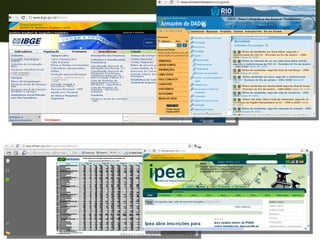
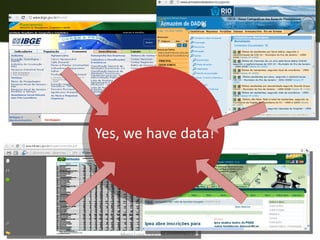
Yes, we have data!


   Maria Luiza (UFRJ) e Giancarlo (UFES)
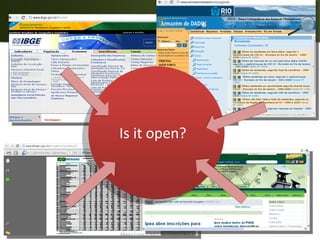
Is it open?


Maria Luiza (UFRJ) e Giancarlo (UFES)
Open Governmental Data

 • In some sense
   – There is a lot already available
   – But…

 • Is it easy to find, access and use together?
Open Governmental Data


• Interoperability and Integration requires a lot of
  work
  – Even inside a single organization!
     (We’ve had DBMS for more than half a century, but have we
     achieved the integration we aimed at? What was missing?)
  – And now, on the Web:
     • Distributed, heterogeneous, in large scale, highly visible,
       large number of different users, …
Linked Open Data (LOD)

  – What is it all about?
    • Using standards
    • A very “fine-grain” representation (RDF triples)
         – Enables LINKING with flexibility!
         – Simple?
         – Powerful!
    • It has interoperability in its essence
         – RDF: Resource DESCRIPTION Framework
             » Created to interoperate METADATA!
         – Common understanding
Linked Open Data (LOD)

  – An exciting “new” way of publishing and
    consuming data!
    • The power of linking
    • The power of collaboration
       – Consumers are publishers too!
    • More and more data being generated and linked
       – Sensors
       – Web of things
    • Data and Metadata being explored together
       – Are some links more important than others?
       – Links between types; Data hubs
    • Querying AND Navegating AND Searching
Linked Open Governmental Data

 – It is not just about converting to a new flexible
  representation
 – It is important to be “linkable”
 – Descriptions are important
   • To know what it really means
   • To know where it comes from
   • To know what we have available
   • ….
 – Some data are more difficult to describe than
   others
Linked Open Governmental Data

 – Open is good!
 – Flexible is good!
 – Semantically interoperable is even better!
   • Having a “ data management approach” to Gov. LOD
      – The role of vocabularies, glossaries
      – The role of database schemas
      – Creating/using existing complementary metadata
          » e.g. Provenance metadata, voID
      – Creating/Exploring ontologies as reference models of a domain
          » Using Foundational Ontologies as a common ground
   A data quality – oriented Governmental LOD
But how long will it take?
Will it ever happen?
  – Lessons learned from the past
     • Incremental, evolutionary
     • Agile, but planned

  – Estimulate initiatives
     • Learn by practicing!
        – Pilot projects
     • Evaluate feedback and impact

  – Observe standards and best practices from existing
    initiatives
Linked Open Governmental Data

– Plan and act for the next steps
  • Capacitate
     – Not only on available technologies, but on reflecting about their use
     – There is a lot to be learned from different knowledge areas
         » Semantic web + databases and data management + AI +
             • What has worked, and also what has not worked
  • Define standards and strategies
     – In Brazil:
         » E-Ping, INDE, INDA
Linked Open Governmental Data
  But can we what have we learned from data management
  in the past?
  • To define priorities
     – There are very different kinds of data
     – Master and reference data need special attention
     – Statistical data is not trivial
         » Faceted or multidimensional, sampled, spatio-temporal
           heterogeous
  • To define strategies for building good reference
    models/ontologies
     – They are fundamental for interoperability
     – Conceptual modelling is important!
  • To support maintenance, lineage, evolution
     – LOD in the data management process of govern. institutions
Where universities can help

• Forming
• Developing, prototyping and experimenting
  new technologies, approaches, innovative
  applications
• Partnerships (with government and private
  initiative)
   – Applying new approaches and technologies
   – Insights from different knowledge areas
   – Discussing perspectives and practices
• Defining new and rescuing old trends!
Thank you !


              mluiza@ufrj.br

Governmental Linked Open Data: A Data Management Perspective

  • 1.
    Governmental Linked OpenData: A Data Management Perspective (or: what is in a link?) Profa. Maria Luiza Machado Campos Federal University of Rio de Janeiro mluiza@ufrj.br
  • 2.
    Maria Luiza (UFRJ)e Giancarlo (UFES)
  • 3.
    Yes, we havedata! Maria Luiza (UFRJ) e Giancarlo (UFES)
  • 4.
    Is it open? MariaLuiza (UFRJ) e Giancarlo (UFES)
  • 5.
    Open Governmental Data • In some sense – There is a lot already available – But… • Is it easy to find, access and use together?
  • 6.
    Open Governmental Data •Interoperability and Integration requires a lot of work – Even inside a single organization! (We’ve had DBMS for more than half a century, but have we achieved the integration we aimed at? What was missing?) – And now, on the Web: • Distributed, heterogeneous, in large scale, highly visible, large number of different users, …
  • 7.
    Linked Open Data(LOD) – What is it all about? • Using standards • A very “fine-grain” representation (RDF triples) – Enables LINKING with flexibility! – Simple? – Powerful! • It has interoperability in its essence – RDF: Resource DESCRIPTION Framework » Created to interoperate METADATA! – Common understanding
  • 8.
    Linked Open Data(LOD) – An exciting “new” way of publishing and consuming data! • The power of linking • The power of collaboration – Consumers are publishers too! • More and more data being generated and linked – Sensors – Web of things • Data and Metadata being explored together – Are some links more important than others? – Links between types; Data hubs • Querying AND Navegating AND Searching
  • 9.
    Linked Open GovernmentalData – It is not just about converting to a new flexible representation – It is important to be “linkable” – Descriptions are important • To know what it really means • To know where it comes from • To know what we have available • …. – Some data are more difficult to describe than others
  • 10.
    Linked Open GovernmentalData – Open is good! – Flexible is good! – Semantically interoperable is even better! • Having a “ data management approach” to Gov. LOD – The role of vocabularies, glossaries – The role of database schemas – Creating/using existing complementary metadata » e.g. Provenance metadata, voID – Creating/Exploring ontologies as reference models of a domain » Using Foundational Ontologies as a common ground A data quality – oriented Governmental LOD
  • 11.
    But how longwill it take? Will it ever happen? – Lessons learned from the past • Incremental, evolutionary • Agile, but planned – Estimulate initiatives • Learn by practicing! – Pilot projects • Evaluate feedback and impact – Observe standards and best practices from existing initiatives
  • 12.
    Linked Open GovernmentalData – Plan and act for the next steps • Capacitate – Not only on available technologies, but on reflecting about their use – There is a lot to be learned from different knowledge areas » Semantic web + databases and data management + AI + • What has worked, and also what has not worked • Define standards and strategies – In Brazil: » E-Ping, INDE, INDA
  • 13.
    Linked Open GovernmentalData But can we what have we learned from data management in the past? • To define priorities – There are very different kinds of data – Master and reference data need special attention – Statistical data is not trivial » Faceted or multidimensional, sampled, spatio-temporal heterogeous • To define strategies for building good reference models/ontologies – They are fundamental for interoperability – Conceptual modelling is important! • To support maintenance, lineage, evolution – LOD in the data management process of govern. institutions
  • 14.
    Where universities canhelp • Forming • Developing, prototyping and experimenting new technologies, approaches, innovative applications • Partnerships (with government and private initiative) – Applying new approaches and technologies – Insights from different knowledge areas – Discussing perspectives and practices • Defining new and rescuing old trends!
  • 15.
    Thank you ! mluiza@ufrj.br