Connecting Credentials to Teaching:
Badges and Faculty Development
Suraj Uttamchandani (suttamch@indiana.edu)
James E. Willis (jaedwill@indiana.edu)
Participatory Assessment Lab
Context: Badges & PD
“Badges signal to colleagues and to current and prospective
employers a professional life of active learning, engagement, and
ongoing development. As the field of badging evolves, badges
will align with competencies and skills directly applicable in the
workplace, and training programs will use badges in ways that
can clarify career pathways.”
“EDUCAUSE 7 things you should know
about…Badging for Professional Development”
Context: Badges & Faculty PD
Though faculty badges are not always taken up, they are more
valuable than paper certificates (Young, 2015)
Badges work better as part of larger ecosystems of learning
(Hickey et al., underway).
Faculty badges may be most effective when paired with teaching
and learning centers’ other offerings.
Young, J. R. (2015, June 9). Can digital badges help encourage professors to take teaching workshops? The Chronicle of Higher Education [web log, Wired Campus]. Retrieved from
http://chronicle.com/blogs/wiredcampus/can-digital-badges-help-encourage-professors-to-take-teaching-workshops/56901
Example: IUPUI
Teachers of “Gateway” courses (first year,
high enrollment)
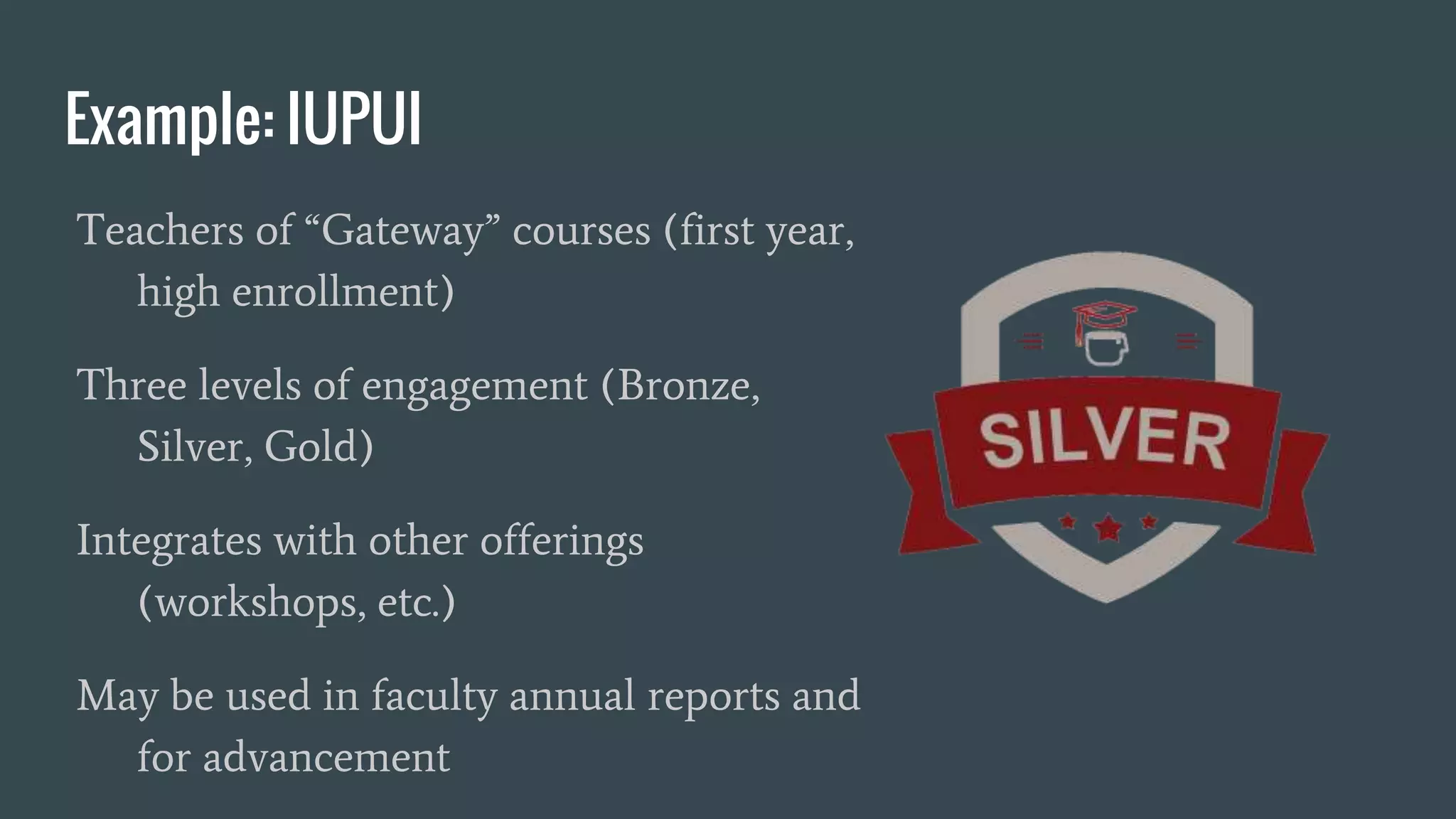
Three levels of engagement (Bronze,
Silver, Gold)
Integrates with other offerings
(workshops, etc.)
May be used in faculty annual reports and
for advancement
Example: Calhoun Community College
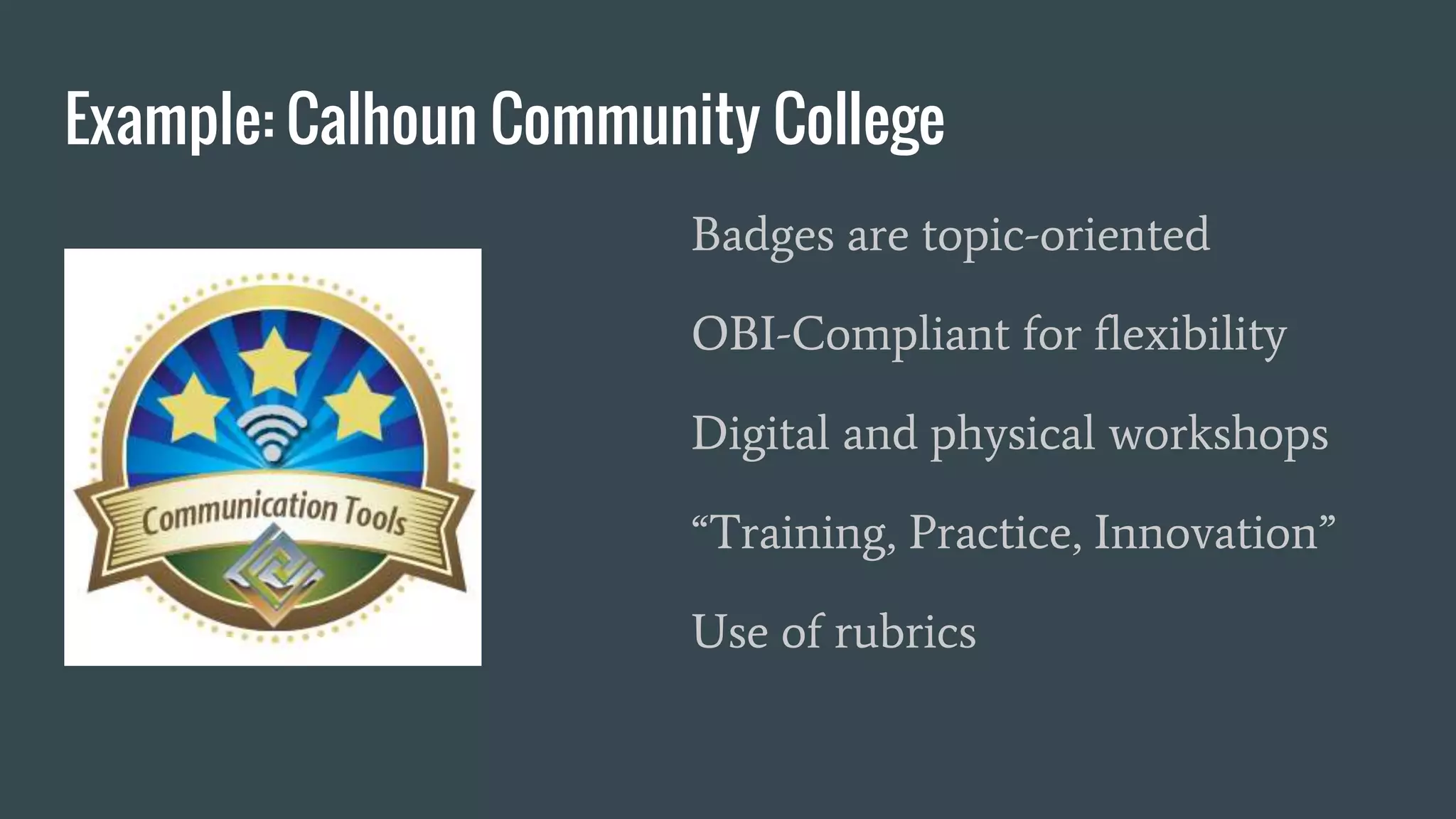
Badges are topic-oriented
OBI-Compliant for flexibility
Digital and physical workshops
“Training, Practice, Innovation”
Use of rubrics
Example: Parker University
Three kinds of badges
Parker Life for (less serious) engagement with teaching and
learning center (e.g., take a selfie with a colleague)
Explorer for (more traditional) engagement with center (e.g.,
attend a workshop)
Parker Difference for classroom work (e.g., rubric design)
Distinction between latter two is not clear.
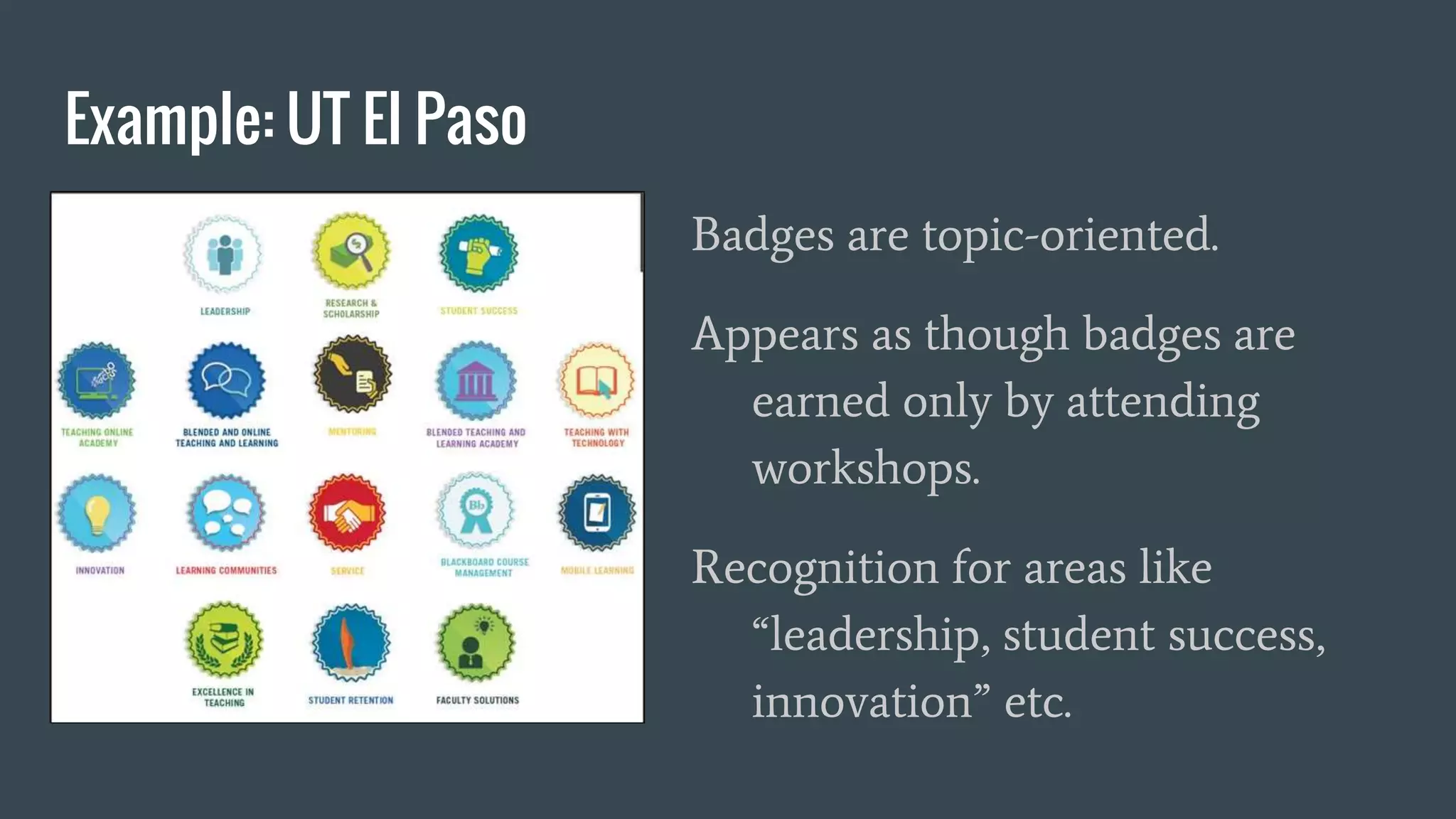
Example: UT El Paso
Badges are topic-oriented.
Appears as though badges are
earned only by attending
workshops.
Recognition for areas like
“leadership, student success,
innovation” etc.
Example: University of Louisiana - Monroe
Two badges
Maroon for faculty who attend
workshops
Gold for faculty who present at
workshops
Issued through Credly
Does not appear to create a “pathway.”
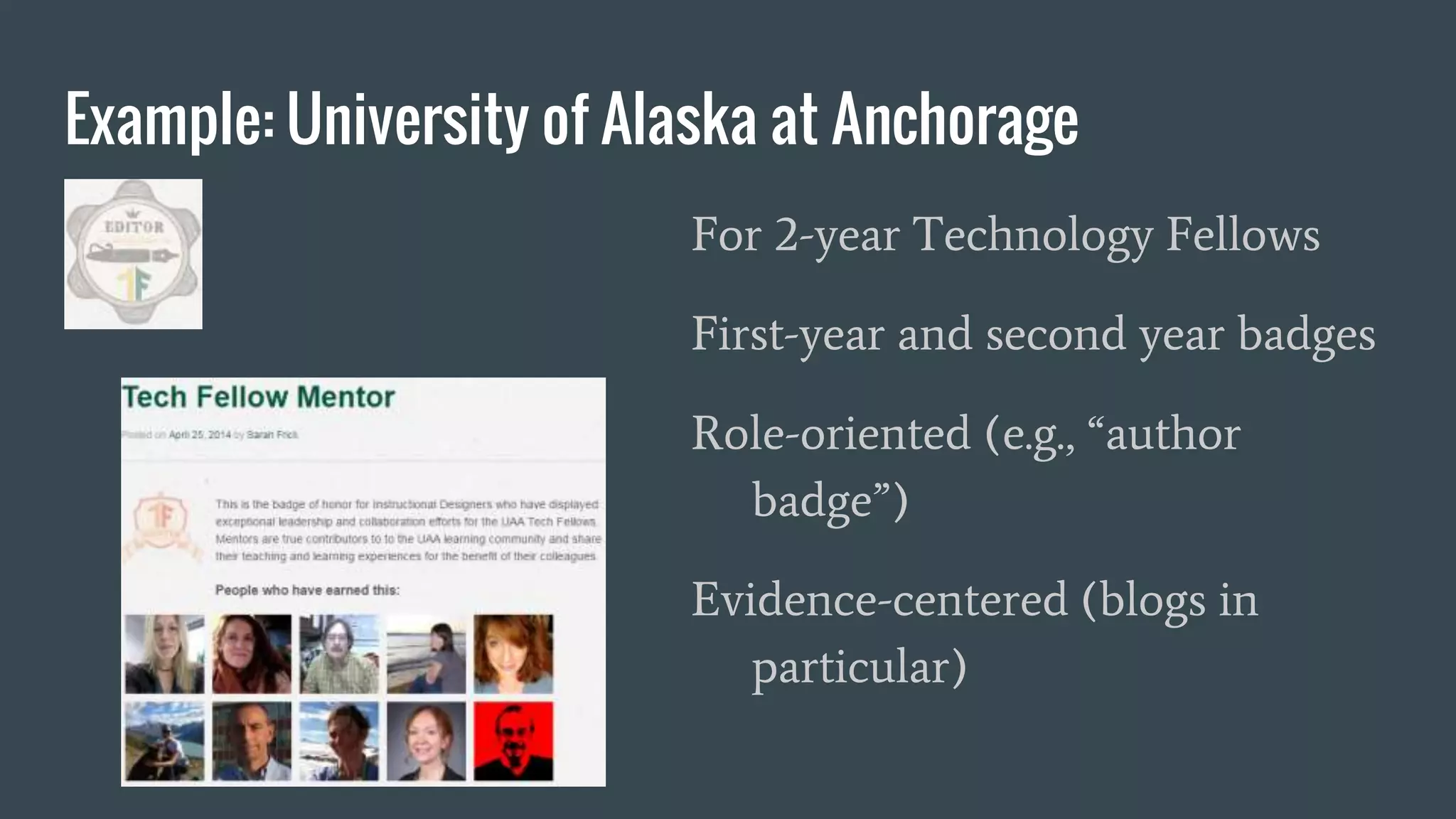
Example: University of Alaska at Anchorage
For 2-year Technology Fellows
First-year and second year badges
Role-oriented (e.g., “author
badge”)
Evidence-centered (blogs in
particular)
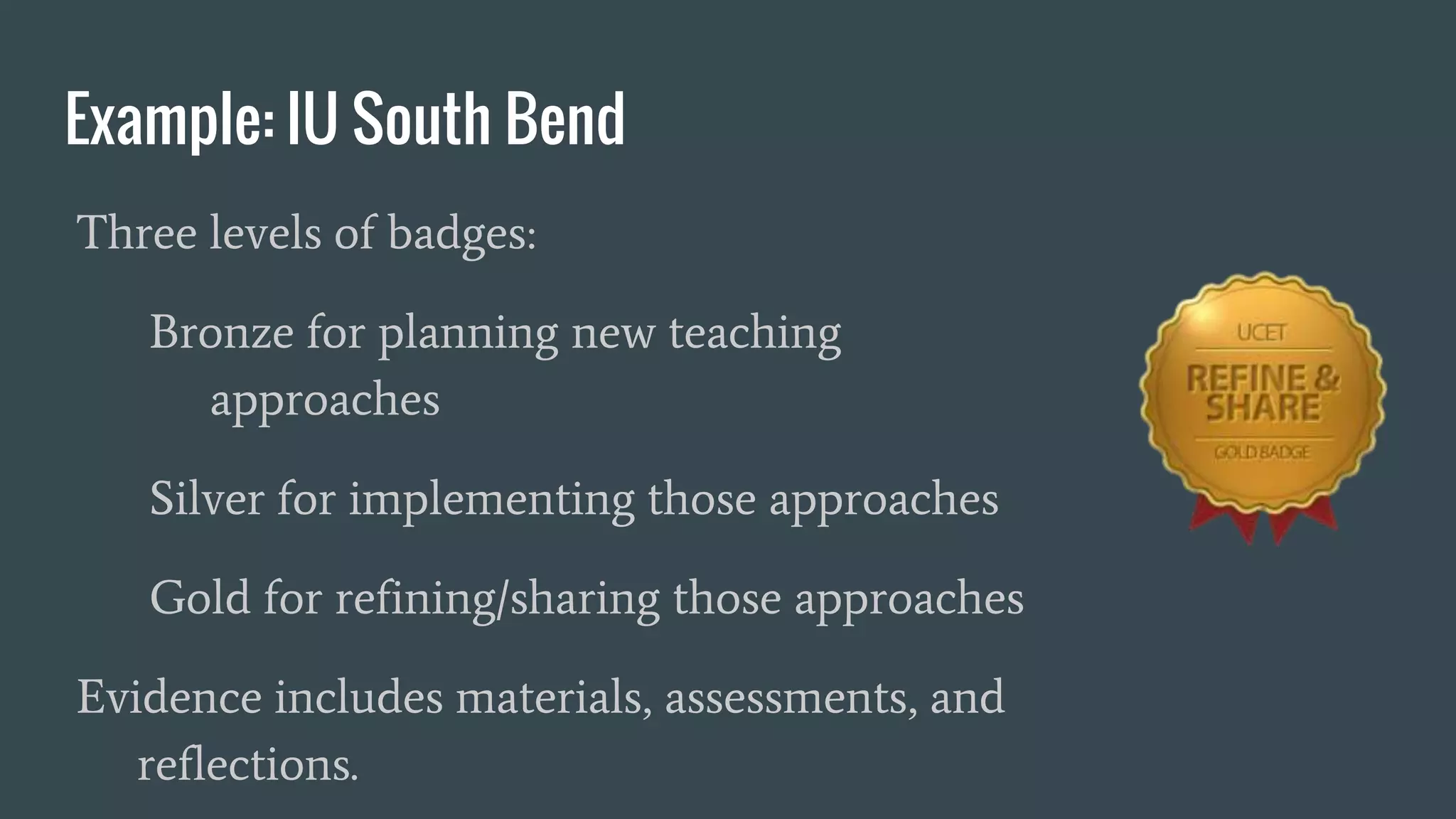
Example: IU South Bend
Three levels of badges:
Bronze for planning new teaching
approaches
Silver for implementing those approaches
Gold for refining/sharing those approaches
Evidence includes materials, assessments, and
reflections.
Discussion: Pathways
Pathways can be accomplished in multiple ways
Gold/silver/bronze
But compromises some meaning to outsiders
Timeline (e.g., Year 1 and Year 2 badges) or through
particular programs
Helps provide reasoning and rationale to faculty time
Discussion: Evidence
Generally all initiatives linked to Teaching and Learning
Center workshops.
Many stopped there.
Some required evidence in the form of reflections/blogs.
Few looked at in-classroom practice.
Few articulate why a badge is helpful beyond learning.
Discussion: Ecosystem
Most systems rewarded engagement in existing initiatives.
Few explicitly stated that badges could be used for
tenure/promotion.
Few provided clear pathways for learning.
Few provided rationale for why and how a badge can benefit
faculty members, i.e. why spend time on the badge?
Next Steps
Find best practices for to creating pathways
Consider most appropriate evidence
Press for university support for tenure/promotion
Include reasonable incentives for participation
Examine success of programs discussed here
Questions?
Suraj Uttamchandani (suttamch@indiana.edu)
James E. Willis (jaedwill@indiana.edu)
@Willis3James

Connecting Credentials to Teaching: Badges and Faculty Development

  • 1.
    Connecting Credentials toTeaching: Badges and Faculty Development Suraj Uttamchandani (suttamch@indiana.edu) James E. Willis (jaedwill@indiana.edu) Participatory Assessment Lab
  • 2.
    Context: Badges &PD “Badges signal to colleagues and to current and prospective employers a professional life of active learning, engagement, and ongoing development. As the field of badging evolves, badges will align with competencies and skills directly applicable in the workplace, and training programs will use badges in ways that can clarify career pathways.” “EDUCAUSE 7 things you should know about…Badging for Professional Development”
  • 3.
    Context: Badges &Faculty PD Though faculty badges are not always taken up, they are more valuable than paper certificates (Young, 2015) Badges work better as part of larger ecosystems of learning (Hickey et al., underway). Faculty badges may be most effective when paired with teaching and learning centers’ other offerings. Young, J. R. (2015, June 9). Can digital badges help encourage professors to take teaching workshops? The Chronicle of Higher Education [web log, Wired Campus]. Retrieved from http://chronicle.com/blogs/wiredcampus/can-digital-badges-help-encourage-professors-to-take-teaching-workshops/56901
  • 4.
    Example: IUPUI Teachers of“Gateway” courses (first year, high enrollment) Three levels of engagement (Bronze, Silver, Gold) Integrates with other offerings (workshops, etc.) May be used in faculty annual reports and for advancement
  • 5.
    Example: Calhoun CommunityCollege Badges are topic-oriented OBI-Compliant for flexibility Digital and physical workshops “Training, Practice, Innovation” Use of rubrics
  • 6.
    Example: Parker University Threekinds of badges Parker Life for (less serious) engagement with teaching and learning center (e.g., take a selfie with a colleague) Explorer for (more traditional) engagement with center (e.g., attend a workshop) Parker Difference for classroom work (e.g., rubric design) Distinction between latter two is not clear.
  • 7.
    Example: UT ElPaso Badges are topic-oriented. Appears as though badges are earned only by attending workshops. Recognition for areas like “leadership, student success, innovation” etc.
  • 8.
    Example: University ofLouisiana - Monroe Two badges Maroon for faculty who attend workshops Gold for faculty who present at workshops Issued through Credly Does not appear to create a “pathway.”
  • 9.
    Example: University ofAlaska at Anchorage For 2-year Technology Fellows First-year and second year badges Role-oriented (e.g., “author badge”) Evidence-centered (blogs in particular)
  • 10.
    Example: IU SouthBend Three levels of badges: Bronze for planning new teaching approaches Silver for implementing those approaches Gold for refining/sharing those approaches Evidence includes materials, assessments, and reflections.
  • 11.
    Discussion: Pathways Pathways canbe accomplished in multiple ways Gold/silver/bronze But compromises some meaning to outsiders Timeline (e.g., Year 1 and Year 2 badges) or through particular programs Helps provide reasoning and rationale to faculty time
  • 12.
    Discussion: Evidence Generally allinitiatives linked to Teaching and Learning Center workshops. Many stopped there. Some required evidence in the form of reflections/blogs. Few looked at in-classroom practice. Few articulate why a badge is helpful beyond learning.
  • 13.
    Discussion: Ecosystem Most systemsrewarded engagement in existing initiatives. Few explicitly stated that badges could be used for tenure/promotion. Few provided clear pathways for learning. Few provided rationale for why and how a badge can benefit faculty members, i.e. why spend time on the badge?
  • 14.
    Next Steps Find bestpractices for to creating pathways Consider most appropriate evidence Press for university support for tenure/promotion Include reasonable incentives for participation Examine success of programs discussed here
  • 15.
    Questions? Suraj Uttamchandani (suttamch@indiana.edu) JamesE. Willis (jaedwill@indiana.edu) @Willis3James

Editor's Notes

  • #6 http://www.calhoun.edu/student-resources/distance-learning/digital-badge-program
  • #7 http://badges.parker.edu/
  • #8 http://at.utep.edu/web/index.php/what-we-do/teaching-and-learning-laboratory/digital-badge-program/111-digital-badge-program
  • #9 http://www.ulm.edu/extendedlearning/resources.html
  • #10 http://techfellows.uaa.alaska.edu/badges1/
  • #11 https://www.iusb.edu/ucet/programs/ucet-digital-badges/index.php