march 2010 | £4.50
                                        good writing about the
                                          things that matter


                                                           www.prospect-magazine.co.uk


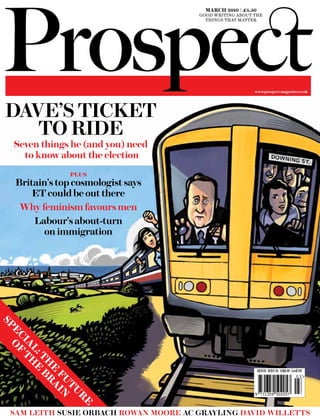
 DAVE’S TICKET
    TO RIDE
  Seven things he (and you) need
    to know about the election
                plus
   Britain's top cosmologist says
       ET could be out there
    Why feminism favours men
       Labour's about-turn
          on immigration
sp
  e of
   ci
     a th
      l: e
        th b


                                                           ISSNNZ$11.95 US$6.99 Can$7.99
                                                                    1359-5024
          e ra


                                                            A$10.95
                                                                                    03
           fu in
             tu


                                                           9 771359 502057
                r
                 e


  SAM LEITH SUSIE ORBACH ROWAN MOORE AC gRAyLINg DAVID WILLETTS
opInIons

council tax and other local issues will also
be strenuously resisted by local authori-
ties, most of which are now conservative
controlled, and which fear being burdened
with policy or spending commitments they
cannot afford. a weaker option would
make such referendums advisory, meaning
a successful petition would give supporters
the right to have their proposals debated at
a council meeting. But this isn’t exactly
giving power to the people.
    the risk of talking big but delivering
small runs through all three of these
notions. more worrying for the tories, all
of them will alienate groups who should be
their natural allies: conservative mps and
councillors, judges and the police. this is
bold, but perhaps not quite in the way
cameron intended.
Robert Hazell is director of the constitution
unit at the school of social policy at UCL

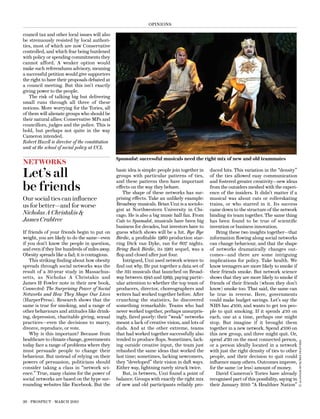
                                                Spamalot: successful musicals need the right mix of new and old teammates
networks
let’s all                                       basic idea is simple: people join together in
                                                groups with particular patterns of ties,
                                                and these patterns then have important
                                                                                                duced hits. this variation in the “density”
                                                                                                of the ties allowed easy communication
                                                                                                and fostered greater creativity—new ideas
be friends                                      effects on the way they behave.
                                                   the shape of these networks has sur-
                                                                                                from the outsiders meshed with the experi-
                                                                                                ence of the insiders. It didn’t matter if a
Our social ties can influence                   prising effects. take an unlikely example:      musical was about cats or rollerskating
us for better—and for worse                     Broadway musicals. Brian Uzzi is a sociolo-     trains, or who starred in it. Its success
                                                gist at northwestern University in chi-         came down to the structure of the network
Nicholas A Christakis &                         cago. he is also a big music hall fan. From     binding its team together. the same thing
James Crabtree                                  Cats to Spamalot, musicals have been big        has been found to be true of scientific
                                                business for decades, but investors have to     invention or business innovation.
If friends of your friends begin to put on      guess which shows will be a hit. Bye Bye           Bring these two insights together—that
weight, you are likely to do the same—even      Birdie, a profitable 1960 production star-      information flowing along social networks
if you don’t know the people in question,       ring Dick van Dyke, ran for 607 nights.         can change behaviour, and that the shape
and even if they live hundreds of miles away.   Bring Back Birdie, its 1981 sequel, was a       of networks dramatically changes out-
obesity spreads like a fad; it is contagious.   flop and closed after just four.                comes—and there are some intriguing
    this striking finding about how obesity        Intrigued, Uzzi used network science to      implications for policy. take health. We
spreads through social networks was the         find out why. he put together a data set of     know teenagers are more likely to smoke if
result of a 30-year study in massachus-         the 321 musicals that launched on Broad-        their friends smoke. But network science
setts, as nicholas a christakis and             way between 1945 and 1989, paying partic-       shows that they are more likely to smoke if
James h Fowler note in their new book,          ular attention to whether the top team of       friends of their friends (whom they don’t
Connected: The Surprising Power of Social       producers, director, choreographers and         know) smoke too. that said, the same can
Networks and How They Shape Our Lives           writers had worked together before. after       be true in reverse. here, governments
(harperpress). research shows that the          crunching the statistics, he discovered         could make budget savings. Let’s say the
same is true for smoking, and a range of        something remarkable. teams who had             nhs has £100, and wants to get ten peo-
other behaviours and attitudes like drink-      never worked together, perhaps unsurpris-       ple to quit smoking. If it spends £10 on
ing, depression, charitable giving, sexual      ingly, fared poorly: their “weak” networks      each, one at a time, perhaps one might
practices—even the decisions to marry,          meant a lack of creative vision, and lots of    stop. But imagine if it brought them
divorce, reproduce, or vote.                    duds. and at the other extreme, teams           together in a new network. spend £100 on
    Why is this important? Because from         that had worked together successfully also      this new group, and three might quit. or,
healthcare to climate change, governments       tended to produce flops. sometimes, lack-       spend £20 on the most connected person,
                                                                                                                                                 © alastair muir/rex features


today face a range of problems where they       ing outside creative input, the team just       or a person ideally located in a network
must persuade people to change their            rehashed the same ideas that worked the         with just the right density of ties to other
behaviour. But instead of relying on their      last time; sometimes, lacking newcomers,        people, and their decision to quit could
powers of persuasion, politicians should        they “developed” their vision in daft ways.     influence many others. outcomes improve,
consider taking a class in “network sci-        either way, lightning rarely struck twice.      for the same (or less) amount of money.
ence.” true, many claims for the power of          But, in between, Uzzi found a point of          David cameron’s tories have already
social networks are based on the hype sur-      balance. Groups with exactly the right mix      recognised part of this possibility, saying in
rounding websites like Facebook. But the        of new and old participants reliably pro-       their January 2010 “a healthier nation”


26 · prospect · march 2010
opInIons

green paper that “social norms are much          introduce more parents to each other?           as many as 10m people—report having not
more important than policymakers have            elsewhere, we know that prisoners who           one such person. a comparable figure for
traditionally assumed,” and announcing           keep good social links to the outside world     Britain would suggest that more than 2m
plans to try to create new, better norms         find it easier to rehabilitate. so helping      people are chronically alone.
(which, by definition, spread by social net-     them keep in touch with people outside             other research shows that being friend-
works). It’s a start, but other areas also       should be a specific aim. even if some pris-    less, or even just being part of a poor net-
seem ripe for a “network policy” approach.       oners do use Facebook to misbehave, or to       work, can exact a shocking toll: a teenage
    If you can make musicals profitable by       influence others, the decision by the justice   girl whose friends do not get on with each
properly configuring the makeup of the           secretary Jack straw in February to ban         other is more likely to contemplate killing
team at the top, why would the same not          some prisoners from using the site was          herself than a second girl whose friends do
work for those who run schools, hospitals,       probably a move in the wrong direction.         like each other—regardless of how well she
even a government department? and if                Why stop here? networked policies            gets on with them, or who the friends are.
you can target anti-smoking measures to          won’t solve the budget crisis, but they            all of this suggests that new, network-
take account of people’s ability to influ-       could help spark some new types of growth       infused policies can help governments
ence others, there is no obvious reason why      to help us out of recession. Business inno-     unpick pressing problems on a tight bud-
the same network-centric techniques could        vation is strongly influenced by the net-       get. they might even help to bridge the
not be used to cut problem drinking,             work structure of project teams and by          divide between left and right. conserva-
tackle obesity, or foster workplace safety.      communication between trading partners          tives have traditionally concerned them-
    more generally, if creating the right        or scientists. policies could tap into this,    selves with individual freedoms, while
type of social networks helps people get on      just as they could try to set up new social     social democrats have worried about the
in life, shouldn’t the state seek to help peo-   norms for domestic energy conservation.         wellbeing of social groups. network sci-
ple build such links? experts in “social            perhaps the most exciting prospect is        ence shows such a distinction to be at least
capital” theory have pushed this for years,      ending social isolation. In 2009 Geoff mul-     overly simplistic. shine a light on how indi-
to little practical effect. But they do have a   gan, head of the Young Foundation think         viduals assemble into groups and you’ll
point: governments should try to build new       tank, launched a report arguing that Brit-      also see how group membership affects
social systems that support social ties, and     ain suffers from a quiet epidemic of loneli-    individuals. taken together, this might not
design policies to take them into account.       ness. he noted that 500,000 British pen-        just improve policy and save money, but
    how might this work? Families with           sioners spend christmas alone. In the Us,       help our politicians to be more persua-
young children, if they had better social        researchers have asked people whom they         sive—in the right sort of way.
links, could save money on childcare by          like to spend free time with, or discuss per-   Nicholas A Christakis is a professor of
relying on friends, or band together to          sonal matters. It turns out that the average    medicine, health policy and sociology at
hold schools to account, or even set up          american has 4.3 such social contacts           Harvard University and co-author of
their own. Why then should schools, or           (including spouses, siblings and friends),      “Connected” (HarperPress). James
sure start early years centres, not try to       but over 4 per cent of adults—or perhaps        Crabtree is Prospect’s managing editor


                                                 everyday philosophy
                                 what’s so special about god?
                                                          By Nigel Warburton


 E
        veryone is equal before the law—         actions as though they were universal           it may be best to ignore conventional
        almost. Britain’s first asian judge      laws. and he’s surely right about this:         morality. But that’s a risky strategy.
        mota singh suggested in                  “What if everyone did that?” is the key         could the inner voice that booms with
 February that it could be discrimination        question. What if all children were             such conviction be a psychiatric
 to prevent young sikhs wearing their            allowed to carry ceremonial daggers?            symptom rather than divine instruction?
 ceremonial kirpans to school, despite a         What if all employers were allowed to           that was abraham’s anguish.
 general ban on carrying daggers. the            discriminate against gay candidates?               perhaps because people think and
 pope, limbering up for a tussle with            some people will bite these bullets and         feel so deeply about it, it is often
 liberalism when he visits Britain in            say “no problem.” that, at least, will get      assumed that there is something special
 september, exhorted catholic bishops            the issues out in the open.                     about religion that should remain
 to oppose “with missionary zeal” a                 But is there something special about         immune to worldly considerations. Yet
 tightening of equality laws that would          religion that grants it privilege to trump      religious affiliation guarantees nothing,
 have required religious organisations to        local law from time to time? søren              as the parable of the predatory priests
 stop discrimination against gay and             Kierkegaard invoked the “teleological           demonstrates. the moral: it’s probably
 transgender candidates for jobs.                suspension of the ethical”—that is,             best not to do religion when you’re
    enforced equality invariably curbs           ditching ethics and even legality for the       doing law. and an early heads up for the
 liberties. But are there any                    sake of something higher. In special            pope: it’s probably best not to do law
 philosophical grounds for exceptions?           circumstances—on those occasions                when you’re doing religion either.
 Immanuel Kant believed that one must            when God asks you to sacrifice your             Nigel Warburton is a senior lecturer in
 scrutinise the principles governing one’s       only son, for example (daggers again)—          philosophy at the Open University


                                                                                                                 march 2010 · prospect · 27

Connected - Christakis Crabtree

  • 1.
    march 2010 |£4.50 good writing about the things that matter www.prospect-magazine.co.uk DAVE’S TICKET TO RIDE Seven things he (and you) need to know about the election plus Britain's top cosmologist says ET could be out there Why feminism favours men Labour's about-turn on immigration sp e of ci a th l: e th b ISSNNZ$11.95 US$6.99 Can$7.99 1359-5024 e ra A$10.95 03 fu in tu 9 771359 502057 r e SAM LEITH SUSIE ORBACH ROWAN MOORE AC gRAyLINg DAVID WILLETTS
  • 2.
    opInIons council tax andother local issues will also be strenuously resisted by local authori- ties, most of which are now conservative controlled, and which fear being burdened with policy or spending commitments they cannot afford. a weaker option would make such referendums advisory, meaning a successful petition would give supporters the right to have their proposals debated at a council meeting. But this isn’t exactly giving power to the people. the risk of talking big but delivering small runs through all three of these notions. more worrying for the tories, all of them will alienate groups who should be their natural allies: conservative mps and councillors, judges and the police. this is bold, but perhaps not quite in the way cameron intended. Robert Hazell is director of the constitution unit at the school of social policy at UCL Spamalot: successful musicals need the right mix of new and old teammates networks let’s all basic idea is simple: people join together in groups with particular patterns of ties, and these patterns then have important duced hits. this variation in the “density” of the ties allowed easy communication and fostered greater creativity—new ideas be friends effects on the way they behave. the shape of these networks has sur- from the outsiders meshed with the experi- ence of the insiders. It didn’t matter if a Our social ties can influence prising effects. take an unlikely example: musical was about cats or rollerskating us for better—and for worse Broadway musicals. Brian Uzzi is a sociolo- trains, or who starred in it. Its success gist at northwestern University in chi- came down to the structure of the network Nicholas A Christakis & cago. he is also a big music hall fan. From binding its team together. the same thing James Crabtree Cats to Spamalot, musicals have been big has been found to be true of scientific business for decades, but investors have to invention or business innovation. If friends of your friends begin to put on guess which shows will be a hit. Bye Bye Bring these two insights together—that weight, you are likely to do the same—even Birdie, a profitable 1960 production star- information flowing along social networks if you don’t know the people in question, ring Dick van Dyke, ran for 607 nights. can change behaviour, and that the shape and even if they live hundreds of miles away. Bring Back Birdie, its 1981 sequel, was a of networks dramatically changes out- obesity spreads like a fad; it is contagious. flop and closed after just four. comes—and there are some intriguing this striking finding about how obesity Intrigued, Uzzi used network science to implications for policy. take health. We spreads through social networks was the find out why. he put together a data set of know teenagers are more likely to smoke if result of a 30-year study in massachus- the 321 musicals that launched on Broad- their friends smoke. But network science setts, as nicholas a christakis and way between 1945 and 1989, paying partic- shows that they are more likely to smoke if James h Fowler note in their new book, ular attention to whether the top team of friends of their friends (whom they don’t Connected: The Surprising Power of Social producers, director, choreographers and know) smoke too. that said, the same can Networks and How They Shape Our Lives writers had worked together before. after be true in reverse. here, governments (harperpress). research shows that the crunching the statistics, he discovered could make budget savings. Let’s say the same is true for smoking, and a range of something remarkable. teams who had nhs has £100, and wants to get ten peo- other behaviours and attitudes like drink- never worked together, perhaps unsurpris- ple to quit smoking. If it spends £10 on ing, depression, charitable giving, sexual ingly, fared poorly: their “weak” networks each, one at a time, perhaps one might practices—even the decisions to marry, meant a lack of creative vision, and lots of stop. But imagine if it brought them divorce, reproduce, or vote. duds. and at the other extreme, teams together in a new network. spend £100 on Why is this important? Because from that had worked together successfully also this new group, and three might quit. or, healthcare to climate change, governments tended to produce flops. sometimes, lack- spend £20 on the most connected person, © alastair muir/rex features today face a range of problems where they ing outside creative input, the team just or a person ideally located in a network must persuade people to change their rehashed the same ideas that worked the with just the right density of ties to other behaviour. But instead of relying on their last time; sometimes, lacking newcomers, people, and their decision to quit could powers of persuasion, politicians should they “developed” their vision in daft ways. influence many others. outcomes improve, consider taking a class in “network sci- either way, lightning rarely struck twice. for the same (or less) amount of money. ence.” true, many claims for the power of But, in between, Uzzi found a point of David cameron’s tories have already social networks are based on the hype sur- balance. Groups with exactly the right mix recognised part of this possibility, saying in rounding websites like Facebook. But the of new and old participants reliably pro- their January 2010 “a healthier nation” 26 · prospect · march 2010
  • 3.
    opInIons green paper that“social norms are much introduce more parents to each other? as many as 10m people—report having not more important than policymakers have elsewhere, we know that prisoners who one such person. a comparable figure for traditionally assumed,” and announcing keep good social links to the outside world Britain would suggest that more than 2m plans to try to create new, better norms find it easier to rehabilitate. so helping people are chronically alone. (which, by definition, spread by social net- them keep in touch with people outside other research shows that being friend- works). It’s a start, but other areas also should be a specific aim. even if some pris- less, or even just being part of a poor net- seem ripe for a “network policy” approach. oners do use Facebook to misbehave, or to work, can exact a shocking toll: a teenage If you can make musicals profitable by influence others, the decision by the justice girl whose friends do not get on with each properly configuring the makeup of the secretary Jack straw in February to ban other is more likely to contemplate killing team at the top, why would the same not some prisoners from using the site was herself than a second girl whose friends do work for those who run schools, hospitals, probably a move in the wrong direction. like each other—regardless of how well she even a government department? and if Why stop here? networked policies gets on with them, or who the friends are. you can target anti-smoking measures to won’t solve the budget crisis, but they all of this suggests that new, network- take account of people’s ability to influ- could help spark some new types of growth infused policies can help governments ence others, there is no obvious reason why to help us out of recession. Business inno- unpick pressing problems on a tight bud- the same network-centric techniques could vation is strongly influenced by the net- get. they might even help to bridge the not be used to cut problem drinking, work structure of project teams and by divide between left and right. conserva- tackle obesity, or foster workplace safety. communication between trading partners tives have traditionally concerned them- more generally, if creating the right or scientists. policies could tap into this, selves with individual freedoms, while type of social networks helps people get on just as they could try to set up new social social democrats have worried about the in life, shouldn’t the state seek to help peo- norms for domestic energy conservation. wellbeing of social groups. network sci- ple build such links? experts in “social perhaps the most exciting prospect is ence shows such a distinction to be at least capital” theory have pushed this for years, ending social isolation. In 2009 Geoff mul- overly simplistic. shine a light on how indi- to little practical effect. But they do have a gan, head of the Young Foundation think viduals assemble into groups and you’ll point: governments should try to build new tank, launched a report arguing that Brit- also see how group membership affects social systems that support social ties, and ain suffers from a quiet epidemic of loneli- individuals. taken together, this might not design policies to take them into account. ness. he noted that 500,000 British pen- just improve policy and save money, but how might this work? Families with sioners spend christmas alone. In the Us, help our politicians to be more persua- young children, if they had better social researchers have asked people whom they sive—in the right sort of way. links, could save money on childcare by like to spend free time with, or discuss per- Nicholas A Christakis is a professor of relying on friends, or band together to sonal matters. It turns out that the average medicine, health policy and sociology at hold schools to account, or even set up american has 4.3 such social contacts Harvard University and co-author of their own. Why then should schools, or (including spouses, siblings and friends), “Connected” (HarperPress). James sure start early years centres, not try to but over 4 per cent of adults—or perhaps Crabtree is Prospect’s managing editor everyday philosophy what’s so special about god? By Nigel Warburton E veryone is equal before the law— actions as though they were universal it may be best to ignore conventional almost. Britain’s first asian judge laws. and he’s surely right about this: morality. But that’s a risky strategy. mota singh suggested in “What if everyone did that?” is the key could the inner voice that booms with February that it could be discrimination question. What if all children were such conviction be a psychiatric to prevent young sikhs wearing their allowed to carry ceremonial daggers? symptom rather than divine instruction? ceremonial kirpans to school, despite a What if all employers were allowed to that was abraham’s anguish. general ban on carrying daggers. the discriminate against gay candidates? perhaps because people think and pope, limbering up for a tussle with some people will bite these bullets and feel so deeply about it, it is often liberalism when he visits Britain in say “no problem.” that, at least, will get assumed that there is something special september, exhorted catholic bishops the issues out in the open. about religion that should remain to oppose “with missionary zeal” a But is there something special about immune to worldly considerations. Yet tightening of equality laws that would religion that grants it privilege to trump religious affiliation guarantees nothing, have required religious organisations to local law from time to time? søren as the parable of the predatory priests stop discrimination against gay and Kierkegaard invoked the “teleological demonstrates. the moral: it’s probably transgender candidates for jobs. suspension of the ethical”—that is, best not to do religion when you’re enforced equality invariably curbs ditching ethics and even legality for the doing law. and an early heads up for the liberties. But are there any sake of something higher. In special pope: it’s probably best not to do law philosophical grounds for exceptions? circumstances—on those occasions when you’re doing religion either. Immanuel Kant believed that one must when God asks you to sacrifice your Nigel Warburton is a senior lecturer in scrutinise the principles governing one’s only son, for example (daggers again)— philosophy at the Open University march 2010 · prospect · 27