IOSR Journal of Mathematics (IOSR-JM)
e-ISSN: 2278-5728, p-ISSN: 2319-765X. Volume 13, Issue 1 Ver. IV (Jan. - Feb. 2017), PP 01-07
www.iosrjournals.org
DOI: 10.9790/5728-1301040107 www.iosrjournals.org 1 | Page
Connected and Distance in G ⊗2 H
U. P. Acharya1
, H. S. Mehta2
1
(Department of Appl. Sci. and Humanities, A. D. Patel Institute of Technology, New V. V. Nagar, India)
2
(Department of Mathematics, S. P. University, V. V. Nagar-388120, India)
Abstract : The tensor product G H of two graphs G and H is well-known graph product and studied in
detail in the literature. This concept has been generalized by introducing 2-tensor product 2G H and it has
been discussed for special graphs like nP and nC [5]. In this paper, we discuss 2G H , where G and H are
connected graphs. Mainly, we discuss connectedness of 2G H and obtained distance between two vertices in
it.
Keywords: Bipartite graph, Connected graph, Non-bipartite graph, 2-tensor product of graphs.
I. Introduction
The tensor product G H of two graphs G and H is very well-known and studied in detail ([1], [2],
[3], [4]). This concept has been extended by introducing 2tensor product 2G H of G and H and studied
for special graphs [5]. In this paper, we discuss connectedness of 2G H for any connected graphs G and H .
We also obtained the results for the distance between two vertices in 2G H .
If = ( ( ), ( ))G V G E G is finite, simple and connected graph, then ( , )Gd u u is the length of the shortest path
between u and u in G . For a graph G , a maximal connected subgraph is a component of G . For the basic
terminology, concepts and results of graph theory, we refer to ([1], [6], [7]).
We recall the definition of 2tensor product of graphs.
Definition 1.1 [5] Let G and H be two connected graphs. The 2tensor product of G and H is the graph
with vertex set {( , ): ( ), ( )}u v u V G v V H  and two vertices ( , )u v and ( , )u v  are adjacent in 2tensor
product if ( , ) = 2Gd u u and ( , ) = 2Hd v v . It is denoted by 2G H .
Note that 2G H is a null graph, if the diameter ( ) < 2D G or ( ) < 2D H . So, throughout this paper we assume
that G and H are non-complete graphs.
II. Connectedness of 2G H
this section, first we consider the graphs G and H , both connected and bipartite with
2
( ) ; ( ) ( )N w w V G V H    , where 2
( ) = { ( ) : ( , ) = 2}GN u u V G d u u 
In usual tensor product G H , the following result is known.
Proposition 2.1 [4] Let G and H be connected bipartite graphs. Then G H has two components.
Note that in case of 2G H , the similar result is not true. We discuss the number of components in 2G H
with different conditions on G and H .
We fix the following notations
Let 1 2( ) =V G U U and 1 2( ) =V H V V with iU and jV , ( , =1,2)i j are partite sets of G and H
respectively. Then, 2 11 12 21 22( ) = with =ij i jV G H W W W W W U V    
Remark 2.2 If ( , )u v and ( , )u v  are from different ijW , then ( , )u v and ( , )u v  can not be adjacent in 2G H
as ( , ) 2Gd u u  or ( , ) 2Hd v v  . So, 2G H has at least four components. Suppose ( , )u v and ( , )u v  are in
the same ijW . Then ( , )Gd u u and ( , )Hd v v are even.
Proposition 2.3 Let G and H be connected bipartite graphs. If ( , )Gd u u and ( , )Hd v v are of the same form,
4k or 4 2k  , ( IN {0})k   then ( , )u v and ( , )u v  are in the same component of 2G H .
Proof.Let 1 1( , ) & ( , )u v u v U V    .Suppose, 1 0 1: = =mP u u u u u   and
2 0 1: = =nP v v v v v   are paths between u , u and v , v respectively.
Suppose 1( ) = 4 / 4 2l P k k  and 2( ) = 4 / 4 2l P t t  with k t . First assume that 0k t  , then there is a
path P or P between ( , )u v and ( , )u v  in 2G H as follows:
Connected and Distance in G ⊗2 H
DOI: 10.9790/5728-1301040107 www.iosrjournals.org 2 | Page
0 0 2 2 4 4 4 2 4 2 4 4 4 4 4:( , ) ( , ) ( , ) ( , ) ( , ) ( , ) = ( , )k k k k k k k tP u v u v u v u v u v u v u v  
         .
0 0 2 2 4 2 4 2 4 4 4 4 2 4 6 4 2 4 2:( , ) ( , ) ( , ) ( , ) ( , ) ( , ) = ( , )k k k k k k k tP u v u v u v u v u v u v u v      
          .
Next, assume that = 0k , i.e. 1( ) = 0l P or 2 , i.e. =u u or 0 1 2= =u u u u u  . Now as 2
( )N u  ,
( )a V G  such that ( , ) = 2Gd u a . So, in case of 1( ) = 0l P and 2( ) = 4l P t , we get the path between ( , )u v and
( , )u v in 2G H as follows:
0 2 4 4( , ) = ( , ) ( , ) ( , ) ( , )tu v u v a v u v u v    .
Next if 1( ) = 2l P and 2( ) = 4 2l P t  , then we get the path between 0( , )u v and 2( , )u v in 2G H as
follows:
0 0 2 2 0 4 2 6 2 4 2 2( , ) = ( , ) ( , ) ( , ) ( , ) ( , ) = ( , )tu v u v u v u v u v u v u v
     .
Thus in all cases there is a path from ( , )u v to ( , )u v  in 2G H . Which completes the proof.
Remarks 2.4
[i] Suppose ( , )u v and ( , )u v  are in same ijW . But if ( , )Gd u u and ( , )Hd v v are not of the same form, then
( , )u v and ( , )u v  may be in different components. So, 1 1U V give at most two components. Thus 2G H has
at most eight components.
[ii] Suppose ( ) 2G  and ( ) 2H  , ( )G and ( )H are maximum degree of G and H respectively.
Then G and H are either path or cycle. If the cycle is of the form 4lC , then in each of the cases, 2m nP P ,
2 4m nP C and 4 2 4m nC C have eight components [5].
Next, we discuss the conditions on G and H under which 2G H has 4 , 5 or 6 components.
Proposition 2.5 Let G and H be connected bipartite graphs and at least one of the graphs contains a cycle
4 2lC  ( IN)l  . Then 2G H has exactly four components.
Proof. Let ( , )u v and ( , )u v  be in 1 1U V . As we have seen in Proposition 2.3, if ( , )Gd u u and ( , )Hd v v are of
the same form 4k or 4 2k  , then 1 1U V gives connected component.
Let 1P and 2P be two paths between u u and v v in G and H respectively, as we have considered in
Proposition 2.3. Suppose 1( )l P and 2( )l P are of the different form.
Suppose H contains a cycle 4 2lC  with 4 2 1 2 4 2( ) ={ , , , }l lV C x x x  . Then select a vertex from 4 2lC  , which is
nearest to =nv v and also it is in 1V . Suppose this vertex is jx . Since nv and jx both are in 1V , we get a path
0P from nv to jx of even length. We consider a walk 0 4 2 02
0: = =
P C PP l
n j j nW v v v x x v v    
between v and v in H . Then,
2 0 4 2 2 2( ) = ( ) 2( ( )) ( ) = ( ) 2(2 ) (4 2) = ( ) 4 2ll W l P l P l C l P t l l P t
        .
Thus, if 2( ) = 4 2l P t  or 4t , then ( ) = 4l W q or 4 2q  . So, in any case, 1( )l P and ( )l W are of the same form
and therefore, as in Proposition 2.3, we can show that there is a path between ( , )u v and ( , )u v  in 2G H . So,
1 1U V gives a connected components in 2G H . Thus, 2G H has four components.
Next, we assume that the graphs G and H do not contain a cycle of the form 4 2lC  . We prove that the number
of components in 2G H is depending upon ( )G as well as ( )H .
Let ( ) = max{ ( ): }i iU d u u U  and ( ) = max{ ( ): }i iV d v v V  ; =1,2i and for ( )a V G ,
( ) ={ ( ): ( , ) =1}GN a b V G d a b .
Proposition 2.6 Let G and H be connected bipartite graphs with ( ) 2G  and ( ) 3H  .
(a) If 1( ) 2V  and 2( ) 3V  , then 2G H has six components.
(b) If 1( ) 3V  and 2( ) 3V  , then 2G H has four components.
Proof. We know that 1 1U V , 1 2U V , 2 1U V and 2 2U V give disconnected subgraphs in 2G H .
(a) Fixed 1 1U V . We shall show that 1 1U V gives connected subgraph of 2G H . Let 2z V with ( ) 3d z 
and 0 1 2 1( ) ={ , , , }N z w w w V .
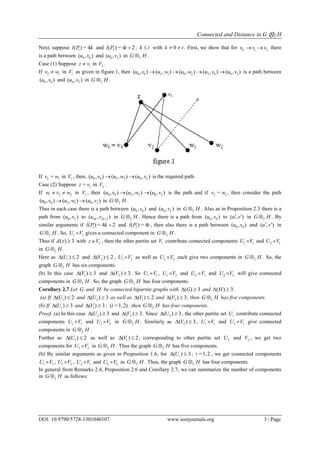
Fixed 0 0 1 1( , )u v U V  with 0 0=v w . Let ( , )u v  be any vertex in 1 1U V . Suppose, 1P and 2P are paths
between 0=u u to u and 0=v v to v in G and H , as we have considered in Proposition 2.3. If 1( ) = 4l P k or
4 2k  and 2( ) = 4l P t or 4 2t  , then the result is clear.
Connected and Distance in G ⊗2 H
DOI: 10.9790/5728-1301040107 www.iosrjournals.org 3 | Page
Next, suppose 1( ) = 4l P k and 2( ) = 4 2l P t  ; k t with 0k t  . First, we show that for 0 1 2v v v  there
is a path between 0 0( , )u v and 0 2( , )u v in 2G H .
Case (1) Suppose 1z v in 2V .
If 2 1v w in 1V as given in figure.1, then 0 0 2 1 0 2 2 0 0 2( , ) ( , ) ( , ) ( , ) ( , )u v u w u w u v u v    is a path between
0 0( , )u v and 0 2( , )u v in 2G H .
If 2 1=v w in 1V , then, 0 0 2 2 0 2( , ) ( , ) ( , )u v u w u v  is the required path.
Case (2) Suppose 1=z v in 2V .
If 1 2 2w v w  in 1V , then 0 0 2 2 0 2( , ) ( , ) ( , )u v u w u v  is the path and if 2 2=v w , then consider the path
0 0 2 1 0 2( , ) ( , ) ( , )u v u w u v  in 2G H .
Thus in each case there is a path between 0 0( , )u v and 0 2( , )u v in 2G H . Also as in Proposition 2.3 there is a
path from 0 2( , )u v to 4 4 2( , )k tu v  in 2G H . Hence there is a path from 0 0( , )u v to ( , )u v  in 2G H . By
similar arguments if 1( ) = 4 2l P k  and 2( ) = 4l P t , then also there is a path between 0 0( , )u v and ( , )u v  in
2G H . So, 1 1U V gives a connected component in 2G H .
Thus if ( ) 3d z  with 2z V , then the other partite set 1V contribute connected components 1 1U V and 2 1U V
in 2G H .
Here as ( ) 2iU  and 2( ) 2V  , 1 2U V as well as 2 2U V each give two components in 2G H . So, the
graph 2G H has six components.
(b) In this case 1( ) 3V  and 2( ) 3V  . So 1 1U V , 1 2U V and 2 1U V and 2 2U V will give connected
components in 2G H . So, the graph 2G H has four components.
Corollary 2.7 Let G and H be connected bipartite graphs with ( ) 3G  and ( ) 3H  .
(a) If 1( ) 2U  and 2( ) 3U  as well as 1( ) 2V  and 2( ) 3V  , then 2G H has five components.
(b) If ( ) 3iU  and ( ) 3iV  ; ( =1,2)i , then 2G H has four components.
Proof. (a) In this case 2( ) 3U  and 2( ) 3V  . Since 2( ) 3U  , the other partite set 1U contribute connected
components 1 1U V and 1 2U V in 2G H . Similarly as 2( ) 3V  , 1 1U V and 2 1U V give connected
components in 2G H .
Further as 1( ) 2U  as well as 1( ) 2V  , corresponding to other partite set 2U and 2V , we get two
components for 2 2U V in 2G H . Thus the graph 2G H has five components.
(b) By similar arguments as given in Proposition 1.6, for ( ) 3iU  ; =1,2i , we get connected components
1 1U V , 1 2U V , 2 1U V and 2 2U V in 2G H . Thus, the graph 2G H has four components.
In general from Remarks 2.4, Proposition 2.6 and Corollary 2.7, we can summarize the number of components
in 2G H as follows:
Connected and Distance in G ⊗2 H
DOI: 10.9790/5728-1301040107 www.iosrjournals.org 4 | Page
Next, we discuss connectedness of 2G H for non-bipartite graphs. First we shall prove the following
Proposition:
Proposition 2.8 labelnon Let G be a non-bipartite connected graph with 2
( ) , ( )N u u V G   . Assume that
G contains 2 1lC  , >1l . Then between every pair of vertices, there exists a walk of length 4k as well as
4 2k  ; ( IN {0})k   form in G .
Proof. Since G is non-bipartite, it contains an odd cycle. Suppose G contains 2 1lC  with
2 1 1 2 1( ) ={ , , }l lV C x x  , >1l . Let u and u be in ( )V G with path 0 1 2 1: = =tP u u u u u
   , where
( ) = ( , ) = 2 1Gl P d u u t  .
Suppose u and u are on 2 1lC  . Then clearly there is a path between u and u of even length.
Next, assume that u , 2 1( )lu V C 
 . Assume that iu is the nearest vertex from the cycle 2 1lC  and jx is the
corresponding nearest vertex of 2 1( )lV C  . Suppose 0P is the path between iu and jx in G . Then there is a
walk W  between u and u in G as follows:
0 2 1 0
0: =
P C Ppart of P part of Pl
i j j iW u u u x x u u      .
Then 2 1 0 0( ) = ( ) ( ) 2 ( ) = (2 1) (2 1) 2 ( )ll W l P l C l P t l l P
       , which is of even length.
If necessary travelling on the cycle more than once, we get length of the walk in both the form 4k as well as
4 2k  in G . If ( )l P is even, then by same arguments as above we get a walk of length 4k and 4 2k  in G .
Thus in all cases there is a walk between u and u of length 4k as well as 4 2k  form in G .
Note that since >1l , in every walk 0 1: = =pW u w w w u    between u and u in above cases, we
get 2( , ) = 2G i id w w .
Now onwards, whenever we consider a non-bipartite graph, we assume that it contain a cycle 2 1lC  , ( >1)l .
Proposition 2.9 Let G and H be two connected graphs. Suppose G is a non-bipartite graph. Then,
(a) the graph 2G H has two components, if H is a bipartite graph.
(b) the graph 2G H is connected, if H is a non-bipartite graph.
Proof. (a) Suppose H is a bipartite graph. It is clear that 1U V and 2U V give two disconnected subgraphs in
2G H .
Let ( , )u v and ( , )u v  be in 1U V .
Let path 1P between u and u in G and path 2 0 1: = =nP v v v v v   ; ( n is an even integer)
between v and v in H be as follows:
Since G is non-bipartite graph, by Proposition 1.11, there are walks between u and u of length of the form
4k as well as 4 2k  . Since n is an even integer, as we have discussed in Proposition 2.3, we get a path
between ( , )u v and ( , )u v  in 2G H . Thus 1U V gives a connected component, which proves ( )a .
(b) Let ( , )u v and ( , )u v  be in U V . Since G and H both are non-bipartite graphs, there exist walks
between v and v of length 4k as well as 4 2k  form. So, as above we get the result.
Corollary 2.10 Let G and H be two connected graphs. Then 2G H is connected if and only if G and H
both are non-bipartite graphs.
Note that the similar result for usual Tensor product is as follows:
Proposition 2.11 [7] Let G and H be connected graphs. Then G H is connected graph if and only if either
G or H is non-bipartite.
Connected and Distance in G ⊗2 H
DOI: 10.9790/5728-1301040107 www.iosrjournals.org 5 | Page
III. Distance between two vertices in 2G H
In this section, we discuss the distance between two vertices in 2G H for G and H both are connected and
2
( ) ; ( ) ( )N w w V G V H    .
First we define
*
( , )Gd u u and
**
( , )Gd u u for u and u in ( )V G , where G is a connected graph.
Definition 2.1 Let = ( , )G U E be a connected graph and ,u v U . Then,
(1)
*
( , )Gd u u is defined as the length of a shortest walk 0 1: = =pW u w w w u   between u and u of
the form 4 ( IN)k k  in which 2( , ) = 2G i id w w for = 0,2,4, ,4 2i k  . (2)
**
( , )Gd u u is defined as the length
of a shortest walk 0 1: = =pW u w w w u   between u and u of the form 4 2 ( 0)k k  in which
2( , ) = 2G i id w w for = 0,2,4, ,4i k .
Note that
* **
** *
( , ) < ( , ), ( , ) = 4
( , )
( , ) < ( , ), ( , ) = 4 2
G G G
G
G G G
d u u d u u if d u u k
d u u
d u u d u u if d u u k
   
 
   
If there is no such shortest walk, then we write
* **
( , ) = ( ( , ) = )G Gd u u d u u   .
Remark 3.2
[i] If G is a non-bipartite graph, then
*
( , ) <Gd u u  and
**
( , ) <Gd u u  for every , ( )u u V G , by
Proposition 1.8.
[ii] If G is a bipartite graph and even, also if ( , )Gd u u is an even number 4k , then
**
( , )Gd u u may not be
finite.
For example, if 6 1 2 5 6= :G P u u u u    , then 1 5( , ) = 4Gd u u but
**
1 5( , ) =Gd u u  . However, if
10=G C , then 1 5( , ) = 4Gd u u but
**
1 5( , ) = 6 <Gd u u  .
Now we fix the following notations:
Let 1= ( , )G U E and 2= ( , )H V E be connected graphs.Then 2( ) =V G H U V  . Fix ,u u U ,
suppose = ( , ) =G Gd d u u m with path 1 0 1: = =mP u u u u u   and ,v v V , = ( , ) =H Hd d v v n with
path 2 0 1: = =nP v v v v v   . Denote
2
= (( , ),( , ))G Hd d u v u v
  . We assume that ( , )u v and ( , )u v  are
in the same component of 2G H , i.e., <d  .
Proposition 3.3 If Gd and Hd are of the same form 4k or 4 2k  , then
1 1
= ,
2 2
G Hd Max d d
 
 
 
.
Proof. Let = 4Gd k and = 4Hd t ; k t . Then using paths 1P and 2P from u to u and v to v in G and H
respectively, there is a path
0 0 2 2 4 4 4 2 4 2 4 4 4 4 4:( , ) = ( , ) ( , ) ( , ) ( , ) ( , ) ( , ) = ( , )k k k k k k k tP u v u v u v u v u v u v u v u v  
        
between ( , )u v and ( , )u v  of length 2t in 2G H . So,
1 1 1
2 = = ,
2 2 2
H G Hd t d Max d d
 
  
 
. Similarly if
= 4 2Gd k  and = 4 2Hd t  , then path
0 0 2 2 4 2 4 2 4 4 4 4 2 4 6 4 2 4 2:( , ) = ( , ) ( , ) ( , ) ( , ) ( , ) ( , ) = ( , )k k k k k k k tP u v u v u v u v u v u v u v u v      
         
between ( , )u v and ( , )u v  of length 2 1t  in 2G H . So,
1 1 1
2 1= = ,
2 2 2
H G Hd t d Max d d
 
   
 
.
Conversely suppose that <d  with the path 0 0 1 1( , ) = ( , ) ( , ) ( , ) = ( , )d du v u v u v u v u v    in 2G H .
Then 1 1( , ) = 2 = ( , );G i i H i id u u d v v i   . So, there is a walk 0 0 1: = =G dW u u a u u u    of length 2d
between u and u in G with 1i iu u  . Similarly we get a walk HW between v and v in H . Hence 2Gd d
and 2Hd d . So, Max
1 1
,
2 2
G Hd d d
 
 
 
. Thus we get Max
1 1
, =
2 2
G Hd d d
 
 
 
.
Next, we consider the case in which Gd and Hd are not in same form, but both are even.
Proposition 3.4 If = 4Gd k and = 4 2Hd t  , then
* **1 1 1 1
= , , ,
2 2 2 2
G H G Hd Min Max d d Max d d
    
    
    
.
Connected and Distance in G ⊗2 H
DOI: 10.9790/5728-1301040107 www.iosrjournals.org 6 | Page
Proof. First we prove that
* **1 1 1 1
, , ,
2 2 2 2
G H G Hd Min Max d d Max d d
    
     
    
.
If
* **
= =H Gd d , then it is clear.
Suppose
*
<Hd  . Suppose = 4Gd k and
*
= 4Hd t ; k t . Then there is a shortest walk
2 0 1 4: = =tW v w w w v    such that 2( , ) = 2H i id w w for = 0,2,4, ,4 2i t  . So, using path 1P and
walk 2W , we get a path between ( , )u v and ( , )u v  in 2G H , as in Proposition 3.3. So,
* *1 1 1
2 = = ,
2 2 2
H G Hd t d Max d d
   
 
.Similarly, if
**
= 4 2Gd k , then
**1 1
,
2 2
G Hd Max d d
 
  
 
.
Hence we get
* **1 1 1 1
, , ,
2 2 2 2
G H G Hd Min Max d d Max d d
    
     
    
.
For the reverse inequality, as <d  , as we have seen in Proposition 3.3, there are walks GW and HW between
u u and v v respectively with ( ) = 2 = ( )G Hl W d l W . Also, as = 4Gd k and = 4 2Hd t  , we get
* **
= <G G Gd d d and
** *
= <H H Hd d d .
Suppose d is even. Let = 2d p .Then ( ) = 4 = ( )G Hl W p l W . So,
*
4Gd p as well as
*
4Hd p . Thus
   * * *
, = , 4 = 2G H G HMax d d Max d d p d . If = 2 1d p  , then ( ) = 4 2 = ( )G Hl W p l W . So,
**
4 2Gd p  and
**
4 2Hd p  and therefore
**
{ , } 4 2 = 2G HMax d d p d  . Hence
* ** * * ** **1 1 1 1 1 1 1 1
, , , = , , ,
2 2 2 2 2 2 2 2
G H G H G H G HMin Max d d Max d d Min Max d d Max d d d
          
         
          
Corollary 3.5 Let Hd be an odd integer.
(i) If Gd is odd, then
* * ** **1 1 1 1
= , , ,
2 2 2 2
G H G Hd Min Max d d Max d d
    
    
    
.
(ii) If = 4Gd k , then
* ** **1 1 1 1
= , , ,
2 2 2 2
G H G Hd Min Max d d Max d d
    
    
    
.
(iii) If = 4 2Gd k  , then
* * **1 1 1 1
= , , ,
2 2 2 2
G H G Hd Min Max d d Max d d
    
    
    
.
Proof. (i) Suppose If Gd , and Hd both are odd integers.
First we prove that
* * ** **1 1 1 1
, , ,
2 2 2 2
G H G Hd Min Max d d Max d d
    
     
    
.
Suppose
* * ** **1 1 1 1
, = = ,
2 2 2 2
G H G HMax d d Max d d
   
   
   
. Then it is clear.
Suppose
* *1 1
, <
2 2
G HMax d d
 
 
 
. Therefore
*
= 4Gd k and
*
= 4Hd t ; k t  . Then using walks 1W and
2W , we get a path between ( , )u v and ( , )u v  , as in Proposition 3.4 by replacing 1P by 1W . So,
* *1 1
,
2 2
G Hd Max d d
 
  
 
. Similarly, if
**
= 4 2Gd k and
**
= 4 2Hd t , then
** **1 1
,
2 2
G Hd Max d d
 
  
 
. Hence we
get
* * ** **1 1 1 1
, , ,
2 2 2 2
G H G Hd Min Max d d Max d d
    
     
    
.
Conversely, as <d  , as we have seen in Proposition 3.4, we get
* * ** **1 1 1 1
, , ,
2 2 2 2
G H G HMin Max d d Max d d d
    
    
    
.
(ii) If = 4Gd k , then
*
=G Gd d and hence the result follows.
(iii) If = 4 2Gd k  , then
**
=G Gd d and hence the result follows.
Connected and Distance in G ⊗2 H
DOI: 10.9790/5728-1301040107 www.iosrjournals.org 7 | Page
Acknowledgements
The research is supported by the SAP programmed to Department of Mathematics, S. P. University, Vallabh
Vidyanagr, by UGC.
References
[1]. R. Balakrishnan and K. Ranganathan, A Textbook of Graph Theory, Universitext, Springer, New York, 2012.
[2]. I. H. Naga Raja Rao and K. V. S. Sarma, On Tensor Product of Standard Graphs, Int. J. Comp., 8(3), (2010), 99-103.
[3]. Sirous Moradi, A note on Tensor Product of Graphs, Iranian J. of Math. Sci. and Inf., 7(1), (2012), 73-81.
[4]. E. Sampathkumar, On Tensor Product of Graphs, J. Austral. Math. Soc., 20(Series-A), (1975), 268-273.
[5]. U. P. Acharya and H. S. Mehta, 2- Tensor Product of special Graphs, Int. J. of Math. and Scietific Comp., 4(1), (2014), 21-24.
[6]. Biggs. N. L., Algebraic Graph Theory, Cambridge University Press, Cambridge, 1993.
[7]. N. Deo, Graph Theory with Application in Engineering and Computer Science, Prentice-Hall of India, Delhi, 1989.

Connected and Distance in G ⊗2 H

  • 1.
    IOSR Journal ofMathematics (IOSR-JM) e-ISSN: 2278-5728, p-ISSN: 2319-765X. Volume 13, Issue 1 Ver. IV (Jan. - Feb. 2017), PP 01-07 www.iosrjournals.org DOI: 10.9790/5728-1301040107 www.iosrjournals.org 1 | Page Connected and Distance in G ⊗2 H U. P. Acharya1 , H. S. Mehta2 1 (Department of Appl. Sci. and Humanities, A. D. Patel Institute of Technology, New V. V. Nagar, India) 2 (Department of Mathematics, S. P. University, V. V. Nagar-388120, India) Abstract : The tensor product G H of two graphs G and H is well-known graph product and studied in detail in the literature. This concept has been generalized by introducing 2-tensor product 2G H and it has been discussed for special graphs like nP and nC [5]. In this paper, we discuss 2G H , where G and H are connected graphs. Mainly, we discuss connectedness of 2G H and obtained distance between two vertices in it. Keywords: Bipartite graph, Connected graph, Non-bipartite graph, 2-tensor product of graphs. I. Introduction The tensor product G H of two graphs G and H is very well-known and studied in detail ([1], [2], [3], [4]). This concept has been extended by introducing 2tensor product 2G H of G and H and studied for special graphs [5]. In this paper, we discuss connectedness of 2G H for any connected graphs G and H . We also obtained the results for the distance between two vertices in 2G H . If = ( ( ), ( ))G V G E G is finite, simple and connected graph, then ( , )Gd u u is the length of the shortest path between u and u in G . For a graph G , a maximal connected subgraph is a component of G . For the basic terminology, concepts and results of graph theory, we refer to ([1], [6], [7]). We recall the definition of 2tensor product of graphs. Definition 1.1 [5] Let G and H be two connected graphs. The 2tensor product of G and H is the graph with vertex set {( , ): ( ), ( )}u v u V G v V H  and two vertices ( , )u v and ( , )u v  are adjacent in 2tensor product if ( , ) = 2Gd u u and ( , ) = 2Hd v v . It is denoted by 2G H . Note that 2G H is a null graph, if the diameter ( ) < 2D G or ( ) < 2D H . So, throughout this paper we assume that G and H are non-complete graphs. II. Connectedness of 2G H this section, first we consider the graphs G and H , both connected and bipartite with 2 ( ) ; ( ) ( )N w w V G V H    , where 2 ( ) = { ( ) : ( , ) = 2}GN u u V G d u u  In usual tensor product G H , the following result is known. Proposition 2.1 [4] Let G and H be connected bipartite graphs. Then G H has two components. Note that in case of 2G H , the similar result is not true. We discuss the number of components in 2G H with different conditions on G and H . We fix the following notations Let 1 2( ) =V G U U and 1 2( ) =V H V V with iU and jV , ( , =1,2)i j are partite sets of G and H respectively. Then, 2 11 12 21 22( ) = with =ij i jV G H W W W W W U V     Remark 2.2 If ( , )u v and ( , )u v  are from different ijW , then ( , )u v and ( , )u v  can not be adjacent in 2G H as ( , ) 2Gd u u  or ( , ) 2Hd v v  . So, 2G H has at least four components. Suppose ( , )u v and ( , )u v  are in the same ijW . Then ( , )Gd u u and ( , )Hd v v are even. Proposition 2.3 Let G and H be connected bipartite graphs. If ( , )Gd u u and ( , )Hd v v are of the same form, 4k or 4 2k  , ( IN {0})k   then ( , )u v and ( , )u v  are in the same component of 2G H . Proof.Let 1 1( , ) & ( , )u v u v U V    .Suppose, 1 0 1: = =mP u u u u u   and 2 0 1: = =nP v v v v v   are paths between u , u and v , v respectively. Suppose 1( ) = 4 / 4 2l P k k  and 2( ) = 4 / 4 2l P t t  with k t . First assume that 0k t  , then there is a path P or P between ( , )u v and ( , )u v  in 2G H as follows:
  • 2.
    Connected and Distancein G ⊗2 H DOI: 10.9790/5728-1301040107 www.iosrjournals.org 2 | Page 0 0 2 2 4 4 4 2 4 2 4 4 4 4 4:( , ) ( , ) ( , ) ( , ) ( , ) ( , ) = ( , )k k k k k k k tP u v u v u v u v u v u v u v            . 0 0 2 2 4 2 4 2 4 4 4 4 2 4 6 4 2 4 2:( , ) ( , ) ( , ) ( , ) ( , ) ( , ) = ( , )k k k k k k k tP u v u v u v u v u v u v u v                 . Next, assume that = 0k , i.e. 1( ) = 0l P or 2 , i.e. =u u or 0 1 2= =u u u u u  . Now as 2 ( )N u  , ( )a V G  such that ( , ) = 2Gd u a . So, in case of 1( ) = 0l P and 2( ) = 4l P t , we get the path between ( , )u v and ( , )u v in 2G H as follows: 0 2 4 4( , ) = ( , ) ( , ) ( , ) ( , )tu v u v a v u v u v    . Next if 1( ) = 2l P and 2( ) = 4 2l P t  , then we get the path between 0( , )u v and 2( , )u v in 2G H as follows: 0 0 2 2 0 4 2 6 2 4 2 2( , ) = ( , ) ( , ) ( , ) ( , ) ( , ) = ( , )tu v u v u v u v u v u v u v      . Thus in all cases there is a path from ( , )u v to ( , )u v  in 2G H . Which completes the proof. Remarks 2.4 [i] Suppose ( , )u v and ( , )u v  are in same ijW . But if ( , )Gd u u and ( , )Hd v v are not of the same form, then ( , )u v and ( , )u v  may be in different components. So, 1 1U V give at most two components. Thus 2G H has at most eight components. [ii] Suppose ( ) 2G  and ( ) 2H  , ( )G and ( )H are maximum degree of G and H respectively. Then G and H are either path or cycle. If the cycle is of the form 4lC , then in each of the cases, 2m nP P , 2 4m nP C and 4 2 4m nC C have eight components [5]. Next, we discuss the conditions on G and H under which 2G H has 4 , 5 or 6 components. Proposition 2.5 Let G and H be connected bipartite graphs and at least one of the graphs contains a cycle 4 2lC  ( IN)l  . Then 2G H has exactly four components. Proof. Let ( , )u v and ( , )u v  be in 1 1U V . As we have seen in Proposition 2.3, if ( , )Gd u u and ( , )Hd v v are of the same form 4k or 4 2k  , then 1 1U V gives connected component. Let 1P and 2P be two paths between u u and v v in G and H respectively, as we have considered in Proposition 2.3. Suppose 1( )l P and 2( )l P are of the different form. Suppose H contains a cycle 4 2lC  with 4 2 1 2 4 2( ) ={ , , , }l lV C x x x  . Then select a vertex from 4 2lC  , which is nearest to =nv v and also it is in 1V . Suppose this vertex is jx . Since nv and jx both are in 1V , we get a path 0P from nv to jx of even length. We consider a walk 0 4 2 02 0: = = P C PP l n j j nW v v v x x v v     between v and v in H . Then, 2 0 4 2 2 2( ) = ( ) 2( ( )) ( ) = ( ) 2(2 ) (4 2) = ( ) 4 2ll W l P l P l C l P t l l P t         . Thus, if 2( ) = 4 2l P t  or 4t , then ( ) = 4l W q or 4 2q  . So, in any case, 1( )l P and ( )l W are of the same form and therefore, as in Proposition 2.3, we can show that there is a path between ( , )u v and ( , )u v  in 2G H . So, 1 1U V gives a connected components in 2G H . Thus, 2G H has four components. Next, we assume that the graphs G and H do not contain a cycle of the form 4 2lC  . We prove that the number of components in 2G H is depending upon ( )G as well as ( )H . Let ( ) = max{ ( ): }i iU d u u U  and ( ) = max{ ( ): }i iV d v v V  ; =1,2i and for ( )a V G , ( ) ={ ( ): ( , ) =1}GN a b V G d a b . Proposition 2.6 Let G and H be connected bipartite graphs with ( ) 2G  and ( ) 3H  . (a) If 1( ) 2V  and 2( ) 3V  , then 2G H has six components. (b) If 1( ) 3V  and 2( ) 3V  , then 2G H has four components. Proof. We know that 1 1U V , 1 2U V , 2 1U V and 2 2U V give disconnected subgraphs in 2G H . (a) Fixed 1 1U V . We shall show that 1 1U V gives connected subgraph of 2G H . Let 2z V with ( ) 3d z  and 0 1 2 1( ) ={ , , , }N z w w w V . Fixed 0 0 1 1( , )u v U V  with 0 0=v w . Let ( , )u v  be any vertex in 1 1U V . Suppose, 1P and 2P are paths between 0=u u to u and 0=v v to v in G and H , as we have considered in Proposition 2.3. If 1( ) = 4l P k or 4 2k  and 2( ) = 4l P t or 4 2t  , then the result is clear.
  • 3.
    Connected and Distancein G ⊗2 H DOI: 10.9790/5728-1301040107 www.iosrjournals.org 3 | Page Next, suppose 1( ) = 4l P k and 2( ) = 4 2l P t  ; k t with 0k t  . First, we show that for 0 1 2v v v  there is a path between 0 0( , )u v and 0 2( , )u v in 2G H . Case (1) Suppose 1z v in 2V . If 2 1v w in 1V as given in figure.1, then 0 0 2 1 0 2 2 0 0 2( , ) ( , ) ( , ) ( , ) ( , )u v u w u w u v u v    is a path between 0 0( , )u v and 0 2( , )u v in 2G H . If 2 1=v w in 1V , then, 0 0 2 2 0 2( , ) ( , ) ( , )u v u w u v  is the required path. Case (2) Suppose 1=z v in 2V . If 1 2 2w v w  in 1V , then 0 0 2 2 0 2( , ) ( , ) ( , )u v u w u v  is the path and if 2 2=v w , then consider the path 0 0 2 1 0 2( , ) ( , ) ( , )u v u w u v  in 2G H . Thus in each case there is a path between 0 0( , )u v and 0 2( , )u v in 2G H . Also as in Proposition 2.3 there is a path from 0 2( , )u v to 4 4 2( , )k tu v  in 2G H . Hence there is a path from 0 0( , )u v to ( , )u v  in 2G H . By similar arguments if 1( ) = 4 2l P k  and 2( ) = 4l P t , then also there is a path between 0 0( , )u v and ( , )u v  in 2G H . So, 1 1U V gives a connected component in 2G H . Thus if ( ) 3d z  with 2z V , then the other partite set 1V contribute connected components 1 1U V and 2 1U V in 2G H . Here as ( ) 2iU  and 2( ) 2V  , 1 2U V as well as 2 2U V each give two components in 2G H . So, the graph 2G H has six components. (b) In this case 1( ) 3V  and 2( ) 3V  . So 1 1U V , 1 2U V and 2 1U V and 2 2U V will give connected components in 2G H . So, the graph 2G H has four components. Corollary 2.7 Let G and H be connected bipartite graphs with ( ) 3G  and ( ) 3H  . (a) If 1( ) 2U  and 2( ) 3U  as well as 1( ) 2V  and 2( ) 3V  , then 2G H has five components. (b) If ( ) 3iU  and ( ) 3iV  ; ( =1,2)i , then 2G H has four components. Proof. (a) In this case 2( ) 3U  and 2( ) 3V  . Since 2( ) 3U  , the other partite set 1U contribute connected components 1 1U V and 1 2U V in 2G H . Similarly as 2( ) 3V  , 1 1U V and 2 1U V give connected components in 2G H . Further as 1( ) 2U  as well as 1( ) 2V  , corresponding to other partite set 2U and 2V , we get two components for 2 2U V in 2G H . Thus the graph 2G H has five components. (b) By similar arguments as given in Proposition 1.6, for ( ) 3iU  ; =1,2i , we get connected components 1 1U V , 1 2U V , 2 1U V and 2 2U V in 2G H . Thus, the graph 2G H has four components. In general from Remarks 2.4, Proposition 2.6 and Corollary 2.7, we can summarize the number of components in 2G H as follows:
  • 4.
    Connected and Distancein G ⊗2 H DOI: 10.9790/5728-1301040107 www.iosrjournals.org 4 | Page Next, we discuss connectedness of 2G H for non-bipartite graphs. First we shall prove the following Proposition: Proposition 2.8 labelnon Let G be a non-bipartite connected graph with 2 ( ) , ( )N u u V G   . Assume that G contains 2 1lC  , >1l . Then between every pair of vertices, there exists a walk of length 4k as well as 4 2k  ; ( IN {0})k   form in G . Proof. Since G is non-bipartite, it contains an odd cycle. Suppose G contains 2 1lC  with 2 1 1 2 1( ) ={ , , }l lV C x x  , >1l . Let u and u be in ( )V G with path 0 1 2 1: = =tP u u u u u    , where ( ) = ( , ) = 2 1Gl P d u u t  . Suppose u and u are on 2 1lC  . Then clearly there is a path between u and u of even length. Next, assume that u , 2 1( )lu V C   . Assume that iu is the nearest vertex from the cycle 2 1lC  and jx is the corresponding nearest vertex of 2 1( )lV C  . Suppose 0P is the path between iu and jx in G . Then there is a walk W  between u and u in G as follows: 0 2 1 0 0: = P C Ppart of P part of Pl i j j iW u u u x x u u      . Then 2 1 0 0( ) = ( ) ( ) 2 ( ) = (2 1) (2 1) 2 ( )ll W l P l C l P t l l P        , which is of even length. If necessary travelling on the cycle more than once, we get length of the walk in both the form 4k as well as 4 2k  in G . If ( )l P is even, then by same arguments as above we get a walk of length 4k and 4 2k  in G . Thus in all cases there is a walk between u and u of length 4k as well as 4 2k  form in G . Note that since >1l , in every walk 0 1: = =pW u w w w u    between u and u in above cases, we get 2( , ) = 2G i id w w . Now onwards, whenever we consider a non-bipartite graph, we assume that it contain a cycle 2 1lC  , ( >1)l . Proposition 2.9 Let G and H be two connected graphs. Suppose G is a non-bipartite graph. Then, (a) the graph 2G H has two components, if H is a bipartite graph. (b) the graph 2G H is connected, if H is a non-bipartite graph. Proof. (a) Suppose H is a bipartite graph. It is clear that 1U V and 2U V give two disconnected subgraphs in 2G H . Let ( , )u v and ( , )u v  be in 1U V . Let path 1P between u and u in G and path 2 0 1: = =nP v v v v v   ; ( n is an even integer) between v and v in H be as follows: Since G is non-bipartite graph, by Proposition 1.11, there are walks between u and u of length of the form 4k as well as 4 2k  . Since n is an even integer, as we have discussed in Proposition 2.3, we get a path between ( , )u v and ( , )u v  in 2G H . Thus 1U V gives a connected component, which proves ( )a . (b) Let ( , )u v and ( , )u v  be in U V . Since G and H both are non-bipartite graphs, there exist walks between v and v of length 4k as well as 4 2k  form. So, as above we get the result. Corollary 2.10 Let G and H be two connected graphs. Then 2G H is connected if and only if G and H both are non-bipartite graphs. Note that the similar result for usual Tensor product is as follows: Proposition 2.11 [7] Let G and H be connected graphs. Then G H is connected graph if and only if either G or H is non-bipartite.
  • 5.
    Connected and Distancein G ⊗2 H DOI: 10.9790/5728-1301040107 www.iosrjournals.org 5 | Page III. Distance between two vertices in 2G H In this section, we discuss the distance between two vertices in 2G H for G and H both are connected and 2 ( ) ; ( ) ( )N w w V G V H    . First we define * ( , )Gd u u and ** ( , )Gd u u for u and u in ( )V G , where G is a connected graph. Definition 2.1 Let = ( , )G U E be a connected graph and ,u v U . Then, (1) * ( , )Gd u u is defined as the length of a shortest walk 0 1: = =pW u w w w u   between u and u of the form 4 ( IN)k k  in which 2( , ) = 2G i id w w for = 0,2,4, ,4 2i k  . (2) ** ( , )Gd u u is defined as the length of a shortest walk 0 1: = =pW u w w w u   between u and u of the form 4 2 ( 0)k k  in which 2( , ) = 2G i id w w for = 0,2,4, ,4i k . Note that * ** ** * ( , ) < ( , ), ( , ) = 4 ( , ) ( , ) < ( , ), ( , ) = 4 2 G G G G G G G d u u d u u if d u u k d u u d u u d u u if d u u k           If there is no such shortest walk, then we write * ** ( , ) = ( ( , ) = )G Gd u u d u u   . Remark 3.2 [i] If G is a non-bipartite graph, then * ( , ) <Gd u u  and ** ( , ) <Gd u u  for every , ( )u u V G , by Proposition 1.8. [ii] If G is a bipartite graph and even, also if ( , )Gd u u is an even number 4k , then ** ( , )Gd u u may not be finite. For example, if 6 1 2 5 6= :G P u u u u    , then 1 5( , ) = 4Gd u u but ** 1 5( , ) =Gd u u  . However, if 10=G C , then 1 5( , ) = 4Gd u u but ** 1 5( , ) = 6 <Gd u u  . Now we fix the following notations: Let 1= ( , )G U E and 2= ( , )H V E be connected graphs.Then 2( ) =V G H U V  . Fix ,u u U , suppose = ( , ) =G Gd d u u m with path 1 0 1: = =mP u u u u u   and ,v v V , = ( , ) =H Hd d v v n with path 2 0 1: = =nP v v v v v   . Denote 2 = (( , ),( , ))G Hd d u v u v   . We assume that ( , )u v and ( , )u v  are in the same component of 2G H , i.e., <d  . Proposition 3.3 If Gd and Hd are of the same form 4k or 4 2k  , then 1 1 = , 2 2 G Hd Max d d       . Proof. Let = 4Gd k and = 4Hd t ; k t . Then using paths 1P and 2P from u to u and v to v in G and H respectively, there is a path 0 0 2 2 4 4 4 2 4 2 4 4 4 4 4:( , ) = ( , ) ( , ) ( , ) ( , ) ( , ) ( , ) = ( , )k k k k k k k tP u v u v u v u v u v u v u v u v            between ( , )u v and ( , )u v  of length 2t in 2G H . So, 1 1 1 2 = = , 2 2 2 H G Hd t d Max d d        . Similarly if = 4 2Gd k  and = 4 2Hd t  , then path 0 0 2 2 4 2 4 2 4 4 4 4 2 4 6 4 2 4 2:( , ) = ( , ) ( , ) ( , ) ( , ) ( , ) ( , ) = ( , )k k k k k k k tP u v u v u v u v u v u v u v u v                 between ( , )u v and ( , )u v  of length 2 1t  in 2G H . So, 1 1 1 2 1= = , 2 2 2 H G Hd t d Max d d         . Conversely suppose that <d  with the path 0 0 1 1( , ) = ( , ) ( , ) ( , ) = ( , )d du v u v u v u v u v    in 2G H . Then 1 1( , ) = 2 = ( , );G i i H i id u u d v v i   . So, there is a walk 0 0 1: = =G dW u u a u u u    of length 2d between u and u in G with 1i iu u  . Similarly we get a walk HW between v and v in H . Hence 2Gd d and 2Hd d . So, Max 1 1 , 2 2 G Hd d d       . Thus we get Max 1 1 , = 2 2 G Hd d d       . Next, we consider the case in which Gd and Hd are not in same form, but both are even. Proposition 3.4 If = 4Gd k and = 4 2Hd t  , then * **1 1 1 1 = , , , 2 2 2 2 G H G Hd Min Max d d Max d d                .
  • 6.
    Connected and Distancein G ⊗2 H DOI: 10.9790/5728-1301040107 www.iosrjournals.org 6 | Page Proof. First we prove that * **1 1 1 1 , , , 2 2 2 2 G H G Hd Min Max d d Max d d                 . If * ** = =H Gd d , then it is clear. Suppose * <Hd  . Suppose = 4Gd k and * = 4Hd t ; k t . Then there is a shortest walk 2 0 1 4: = =tW v w w w v    such that 2( , ) = 2H i id w w for = 0,2,4, ,4 2i t  . So, using path 1P and walk 2W , we get a path between ( , )u v and ( , )u v  in 2G H , as in Proposition 3.3. So, * *1 1 1 2 = = , 2 2 2 H G Hd t d Max d d       .Similarly, if ** = 4 2Gd k , then **1 1 , 2 2 G Hd Max d d        . Hence we get * **1 1 1 1 , , , 2 2 2 2 G H G Hd Min Max d d Max d d                 . For the reverse inequality, as <d  , as we have seen in Proposition 3.3, there are walks GW and HW between u u and v v respectively with ( ) = 2 = ( )G Hl W d l W . Also, as = 4Gd k and = 4 2Hd t  , we get * ** = <G G Gd d d and ** * = <H H Hd d d . Suppose d is even. Let = 2d p .Then ( ) = 4 = ( )G Hl W p l W . So, * 4Gd p as well as * 4Hd p . Thus    * * * , = , 4 = 2G H G HMax d d Max d d p d . If = 2 1d p  , then ( ) = 4 2 = ( )G Hl W p l W . So, ** 4 2Gd p  and ** 4 2Hd p  and therefore ** { , } 4 2 = 2G HMax d d p d  . Hence * ** * * ** **1 1 1 1 1 1 1 1 , , , = , , , 2 2 2 2 2 2 2 2 G H G H G H G HMin Max d d Max d d Min Max d d Max d d d                                 Corollary 3.5 Let Hd be an odd integer. (i) If Gd is odd, then * * ** **1 1 1 1 = , , , 2 2 2 2 G H G Hd Min Max d d Max d d                . (ii) If = 4Gd k , then * ** **1 1 1 1 = , , , 2 2 2 2 G H G Hd Min Max d d Max d d                . (iii) If = 4 2Gd k  , then * * **1 1 1 1 = , , , 2 2 2 2 G H G Hd Min Max d d Max d d                . Proof. (i) Suppose If Gd , and Hd both are odd integers. First we prove that * * ** **1 1 1 1 , , , 2 2 2 2 G H G Hd Min Max d d Max d d                 . Suppose * * ** **1 1 1 1 , = = , 2 2 2 2 G H G HMax d d Max d d             . Then it is clear. Suppose * *1 1 , < 2 2 G HMax d d       . Therefore * = 4Gd k and * = 4Hd t ; k t  . Then using walks 1W and 2W , we get a path between ( , )u v and ( , )u v  , as in Proposition 3.4 by replacing 1P by 1W . So, * *1 1 , 2 2 G Hd Max d d        . Similarly, if ** = 4 2Gd k and ** = 4 2Hd t , then ** **1 1 , 2 2 G Hd Max d d        . Hence we get * * ** **1 1 1 1 , , , 2 2 2 2 G H G Hd Min Max d d Max d d                 . Conversely, as <d  , as we have seen in Proposition 3.4, we get * * ** **1 1 1 1 , , , 2 2 2 2 G H G HMin Max d d Max d d d                . (ii) If = 4Gd k , then * =G Gd d and hence the result follows. (iii) If = 4 2Gd k  , then ** =G Gd d and hence the result follows.
  • 7.
    Connected and Distancein G ⊗2 H DOI: 10.9790/5728-1301040107 www.iosrjournals.org 7 | Page Acknowledgements The research is supported by the SAP programmed to Department of Mathematics, S. P. University, Vallabh Vidyanagr, by UGC. References [1]. R. Balakrishnan and K. Ranganathan, A Textbook of Graph Theory, Universitext, Springer, New York, 2012. [2]. I. H. Naga Raja Rao and K. V. S. Sarma, On Tensor Product of Standard Graphs, Int. J. Comp., 8(3), (2010), 99-103. [3]. Sirous Moradi, A note on Tensor Product of Graphs, Iranian J. of Math. Sci. and Inf., 7(1), (2012), 73-81. [4]. E. Sampathkumar, On Tensor Product of Graphs, J. Austral. Math. Soc., 20(Series-A), (1975), 268-273. [5]. U. P. Acharya and H. S. Mehta, 2- Tensor Product of special Graphs, Int. J. of Math. and Scietific Comp., 4(1), (2014), 21-24. [6]. Biggs. N. L., Algebraic Graph Theory, Cambridge University Press, Cambridge, 1993. [7]. N. Deo, Graph Theory with Application in Engineering and Computer Science, Prentice-Hall of India, Delhi, 1989.