1
Define and Use Ellipses
and Conic Sections
2
Student Learning Objectives
1. Define technical terms
related to ellipses and
conic sections.
2. Create ellipses and conic
sections.
3
Terms
 conic sections
 ellipse
 ellipse template
 four-center ellipse
 hyperbola
 major axis
 minor axis
 oblique
 parabola
4
Objective 1
Define technical terms related to ellipses
and conic sections.
Anticipated Problem:
What are the common terms used in the
construction of ellipses and conic sections?
5
Objective 1 (cont’d)
I. Common geometric terms used
in the construction of ellipses
and conic sections
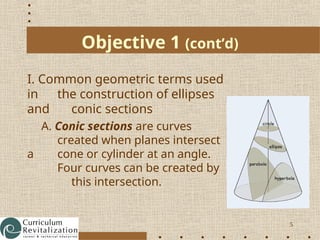
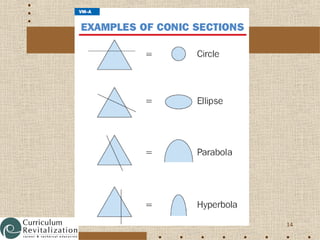
A. Conic sections are curves
created when planes intersect
a cone or cylinder at an angle.
Four curves can be created by
this intersection.
6
Objective 1 (cont’d)
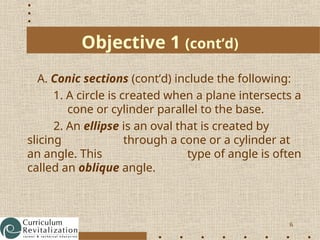
A. Conic sections (cont’d) include the following:
1. A circle is created when a plane intersects a
cone or cylinder parallel to the base.
2. An ellipse is an oval that is created by
slicing through a cone or a cylinder at
an angle. This type of angle is often
called an oblique angle.
7
Objective 1 (cont’d)
A. Conic sections (cont’d)
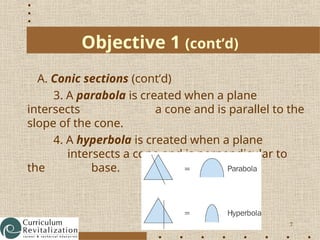
3. A parabola is created when a plane
intersects a cone and is parallel to the
slope of the cone.
4. A hyperbola is created when a plane
intersects a cone and is perpendicular to
the base.
8
Objective 1 (cont’d)
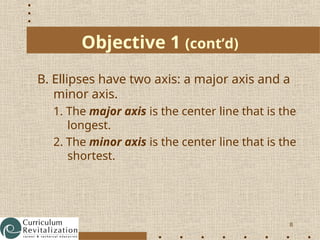
B. Ellipses have two axis: a major axis and a
minor axis.
1. The major axis is the center line that is the
longest.
2. The minor axis is the center line that is the
shortest.
9
Objective 1 (cont’d)
C. An ellipse template is a thin sheet of plastic
with commonly used sizes of ellipses cut into
it.
1. The drafter aligns the desired ellipse in the
template with the center lines on the drawing
where the ellipse is to be drawn.
2. The template is used to guide the pencil as
the drafter traces the ellipse.
10
Objective 1 (cont’d)
C. An ellipse template (cont’d)
3. To create an ellipse that is not a common
size, or if a drafter does not have an
ellipse template, the most
common method is to create a
four-center ellipse. As the name
implies, four center points are located and a
compass is used to create the ellipse by
using the center points.
11
Objective 2
Create ellipses and conic sections.
Anticipated Problem:
What techniques do drafters use to create
ellipses and conic sections?
12
Objective 2 (cont’d)
II. Drafters use computers and traditional
drafting tools to create ellipses, parabolas,
and hyperbolas.
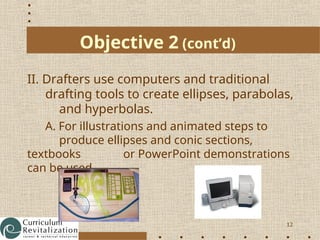
A. For illustrations and animated steps to
produce ellipses and conic sections,
textbooks or PowerPoint demonstrations
can be used.
13
Objective 2 (cont’d)
B. For illustrations and animated steps to
produce ellipses and conic sections, the following
Web sites (or others) can be used for
demonstration purposes:
http://clem.mscd.edu/~talmanl/MathAnim.html
http://www.mathopenref.com/tocs/constructionstoc.html
14

Conic section understanding high school.ppt

  • 1.
    1 Define and UseEllipses and Conic Sections
  • 2.
    2 Student Learning Objectives 1.Define technical terms related to ellipses and conic sections. 2. Create ellipses and conic sections.
  • 3.
    3 Terms  conic sections ellipse  ellipse template  four-center ellipse  hyperbola  major axis  minor axis  oblique  parabola
  • 4.
    4 Objective 1 Define technicalterms related to ellipses and conic sections. Anticipated Problem: What are the common terms used in the construction of ellipses and conic sections?
  • 5.
    5 Objective 1 (cont’d) I.Common geometric terms used in the construction of ellipses and conic sections A. Conic sections are curves created when planes intersect a cone or cylinder at an angle. Four curves can be created by this intersection.
  • 6.
    6 Objective 1 (cont’d) A.Conic sections (cont’d) include the following: 1. A circle is created when a plane intersects a cone or cylinder parallel to the base. 2. An ellipse is an oval that is created by slicing through a cone or a cylinder at an angle. This type of angle is often called an oblique angle.
  • 7.
    7 Objective 1 (cont’d) A.Conic sections (cont’d) 3. A parabola is created when a plane intersects a cone and is parallel to the slope of the cone. 4. A hyperbola is created when a plane intersects a cone and is perpendicular to the base.
  • 8.
    8 Objective 1 (cont’d) B.Ellipses have two axis: a major axis and a minor axis. 1. The major axis is the center line that is the longest. 2. The minor axis is the center line that is the shortest.
  • 9.
    9 Objective 1 (cont’d) C.An ellipse template is a thin sheet of plastic with commonly used sizes of ellipses cut into it. 1. The drafter aligns the desired ellipse in the template with the center lines on the drawing where the ellipse is to be drawn. 2. The template is used to guide the pencil as the drafter traces the ellipse.
  • 10.
    10 Objective 1 (cont’d) C.An ellipse template (cont’d) 3. To create an ellipse that is not a common size, or if a drafter does not have an ellipse template, the most common method is to create a four-center ellipse. As the name implies, four center points are located and a compass is used to create the ellipse by using the center points.
  • 11.
    11 Objective 2 Create ellipsesand conic sections. Anticipated Problem: What techniques do drafters use to create ellipses and conic sections?
  • 12.
    12 Objective 2 (cont’d) II.Drafters use computers and traditional drafting tools to create ellipses, parabolas, and hyperbolas. A. For illustrations and animated steps to produce ellipses and conic sections, textbooks or PowerPoint demonstrations can be used.
  • 13.
    13 Objective 2 (cont’d) B.For illustrations and animated steps to produce ellipses and conic sections, the following Web sites (or others) can be used for demonstration purposes: http://clem.mscd.edu/~talmanl/MathAnim.html http://www.mathopenref.com/tocs/constructionstoc.html
  • 14.