Shigraf Ma’am
Lecture No.- 01
Chapter - Confronting Marginalisation
UMANG 2024
For class 8th students
• Subject – Civics
Topics to be Covered
Topic
Topic
Marginalised groups challenged existing inequalities- How and in
what ways?
Invoking Fundamental Rights - Constitutional Protection.
Protection through laws - legal protection.
Government efforts - Policies and Schemes.
Topic
Topic
Marginalised groups challenged existing inequalities-
different ways
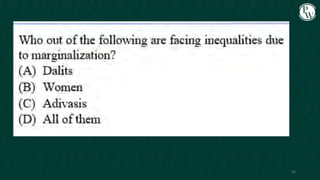
 Marginalised groups [though powerless] – Adivasis, Dalits,
Muslims, Women etc.- fought, protested and struggled against
existing inequalities by adopting different strategies.
 They argued that being a citizen of this country, they possess
equal rights and their rights must be respected.
 They followed three ways in the course of their struggles –
Invoking constitutional provisions (Fundamental Rights),
forced to translate their rights into laws and Government
efforts (polices and schemes).
Invoking Fundamental Rights- Constitutional
Protection
 Marginalised groups invoked fundamental rights in two ways-
 First, they forced the government to recognise the injustice
done to them.
 Second, they insisted on that the government enforce these
fundamental rights.
 In some instances, the struggles of the marginalised have
influenced the government to frame new laws, in keeping with the
spirit of the fundamental rights. For ex- Art. 17- Untouchability
abolished- now, no one can prevent Dalits from educating
themselves, entering temples, using public facilities etc.
 Untouchability is a punishable offense now and this practice will
not be tolerated by a democratic government.
Art. 15 : Right to Equality
 No citizen of India shall be discriminated against on the basis of
religion, race, caste, sex or place of birth etc.
 Dalits invoke this fundamental right to seek equality where it
has been denied to them or where they feel that they have been
treated badly by some individual or community or even by the
government.
Art. 25 to 28 and Art. 29-30
 Apart from Dalits, other minority groups have also invoked the
fundamental rights of freedom of religion and cultural and
educational rights.
 Different cultural and religious groups (Muslims and Parsis)
have the right to be guardians of their culture and right to
decide how their culture has to be preserved.
 These provisions helps marginalised community culture not to
be dominated nor wiped out by majority community.
Laws for the marginalised: Legal Protection
 There are specific laws in our country that protect against the
discrimination and exploitation of marginalised communities.
 For example- Schedule caste and Schedule Tribes (prevention of
Atrocities) Act 1989, Laws related to manual scavenging, Laws
related to Schedule Tribes and traditional forest dwellers etc.
Promoting social justice : Government efforts
 Apart from the routine legislation, there are policies or schemes
that emerge through the committee reports or surveys etc.
 On the basis of such reports or surveys or recommendation,
the government makes an effort to promote such policies or
schemes that give opportunities to specific groups.
 For example- Other Backward Classes reservation policy.
 Both central and state governments launches specific schemes
for implementation in tribal areas or in areas that have high
Dalit population.
 For example free or subsidised hostels for Dalit and Adivasi
students so that they can avail of education facilities which may
not be available in their localities.
Promoting social justice: Government efforts
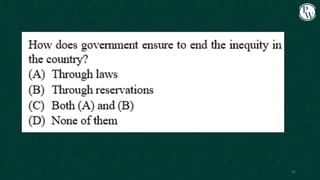
 Government also operates through laws to ensure that
concrete steps are taken to end inequality in the society
and the system. One such law/policy is reservation policy.
Reservation Policy: Why implemented?
 Highly significant and highly debated.
 Reservation of seats in educational institutions and government
employment.
 The important argument is that in a society like ours, where for
centuries, these marginalised groups or sections have been
denied opportunities of education or employment, a democratic
government needs to step in and assist these groups or sections.
How reservation policy works?
 Central government and the state governments have their own
list of SC, ST, Backward and most Backward castes.
 While applying to educational institutions and for government
employment, a caste or tribe certificate is expected to furnish as
proof of their caste or tribe.
 If a Dalit caste or tribe included in the government’s list
(Central or state government), he is eligible to avail the benefit
of reservation.
 For admission to colleges (particularly institutes of professional
education such as medical colleges etc.) government declares a
set of cut-off marks which means that not all Dalit or tribal
candidates but only those who have secured marks above the
cut-off point can qualify for admissions.
 Government also offer special scholarships for these students.
Soyrabai : Mahar poetess of Maharashtra
 Wife of famous Bhakti Poet Chokhamela from Maharashtra.
 Belonged to Mahar caste- at that time considered untouchable.
 She questioned the idea of purity and argued that since every
human is born in the same manner, there is nothing that makes
one body less or more pure than the other.
17
18
19
20
21
22
THANK YU

Confronting Marginalisation 01 Summary Note.pdf

  • 1.
    Shigraf Ma’am Lecture No.-01 Chapter - Confronting Marginalisation UMANG 2024 For class 8th students • Subject – Civics
  • 2.
    Topics to beCovered Topic Topic Marginalised groups challenged existing inequalities- How and in what ways? Invoking Fundamental Rights - Constitutional Protection. Protection through laws - legal protection. Government efforts - Policies and Schemes. Topic Topic
  • 3.
    Marginalised groups challengedexisting inequalities- different ways  Marginalised groups [though powerless] – Adivasis, Dalits, Muslims, Women etc.- fought, protested and struggled against existing inequalities by adopting different strategies.  They argued that being a citizen of this country, they possess equal rights and their rights must be respected.
  • 4.
     They followedthree ways in the course of their struggles – Invoking constitutional provisions (Fundamental Rights), forced to translate their rights into laws and Government efforts (polices and schemes).
  • 5.
    Invoking Fundamental Rights-Constitutional Protection  Marginalised groups invoked fundamental rights in two ways-  First, they forced the government to recognise the injustice done to them.  Second, they insisted on that the government enforce these fundamental rights.
  • 6.
     In someinstances, the struggles of the marginalised have influenced the government to frame new laws, in keeping with the spirit of the fundamental rights. For ex- Art. 17- Untouchability abolished- now, no one can prevent Dalits from educating themselves, entering temples, using public facilities etc.  Untouchability is a punishable offense now and this practice will not be tolerated by a democratic government.
  • 7.
    Art. 15 :Right to Equality  No citizen of India shall be discriminated against on the basis of religion, race, caste, sex or place of birth etc.  Dalits invoke this fundamental right to seek equality where it has been denied to them or where they feel that they have been treated badly by some individual or community or even by the government.
  • 8.
    Art. 25 to28 and Art. 29-30  Apart from Dalits, other minority groups have also invoked the fundamental rights of freedom of religion and cultural and educational rights.  Different cultural and religious groups (Muslims and Parsis) have the right to be guardians of their culture and right to decide how their culture has to be preserved.  These provisions helps marginalised community culture not to be dominated nor wiped out by majority community.
  • 9.
    Laws for themarginalised: Legal Protection  There are specific laws in our country that protect against the discrimination and exploitation of marginalised communities.  For example- Schedule caste and Schedule Tribes (prevention of Atrocities) Act 1989, Laws related to manual scavenging, Laws related to Schedule Tribes and traditional forest dwellers etc.
  • 10.
    Promoting social justice: Government efforts  Apart from the routine legislation, there are policies or schemes that emerge through the committee reports or surveys etc.  On the basis of such reports or surveys or recommendation, the government makes an effort to promote such policies or schemes that give opportunities to specific groups.  For example- Other Backward Classes reservation policy.
  • 11.
     Both centraland state governments launches specific schemes for implementation in tribal areas or in areas that have high Dalit population.  For example free or subsidised hostels for Dalit and Adivasi students so that they can avail of education facilities which may not be available in their localities.
  • 12.
    Promoting social justice:Government efforts  Government also operates through laws to ensure that concrete steps are taken to end inequality in the society and the system. One such law/policy is reservation policy.
  • 13.
    Reservation Policy: Whyimplemented?  Highly significant and highly debated.  Reservation of seats in educational institutions and government employment.  The important argument is that in a society like ours, where for centuries, these marginalised groups or sections have been denied opportunities of education or employment, a democratic government needs to step in and assist these groups or sections.
  • 14.
    How reservation policyworks?  Central government and the state governments have their own list of SC, ST, Backward and most Backward castes.  While applying to educational institutions and for government employment, a caste or tribe certificate is expected to furnish as proof of their caste or tribe.  If a Dalit caste or tribe included in the government’s list (Central or state government), he is eligible to avail the benefit of reservation.
  • 15.
     For admissionto colleges (particularly institutes of professional education such as medical colleges etc.) government declares a set of cut-off marks which means that not all Dalit or tribal candidates but only those who have secured marks above the cut-off point can qualify for admissions.  Government also offer special scholarships for these students.
  • 16.
    Soyrabai : Maharpoetess of Maharashtra  Wife of famous Bhakti Poet Chokhamela from Maharashtra.  Belonged to Mahar caste- at that time considered untouchable.  She questioned the idea of purity and argued that since every human is born in the same manner, there is nothing that makes one body less or more pure than the other.
  • 17.
  • 18.
  • 19.
  • 20.
  • 21.
  • 22.
  • 23.