Goldratt’s “Thinking Process”
Focus on Conflict Resolution
“The Evaporating Cloud”
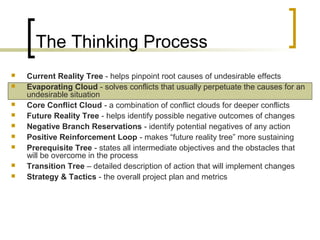
 Current Reality Tree - helps pinpoint root causes of undesirable effects
 Evaporating Cloud - solves conflicts that usually perpetuate the causes for an
undesirable situation
 Core Conflict Cloud - a combination of conflict clouds for deeper conflicts
 Future Reality Tree - helps identify possible negative outcomes of changes
 Negative Branch Reservations - identify potential negatives of any action
 Positive Reinforcement Loop - makes “future reality tree” more sustaining
 Prerequisite Tree - states all intermediate objectives and the obstacles that
will be overcome in the process
 Transition Tree – detailed description of action that will implement changes
 Strategy & Tactics - the overall project plan and metrics
The Thinking Process
Conflict Resolution
 “The Evaporating Cloud”
 Suited to finding a solution to conflict
between two parties or two points of
view.
 The method requires the participants
to find 'win-win' solutions because it
emphasizes that both parties are trying
to reach the same ultimate goal.
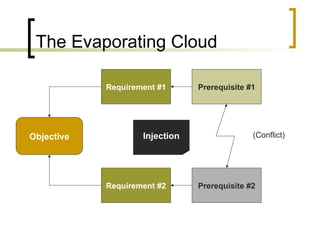
The Evaporating Cloud
Objective
Requirement #1 Prerequisite #1
Prerequisite #2Requirement #2
(Conflict)Injection
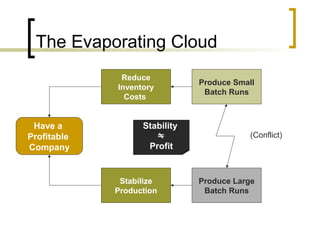
The Evaporating Cloud
Have a
Profitable
Company
Reduce
Inventory
Costs
Produce Small
Batch Runs
Produce Large
Batch Runs
Stabilize
Production
(Conflict)
Stability

Profit
Assumptions
 Assumption-a statement about reality that is
accepted as true or valid without question or
demand for proof
 The presence of an “arrow” in the diagram
indicates an “assumption”
 Invariably some assumptions are not valid
 Solving problems or resolving conflicts calls
upon locating all underlying assumptions we
can that are invalid
Invalid Assumptions
 Some assumptions are noticeably
invalid
 Some may have been valid at one
time but are no longer valid
 When all else fails, attempt to validate
all assumptions (arrows)
Steps to Resolving Conflict
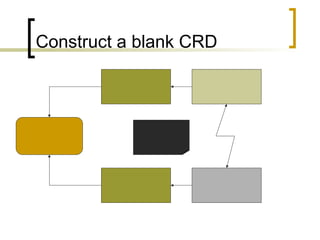
 Construct a blank
conflict resolution
diagram (CRD)
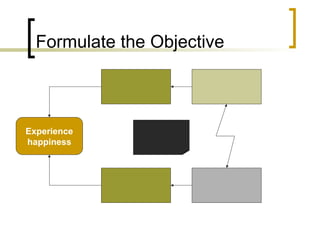
 Formulate the
objective
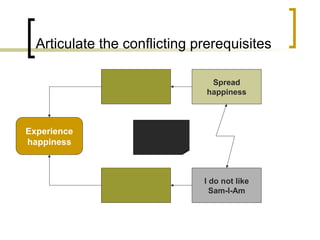
 Articulate the
conflicting
prerequisites
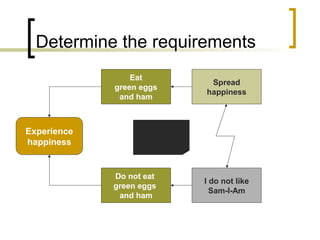
 Determine the
requirements
 Evaluate the CRD
Relationship
 Develop underlying
assumptions
 Evaluate assumptions
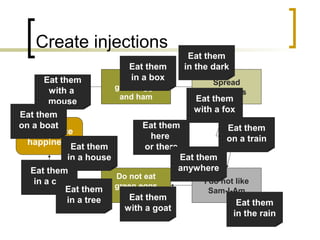
 Create injections
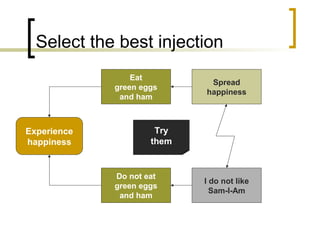
 Select the best
injection
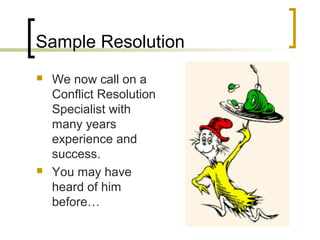
Sample Resolution
 We now call on a
Conflict Resolution
Specialist with
many years
experience and
success.
 You may have
heard of him
before…
Construct a blank CRD
Experience
happiness
Formulate the Objective
Articulate the conflicting prerequisites
Experience
happiness
Spread
happiness
I do not like
Sam-I-Am
Determine the requirements
Experience
happiness
Eat
green eggs
and ham
Spread
happiness
I do not like
Sam-I-Am
Do not eat
green eggs
and ham
Create injections
Experience
happiness
Eat
green eggs
and ham
Spread
happiness
I do not like
Sam-I-Am
Do not eat
green eggs
and ham
Eat them
here
or there
Eat them
anywhere
Eat them
with a
mouse
Eat them
in a house
Eat them
in a box
Eat them
with a fox
Eat them
in a car
Eat them
in a tree
Eat them
in the dark
Eat them
on a train
Eat them
in the rain
Eat them
with a goat
Eat them
on a boat
Select the best injection
Experience
happiness
Eat
green eggs
and ham
Spread
happiness
I do not like
Sam-I-Am
Do not eat
green eggs
and ham
Try
them
Try
them
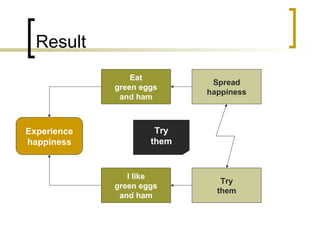
Result
Experience
happiness
Eat
green eggs
and ham
Spread
happiness
I do not like
Sam-I-Am
Get away from
Sam-I-Am
I like
green eggs
and ham
Try
them
Things to remember
 In any conflict, there are usually 5 arrows indicating
underlying assumptions
 Each arrow implies the existence of at least one but
probably more assumptions
 Expose as many assumptions underlying each arrow as you
can
 Injections you develop to invalidate assumptions are ideas,
not solutions. They should not be constrained by premature
considerations of feasibility
 In complex situations, injections are likely to be conditions
you want to create rather than actions you expect to
perform. Many separate actions may be necessary to
achieve these conditions.
Where to learn more
 Goldratt’s Theory of Constraints by H.
William Dettmer
 Wikipedia article “Theory of
Constraints”
 Green Eggs and Ham by Dr. Seuss

Conflict resolution and the evaporating cloud

  • 1.
    Goldratt’s “Thinking Process” Focuson Conflict Resolution “The Evaporating Cloud”
  • 2.
     Current RealityTree - helps pinpoint root causes of undesirable effects  Evaporating Cloud - solves conflicts that usually perpetuate the causes for an undesirable situation  Core Conflict Cloud - a combination of conflict clouds for deeper conflicts  Future Reality Tree - helps identify possible negative outcomes of changes  Negative Branch Reservations - identify potential negatives of any action  Positive Reinforcement Loop - makes “future reality tree” more sustaining  Prerequisite Tree - states all intermediate objectives and the obstacles that will be overcome in the process  Transition Tree – detailed description of action that will implement changes  Strategy & Tactics - the overall project plan and metrics The Thinking Process
  • 3.
    Conflict Resolution  “TheEvaporating Cloud”  Suited to finding a solution to conflict between two parties or two points of view.  The method requires the participants to find 'win-win' solutions because it emphasizes that both parties are trying to reach the same ultimate goal.
  • 4.
    The Evaporating Cloud Objective Requirement#1 Prerequisite #1 Prerequisite #2Requirement #2 (Conflict)Injection
  • 5.
    The Evaporating Cloud Havea Profitable Company Reduce Inventory Costs Produce Small Batch Runs Produce Large Batch Runs Stabilize Production (Conflict) Stability  Profit
  • 6.
    Assumptions  Assumption-a statementabout reality that is accepted as true or valid without question or demand for proof  The presence of an “arrow” in the diagram indicates an “assumption”  Invariably some assumptions are not valid  Solving problems or resolving conflicts calls upon locating all underlying assumptions we can that are invalid
  • 7.
    Invalid Assumptions  Someassumptions are noticeably invalid  Some may have been valid at one time but are no longer valid  When all else fails, attempt to validate all assumptions (arrows)
  • 8.
    Steps to ResolvingConflict  Construct a blank conflict resolution diagram (CRD)  Formulate the objective  Articulate the conflicting prerequisites  Determine the requirements  Evaluate the CRD Relationship  Develop underlying assumptions  Evaluate assumptions  Create injections  Select the best injection
  • 9.
    Sample Resolution  Wenow call on a Conflict Resolution Specialist with many years experience and success.  You may have heard of him before…
  • 10.
  • 11.
  • 12.
    Articulate the conflictingprerequisites Experience happiness Spread happiness I do not like Sam-I-Am
  • 13.
    Determine the requirements Experience happiness Eat greeneggs and ham Spread happiness I do not like Sam-I-Am Do not eat green eggs and ham
  • 14.
    Create injections Experience happiness Eat green eggs andham Spread happiness I do not like Sam-I-Am Do not eat green eggs and ham Eat them here or there Eat them anywhere Eat them with a mouse Eat them in a house Eat them in a box Eat them with a fox Eat them in a car Eat them in a tree Eat them in the dark Eat them on a train Eat them in the rain Eat them with a goat Eat them on a boat
  • 15.
    Select the bestinjection Experience happiness Eat green eggs and ham Spread happiness I do not like Sam-I-Am Do not eat green eggs and ham Try them
  • 16.
    Try them Result Experience happiness Eat green eggs and ham Spread happiness Ido not like Sam-I-Am Get away from Sam-I-Am I like green eggs and ham Try them
  • 17.
    Things to remember In any conflict, there are usually 5 arrows indicating underlying assumptions  Each arrow implies the existence of at least one but probably more assumptions  Expose as many assumptions underlying each arrow as you can  Injections you develop to invalidate assumptions are ideas, not solutions. They should not be constrained by premature considerations of feasibility  In complex situations, injections are likely to be conditions you want to create rather than actions you expect to perform. Many separate actions may be necessary to achieve these conditions.
  • 18.
    Where to learnmore  Goldratt’s Theory of Constraints by H. William Dettmer  Wikipedia article “Theory of Constraints”  Green Eggs and Ham by Dr. Seuss