Asif Abbasi & Waqar Ahmed9/27/2013
CONFLICT MANAGEMENT
Presented by…
ASIF ABBASI WAQAR AHMED
Asif Abbasi & Waqar Ahmed9/27/2013
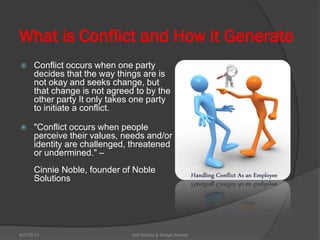
What is Conflict and How it Generate
 Conflict occurs when one party
decides that the way things are is
not okay and seeks change, but
that change is not agreed to by the
other party It only takes one party
to initiate a conflict.
 "Conflict occurs when people
perceive their values, needs and/or
identity are challenged, threatened
or undermined." –
Cinnie Noble, founder of Noble
Solutions
Asif Abbasi & Waqar Ahmed9/27/2013
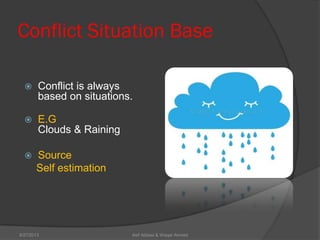
Conflict Situation Base
 Conflict is always
based on situations.
 E.G
Clouds & Raining
 Source
Self estimation
Asif Abbasi & Waqar Ahmed9/27/2013
Definitions
 Conflict is a disagreement
between two or more
parties, such as individuals,
groups, organizations or
countries, who perceive that
they have incompatible
concerns.
"Kavita singh―
 Source Book
Asif Abbasi & Waqar Ahmed9/27/2013
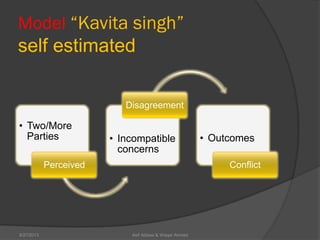
Model “Kavita singh”
self estimated
• Two/More
Parties
Perceived
• Incompatible
concerns
Disagreement
• Outcomes
Conflict
Asif Abbasi & Waqar Ahmed9/27/2013
DEFINATION
 Robbins Stephen P.
Conflict is a process that
begins when one party
perceives that another
party has negatively
affected, or is about to
negatively
affect, something that the
first party cares about.
Asif Abbasi & Waqar Ahmed9/27/2013
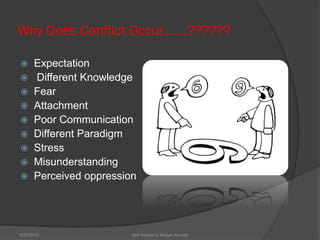
Why Does Conflict Occur.......??????
 Expectation
 Different Knowledge
 Fear
 Attachment
 Poor Communication
 Different Paradigm
 Stress
 Misunderstanding
 Perceived oppression
Asif Abbasi & Waqar Ahmed9/27/2013
Views about Conflict
 "If you want to make
quantum improvements,
either as an individual or as
an organization, change your
frame of reference. Change
how you see the
world...change your
paradigm, your scheme for
understanding and explaining
certain aspects of reality."
―Steven Covey‖
Asif Abbasi & Waqar Ahmed9/27/2013
Different Views about Conflict
 Traditional View
(until 1940’s)
Conflict is Bad
 Human Relation Views
(1940s though the mid
1970s)
Its going to happen, so
cope with it
 Integrationist Views
(later on 1970’s)
The integrationist
approach encourages
conflict and take as
innovative and creative.
Asif Abbasi & Waqar Ahmed9/27/2013
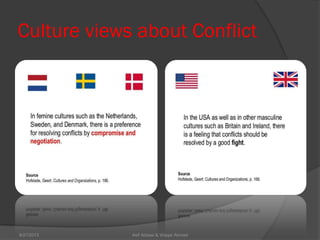
Culture views about Conflict
Asif Abbasi & Waqar Ahmed9/27/2013
Conflict:
Constructive v/s Destructive
 Result in Issue
Clarification
 High Quality
Idea’s
 Develop
Relationship
 Promotes
Inequality
 Poor Results
 Create
complex city in
Processes
Asif Abbasi & Waqar Ahmed9/27/2013
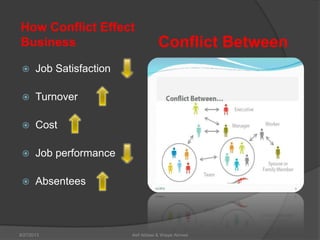
How Conflict Effect
Business Conflict Between
 Job Satisfaction
 Turnover
 Cost
 Job performance
 Absentees
Asif Abbasi & Waqar Ahmed9/27/2013
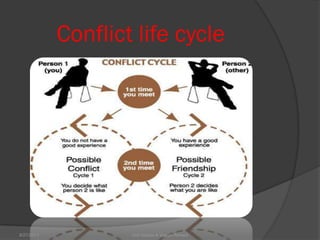
Conflict life cycle
Asif Abbasi & Waqar Ahmed9/27/2013
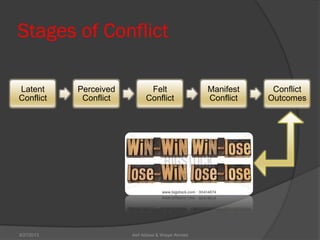
Stages of Conflict
Latent
Conflict
Perceived
Conflict
Felt
Conflict
Manifest
Conflict
Conflict
Outcomes
Asif Abbasi & Waqar Ahmed9/27/2013
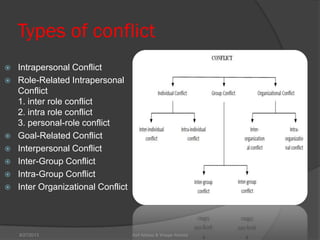
Types of conflict
 Intrapersonal Conflict
 Role-Related Intrapersonal
Conflict
1. inter role conflict
2. intra role conflict
3. personal-role conflict
 Goal-Related Conflict
 Interpersonal Conflict
 Inter-Group Conflict
 Intra-Group Conflict
 Inter Organizational Conflict
Asif Abbasi & Waqar Ahmed9/27/2013
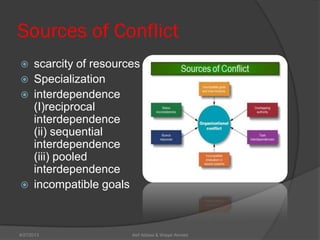
Sources of Conflict
 scarcity of resources
 Specialization
 interdependence
(I)reciprocal
interdependence
(ii) sequential
interdependence
(iii) pooled
interdependence
 incompatible goals
Asif Abbasi & Waqar Ahmed9/27/2013
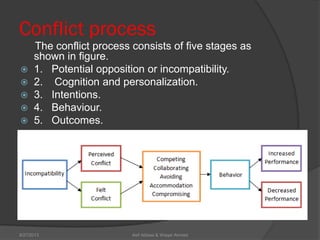
Conflict process
The conflict process consists of five stages as
shown in figure.
 1. Potential opposition or incompatibility.
 2. Cognition and personalization.
 3. Intentions.
 4. Behaviour.
 5. Outcomes.
Asif Abbasi & Waqar Ahmed9/27/2013
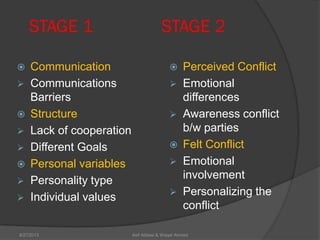
STAGE 1 STAGE 2
 Communication
 Communications
Barriers
 Structure
 Lack of cooperation
 Different Goals
 Personal variables
 Personality type
 Individual values
 Perceived Conflict
 Emotional
differences
 Awareness conflict
b/w parties
 Felt Conflict
 Emotional
involvement
 Personalizing the
conflict
Asif Abbasi & Waqar Ahmed9/27/2013
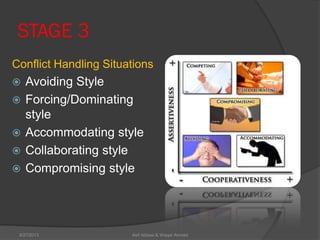
STAGE 3
Conflict Handling Situations
 Avoiding Style
 Forcing/Dominating
style
 Accommodating style
 Collaborating style
 Compromising style
Asif Abbasi & Waqar Ahmed9/27/2013
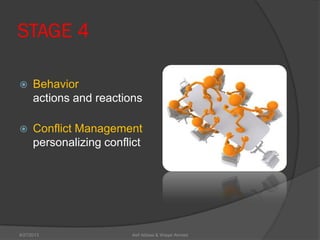
STAGE 4
 Behavior
actions and reactions
 Conflict Management
personalizing conflict
Asif Abbasi & Waqar Ahmed9/27/2013
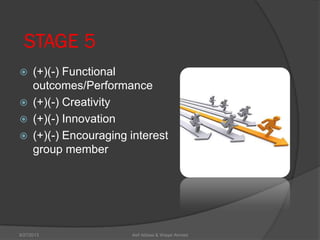
STAGE 5
 (+)(-) Functional
outcomes/Performance
 (+)(-) Creativity
 (+)(-) Innovation
 (+)(-) Encouraging interest
group member
Asif Abbasi & Waqar Ahmed9/27/2013
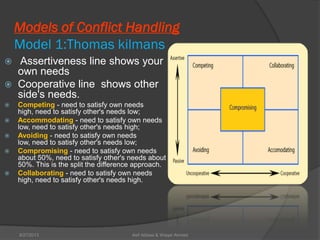
Models of Conflict Handling
Model 1:Thomas kilmans
 Assertiveness line shows your
own needs
 Cooperative line shows other
side's needs.
 Competing - need to satisfy own needs
high, need to satisfy other's needs low;
 Accommodating - need to satisfy own needs
low, need to satisfy other's needs high;
 Avoiding - need to satisfy own needs
low, need to satisfy other's needs low;
 Compromising - need to satisfy own needs
about 50%, need to satisfy other's needs about
50%. This is the split the difference approach.
 Collaborating - need to satisfy own needs
high, need to satisfy other's needs high.
Asif Abbasi & Waqar Ahmed9/27/2013
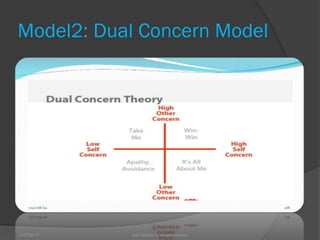
Model2: Dual Concern Model
Asif Abbasi & Waqar Ahmed9/27/2013
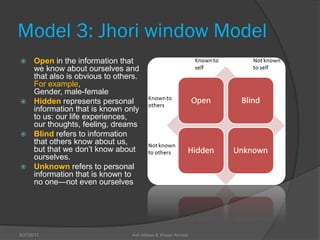
Model 3: Jhori window Model
 Open in the information that
we know about ourselves and
that also is obvious to others.
For example,
Gender, male-female
 Hidden represents personal
information that is known only
to us: our life experiences,
our thoughts, feeling, dreams
 Blind refers to information
that others know about us,
but that we don’t know about
ourselves.
 Unknown refers to personal
information that is known to
no one—not even ourselves
Asif Abbasi & Waqar Ahmed9/27/2013
Islam Define conflict
 Quran
"
―And if two factions among the believers should
fight, then make settlement between the two. But if
one of them oppresses the other, then fight against
the one that oppresses until it returns to the
ordinance of Allah. And if it returns, then make
settlement between them in justice and act justly.
Indeed, Allah loves those who act justly."
Asif Abbasi & Waqar Ahmed9/27/2013
Hadees
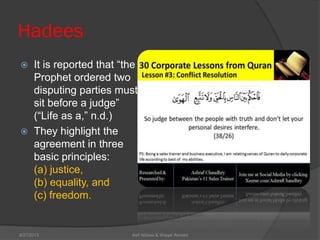
 It is reported that ―the
Prophet ordered two
disputing parties must
sit before a judge‖
(―Life as a,‖ n.d.)
 They highlight the
agreement in three
basic principles:
(a) justice,
(b) equality, and
(c) freedom.
Asif Abbasi & Waqar Ahmed9/27/2013
Matthews (2005)
 ―Islamic intervention in
conflict is guided by the
goals of restoring Islam’s
original messages of
justice, equality, and
freedom, especially those
who have been
disempowered‖
A Community-Based Development of an
Islamic Approach to Conflict Resolution
source
http://yusufmendez.wordpress.com/islamic-
conflict-resolution-approach-proposal/
Asif Abbasi & Waqar Ahmed9/27/2013
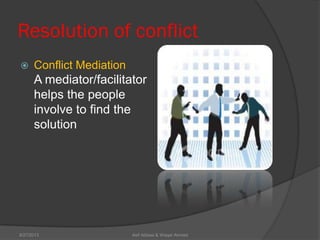
Resolution of conflict
 Conflict Mediation
A mediator/facilitator
helps the people
involve to find the
solution
Asif Abbasi & Waqar Ahmed9/27/2013
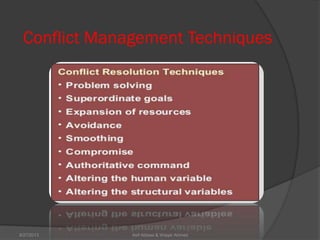
Conflict Management Techniques
Asif Abbasi & Waqar Ahmed9/27/2013
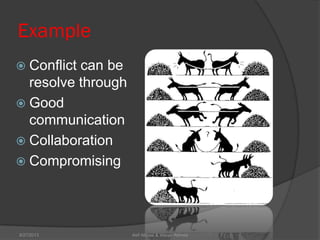
Example
 Conflict can be
resolve through
 Good
communication
 Collaboration
 Compromising
Asif Abbasi & Waqar Ahmed9/27/2013
RESOLUTION WITH EFFICEINCY
EXAMPLE THE ORANGE

Two little girls were arguing over an orange, "Give it
to me, I want this orange, it's mine" shouted the first
girl. "And I want this orange too, I need it right now,"
cried the other girl. The teacher came in and listened
to the requirement of each of the girls. Both wanted
the same thing. The teacher takes a knife and cut the
orange in two halves. She gives each little girl one
half.
 The first girl peels her half, throws away the
skin, and eats the inside.
 The second girl also peels her half of the orange, but
throws away the inside, and puts the skin aside to
dry. She wanted to make some cookies out of the
orange.
Asif Abbasi & Waqar Ahmed9/27/2013
AnY QuesTioN…..???
Asif Abbasi & Waqar Ahmed9/27/2013

Conflict management ppt

  • 1.
    Asif Abbasi &Waqar Ahmed9/27/2013
  • 2.
    CONFLICT MANAGEMENT Presented by… ASIFABBASI WAQAR AHMED Asif Abbasi & Waqar Ahmed9/27/2013
  • 3.
    What is Conflictand How it Generate  Conflict occurs when one party decides that the way things are is not okay and seeks change, but that change is not agreed to by the other party It only takes one party to initiate a conflict.  "Conflict occurs when people perceive their values, needs and/or identity are challenged, threatened or undermined." – Cinnie Noble, founder of Noble Solutions Asif Abbasi & Waqar Ahmed9/27/2013
  • 4.
    Conflict Situation Base Conflict is always based on situations.  E.G Clouds & Raining  Source Self estimation Asif Abbasi & Waqar Ahmed9/27/2013
  • 5.
    Definitions  Conflict isa disagreement between two or more parties, such as individuals, groups, organizations or countries, who perceive that they have incompatible concerns. "Kavita singh―  Source Book Asif Abbasi & Waqar Ahmed9/27/2013
  • 6.
    Model “Kavita singh” selfestimated • Two/More Parties Perceived • Incompatible concerns Disagreement • Outcomes Conflict Asif Abbasi & Waqar Ahmed9/27/2013
  • 7.
    DEFINATION  Robbins StephenP. Conflict is a process that begins when one party perceives that another party has negatively affected, or is about to negatively affect, something that the first party cares about. Asif Abbasi & Waqar Ahmed9/27/2013
  • 8.
    Why Does ConflictOccur.......??????  Expectation  Different Knowledge  Fear  Attachment  Poor Communication  Different Paradigm  Stress  Misunderstanding  Perceived oppression Asif Abbasi & Waqar Ahmed9/27/2013
  • 9.
    Views about Conflict "If you want to make quantum improvements, either as an individual or as an organization, change your frame of reference. Change how you see the world...change your paradigm, your scheme for understanding and explaining certain aspects of reality." ―Steven Covey‖ Asif Abbasi & Waqar Ahmed9/27/2013
  • 10.
    Different Views aboutConflict  Traditional View (until 1940’s) Conflict is Bad  Human Relation Views (1940s though the mid 1970s) Its going to happen, so cope with it  Integrationist Views (later on 1970’s) The integrationist approach encourages conflict and take as innovative and creative. Asif Abbasi & Waqar Ahmed9/27/2013
  • 11.
    Culture views aboutConflict Asif Abbasi & Waqar Ahmed9/27/2013
  • 12.
    Conflict: Constructive v/s Destructive Result in Issue Clarification  High Quality Idea’s  Develop Relationship  Promotes Inequality  Poor Results  Create complex city in Processes Asif Abbasi & Waqar Ahmed9/27/2013
  • 13.
    How Conflict Effect BusinessConflict Between  Job Satisfaction  Turnover  Cost  Job performance  Absentees Asif Abbasi & Waqar Ahmed9/27/2013
  • 14.
    Conflict life cycle AsifAbbasi & Waqar Ahmed9/27/2013
  • 15.
  • 16.
    Types of conflict Intrapersonal Conflict  Role-Related Intrapersonal Conflict 1. inter role conflict 2. intra role conflict 3. personal-role conflict  Goal-Related Conflict  Interpersonal Conflict  Inter-Group Conflict  Intra-Group Conflict  Inter Organizational Conflict Asif Abbasi & Waqar Ahmed9/27/2013
  • 17.
    Sources of Conflict scarcity of resources  Specialization  interdependence (I)reciprocal interdependence (ii) sequential interdependence (iii) pooled interdependence  incompatible goals Asif Abbasi & Waqar Ahmed9/27/2013
  • 18.
    Conflict process The conflictprocess consists of five stages as shown in figure.  1. Potential opposition or incompatibility.  2. Cognition and personalization.  3. Intentions.  4. Behaviour.  5. Outcomes. Asif Abbasi & Waqar Ahmed9/27/2013
  • 19.
    STAGE 1 STAGE2  Communication  Communications Barriers  Structure  Lack of cooperation  Different Goals  Personal variables  Personality type  Individual values  Perceived Conflict  Emotional differences  Awareness conflict b/w parties  Felt Conflict  Emotional involvement  Personalizing the conflict Asif Abbasi & Waqar Ahmed9/27/2013
  • 20.
    STAGE 3 Conflict HandlingSituations  Avoiding Style  Forcing/Dominating style  Accommodating style  Collaborating style  Compromising style Asif Abbasi & Waqar Ahmed9/27/2013
  • 21.
    STAGE 4  Behavior actionsand reactions  Conflict Management personalizing conflict Asif Abbasi & Waqar Ahmed9/27/2013
  • 22.
    STAGE 5  (+)(-)Functional outcomes/Performance  (+)(-) Creativity  (+)(-) Innovation  (+)(-) Encouraging interest group member Asif Abbasi & Waqar Ahmed9/27/2013
  • 23.
    Models of ConflictHandling Model 1:Thomas kilmans  Assertiveness line shows your own needs  Cooperative line shows other side's needs.  Competing - need to satisfy own needs high, need to satisfy other's needs low;  Accommodating - need to satisfy own needs low, need to satisfy other's needs high;  Avoiding - need to satisfy own needs low, need to satisfy other's needs low;  Compromising - need to satisfy own needs about 50%, need to satisfy other's needs about 50%. This is the split the difference approach.  Collaborating - need to satisfy own needs high, need to satisfy other's needs high. Asif Abbasi & Waqar Ahmed9/27/2013
  • 24.
    Model2: Dual ConcernModel Asif Abbasi & Waqar Ahmed9/27/2013
  • 25.
    Model 3: Jhoriwindow Model  Open in the information that we know about ourselves and that also is obvious to others. For example, Gender, male-female  Hidden represents personal information that is known only to us: our life experiences, our thoughts, feeling, dreams  Blind refers to information that others know about us, but that we don’t know about ourselves.  Unknown refers to personal information that is known to no one—not even ourselves Asif Abbasi & Waqar Ahmed9/27/2013
  • 26.
    Islam Define conflict Quran " ―And if two factions among the believers should fight, then make settlement between the two. But if one of them oppresses the other, then fight against the one that oppresses until it returns to the ordinance of Allah. And if it returns, then make settlement between them in justice and act justly. Indeed, Allah loves those who act justly." Asif Abbasi & Waqar Ahmed9/27/2013
  • 27.
    Hadees  It isreported that ―the Prophet ordered two disputing parties must sit before a judge‖ (―Life as a,‖ n.d.)  They highlight the agreement in three basic principles: (a) justice, (b) equality, and (c) freedom. Asif Abbasi & Waqar Ahmed9/27/2013
  • 28.
    Matthews (2005)  ―Islamicintervention in conflict is guided by the goals of restoring Islam’s original messages of justice, equality, and freedom, especially those who have been disempowered‖ A Community-Based Development of an Islamic Approach to Conflict Resolution source http://yusufmendez.wordpress.com/islamic- conflict-resolution-approach-proposal/ Asif Abbasi & Waqar Ahmed9/27/2013
  • 29.
    Resolution of conflict Conflict Mediation A mediator/facilitator helps the people involve to find the solution Asif Abbasi & Waqar Ahmed9/27/2013
  • 30.
    Conflict Management Techniques AsifAbbasi & Waqar Ahmed9/27/2013
  • 31.
    Example  Conflict canbe resolve through  Good communication  Collaboration  Compromising Asif Abbasi & Waqar Ahmed9/27/2013
  • 32.
    RESOLUTION WITH EFFICEINCY EXAMPLETHE ORANGE  Two little girls were arguing over an orange, "Give it to me, I want this orange, it's mine" shouted the first girl. "And I want this orange too, I need it right now," cried the other girl. The teacher came in and listened to the requirement of each of the girls. Both wanted the same thing. The teacher takes a knife and cut the orange in two halves. She gives each little girl one half.  The first girl peels her half, throws away the skin, and eats the inside.  The second girl also peels her half of the orange, but throws away the inside, and puts the skin aside to dry. She wanted to make some cookies out of the orange. Asif Abbasi & Waqar Ahmed9/27/2013
  • 33.
    AnY QuesTioN…..??? Asif Abbasi& Waqar Ahmed9/27/2013