SACRAMENT OF
CONFIRMATION
A Presentation for BSN-IIIC
27th of September, 2021
Barba, David
Feliciano, Angelica
Montejar, Ester Beth
Ramirez, Gered
Tubis, Gheona Gee
FLOW OF PRESENTATION
3
I. Scriptural Foundation on the Sacrament of Confirmation
II. Sacrament of Confirmation Defined
III.Importance of the Sacrament of Confirmation
IV. Important Concepts on the Sacrament
Objectives:
1. To learn what is the sacrament of
confirmation all about.
2. To appreciate the essence of the sacrament
in our Christian lives.
4
1. Scriptural Foundation on the
Sacrament of Confirmation
⋄ The prophets of the Old Testament foretold that God's Spirit
would rest upon the Messiah to sustain his mission.
Their prophecy was fulfilled!
HOW?
6
7
The roots of confirmation are found in the Church of the
New Testament.
⋄ In the Gospel of John 14, Christ speaks of the coming of the
Holy Spirit on the Apostles (John 14:15–26).
⋄ Later, after his Resurrection, Jesus breathed upon them and
they received the Holy Spirit (John 20:22), a process completed
on the day of Pentecost (Acts 2:1–4).
⋄ That Pentecostal outpouring of the Spirit was the sign of the
messianic age foretold by the prophets (cf. Ezek 36:25–27; Joel
3:1–2). Its arrival was proclaimed by Apostle Peter. Filled with
the Holy Spirit the apostles began to proclaim "the mighty
works of God" (Acts 2:11; Cf. 2:17–18). After this point, the New
Testament records the apostles bestowing the Holy Spirit upon
others through the laying on of hands.
8
⋄ Hebrews 6:1–3 — New Living Translation (NLT)
1 So let us stop going over the basic teachings about Christ again and
again. Let us go on instead and become mature in our understanding.
Surely we don’t need to start again with the fundamental importance
of repenting from evil deeds and placing our faith in God. 2 You don’t
need further instruction about baptisms, the laying on of hands, the
resurrection of the dead, and eternal judgment. 3 And so, God willing,
we will move forward to further understanding.
9
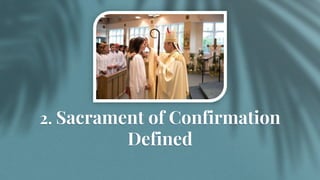
2. Sacrament of Confirmation
Defined
11
The word comes from the Latin con- "together,
altogether," and firmāre "make firm," so confirm
originally meant roughly "to make (something)
altogether firm."
⋄ Confirmation is the sacrament of spiritual strengthening
through a special conferral of the Holy Spirit for those who
have already received spiritual regeneration in Baptism.
⋄ It is a rite of initiation in Christian churches, normally carried
out through anointing and/or the laying on of hands and
prayer for the purpose of bestowing the Gift of the Holy Spirit.
12
⋄ Other terms for the Sacrament of Confirmation:
• The Sacrament of Myron
• Holy Anointment
The word ‘Myron’ is a Greek word which means ‘ointment’ or
‘fragrant perfume’. Confirmation confers a sacramental
character that cannot be erased and that predisposes the Christian
person to receive the very life of God, and his divine protection.
Confirmation perpetuates (keeps alive) the grace of Pentecost.
Confirmation has a Messianic (salvific) character.
13
⋄ In the Sacrament of Confirmation, the baptized person is "sealed
with the gift of the Holy Spirit" and is strengthened for service to
the Body of Christ.
⋄ Confirmation deepens our baptismal life that calls us to be
missionary witnesses of Jesus Christ in our families,
neighborhoods, society, and the world. We receive the message of
faith in a deeper and more intensive manner with great emphasis
given to the person of Jesus Christ, who asked the Father to give
the Holy Spirit to the Church for building up the community in
loving service.
14
3. Importance of the Sacrament of
Confirmation
⋄ The Holy Spirit bestows seven gifts to assist us
in our mission and witness. The impact of
these gifts accompanies us in the various
stages of our spiritual development.
16
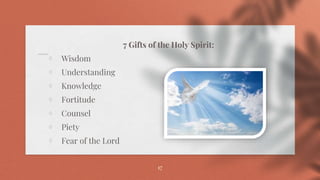
7 Gifts of the Holy Spirit:
⋄ Wisdom
⋄ Understanding
⋄ Knowledge
⋄ Fortitude
⋄ Counsel
⋄ Piety
⋄ Fear of the Lord
17
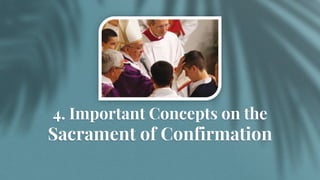
4. Important Concepts on the
Sacrament of Confirmation
Who can receive the Sacrament of Confirmation?
⋄ Only those who were already baptized can and should receive
this sacrament which can be received only once. To receive
Confirmation efficaciously the candidate must be in the state
of grace.
19
Who can minister the Sacrament of Confirmation?
⋄ The original minister of Confirmation is the bishop. When a
priest confers this sacrament, as ordinarily happens in the East
and in special cases in the West, the link with the bishop and
with the Church is expressed by the priest who is the
collaborator of the bishop and by the Sacred Chrism,
consecrated by the bishop himself.
20
Current Ritual Structure of the Sacrament
⋄ The sacrament of Confirmation is usually celebrated during the
Eucharist after the Liturgy of the Word.
⋄ There are six parts to the Confirmation ceremony. Rite of
Confirmation:
Presentation of the Candidates, Homily, Renewal of Baptismal
promises, Laying on of hands, Naming and anointing with Chrism,
Sign of peace
21
Concept on Form and Matter
⋄ The matter of the sacrament of Confirmation is the
anointing with chrism, a mixture of olive oil and balm blessed
by the bishop during the Holy Thursday ceremony. Balm is
fragrant and preserves from corruption; it signifies that the
Christian is henceforth capable of giving off the perfume of
Christian virtues and preserving himself from the corruption
of vice.
22
Who are the sponsors for the Sacrament of Confirmation?
⋄ Being a sponsor is a lifelong commitment. A sponsor takes
on the role of a spiritual parent who “brings the candidate to
receive the sacrament, presents him to the minister for the
anointing, and will later help him to fulfill his baptismal
promises faithfully under the influence of the Holy Spirit” (Rite
of Confirmation 5).
⋄
23
⋄ The primary responsibility of the sponsor is to provide the
candidate prayerful support and guidance in his or her
Christian walk and to “take care that the confirmed person
behaves as a true witness of Christ and faithfully fulfills the
obligations inherent in this sacrament” (canon 892).
24
End of Presentation

Confirmation

  • 1.
    SACRAMENT OF CONFIRMATION A Presentationfor BSN-IIIC 27th of September, 2021
  • 2.
    Barba, David Feliciano, Angelica Montejar,Ester Beth Ramirez, Gered Tubis, Gheona Gee
  • 3.
    FLOW OF PRESENTATION 3 I.Scriptural Foundation on the Sacrament of Confirmation II. Sacrament of Confirmation Defined III.Importance of the Sacrament of Confirmation IV. Important Concepts on the Sacrament
  • 4.
    Objectives: 1. To learnwhat is the sacrament of confirmation all about. 2. To appreciate the essence of the sacrament in our Christian lives. 4
  • 5.
    1. Scriptural Foundationon the Sacrament of Confirmation
  • 6.
    ⋄ The prophetsof the Old Testament foretold that God's Spirit would rest upon the Messiah to sustain his mission. Their prophecy was fulfilled! HOW? 6
  • 7.
    7 The roots ofconfirmation are found in the Church of the New Testament. ⋄ In the Gospel of John 14, Christ speaks of the coming of the Holy Spirit on the Apostles (John 14:15–26). ⋄ Later, after his Resurrection, Jesus breathed upon them and they received the Holy Spirit (John 20:22), a process completed on the day of Pentecost (Acts 2:1–4).
  • 8.
    ⋄ That Pentecostaloutpouring of the Spirit was the sign of the messianic age foretold by the prophets (cf. Ezek 36:25–27; Joel 3:1–2). Its arrival was proclaimed by Apostle Peter. Filled with the Holy Spirit the apostles began to proclaim "the mighty works of God" (Acts 2:11; Cf. 2:17–18). After this point, the New Testament records the apostles bestowing the Holy Spirit upon others through the laying on of hands. 8
  • 9.
    ⋄ Hebrews 6:1–3— New Living Translation (NLT) 1 So let us stop going over the basic teachings about Christ again and again. Let us go on instead and become mature in our understanding. Surely we don’t need to start again with the fundamental importance of repenting from evil deeds and placing our faith in God. 2 You don’t need further instruction about baptisms, the laying on of hands, the resurrection of the dead, and eternal judgment. 3 And so, God willing, we will move forward to further understanding. 9
  • 10.
    2. Sacrament ofConfirmation Defined
  • 11.
    11 The word comesfrom the Latin con- "together, altogether," and firmāre "make firm," so confirm originally meant roughly "to make (something) altogether firm."
  • 12.
    ⋄ Confirmation isthe sacrament of spiritual strengthening through a special conferral of the Holy Spirit for those who have already received spiritual regeneration in Baptism. ⋄ It is a rite of initiation in Christian churches, normally carried out through anointing and/or the laying on of hands and prayer for the purpose of bestowing the Gift of the Holy Spirit. 12
  • 13.
    ⋄ Other termsfor the Sacrament of Confirmation: • The Sacrament of Myron • Holy Anointment The word ‘Myron’ is a Greek word which means ‘ointment’ or ‘fragrant perfume’. Confirmation confers a sacramental character that cannot be erased and that predisposes the Christian person to receive the very life of God, and his divine protection. Confirmation perpetuates (keeps alive) the grace of Pentecost. Confirmation has a Messianic (salvific) character. 13
  • 14.
    ⋄ In theSacrament of Confirmation, the baptized person is "sealed with the gift of the Holy Spirit" and is strengthened for service to the Body of Christ. ⋄ Confirmation deepens our baptismal life that calls us to be missionary witnesses of Jesus Christ in our families, neighborhoods, society, and the world. We receive the message of faith in a deeper and more intensive manner with great emphasis given to the person of Jesus Christ, who asked the Father to give the Holy Spirit to the Church for building up the community in loving service. 14
  • 15.
    3. Importance ofthe Sacrament of Confirmation
  • 16.
    ⋄ The HolySpirit bestows seven gifts to assist us in our mission and witness. The impact of these gifts accompanies us in the various stages of our spiritual development. 16
  • 17.
    7 Gifts ofthe Holy Spirit: ⋄ Wisdom ⋄ Understanding ⋄ Knowledge ⋄ Fortitude ⋄ Counsel ⋄ Piety ⋄ Fear of the Lord 17
  • 18.
    4. Important Conceptson the Sacrament of Confirmation
  • 19.
    Who can receivethe Sacrament of Confirmation? ⋄ Only those who were already baptized can and should receive this sacrament which can be received only once. To receive Confirmation efficaciously the candidate must be in the state of grace. 19
  • 20.
    Who can ministerthe Sacrament of Confirmation? ⋄ The original minister of Confirmation is the bishop. When a priest confers this sacrament, as ordinarily happens in the East and in special cases in the West, the link with the bishop and with the Church is expressed by the priest who is the collaborator of the bishop and by the Sacred Chrism, consecrated by the bishop himself. 20
  • 21.
    Current Ritual Structureof the Sacrament ⋄ The sacrament of Confirmation is usually celebrated during the Eucharist after the Liturgy of the Word. ⋄ There are six parts to the Confirmation ceremony. Rite of Confirmation: Presentation of the Candidates, Homily, Renewal of Baptismal promises, Laying on of hands, Naming and anointing with Chrism, Sign of peace 21
  • 22.
    Concept on Formand Matter ⋄ The matter of the sacrament of Confirmation is the anointing with chrism, a mixture of olive oil and balm blessed by the bishop during the Holy Thursday ceremony. Balm is fragrant and preserves from corruption; it signifies that the Christian is henceforth capable of giving off the perfume of Christian virtues and preserving himself from the corruption of vice. 22
  • 23.
    Who are thesponsors for the Sacrament of Confirmation? ⋄ Being a sponsor is a lifelong commitment. A sponsor takes on the role of a spiritual parent who “brings the candidate to receive the sacrament, presents him to the minister for the anointing, and will later help him to fulfill his baptismal promises faithfully under the influence of the Holy Spirit” (Rite of Confirmation 5). ⋄ 23
  • 24.
    ⋄ The primaryresponsibility of the sponsor is to provide the candidate prayerful support and guidance in his or her Christian walk and to “take care that the confirmed person behaves as a true witness of Christ and faithfully fulfills the obligations inherent in this sacrament” (canon 892). 24
  • 25.