08 Nov 2007 Copyright 2007 Patrick Wegerson - All Rights Reserved 1
Configuration Management for
Embedded Systems
Software and the “Hard” Stuff
Patrick Wegerson
Bloomington, Minnesota USA
08 Nov 2007 Copyright 2007 Patrick Wegerson - All Rights Reserved2
Presentation Objectives
 To Compare Software and Hardware
Configuration Management (CM)
 To Describe the Challenges of
Systems (not just Software) CM
 To Describe Best Practices of
Embedded Systems CM
 To Answer Your Questions
 To Enjoy the Presentation!
08 Nov 2007 Copyright 2007 Patrick Wegerson - All Rights Reserved3
Agenda
 Introduction
 Compare Software CM to Hardware CM
 Systems CM Overview
 Systems CM Best Practices
 Summary
 References
08 Nov 2007 Copyright 2007 Patrick Wegerson - All Rights Reserved4
Introduction
 Who: Your Presenter
 What: Effectively integrating
Hardware CM with Software CM to
create System CM
 Why: Embedded Systems
development works better when
supported by System CM
 Where and When: Here and Now!
08 Nov 2007 Copyright 2007 Patrick Wegerson - All Rights Reserved5
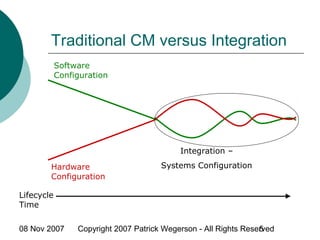
Traditional CM versus Integration
Software
Configuration
Hardware
Configuration
Integration –
Systems Configuration
Lifecycle
Time
08 Nov 2007 Copyright 2007 Patrick Wegerson - All Rights Reserved6
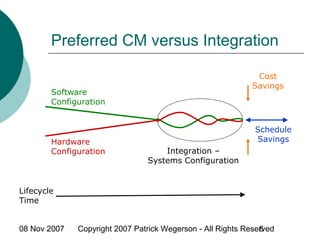
Preferred CM versus Integration
Software
Configuration
Hardware
Configuration Integration –
Systems Configuration
Lifecycle
Time
Schedule
Savings
Cost
Savings
08 Nov 2007 Copyright 2007 Patrick Wegerson - All Rights Reserved7
Agenda
 Introduction
 Compare Software CM to Hardware CM
 Systems CM Overview
 Systems CM Best Practices
 Summary
 References
08 Nov 2007 Copyright 2007 Patrick Wegerson - All Rights Reserved8
Hardware Configuration Management
 Developed from military and
aerospace systems experience
 Nearly 50 years of experience (as a
defined support process)
 Numerous supporting tools available
 Standardized practices across
differing industries
 Only sometimes integrated with

hardware development tools
08 Nov 2007 Copyright 2007 Patrick Wegerson - All Rights Reserved9
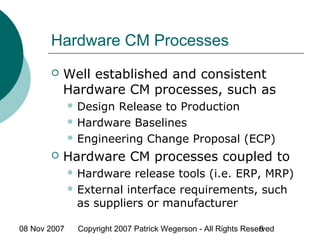
Hardware CM Processes
 Well established and consistent
Hardware CM processes, such as
 Design Release to Production
 Hardware Baselines
 Engineering Change Proposal (ECP)
 Hardware CM processes coupled to
 Hardware release tools (i.e. ERP, MRP)
 External interface requirements, such
as suppliers or manufacturer
08 Nov 2007 Copyright 2007 Patrick Wegerson - All Rights Reserved10
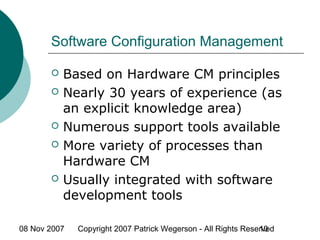
Software Configuration Management
 Based on Hardware CM principles
 Nearly 30 years of experience (as
an explicit knowledge area)
 Numerous support tools available
 More variety of processes than
Hardware CM
 Usually integrated with software
development tools
08 Nov 2007 Copyright 2007 Patrick Wegerson - All Rights Reserved11
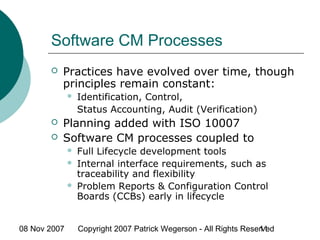
Software CM Processes
 Practices have evolved over time, though
principles remain constant:
 Identification, Control,
Status Accounting, Audit (Verification)
 Planning added with ISO 10007
 Software CM processes coupled to
 Full Lifecycle development tools
 Internal interface requirements, such as
traceability and flexibility
 Problem Reports & Configuration Control
Boards (CCBs) early in lifecycle
08 Nov 2007 Copyright 2007 Patrick Wegerson - All Rights Reserved12
Agenda
 Introduction
 Compare Software CM to Hardware CM
 Systems CM Overview
 Systems CM Best Practices
 Summary
 References
08 Nov 2007 Copyright 2007 Patrick Wegerson - All Rights Reserved13
Systems CM Overview
 “Begin with the end in mind”
 Fully integrated embedded system
 Efficient use of resources, cost and
schedule
 Effective product development processes
 Project management is equivalent
across hardware and software
 CM complements project management
 Project management drives to results
 CM accurately records what resulted
08 Nov 2007 Copyright 2007 Patrick Wegerson - All Rights Reserved14
Systems CM Challenges
 Why are Hardware CM and Software
CM treated so differently?
 Are there major differences between
Hardware CM and Software CM?
 How are Hardware CM and Software
CM similar?
 How can Hardware CM and Software
CM be better aligned and integrated?
08 Nov 2007 Copyright 2007 Patrick Wegerson - All Rights Reserved15
Systems CM Planning
 “Plan CM Work, Work the CM Plan”
 Plan for integrated CM through
 Processes selected or defined
 Tools selected and used
 One comprehensive (Systems) CM Plan
 Hierarchy of Configuration Control Boards
(SE/SW/HW)
 Best if supported by organizational CM
processes and tools
 Iterative (on-going) CM planning
 Resources need to be assigned
08 Nov 2007 Copyright 2007 Patrick Wegerson - All Rights Reserved16
Systems CM Identification
 Baselines include software and
hardware configuration items (CI)
 Software CI and Hardware CI use
consistent identification scheme
 Same CM Identification “language”
regardless of hardware or software
 Includes identifying components,
baselines, versions, etc.
 Reduces defects / simplifies auditing
08 Nov 2007 Copyright 2007 Patrick Wegerson - All Rights Reserved17
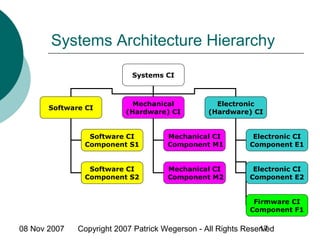
Systems Architecture Hierarchy
Systems CI
Software CI
Mechanical
(Hardware) CI
Electronic
(Hardware) CI
Software CI
Component S1
Software CI
Component S2
Mechanical CI
Component M1
Mechanical CI
Component M2
Electronic CI
Component E1
Electronic CI
Component E2
Firmware CI
Component F1
08 Nov 2007 Copyright 2007 Patrick Wegerson - All Rights Reserved18
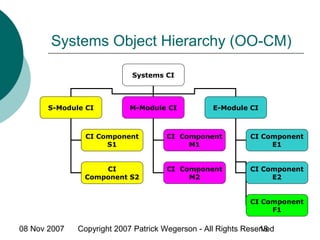
Systems Object Hierarchy (OO-CM)
Systems CI
S-Module CI M-Module CI E-Module CI
CI Component
S1
CI
Component S2
CI Component
M1
CI Component
M2
CI Component
E1
CI Component
E2
CI Component
F1
08 Nov 2007 Copyright 2007 Patrick Wegerson - All Rights Reserved19
Systems CM Control
 Use same tools for tracking hardware
or software change proposals
 Change impact must consider effects
on both hardware and software CI
 Hierarchy of Configuration Control
Boards (CCBs or ISO 10007
“dispositioning authority”)
08 Nov 2007 Copyright 2007 Patrick Wegerson - All Rights Reserved20
Systems CM Status Accounting
 Best generated from an automated
configuration information system
 Should tailor CM status reports to a
specific audience, such as hardware
 Essential for current traceability of
the complete system
 Data retention, security, recovery are
critical product configuration data
08 Nov 2007 Copyright 2007 Patrick Wegerson - All Rights Reserved21
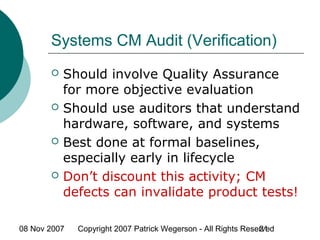
Systems CM Audit (Verification)
 Should involve Quality Assurance
for more objective evaluation
 Should use auditors that understand
hardware, software, and systems
 Best done at formal baselines,
especially early in lifecycle
 Don’t discount this activity; CM
defects can invalidate product tests!
08 Nov 2007 Copyright 2007 Patrick Wegerson - All Rights Reserved22
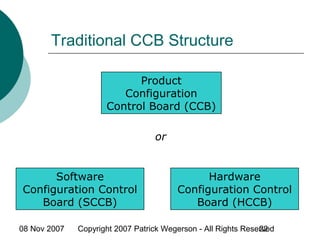
Traditional CCB Structure
Product
Configuration
Control Board (CCB)
or
Software
Configuration Control
Board (SCCB)
Hardware
Configuration Control
Board (HCCB)
08 Nov 2007 Copyright 2007 Patrick Wegerson - All Rights Reserved23
Agenda
 Introduction
 Compare Software CM to Hardware CM
 Systems CM Overview
 Systems CM Best Practices
 Summary
 References
08 Nov 2007 Copyright 2007 Patrick Wegerson - All Rights Reserved24
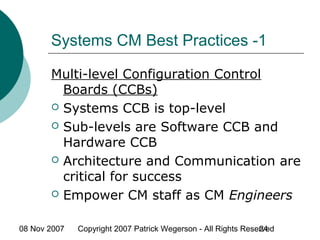
Systems CM Best Practices -1
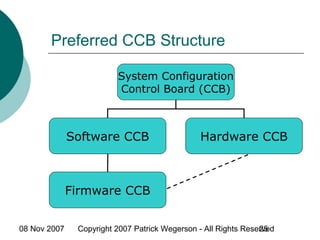
Multi-level Configuration Control
Boards (CCBs)
 Systems CCB is top-level
 Sub-levels are Software CCB and
Hardware CCB
 Architecture and Communication are
critical for success
 Empower CM staff as CM Engineers
08 Nov 2007 Copyright 2007 Patrick Wegerson - All Rights Reserved25
Preferred CCB Structure
System Configuration
Control Board (CCB)
Software CCB Hardware CCB
Firmware CCB
08 Nov 2007 Copyright 2007 Patrick Wegerson - All Rights Reserved26
Systems CM Best Practices - 2
Integrated or Same CM Tools for
Software and Hardware
 Can baseline software and hardware
components with similar / same tool
 Better full-lifecycle configuration
management and support
 All CM activities use centralized data
 Fewer (CM) tools to maintain
08 Nov 2007 Copyright 2007 Patrick Wegerson - All Rights Reserved27
Systems CM Best Practices -3
Equivalent Software CM and Hardware CM
Processes
 Capability Maturity Model®
Integration for
Development, Ver. 1.2
 Key standards don’t differentiate Software
CM from Hardware CM
 ISO 9001, ISO 10007, EIA-649-A (USA Std.)
 Improves cross-functional (software –
hardware) communication
08 Nov 2007 Copyright 2007 Patrick Wegerson - All Rights Reserved28
Systems CM Best Practices -4
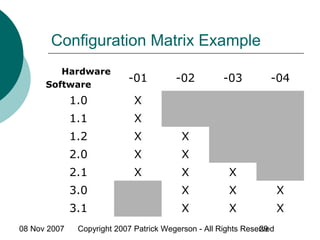
System Configuration Matrices
 Document compatible hardware and
software versions
 Proactively plan supported product
configurations
 Good summary of Status Accounting
and useful for Auditing / Verification
08 Nov 2007 Copyright 2007 Patrick Wegerson - All Rights Reserved29
Configuration Matrix Example
Hardware
Software
-01 -02 -03 -04
1.0 X
1.1 X
1.2 X X
2.0 X X
2.1 X X X
3.0 X X X
3.1 X X X
08 Nov 2007 Copyright 2007 Patrick Wegerson - All Rights Reserved30
Agenda
 Introduction
 Compare Software CM to Hardware CM
 Systems CM Overview
 Systems CM Best Practices
 Summary
 References
08 Nov 2007 Copyright 2007 Patrick Wegerson - All Rights Reserved31
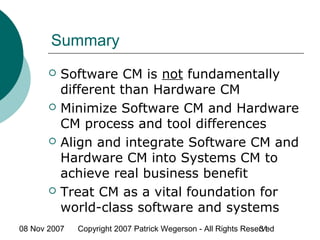
Summary
 Software CM is not fundamentally
different than Hardware CM
 Minimize Software CM and Hardware
CM process and tool differences
 Align and integrate Software CM and
Hardware CM into Systems CM to
achieve real business benefit
 Treat CM as a vital foundation for
world-class software and systems
08 Nov 2007 Copyright 2007 Patrick Wegerson - All Rights Reserved32
Agenda
 Introduction
 Compare Software CM to Hardware CM
 Systems CM Overview
 Systems CM Best Practices
 Summary
 References
08 Nov 2007 Copyright 2007 Patrick Wegerson - All Rights Reserved33
Presentation References
 ISO 10007:2003(E) “Quality Management Systems
– Guidelines for Configuration Management”
 ANSI/EIA-649-A 2004 “National Consensus
Standard for Configuration Management”
 Bersoff, Edward et. al., “Software Configuration
Management – An Investment in Product Integrity”,
Prentice-Hall, 1980, ISBN 0-13-821769-6
 CMMI for Development, Version 1.2 (CMU/SEI-
2006-TR-008, ESC-TR-2006-08). Pittsburgh, PA:
Software Engineering Institute, Carnegie Mellon
University, August 2006
08 Nov 2007 Copyright 2007 Patrick Wegerson - All Rights Reserved34
“Take-Away” References
 CM Crossroads: www.cmcrossroads.com
 Institute of Configuration Management: www.icmhq.com
 Data & Analysis Center for Software (DACS):
https://www.thedacs.com/databases/url/key.php?keycode=2920
 Quality Resources On-Line CM Resource Guide: http://
www.quality.org/config/cmresourceguidemaster.txt
 Software Engineering Institute – Capability Maturity
Model®
Integration (CMMI®
) for Development Ver. 1.2
http://www.sei.cmu.edu/cmmi/
08 Nov 2007 Copyright 2007 Patrick Wegerson - All Rights Reserved35
Presenter Vitae
Patrick Wegerson
Bloomington, Minnesota USA
Phone: 952-921-6994
Email: patrick.wegerson@gd-ais.com

Configuration Management for Embedded Systems

  • 1.
    08 Nov 2007Copyright 2007 Patrick Wegerson - All Rights Reserved 1 Configuration Management for Embedded Systems Software and the “Hard” Stuff Patrick Wegerson Bloomington, Minnesota USA
  • 2.
    08 Nov 2007Copyright 2007 Patrick Wegerson - All Rights Reserved2 Presentation Objectives  To Compare Software and Hardware Configuration Management (CM)  To Describe the Challenges of Systems (not just Software) CM  To Describe Best Practices of Embedded Systems CM  To Answer Your Questions  To Enjoy the Presentation!
  • 3.
    08 Nov 2007Copyright 2007 Patrick Wegerson - All Rights Reserved3 Agenda  Introduction  Compare Software CM to Hardware CM  Systems CM Overview  Systems CM Best Practices  Summary  References
  • 4.
    08 Nov 2007Copyright 2007 Patrick Wegerson - All Rights Reserved4 Introduction  Who: Your Presenter  What: Effectively integrating Hardware CM with Software CM to create System CM  Why: Embedded Systems development works better when supported by System CM  Where and When: Here and Now!
  • 5.
    08 Nov 2007Copyright 2007 Patrick Wegerson - All Rights Reserved5 Traditional CM versus Integration Software Configuration Hardware Configuration Integration – Systems Configuration Lifecycle Time
  • 6.
    08 Nov 2007Copyright 2007 Patrick Wegerson - All Rights Reserved6 Preferred CM versus Integration Software Configuration Hardware Configuration Integration – Systems Configuration Lifecycle Time Schedule Savings Cost Savings
  • 7.
    08 Nov 2007Copyright 2007 Patrick Wegerson - All Rights Reserved7 Agenda  Introduction  Compare Software CM to Hardware CM  Systems CM Overview  Systems CM Best Practices  Summary  References
  • 8.
    08 Nov 2007Copyright 2007 Patrick Wegerson - All Rights Reserved8 Hardware Configuration Management  Developed from military and aerospace systems experience  Nearly 50 years of experience (as a defined support process)  Numerous supporting tools available  Standardized practices across differing industries  Only sometimes integrated with hardware development tools
  • 9.
    08 Nov 2007Copyright 2007 Patrick Wegerson - All Rights Reserved9 Hardware CM Processes  Well established and consistent Hardware CM processes, such as  Design Release to Production  Hardware Baselines  Engineering Change Proposal (ECP)  Hardware CM processes coupled to  Hardware release tools (i.e. ERP, MRP)  External interface requirements, such as suppliers or manufacturer
  • 10.
    08 Nov 2007Copyright 2007 Patrick Wegerson - All Rights Reserved10 Software Configuration Management  Based on Hardware CM principles  Nearly 30 years of experience (as an explicit knowledge area)  Numerous support tools available  More variety of processes than Hardware CM  Usually integrated with software development tools
  • 11.
    08 Nov 2007Copyright 2007 Patrick Wegerson - All Rights Reserved11 Software CM Processes  Practices have evolved over time, though principles remain constant:  Identification, Control, Status Accounting, Audit (Verification)  Planning added with ISO 10007  Software CM processes coupled to  Full Lifecycle development tools  Internal interface requirements, such as traceability and flexibility  Problem Reports & Configuration Control Boards (CCBs) early in lifecycle
  • 12.
    08 Nov 2007Copyright 2007 Patrick Wegerson - All Rights Reserved12 Agenda  Introduction  Compare Software CM to Hardware CM  Systems CM Overview  Systems CM Best Practices  Summary  References
  • 13.
    08 Nov 2007Copyright 2007 Patrick Wegerson - All Rights Reserved13 Systems CM Overview  “Begin with the end in mind”  Fully integrated embedded system  Efficient use of resources, cost and schedule  Effective product development processes  Project management is equivalent across hardware and software  CM complements project management  Project management drives to results  CM accurately records what resulted
  • 14.
    08 Nov 2007Copyright 2007 Patrick Wegerson - All Rights Reserved14 Systems CM Challenges  Why are Hardware CM and Software CM treated so differently?  Are there major differences between Hardware CM and Software CM?  How are Hardware CM and Software CM similar?  How can Hardware CM and Software CM be better aligned and integrated?
  • 15.
    08 Nov 2007Copyright 2007 Patrick Wegerson - All Rights Reserved15 Systems CM Planning  “Plan CM Work, Work the CM Plan”  Plan for integrated CM through  Processes selected or defined  Tools selected and used  One comprehensive (Systems) CM Plan  Hierarchy of Configuration Control Boards (SE/SW/HW)  Best if supported by organizational CM processes and tools  Iterative (on-going) CM planning  Resources need to be assigned
  • 16.
    08 Nov 2007Copyright 2007 Patrick Wegerson - All Rights Reserved16 Systems CM Identification  Baselines include software and hardware configuration items (CI)  Software CI and Hardware CI use consistent identification scheme  Same CM Identification “language” regardless of hardware or software  Includes identifying components, baselines, versions, etc.  Reduces defects / simplifies auditing
  • 17.
    08 Nov 2007Copyright 2007 Patrick Wegerson - All Rights Reserved17 Systems Architecture Hierarchy Systems CI Software CI Mechanical (Hardware) CI Electronic (Hardware) CI Software CI Component S1 Software CI Component S2 Mechanical CI Component M1 Mechanical CI Component M2 Electronic CI Component E1 Electronic CI Component E2 Firmware CI Component F1
  • 18.
    08 Nov 2007Copyright 2007 Patrick Wegerson - All Rights Reserved18 Systems Object Hierarchy (OO-CM) Systems CI S-Module CI M-Module CI E-Module CI CI Component S1 CI Component S2 CI Component M1 CI Component M2 CI Component E1 CI Component E2 CI Component F1
  • 19.
    08 Nov 2007Copyright 2007 Patrick Wegerson - All Rights Reserved19 Systems CM Control  Use same tools for tracking hardware or software change proposals  Change impact must consider effects on both hardware and software CI  Hierarchy of Configuration Control Boards (CCBs or ISO 10007 “dispositioning authority”)
  • 20.
    08 Nov 2007Copyright 2007 Patrick Wegerson - All Rights Reserved20 Systems CM Status Accounting  Best generated from an automated configuration information system  Should tailor CM status reports to a specific audience, such as hardware  Essential for current traceability of the complete system  Data retention, security, recovery are critical product configuration data
  • 21.
    08 Nov 2007Copyright 2007 Patrick Wegerson - All Rights Reserved21 Systems CM Audit (Verification)  Should involve Quality Assurance for more objective evaluation  Should use auditors that understand hardware, software, and systems  Best done at formal baselines, especially early in lifecycle  Don’t discount this activity; CM defects can invalidate product tests!
  • 22.
    08 Nov 2007Copyright 2007 Patrick Wegerson - All Rights Reserved22 Traditional CCB Structure Product Configuration Control Board (CCB) or Software Configuration Control Board (SCCB) Hardware Configuration Control Board (HCCB)
  • 23.
    08 Nov 2007Copyright 2007 Patrick Wegerson - All Rights Reserved23 Agenda  Introduction  Compare Software CM to Hardware CM  Systems CM Overview  Systems CM Best Practices  Summary  References
  • 24.
    08 Nov 2007Copyright 2007 Patrick Wegerson - All Rights Reserved24 Systems CM Best Practices -1 Multi-level Configuration Control Boards (CCBs)  Systems CCB is top-level  Sub-levels are Software CCB and Hardware CCB  Architecture and Communication are critical for success  Empower CM staff as CM Engineers
  • 25.
    08 Nov 2007Copyright 2007 Patrick Wegerson - All Rights Reserved25 Preferred CCB Structure System Configuration Control Board (CCB) Software CCB Hardware CCB Firmware CCB
  • 26.
    08 Nov 2007Copyright 2007 Patrick Wegerson - All Rights Reserved26 Systems CM Best Practices - 2 Integrated or Same CM Tools for Software and Hardware  Can baseline software and hardware components with similar / same tool  Better full-lifecycle configuration management and support  All CM activities use centralized data  Fewer (CM) tools to maintain
  • 27.
    08 Nov 2007Copyright 2007 Patrick Wegerson - All Rights Reserved27 Systems CM Best Practices -3 Equivalent Software CM and Hardware CM Processes  Capability Maturity Model® Integration for Development, Ver. 1.2  Key standards don’t differentiate Software CM from Hardware CM  ISO 9001, ISO 10007, EIA-649-A (USA Std.)  Improves cross-functional (software – hardware) communication
  • 28.
    08 Nov 2007Copyright 2007 Patrick Wegerson - All Rights Reserved28 Systems CM Best Practices -4 System Configuration Matrices  Document compatible hardware and software versions  Proactively plan supported product configurations  Good summary of Status Accounting and useful for Auditing / Verification
  • 29.
    08 Nov 2007Copyright 2007 Patrick Wegerson - All Rights Reserved29 Configuration Matrix Example Hardware Software -01 -02 -03 -04 1.0 X 1.1 X 1.2 X X 2.0 X X 2.1 X X X 3.0 X X X 3.1 X X X
  • 30.
    08 Nov 2007Copyright 2007 Patrick Wegerson - All Rights Reserved30 Agenda  Introduction  Compare Software CM to Hardware CM  Systems CM Overview  Systems CM Best Practices  Summary  References
  • 31.
    08 Nov 2007Copyright 2007 Patrick Wegerson - All Rights Reserved31 Summary  Software CM is not fundamentally different than Hardware CM  Minimize Software CM and Hardware CM process and tool differences  Align and integrate Software CM and Hardware CM into Systems CM to achieve real business benefit  Treat CM as a vital foundation for world-class software and systems
  • 32.
    08 Nov 2007Copyright 2007 Patrick Wegerson - All Rights Reserved32 Agenda  Introduction  Compare Software CM to Hardware CM  Systems CM Overview  Systems CM Best Practices  Summary  References
  • 33.
    08 Nov 2007Copyright 2007 Patrick Wegerson - All Rights Reserved33 Presentation References  ISO 10007:2003(E) “Quality Management Systems – Guidelines for Configuration Management”  ANSI/EIA-649-A 2004 “National Consensus Standard for Configuration Management”  Bersoff, Edward et. al., “Software Configuration Management – An Investment in Product Integrity”, Prentice-Hall, 1980, ISBN 0-13-821769-6  CMMI for Development, Version 1.2 (CMU/SEI- 2006-TR-008, ESC-TR-2006-08). Pittsburgh, PA: Software Engineering Institute, Carnegie Mellon University, August 2006
  • 34.
    08 Nov 2007Copyright 2007 Patrick Wegerson - All Rights Reserved34 “Take-Away” References  CM Crossroads: www.cmcrossroads.com  Institute of Configuration Management: www.icmhq.com  Data & Analysis Center for Software (DACS): https://www.thedacs.com/databases/url/key.php?keycode=2920  Quality Resources On-Line CM Resource Guide: http:// www.quality.org/config/cmresourceguidemaster.txt  Software Engineering Institute – Capability Maturity Model® Integration (CMMI® ) for Development Ver. 1.2 http://www.sei.cmu.edu/cmmi/
  • 35.
    08 Nov 2007Copyright 2007 Patrick Wegerson - All Rights Reserved35 Presenter Vitae Patrick Wegerson Bloomington, Minnesota USA Phone: 952-921-6994 Email: patrick.wegerson@gd-ais.com