Basic questions in Collaborative Learning
 Some answers from the Psychology research,
 and new questions for the study of Collaborative Learning in
 Serious Games.


           Margarida ROMERO, Ph.D.
           Associate Director of E-learning. ESADE, Universitat Ramon Llull.
           Margarida.Romero@Esade.edu


02/11/2011 ESADE.

                                                                               1
Margarida Romero, Ph. D.
                                         Collaborative GBL & Group Awareness


INDEX

1.   Collaborative Serious Games (C-SG)
2.   How do we learn together?
3.   Collaborative game dynamics and learning
4.   eFinance Game Design (eFG) and Research Objectives
Margarida Romero, Ph. D.
                         Collaborative GBL & Group Awareness


Main question


Can we support
collaborative learning
through the use of
Serious Games ?
Margarida Romero, Ph. D.
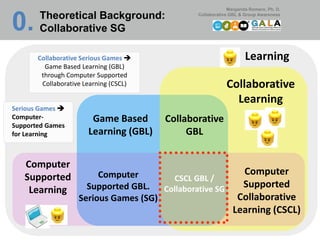
       Theoretical Background:
0.
                                               Collaborative GBL & Group Awareness


       Collaborative SG

       Collaborative Serious Games                                 Learning
         Game Based Learning (GBL)
        through Computer Supported
        Collaborative Learning (CSCL)                      Collaborative
                                                             Learning
Serious Games 
Computer-               Game Based      Collaborative
Supported Games
for Learning           Learning (GBL)        GBL


   Computer
                         Computer                               Computer
   Supported                           CSCL GBL /
                      Supported GBL. Collaborative SG           Supported
    Learning
                    Serious Games (SG)                         Collaborative
                                                              Learning (CSCL)
Margarida Romero, Ph. D.
                                             Collaborative GBL & Group Awareness


Factors in (collaborative) learning


  Contextual factors
  (collaboration task and
environment, collaboration
dynamics – game rules-, ...)
                                                     Inter-group factors
                                                 (identity, competitiveness...)


                                     Inter-psychological
                                        factors (group
                                       awareness, social
                                       competencies, ...)
    Intra-psychological factors
      (cognitive and metacognitive
         potential, development
          stage, motivation, ...)
Margarida Romero, Ph. D.
                             Collaborative GBL & Group Awareness


How do we learn together?
             3 theoretical approaches :
             transmissive,
             conductivism,
             constructivism,
              knowledge convergence
Margarida Romero, Ph. D.
     How do we learn
1.
                                                Collaborative GBL & Group Awareness


     together ?


Transmisive Approach:
Assumes that learning is mainly dependent on
the teacher.
Learning is through repetition; the learner is a
passive container (tabula rasa), waiting to be filled
with knowledge.
Margarida Romero, Ph. D.
     How do we learn
1.
                                  Collaborative GBL & Group Awareness


     together ?

Conductivism:
Professors should reinforce
students’ correct behaviour and
knowledge.
Margarida Romero, Ph. D.
     How do we learn
1.
                                                 Collaborative GBL & Group Awareness


     together ?


Constructivism:
A process where individuals construct new knowledge based on prior
knowledge and/or experience through the social
interaction, discovery, and the personal construction of meaning from
experience (Piaget, 1968, Vygotsky, 1978)
                    Previous knowledge      Individual learning in social contexts
                         elicitation               (Collaborative learning)
Margarida Romero, Ph. D.
     How do we learn
1.
                                   Collaborative GBL & Group Awareness


     together ?


Constructivism  Knowledge convergence
An increase in common knowledge following
collaboration, sharing mutual understanding through
social interaction (Jeong & Chi, 2007).
                                       3 Knowledge Equivalence
1 Knowledge Equivalence                + 2 Knowledge Convergence
Margarida Romero, Ph. D.
                            Collaborative GBL & Group Awareness


Collaborative game dynamics and
learning
             Positive Interdependence VS
             Competition
Margarida Romero, Ph. D.
     Collaborative Game
2.
                                  Collaborative GBL & Group Awareness


     Dynamics and Learning

Collaborative learning depends also on the (learning)
context.
What are the game rules ?
Margarida Romero, Ph. D.
     Collaborative Game
2.
                                    Collaborative GBL & Group Awareness


     Dynamics and Learning


In interindividual competitive situations sharing
knowledge with others is counterproductive...
Margarida Romero, Ph. D.
     Collaborative Game
2.
                                           Collaborative GBL & Group Awareness


     Dynamics and Learning

Cooperative intragroup positive interdependence
happens when an individual success depends on
the group’s success.


 However, the gameplay (“performance oriented
 stimulation”, Bateman & Boon, 2005, p. 27) is reduced in these
 cooperative situations situations !
Margarida Romero, Ph. D.
     Collaborative Game
2.
                                                       Collaborative GBL & Group Awareness


     Dynamics and Learning

Playing together against other teams generetes
intragroup positive interdependence and intergroup
competitiveness.


          Individual learners collaborating TOGETHER, AGAINST the other small groups
                      Intragroup sharing Knowledge is a productive strategy

         Positive interdependence through common         Learners’ (previous) knowledge
        performance interest (intragroup cooperation      elicitation for facilitating the
                 and intergroup competition)                 awareness of the MKO
Margarida Romero, Ph. D.
                          Collaborative GBL & Group Awareness


eFinance Game (eFG) Design and
Research Objectives

             eFinance Game Design
             Research Objectives
Margarida Romero, Ph. D.
     eFinance Game Design
3.
                                      Collaborative GBL & Group Awareness


     and Research Objectives


The eFinance Game is based
                                    Are students elicitating their
- In the constructivist knowledge
                                       previous knowledge ?
convergence approach
                                    Are students sharing their on-
                                          task knowledge ?
- In the intragroup positive
interdependence and intergroup      Are students learning more in
competitiveness.                      groups than individually ?
Margarida Romero, Ph. D.
     eFinance Game Design
3.
                                   Collaborative GBL & Group Awareness


     and Research Objectives


1. The students should
declare their previous
                                 Are students elicitating their
knowledge in their profile.         previous knowledge ?
                                Are students sharing their on-
                                      task knowledge ?
                                 Are students learning more in
                                   groups than individually ?


                                Research Question: How affects
                                  knowledge symmetry in the
                               knowledge convergence process?
Margarida Romero, Ph. D.
     eFinance Game Design
3.
                                   Collaborative GBL & Group Awareness


     and Research Objectives


In the first individual
phase, the students should
define their answers... and      Are students elicitating their
their level of certainty            previous knowledge ?
                                Are students sharing their on-
                                      task knowledge ?
                                 Are students learning more in
                                   groups than individually ?


                               Research Question: Is the level of
                                 certainty elicitation having a
                                positive impact on the results ?
Margarida Romero, Ph. D.
     eFinance Game Design
3.
                                   Collaborative GBL & Group Awareness


     and Research Objectives


The eFinance Game
includes 3 phases :
•Individual                      Are students elicitating their
•Peer Assessment                    previous knowledge ?
•Collaborative                  Are students sharing their on-
                                      task knowledge ?
Results in the three phases
                                 Are students learning more in
are being compared.                groups than individually ?


                               Research Question: Are students’
                                      learning more in the
                                individual, peer assessment, or
                                     collaborative phase ?
Your contribution is welcome !


Thank you for your attention


             Margarida ROMERO, Ph.D.
             Associate Director of E-learning. ESADE Business School.
             Margarida.Romero@Esade.edu


                                                                        21

Serious Games, Collaborative Learning,

  • 1.
    Basic questions inCollaborative Learning Some answers from the Psychology research, and new questions for the study of Collaborative Learning in Serious Games. Margarida ROMERO, Ph.D. Associate Director of E-learning. ESADE, Universitat Ramon Llull. Margarida.Romero@Esade.edu 02/11/2011 ESADE. 1
  • 2.
    Margarida Romero, Ph.D. Collaborative GBL & Group Awareness INDEX 1. Collaborative Serious Games (C-SG) 2. How do we learn together? 3. Collaborative game dynamics and learning 4. eFinance Game Design (eFG) and Research Objectives
  • 3.
    Margarida Romero, Ph.D. Collaborative GBL & Group Awareness Main question Can we support collaborative learning through the use of Serious Games ?
  • 4.
    Margarida Romero, Ph.D. Theoretical Background: 0. Collaborative GBL & Group Awareness Collaborative SG Collaborative Serious Games  Learning Game Based Learning (GBL) through Computer Supported Collaborative Learning (CSCL) Collaborative Learning Serious Games  Computer- Game Based Collaborative Supported Games for Learning Learning (GBL) GBL Computer Computer Computer Supported CSCL GBL / Supported GBL. Collaborative SG Supported Learning Serious Games (SG) Collaborative Learning (CSCL)
  • 5.
    Margarida Romero, Ph.D. Collaborative GBL & Group Awareness Factors in (collaborative) learning Contextual factors (collaboration task and environment, collaboration dynamics – game rules-, ...) Inter-group factors (identity, competitiveness...) Inter-psychological factors (group awareness, social competencies, ...) Intra-psychological factors (cognitive and metacognitive potential, development stage, motivation, ...)
  • 6.
    Margarida Romero, Ph.D. Collaborative GBL & Group Awareness How do we learn together? 3 theoretical approaches : transmissive, conductivism, constructivism,  knowledge convergence
  • 7.
    Margarida Romero, Ph.D. How do we learn 1. Collaborative GBL & Group Awareness together ? Transmisive Approach: Assumes that learning is mainly dependent on the teacher. Learning is through repetition; the learner is a passive container (tabula rasa), waiting to be filled with knowledge.
  • 8.
    Margarida Romero, Ph.D. How do we learn 1. Collaborative GBL & Group Awareness together ? Conductivism: Professors should reinforce students’ correct behaviour and knowledge.
  • 9.
    Margarida Romero, Ph.D. How do we learn 1. Collaborative GBL & Group Awareness together ? Constructivism: A process where individuals construct new knowledge based on prior knowledge and/or experience through the social interaction, discovery, and the personal construction of meaning from experience (Piaget, 1968, Vygotsky, 1978) Previous knowledge Individual learning in social contexts elicitation (Collaborative learning)
  • 10.
    Margarida Romero, Ph.D. How do we learn 1. Collaborative GBL & Group Awareness together ? Constructivism  Knowledge convergence An increase in common knowledge following collaboration, sharing mutual understanding through social interaction (Jeong & Chi, 2007). 3 Knowledge Equivalence 1 Knowledge Equivalence + 2 Knowledge Convergence
  • 11.
    Margarida Romero, Ph.D. Collaborative GBL & Group Awareness Collaborative game dynamics and learning Positive Interdependence VS Competition
  • 12.
    Margarida Romero, Ph.D. Collaborative Game 2. Collaborative GBL & Group Awareness Dynamics and Learning Collaborative learning depends also on the (learning) context. What are the game rules ?
  • 13.
    Margarida Romero, Ph.D. Collaborative Game 2. Collaborative GBL & Group Awareness Dynamics and Learning In interindividual competitive situations sharing knowledge with others is counterproductive...
  • 14.
    Margarida Romero, Ph.D. Collaborative Game 2. Collaborative GBL & Group Awareness Dynamics and Learning Cooperative intragroup positive interdependence happens when an individual success depends on the group’s success. However, the gameplay (“performance oriented stimulation”, Bateman & Boon, 2005, p. 27) is reduced in these cooperative situations situations !
  • 15.
    Margarida Romero, Ph.D. Collaborative Game 2. Collaborative GBL & Group Awareness Dynamics and Learning Playing together against other teams generetes intragroup positive interdependence and intergroup competitiveness. Individual learners collaborating TOGETHER, AGAINST the other small groups Intragroup sharing Knowledge is a productive strategy Positive interdependence through common Learners’ (previous) knowledge performance interest (intragroup cooperation elicitation for facilitating the and intergroup competition) awareness of the MKO
  • 16.
    Margarida Romero, Ph.D. Collaborative GBL & Group Awareness eFinance Game (eFG) Design and Research Objectives eFinance Game Design Research Objectives
  • 17.
    Margarida Romero, Ph.D. eFinance Game Design 3. Collaborative GBL & Group Awareness and Research Objectives The eFinance Game is based Are students elicitating their - In the constructivist knowledge previous knowledge ? convergence approach Are students sharing their on- task knowledge ? - In the intragroup positive interdependence and intergroup Are students learning more in competitiveness. groups than individually ?
  • 18.
    Margarida Romero, Ph.D. eFinance Game Design 3. Collaborative GBL & Group Awareness and Research Objectives 1. The students should declare their previous Are students elicitating their knowledge in their profile. previous knowledge ? Are students sharing their on- task knowledge ? Are students learning more in groups than individually ? Research Question: How affects knowledge symmetry in the knowledge convergence process?
  • 19.
    Margarida Romero, Ph.D. eFinance Game Design 3. Collaborative GBL & Group Awareness and Research Objectives In the first individual phase, the students should define their answers... and Are students elicitating their their level of certainty previous knowledge ? Are students sharing their on- task knowledge ? Are students learning more in groups than individually ? Research Question: Is the level of certainty elicitation having a positive impact on the results ?
  • 20.
    Margarida Romero, Ph.D. eFinance Game Design 3. Collaborative GBL & Group Awareness and Research Objectives The eFinance Game includes 3 phases : •Individual Are students elicitating their •Peer Assessment previous knowledge ? •Collaborative Are students sharing their on- task knowledge ? Results in the three phases Are students learning more in are being compared. groups than individually ? Research Question: Are students’ learning more in the individual, peer assessment, or collaborative phase ?
  • 21.
    Your contribution iswelcome ! Thank you for your attention Margarida ROMERO, Ph.D. Associate Director of E-learning. ESADE Business School. Margarida.Romero@Esade.edu 21