Science Policy
and Evidence
Light Pollution and
Astronomy
A Case Study
Astronomy in the UK
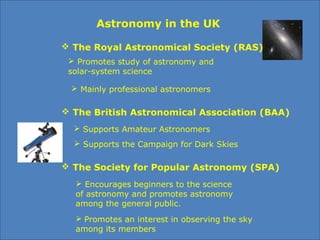
 The Royal Astronomical Society (RAS)
 Promotes study of astronomy and 
solar-system science
 Mainly professional astronomers 
 The British Astronomical Association (BAA)
 Supports Amateur Astronomers 
 Supports the Campaign for Dark Skies
 The Society for Popular Astronomy (SPA)
 Encourages beginners to the science 
of astronomy and promotes astronomy 
among the general public.
 Promotes an interest in observing the sky 
among its members
Astronomy in the UK
 200-300 tenured academic astronomers 
plus “several thousand” making  a living 
from Astronomy (incl PhD students)
 Over 3,500 amateur Astronomers
 About 50 Universities were offering 
undergraduate modules in astronomy 
 About 25 Universities were offering 
Postgraduate courses in astronomy
 About 33 Observatories attached to Universities
Why is Astronomy and access
to dark skies important?
 For the understanding the structure 
and nature of the Universe 
 For the Promotion of the study of 
geophysics and related branches of Science
 As a means of  enthusing young people for 
the study of science – astronomy  included in 
the National curriculum 
 As a means of  introducing the wider public to
the wonders of the universe through the night skies 
Light Pollution as a threat to
Astronomy in the UK
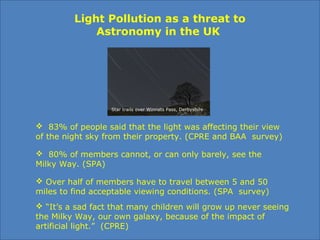
  83% of people said that the light was affecting their view 
of the night sky from their property. (CPRE and BAA  survey)
Star trails over Winnats Pass, Derbyshire
  80% of members cannot, or can only barely, see the 
Milky Way. (SPA)
 Over half of members have to travel between 5 and 50 
miles to find acceptable viewing conditions. (SPA  survey)
 “It’s a sad fact that many children will grow up never seeing 
the Milky Way, our own galaxy, because of the impact of 
artificial light.”  (CPRE)
What is Light Pollution?
Light pollution is “Artificial light that is allowed to
illuminate, or pollute, areas that are not intended to be lit”
“Good illumination is the right amount of light,
where it is needed, when it is needed”
( The BAA Commission for Dark Skies)
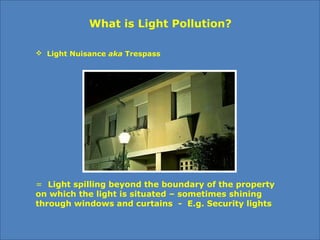
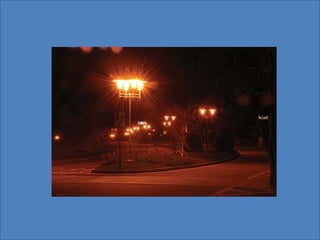
 Light Nuisance aka Trespass
What is Light Pollution?
=  Light spilling beyond the boundary of the property
on which the light is situated – sometimes shining
through windows and curtains - E.g. Security lights
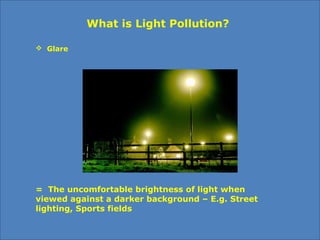
 Glare
What is Light Pollution?
= The uncomfortable brightness of light when
viewed against a darker background – E.g. Street
lighting, Sports fields
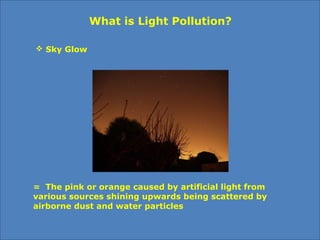
 Sky Glow
What is Light Pollution?
= The pink or orange caused by artificial light from
various sources shining upwards being scattered by
airborne dust and water particles
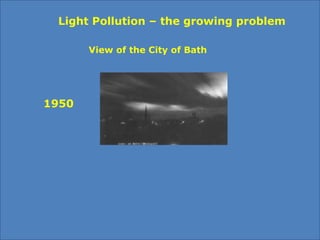
1950
2000
View of the City of Bath
Light Pollution – the growing problem
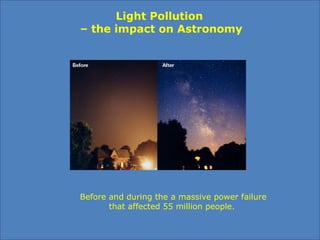
Before and during the a massive power failure
that affected 55 million people.
Light Pollution
– the impact on Astronomy
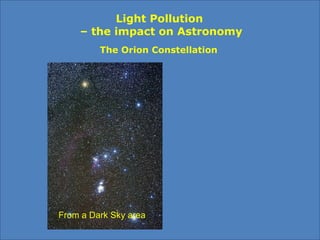
The Orion Constellation
From a Dark Sky area From a Residential area
Light Pollution
– the impact on Astronomy
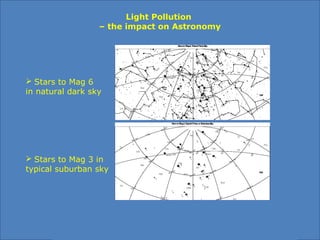
Light Pollution
– the impact on Astronomy
 Stars to Mag 6
in natural dark sky
 Stars to Mag 3 in
typical suburban sky
House of Commons
Science and Technology Select
Committee Inquiry 2003
Light Pollution and Astronomy
127 Submissions of Evidence
Individuals - 78
Astronomical Societies and Observatories – 30
Chartered Institutions – 5
Government Departments and agencies (inc PPARC) -9
Local Authorities 2
Others -3
Astronomers, Campaigners, Lighting Specialists,
Regulators, Government Ministers, PPARC
Two Witness Sessions – 16 Witnesses
The Evidence
Light Pollution and Astronomy
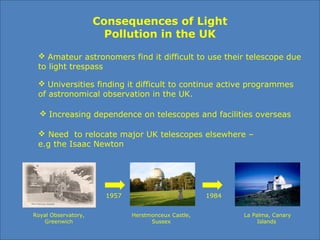
Consequences of Light
Pollution in the UK
 Amateur astronomers find it difficult to use their telescope due
to light trespass
 Universities finding it difficult to continue active programmes
of astronomical observation in the UK.
 Increasing dependence on telescopes and facilities overseas
 Need to relocate major UK telescopes elsewhere –
e.g the Isaac Newton
Royal Observatory,
Greenwich
Herstmonceux Castle,
Sussex
1957
La Palma, Canary
Islands
1984
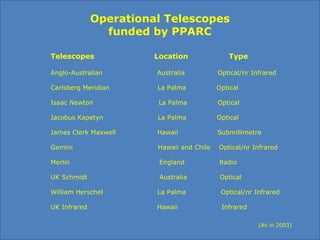
Operational Telescopes
funded by PPARC
Telescopes Location Type
Anglo-Australian Australia Optical/nr Infrared
Carlsberg Meridian La Palma Optical
Isaac Newton La Palma Optical
Jacobus Kapetyn La Palma Optical
James Clerk Maxwell Hawaii Submillimetre
Gemini Hawaii and Chile Optical/nr Infrared
Merlin England Radio
UK Schmidt Australia Optical
William Herschel La Palma Optical/nr Infrared
UK Infrared Hawaii Infrared
(As in 2003)
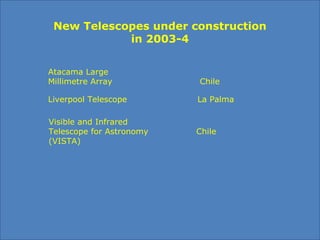
New Telescopes under construction
in 2003-4
Atacama Large
Millimetre Array Chile
Liverpool Telescope La Palma
Visible and Infrared
Telescope for Astronomy Chile
(VISTA)
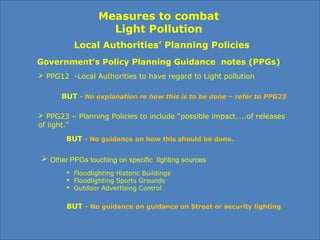
Measures to combat
Light Pollution
Government’s Policy Planning Guidance notes (PPGs)
 PPG12 -Local Authorities to have regard to Light pollution
BUT - No explanation re how this is to be done – refer to PPG23
 PPG23 – Planning Policies to include “possible impact…..of releases
of light.”
BUT - No guidance on how this should be done.
 Floodlighting Historic Buildings
 Floodlighting Sports Grounds
 Outdoor Advertising Control
Local Authorities’ Planning Policies
 Other PPGs touching on specific lighting sources
BUT - No guidance on guidance on Street or security lighting
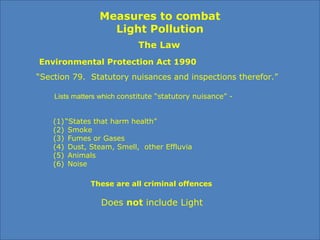
Measures to combat
Light Pollution
The Law
Environmental Protection Act 1990
“Section 79. Statutory nuisances and inspections therefor.”
(1)“States that harm health”
(2) Smoke
(3) Fumes or Gases
(4) Dust, Steam, Smell, other Effluvia
(5) Animals
(6) Noise
These are all criminal offences
Lists matters which constitute “statutory nuisance” -
Does not include Light
Measures to combat
Light Pollution
The Law
Only remedy for Light nuisance lay in the Civil Law
 Must sue owner of the offending light in the Civil Courts
 Loser bears the legal costs of both sides
 You will have to prove the nuisance - Difficult!
 BUT a few have been successful:
 Stone Haven and District Angling Association v
Stonehaven Tennis Club (1997) – sports ground lights
 Bonwick vs Brighton and Hove Council (2000) – local
authority lights
 Bacon v Gwynedd CC Tywyn (2004) - sports ground lights
 Cases rarely succeed
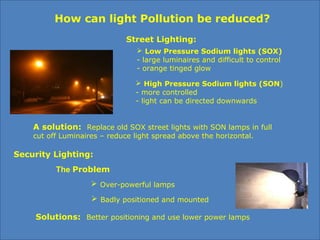
How can light Pollution be reduced?
Street Lighting:
 Low Pressure Sodium lights (SOX)
- large luminaires and difficult to control
- orange tinged glow
 High Pressure Sodium lights (SON)
- more controlled
- light can be directed downwards
A solution: Replace old SOX street lights with SON lamps in full
cut off Luminaires – reduce light spread above the horizontal.
Security Lighting:
 Over-powerful lamps
 Badly positioned and mounted
Solutions: Better positioning and use lower power lamps
The Problem
What did the Committee conclude?
 Government has adopted a defeatist attitude towards light
pollution.
 The Government fails to consider light pollution with all its adverse effects
seriously.
 No doubt that light pollution is getting worse and the Government
should take serious action to tackle the problem.
 The Highways Agency is giving environmental considerations top
priority in replacement of lights.
 Local authorities must be strongly advised to install High Pressure
Sodium lighting, with appropriate luminaires when replacing lighting.
 On Street Lighting:
Based on the Evidence:
The Government should issue clear guidance on the most
suitable types of lighting.
 Government and PPARC should support amateur and
professional astronomers.
What did the Committee conclude?
 Planning guidance on light pollution to local authorities lacks coherence
and force.
 Government should provide new guidance tackling light shining above the
horizontal by controlling direction, position, type and duration of lighting.
 Planning Permission Conditions should be imposed for new buildings with
floodlighting, new floodlighting systems or new car parks, to ensure it is
not obtrusive and is energy efficient.
Lighting and Planning
 For normal domestic purposes 500w security lights are energy-
inefficient and liable to cause nuisance. Remedy is legislation banning
the sale of 500w lights.
 Lighting schemes must only include lights that do not shine above the
horizontal.
What did the Committee conclude?
 If the Government accepts the Committee’s
recommendations and starts the process of reducing light
pollution then -
 Light trespass is measurable and controlable.
 Obtrusive light should be made a statutory nuisance.
“In 20 years time it might then be possible for young
people studying astronomy to see the Milky Way in the
UK night skies once more.”
What happened next?
 an increase in light pollution as a result of a wide range
external lighting.
 the significant contribution to research made by amateur
astronomers.
 “The Government welcomes the Committee's focus on the
planning system to deal with light pollution. It will have helped to
raise awareness of light pollution with those responsible for
making decisions.”
 the valuable role that astronomers play in introducing young
people into science.
The Government’s Response
 the adverse effect of light pollution on amateur astronomy, the
public's enjoyment of the night sky and the potential impact on
education.
The Government recognises :-
What happened next?
Planning and Light pollution
 2004 - New Planning Policy Statement (PPS) 23 Provides
guidance in Annex 3: “Planning and Light Pollution”
 2012 - National Planning Policy Framework
Replaces PPS23. Consideration of the impact of light
pollution on local amenity, intrinsically dark landscapes
and nature conservation.
 2009 - Royal Commission on Environmental Pollution (RCEP)
Highlighted impacts of artificial light on human
health and on wildlife.
 2011 - Natural Environment White Paper (NEWP)
Vision for next 50 years to protect natural environment and
“intention to work with industry and other bodies to reduce
the negative impacts of artificial light and protect dark areas.
Increased awareness of the problem.
- Clean Neighbourhoods and Environment Act (2005)
Section 102.
(1) Section 79 of the Environmental Protection Act 1990 is amended to
include artificial light emitted from premises so as to be prejudicial
to health or a nuisance;
The new law makes 'exterior light emitted from premises - under some
circumstances - a statutory nuisance and a criminal offence.
 The first UK law tackling light pollution came
into force in 2006 -
What happened next?
The Law
 Local Authorities have duty to investigate complaints of Light Nuisance
and take action.
One objective of Committee achieved!
What happened next?
 Airports
 harbour premises
 railways premises
 tramway premises
 bus stations and any associated facilities
 public service or goods vehicle operating centres
 Lighthouses
 prisons
The Law
But there are some exemptions from the new law -
 Premises regarded as of “strategic importance”
 List reviewed in 2012 and decision was to retain them
WHY?
 Campaign for Dark Skies - 500W 'security' lights feature in
many of the complaints.
What happened next?
Security Lights
Sale of 500W tungsten halogen 'security' lamps
banned from September 2009.
 THEN -EU Directive -
 But for energy efficiency reasons not light pollution.
 Raised awareness of light pollution by Local Authorities.
 ... believed there is no case for banning the sale of security
lights to the public.
 Government recognised the nuisance caused by poor
and incorrectly installed lights – BUT ...
Light Pollution and Astronomy by Dr Michael Elves

Light Pollution and Astronomy by Dr Michael Elves

  • 1.
    Science Policy and Evidence LightPollution and Astronomy A Case Study
  • 2.
    Astronomy in theUK  The Royal Astronomical Society (RAS)  Promotes study of astronomy and  solar-system science  Mainly professional astronomers   The British Astronomical Association (BAA)  Supports Amateur Astronomers   Supports the Campaign for Dark Skies  The Society for Popular Astronomy (SPA)  Encourages beginners to the science  of astronomy and promotes astronomy  among the general public.  Promotes an interest in observing the sky  among its members
  • 3.
    Astronomy in theUK  200-300 tenured academic astronomers  plus “several thousand” making  a living  from Astronomy (incl PhD students)  Over 3,500 amateur Astronomers  About 50 Universities were offering  undergraduate modules in astronomy   About 25 Universities were offering  Postgraduate courses in astronomy  About 33 Observatories attached to Universities
  • 4.
    Why is Astronomyand access to dark skies important?  For the understanding the structure  and nature of the Universe   For the Promotion of the study of  geophysics and related branches of Science  As a means of  enthusing young people for  the study of science – astronomy  included in  the National curriculum   As a means of  introducing the wider public to the wonders of the universe through the night skies 
  • 5.
    Light Pollution asa threat to Astronomy in the UK   83% of people said that the light was affecting their view  of the night sky from their property. (CPRE and BAA  survey) Star trails over Winnats Pass, Derbyshire   80% of members cannot, or can only barely, see the  Milky Way. (SPA)  Over half of members have to travel between 5 and 50  miles to find acceptable viewing conditions. (SPA  survey)  “It’s a sad fact that many children will grow up never seeing  the Milky Way, our own galaxy, because of the impact of  artificial light.”  (CPRE)
  • 6.
    What is LightPollution? Light pollution is “Artificial light that is allowed to illuminate, or pollute, areas that are not intended to be lit” “Good illumination is the right amount of light, where it is needed, when it is needed” ( The BAA Commission for Dark Skies)
  • 7.
     Light Nuisanceaka Trespass What is Light Pollution? =  Light spilling beyond the boundary of the property on which the light is situated – sometimes shining through windows and curtains - E.g. Security lights
  • 8.
     Glare What isLight Pollution? = The uncomfortable brightness of light when viewed against a darker background – E.g. Street lighting, Sports fields
  • 9.
     Sky Glow Whatis Light Pollution? = The pink or orange caused by artificial light from various sources shining upwards being scattered by airborne dust and water particles
  • 10.
    1950 2000 View of theCity of Bath Light Pollution – the growing problem
  • 11.
    Before and duringthe a massive power failure that affected 55 million people. Light Pollution – the impact on Astronomy
  • 12.
    The Orion Constellation Froma Dark Sky area From a Residential area Light Pollution – the impact on Astronomy
  • 13.
    Light Pollution – theimpact on Astronomy  Stars to Mag 6 in natural dark sky  Stars to Mag 3 in typical suburban sky
  • 14.
    House of Commons Scienceand Technology Select Committee Inquiry 2003 Light Pollution and Astronomy 127 Submissions of Evidence Individuals - 78 Astronomical Societies and Observatories – 30 Chartered Institutions – 5 Government Departments and agencies (inc PPARC) -9 Local Authorities 2 Others -3 Astronomers, Campaigners, Lighting Specialists, Regulators, Government Ministers, PPARC Two Witness Sessions – 16 Witnesses
  • 15.
  • 16.
    Consequences of Light Pollutionin the UK  Amateur astronomers find it difficult to use their telescope due to light trespass  Universities finding it difficult to continue active programmes of astronomical observation in the UK.  Increasing dependence on telescopes and facilities overseas  Need to relocate major UK telescopes elsewhere – e.g the Isaac Newton Royal Observatory, Greenwich Herstmonceux Castle, Sussex 1957 La Palma, Canary Islands 1984
  • 17.
    Operational Telescopes funded byPPARC Telescopes Location Type Anglo-Australian Australia Optical/nr Infrared Carlsberg Meridian La Palma Optical Isaac Newton La Palma Optical Jacobus Kapetyn La Palma Optical James Clerk Maxwell Hawaii Submillimetre Gemini Hawaii and Chile Optical/nr Infrared Merlin England Radio UK Schmidt Australia Optical William Herschel La Palma Optical/nr Infrared UK Infrared Hawaii Infrared (As in 2003)
  • 18.
    New Telescopes underconstruction in 2003-4 Atacama Large Millimetre Array Chile Liverpool Telescope La Palma Visible and Infrared Telescope for Astronomy Chile (VISTA)
  • 19.
    Measures to combat LightPollution Government’s Policy Planning Guidance notes (PPGs)  PPG12 -Local Authorities to have regard to Light pollution BUT - No explanation re how this is to be done – refer to PPG23  PPG23 – Planning Policies to include “possible impact…..of releases of light.” BUT - No guidance on how this should be done.  Floodlighting Historic Buildings  Floodlighting Sports Grounds  Outdoor Advertising Control Local Authorities’ Planning Policies  Other PPGs touching on specific lighting sources BUT - No guidance on guidance on Street or security lighting
  • 20.
    Measures to combat LightPollution The Law Environmental Protection Act 1990 “Section 79. Statutory nuisances and inspections therefor.” (1)“States that harm health” (2) Smoke (3) Fumes or Gases (4) Dust, Steam, Smell, other Effluvia (5) Animals (6) Noise These are all criminal offences Lists matters which constitute “statutory nuisance” - Does not include Light
  • 21.
    Measures to combat LightPollution The Law Only remedy for Light nuisance lay in the Civil Law  Must sue owner of the offending light in the Civil Courts  Loser bears the legal costs of both sides  You will have to prove the nuisance - Difficult!  BUT a few have been successful:  Stone Haven and District Angling Association v Stonehaven Tennis Club (1997) – sports ground lights  Bonwick vs Brighton and Hove Council (2000) – local authority lights  Bacon v Gwynedd CC Tywyn (2004) - sports ground lights  Cases rarely succeed
  • 22.
    How can lightPollution be reduced? Street Lighting:  Low Pressure Sodium lights (SOX) - large luminaires and difficult to control - orange tinged glow  High Pressure Sodium lights (SON) - more controlled - light can be directed downwards A solution: Replace old SOX street lights with SON lamps in full cut off Luminaires – reduce light spread above the horizontal. Security Lighting:  Over-powerful lamps  Badly positioned and mounted Solutions: Better positioning and use lower power lamps The Problem
  • 23.
    What did theCommittee conclude?  Government has adopted a defeatist attitude towards light pollution.  The Government fails to consider light pollution with all its adverse effects seriously.  No doubt that light pollution is getting worse and the Government should take serious action to tackle the problem.  The Highways Agency is giving environmental considerations top priority in replacement of lights.  Local authorities must be strongly advised to install High Pressure Sodium lighting, with appropriate luminaires when replacing lighting.  On Street Lighting: Based on the Evidence: The Government should issue clear guidance on the most suitable types of lighting.  Government and PPARC should support amateur and professional astronomers.
  • 24.
    What did theCommittee conclude?  Planning guidance on light pollution to local authorities lacks coherence and force.  Government should provide new guidance tackling light shining above the horizontal by controlling direction, position, type and duration of lighting.  Planning Permission Conditions should be imposed for new buildings with floodlighting, new floodlighting systems or new car parks, to ensure it is not obtrusive and is energy efficient. Lighting and Planning  For normal domestic purposes 500w security lights are energy- inefficient and liable to cause nuisance. Remedy is legislation banning the sale of 500w lights.  Lighting schemes must only include lights that do not shine above the horizontal.
  • 25.
    What did theCommittee conclude?  If the Government accepts the Committee’s recommendations and starts the process of reducing light pollution then -  Light trespass is measurable and controlable.  Obtrusive light should be made a statutory nuisance. “In 20 years time it might then be possible for young people studying astronomy to see the Milky Way in the UK night skies once more.”
  • 26.
    What happened next? an increase in light pollution as a result of a wide range external lighting.  the significant contribution to research made by amateur astronomers.  “The Government welcomes the Committee's focus on the planning system to deal with light pollution. It will have helped to raise awareness of light pollution with those responsible for making decisions.”  the valuable role that astronomers play in introducing young people into science. The Government’s Response  the adverse effect of light pollution on amateur astronomy, the public's enjoyment of the night sky and the potential impact on education. The Government recognises :-
  • 27.
    What happened next? Planningand Light pollution  2004 - New Planning Policy Statement (PPS) 23 Provides guidance in Annex 3: “Planning and Light Pollution”  2012 - National Planning Policy Framework Replaces PPS23. Consideration of the impact of light pollution on local amenity, intrinsically dark landscapes and nature conservation.  2009 - Royal Commission on Environmental Pollution (RCEP) Highlighted impacts of artificial light on human health and on wildlife.  2011 - Natural Environment White Paper (NEWP) Vision for next 50 years to protect natural environment and “intention to work with industry and other bodies to reduce the negative impacts of artificial light and protect dark areas. Increased awareness of the problem.
  • 28.
    - Clean Neighbourhoodsand Environment Act (2005) Section 102. (1) Section 79 of the Environmental Protection Act 1990 is amended to include artificial light emitted from premises so as to be prejudicial to health or a nuisance; The new law makes 'exterior light emitted from premises - under some circumstances - a statutory nuisance and a criminal offence.  The first UK law tackling light pollution came into force in 2006 - What happened next? The Law  Local Authorities have duty to investigate complaints of Light Nuisance and take action. One objective of Committee achieved!
  • 29.
    What happened next? Airports  harbour premises  railways premises  tramway premises  bus stations and any associated facilities  public service or goods vehicle operating centres  Lighthouses  prisons The Law But there are some exemptions from the new law -  Premises regarded as of “strategic importance”  List reviewed in 2012 and decision was to retain them WHY?
  • 30.
     Campaign forDark Skies - 500W 'security' lights feature in many of the complaints. What happened next? Security Lights Sale of 500W tungsten halogen 'security' lamps banned from September 2009.  THEN -EU Directive -  But for energy efficiency reasons not light pollution.  Raised awareness of light pollution by Local Authorities.  ... believed there is no case for banning the sale of security lights to the public.  Government recognised the nuisance caused by poor and incorrectly installed lights – BUT ...