Report on 
 
Conductive Plastic
Name:  ‫ﻓﺮﺝ‬ ‫ﻣﺤﻤﺪ‬ ‫ﻣﺤﻤﻮﺩ‬‫ﺃﺣﻤﺪ‬
Section: 7 
No: 169 
Conductive thermoplastic compounds offer reliability and value for applications that 
require dissipation of static charges, protection from electrostatic discharge (ESD), or 
thermal management. 
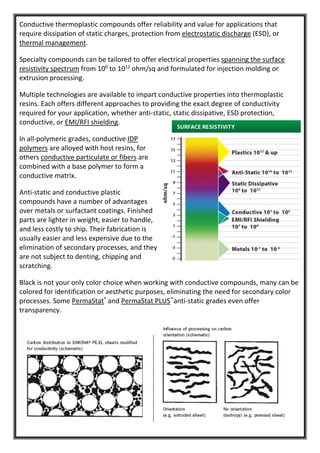
Specialty compounds can be tailored to offer electrical properties spanning the surface 
resistivity spectrum from 100
 to 1012
 ohm/sq and formulated for injection molding or 
extrusion processing. 
Multiple technologies are available to impart conductive properties into thermoplastic 
resins. Each offers different approaches to providing the exact degree of conductivity 
required for your application, whether anti‐static, static dissipative, ESD protection, 
conductive, or EMI/RFI shielding. 
In all‐polymeric grades, conductive IDP 
polymers are alloyed with host resins, for 
others conductive particulate or fibers are 
combined with a base polymer to form a 
conductive matrix. 
Anti‐static and conductive plastic 
compounds have a number of advantages 
over metals or surfactant coatings. Finished 
parts are lighter in weight, easier to handle, 
and less costly to ship. Their fabrication is 
usually easier and less expensive due to the 
elimination of secondary processes, and they 
are not subject to denting, chipping and 
scratching. 
Black is not your only color choice when working with conductive compounds, many can be 
colored for identification or aesthetic purposes, eliminating the need for secondary color 
processes. Some PermaStat®
 and PermaStat PLUS™
anti‐static grades even offer 
transparency. 
 

Conductive Plastic