Conducting Surveys,
Experiments or
Observations
Pre-Test
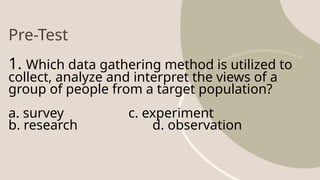
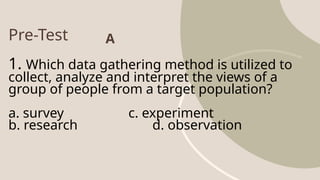
1. Which data gathering method is utilized to
collect, analyze and interpret the views of a
group of people from a target population?
a. survey c. experiment
b. research d. observation
Pre-Test
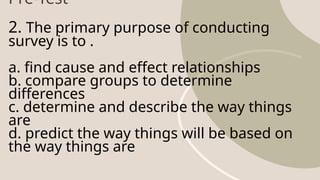
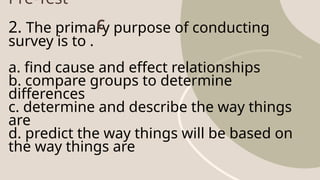
2. The primary purpose of conducting
survey is to .
a. find cause and effect relationships
b. compare groups to determine
differences
c. determine and describe the way things
are
d. predict the way things will be based on
the way things are
Pre-Test
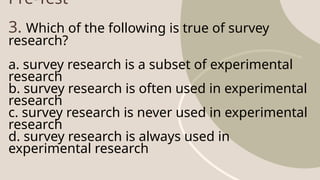
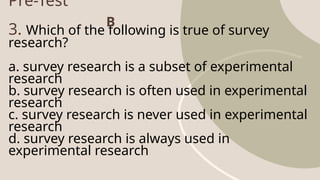
3. Which of the following is true of survey
research?
a. survey research is a subset of experimental
research
b. survey research is often used in experimental
research
c. survey research is never used in experimental
research
d. survey research is always used in
experimental research
Pre-Test
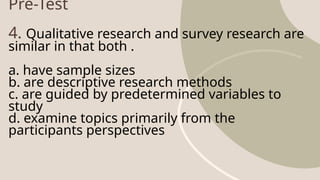
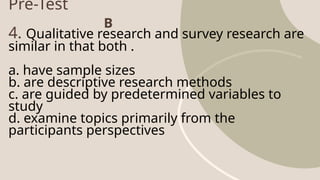
4. Qualitative research and survey research are
similar in that both .
a. have sample sizes
b. are descriptive research methods
c. are guided by predetermined variables to
study
d. examine topics primarily from the
participants perspectives
Pre-Test
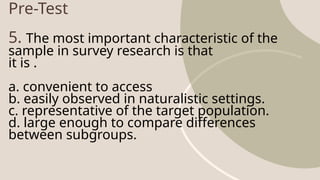
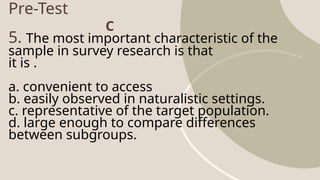
5. The most important characteristic of the
sample in survey research is that
it is .
a. convenient to access
b. easily observed in naturalistic settings.
c. representative of the target population.
d. large enough to compare differences
between subgroups.
Pre-Test
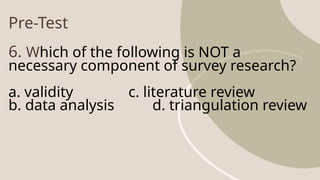
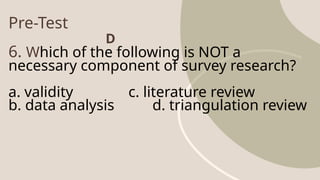
6. Which of the following is NOT a
necessary component of survey research?
a. validity c. literature review
b. data analysis d. triangulation review
Pre-Test
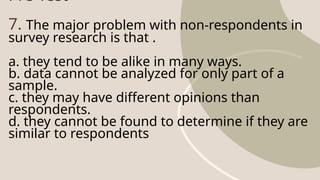
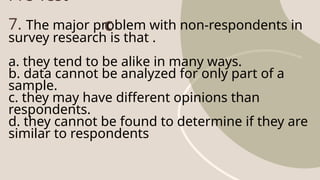
7. The major problem with non-respondents in
survey research is that .
a. they tend to be alike in many ways.
b. data cannot be analyzed for only part of a
sample.
c. they may have different opinions than
respondents.
d. they cannot be found to determine if they are
similar to respondents
Pre-Test
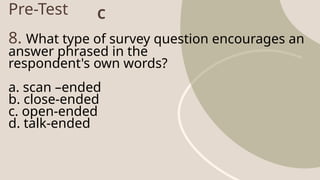
8. What type of survey question encourages an
answer phrased in the
respondent's own words?
a. scan –ended
b. close-ended
c. open-ended
d. talk-ended
Pre-Test
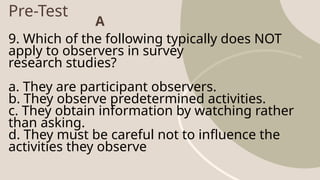
9. Which of the following typically does NOT
apply to observers in survey
research studies?
a. They are participant observers.
b. They observe predetermined activities.
c. They obtain information by watching rather
than asking.
d. They must be careful not to influence the
activities they observe
Pre-Test
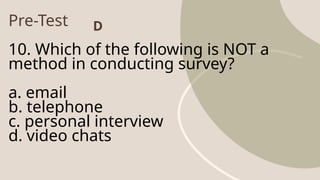
10. Which of the following is NOT a
method in conducting survey?
a. email
b. telephone
c. personal interview
d. video chats
Pre-Test
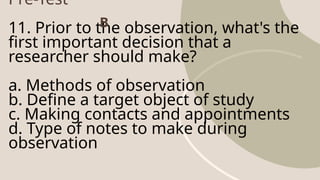
11. Prior to the observation, what's the
first important decision that a
researcher should make?
a. Methods of observation
b. Define a target object of study
c. Making contacts and appointments
d. Type of notes to make during
observation
Pre-Test
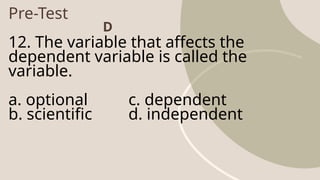
12. The variable that affects the
dependent variable is called the
variable.
a. optional c. dependent
b. scientific d. independent
Pre-Test
13. An experiment generally tests how
one is affected by another.
A. test
B. option
C. scientist
D. variable
Pre-Test
14. Which of these would be called
results?
a. Number of Fruit Flies
b. Counting Fruit Flies
c. Seeing Fruit Flies on an Apple
d. Wondering Why a Fruit Fly was Born
Pre-Test
15. Which of the following is NOT
something one needs to consider when
conducting an experiment?
a. The scientist's biases
b. The errors induced by measurement
c. Other variables that may not be under
the scientist's control
d. Whether the results of the experiment
will confirm the hypothesis
Pre-Test
1. Which data gathering method is utilized to
collect, analyze and interpret the views of a
group of people from a target population?
a. survey c. experiment
b. research d. observation
A
Pre-Test
2. The primary purpose of conducting
survey is to .
a. find cause and effect relationships
b. compare groups to determine
differences
c. determine and describe the way things
are
d. predict the way things will be based on
the way things are
C
Pre-Test
3. Which of the following is true of survey
research?
a. survey research is a subset of experimental
research
b. survey research is often used in experimental
research
c. survey research is never used in experimental
research
d. survey research is always used in
experimental research
B
Pre-Test
4. Qualitative research and survey research are
similar in that both .
a. have sample sizes
b. are descriptive research methods
c. are guided by predetermined variables to
study
d. examine topics primarily from the
participants perspectives
B
Pre-Test
5. The most important characteristic of the
sample in survey research is that
it is .
a. convenient to access
b. easily observed in naturalistic settings.
c. representative of the target population.
d. large enough to compare differences
between subgroups.
C
Pre-Test
6. Which of the following is NOT a
necessary component of survey research?
a. validity c. literature review
b. data analysis d. triangulation review
D
Pre-Test
7. The major problem with non-respondents in
survey research is that .
a. they tend to be alike in many ways.
b. data cannot be analyzed for only part of a
sample.
c. they may have different opinions than
respondents.
d. they cannot be found to determine if they are
similar to respondents
C
Pre-Test
8. What type of survey question encourages an
answer phrased in the
respondent's own words?
a. scan –ended
b. close-ended
c. open-ended
d. talk-ended
C
Pre-Test
9. Which of the following typically does NOT
apply to observers in survey
research studies?
a. They are participant observers.
b. They observe predetermined activities.
c. They obtain information by watching rather
than asking.
d. They must be careful not to influence the
activities they observe
A
Pre-Test
10. Which of the following is NOT a
method in conducting survey?
a. email
b. telephone
c. personal interview
d. video chats
D
Pre-Test
11. Prior to the observation, what's the
first important decision that a
researcher should make?
a. Methods of observation
b. Define a target object of study
c. Making contacts and appointments
d. Type of notes to make during
observation
B
Pre-Test
12. The variable that affects the
dependent variable is called the
variable.
a. optional c. dependent
b. scientific d. independent
D
Pre-Test
13. An experiment generally tests how
one is affected by another.
A. test
B. option
C. scientist
D. variable
D
Pre-Test
14. Which of these would be called
results?
a. Number of Fruit Flies
b. Counting Fruit Flies
c. Seeing Fruit Flies on an Apple
d. Wondering Why a Fruit Fly was Born
A
Pre-Test
15. Which of the following is NOT
something one needs to consider when
conducting an experiment?
a. The scientist's biases
b. The errors induced by measurement
c. Other variables that may not be under
the scientist's control
d. Whether the results of the experiment
will confirm the hypothesis
A
Conducting Surveys,
Experiments or
Observations
“Reporting Activity”
Methods for Data Collection
Group 1: Surveys
Group 2: Experiments
Group 3: Observations
- Game about the topic
- Discussion (definitions, process,
advantages, and disadvantages)
- Examples following the process
- Quiz : 15 items
*Pass a written report of your topic.
Conducting Surveys,
Experiments or
Observations
1. Surveys
Definition: a research method used to
gather information from a group of
people through questionnaires or
interviews.
Purpose: Surveys aim to collect data on
opinions, behaviors, or characteristics
of a specific population.
Process:
1. Define the Objective: Clearly state what you want
to learn from the survey.
2. Design the Questionnaire: Create questions that
are clear and concise. They can be multiple-choice,
Likert scale (rating), or open-ended.
3. Select a Sample: Choose a representative group
from the population to survey. Ensure your sample
size is sufficient for accurate results.
Process:
4. Administer the Survey: Distribute the survey to
the selected participants, either online or in person.
5. Analyze the Data: Collect responses and use
statistical methods to interpret the data.
6. Report Findings: Summarize the results in a
report, highlighting key insights.
Positive side of this method :
1. it’s very time efficient.
2. very quick to just come up with a question,
ask someone a question and get their answer
then record it.
3. you get the right to the point in your
question, you’re designing the question to get
the exact information you’re looking for so it
focuses on the desired response.
Negative side of this method :
1. it’s very likely you could get biased
responses.
2. The wording of the question or the way
someone interprets your question can cause
you to have biased responses.
2. Experiments
Definition: a controlled study conducted
to determine the cause-and-effect
relationship between variables.
Purpose: Experiments aim to test
hypotheses by manipulating one
variable (independent variable) and
observing the effect on another variable
(dependent variable).
Process:
1. Formulate a Hypothesis: Develop a
testable statement predicting the outcome
of the experiment.
2. Identify Variables: Clearly define the
independent and dependent variables.
3. Design the Experiment: Create a step-by-
step plan, including materials needed and
procedures to follow.
Process:
4. Conduct the Experiment: Carry out the
experiment while controlling for external
variables.
5. Collect Data: Gather quantitative or
qualitative data during the experiment.
6. Analyze Results: Use statistical methods to
determine if the results support the hypothesis.
7. Draw Conclusions: Discuss the implications of
the findings and any potential limitations.
Positive side of this method :
1. the control group reduces bias whereas in the
survey and observational study, you didn’t have a
control group.
2. allows you to determine if there’s a cause and an
effect happening. So it will really just give you a much
deeper understanding of how people are behaving
based on your treatment to them, especially to the
example medication, you can really determine if the
medication is helping people or not.
Negative side of this method :
1. time consuming because you’re going have
two different groups.
2. harder to keep track of who’s in which group,
how are you treating each group, and also this
method always have to be concerned with
ethics meaning you are not going to persuade
them to behave in certain way or treating them
in a way that is not okay.
3. Observations
Definition: Observation is a research
method that involves systematically
watching and recording behaviors or
events as they occur in a natural setting.
Purpose: Observations aim to collect
data on how subjects behave in their
natural environment without
interference.
Process:
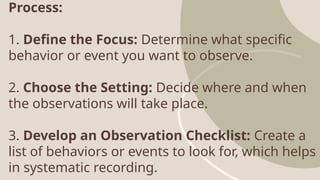
1. Define the Focus: Determine what specific
behavior or event you want to observe.
2. Choose the Setting: Decide where and when
the observations will take place.
3. Develop an Observation Checklist: Create a
list of behaviors or events to look for, which helps
in systematic recording.
Process:
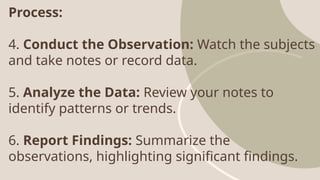
4. Conduct the Observation: Watch the subjects
and take notes or record data.
5. Analyze the Data: Review your notes to
identify patterns or trends.
6. Report Findings: Summarize the
observations, highlighting significant findings.
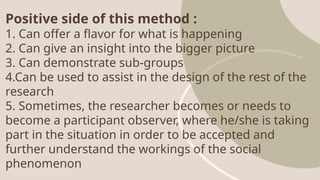
Positive side of this method :
1. Can offer a flavor for what is happening
2. Can give an insight into the bigger picture
3. Can demonstrate sub-groups
4.Can be used to assist in the design of the rest of the
research
5. Sometimes, the researcher becomes or needs to
become a participant observer, where he/she is taking
part in the situation in order to be accepted and
further understand the workings of the social
phenomenon
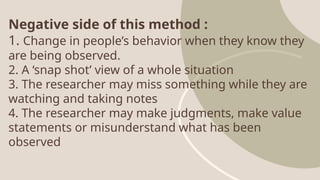
Negative side of this method :
1. Change in people’s behavior when they know they
are being observed.
2. A ‘snap shot’ view of a whole situation
3. The researcher may miss something while they are
watching and taking notes
4. The researcher may make judgments, make value
statements or misunderstand what has been
observed

Conducting Surveys, Experiments or Observations.pptx

  • 1.
  • 2.
    Pre-Test 1. Which datagathering method is utilized to collect, analyze and interpret the views of a group of people from a target population? a. survey c. experiment b. research d. observation
  • 3.
    Pre-Test 2. The primarypurpose of conducting survey is to . a. find cause and effect relationships b. compare groups to determine differences c. determine and describe the way things are d. predict the way things will be based on the way things are
  • 4.
    Pre-Test 3. Which ofthe following is true of survey research? a. survey research is a subset of experimental research b. survey research is often used in experimental research c. survey research is never used in experimental research d. survey research is always used in experimental research
  • 5.
    Pre-Test 4. Qualitative researchand survey research are similar in that both . a. have sample sizes b. are descriptive research methods c. are guided by predetermined variables to study d. examine topics primarily from the participants perspectives
  • 6.
    Pre-Test 5. The mostimportant characteristic of the sample in survey research is that it is . a. convenient to access b. easily observed in naturalistic settings. c. representative of the target population. d. large enough to compare differences between subgroups.
  • 7.
    Pre-Test 6. Which ofthe following is NOT a necessary component of survey research? a. validity c. literature review b. data analysis d. triangulation review
  • 8.
    Pre-Test 7. The majorproblem with non-respondents in survey research is that . a. they tend to be alike in many ways. b. data cannot be analyzed for only part of a sample. c. they may have different opinions than respondents. d. they cannot be found to determine if they are similar to respondents
  • 9.
    Pre-Test 8. What typeof survey question encourages an answer phrased in the respondent's own words? a. scan –ended b. close-ended c. open-ended d. talk-ended
  • 10.
    Pre-Test 9. Which ofthe following typically does NOT apply to observers in survey research studies? a. They are participant observers. b. They observe predetermined activities. c. They obtain information by watching rather than asking. d. They must be careful not to influence the activities they observe
  • 11.
    Pre-Test 10. Which ofthe following is NOT a method in conducting survey? a. email b. telephone c. personal interview d. video chats
  • 12.
    Pre-Test 11. Prior tothe observation, what's the first important decision that a researcher should make? a. Methods of observation b. Define a target object of study c. Making contacts and appointments d. Type of notes to make during observation
  • 13.
    Pre-Test 12. The variablethat affects the dependent variable is called the variable. a. optional c. dependent b. scientific d. independent
  • 14.
    Pre-Test 13. An experimentgenerally tests how one is affected by another. A. test B. option C. scientist D. variable
  • 15.
    Pre-Test 14. Which ofthese would be called results? a. Number of Fruit Flies b. Counting Fruit Flies c. Seeing Fruit Flies on an Apple d. Wondering Why a Fruit Fly was Born
  • 16.
    Pre-Test 15. Which ofthe following is NOT something one needs to consider when conducting an experiment? a. The scientist's biases b. The errors induced by measurement c. Other variables that may not be under the scientist's control d. Whether the results of the experiment will confirm the hypothesis
  • 17.
    Pre-Test 1. Which datagathering method is utilized to collect, analyze and interpret the views of a group of people from a target population? a. survey c. experiment b. research d. observation A
  • 18.
    Pre-Test 2. The primarypurpose of conducting survey is to . a. find cause and effect relationships b. compare groups to determine differences c. determine and describe the way things are d. predict the way things will be based on the way things are C
  • 19.
    Pre-Test 3. Which ofthe following is true of survey research? a. survey research is a subset of experimental research b. survey research is often used in experimental research c. survey research is never used in experimental research d. survey research is always used in experimental research B
  • 20.
    Pre-Test 4. Qualitative researchand survey research are similar in that both . a. have sample sizes b. are descriptive research methods c. are guided by predetermined variables to study d. examine topics primarily from the participants perspectives B
  • 21.
    Pre-Test 5. The mostimportant characteristic of the sample in survey research is that it is . a. convenient to access b. easily observed in naturalistic settings. c. representative of the target population. d. large enough to compare differences between subgroups. C
  • 22.
    Pre-Test 6. Which ofthe following is NOT a necessary component of survey research? a. validity c. literature review b. data analysis d. triangulation review D
  • 23.
    Pre-Test 7. The majorproblem with non-respondents in survey research is that . a. they tend to be alike in many ways. b. data cannot be analyzed for only part of a sample. c. they may have different opinions than respondents. d. they cannot be found to determine if they are similar to respondents C
  • 24.
    Pre-Test 8. What typeof survey question encourages an answer phrased in the respondent's own words? a. scan –ended b. close-ended c. open-ended d. talk-ended C
  • 25.
    Pre-Test 9. Which ofthe following typically does NOT apply to observers in survey research studies? a. They are participant observers. b. They observe predetermined activities. c. They obtain information by watching rather than asking. d. They must be careful not to influence the activities they observe A
  • 26.
    Pre-Test 10. Which ofthe following is NOT a method in conducting survey? a. email b. telephone c. personal interview d. video chats D
  • 27.
    Pre-Test 11. Prior tothe observation, what's the first important decision that a researcher should make? a. Methods of observation b. Define a target object of study c. Making contacts and appointments d. Type of notes to make during observation B
  • 28.
    Pre-Test 12. The variablethat affects the dependent variable is called the variable. a. optional c. dependent b. scientific d. independent D
  • 29.
    Pre-Test 13. An experimentgenerally tests how one is affected by another. A. test B. option C. scientist D. variable D
  • 30.
    Pre-Test 14. Which ofthese would be called results? a. Number of Fruit Flies b. Counting Fruit Flies c. Seeing Fruit Flies on an Apple d. Wondering Why a Fruit Fly was Born A
  • 31.
    Pre-Test 15. Which ofthe following is NOT something one needs to consider when conducting an experiment? a. The scientist's biases b. The errors induced by measurement c. Other variables that may not be under the scientist's control d. Whether the results of the experiment will confirm the hypothesis A
  • 32.
  • 33.
    “Reporting Activity” Methods forData Collection Group 1: Surveys Group 2: Experiments Group 3: Observations
  • 34.
    - Game aboutthe topic - Discussion (definitions, process, advantages, and disadvantages) - Examples following the process - Quiz : 15 items *Pass a written report of your topic.
  • 35.
  • 36.
    1. Surveys Definition: aresearch method used to gather information from a group of people through questionnaires or interviews. Purpose: Surveys aim to collect data on opinions, behaviors, or characteristics of a specific population.
  • 37.
    Process: 1. Define theObjective: Clearly state what you want to learn from the survey. 2. Design the Questionnaire: Create questions that are clear and concise. They can be multiple-choice, Likert scale (rating), or open-ended. 3. Select a Sample: Choose a representative group from the population to survey. Ensure your sample size is sufficient for accurate results.
  • 38.
    Process: 4. Administer theSurvey: Distribute the survey to the selected participants, either online or in person. 5. Analyze the Data: Collect responses and use statistical methods to interpret the data. 6. Report Findings: Summarize the results in a report, highlighting key insights.
  • 39.
    Positive side ofthis method : 1. it’s very time efficient. 2. very quick to just come up with a question, ask someone a question and get their answer then record it. 3. you get the right to the point in your question, you’re designing the question to get the exact information you’re looking for so it focuses on the desired response.
  • 40.
    Negative side ofthis method : 1. it’s very likely you could get biased responses. 2. The wording of the question or the way someone interprets your question can cause you to have biased responses.
  • 41.
    2. Experiments Definition: acontrolled study conducted to determine the cause-and-effect relationship between variables. Purpose: Experiments aim to test hypotheses by manipulating one variable (independent variable) and observing the effect on another variable (dependent variable).
  • 42.
    Process: 1. Formulate aHypothesis: Develop a testable statement predicting the outcome of the experiment. 2. Identify Variables: Clearly define the independent and dependent variables. 3. Design the Experiment: Create a step-by- step plan, including materials needed and procedures to follow.
  • 43.
    Process: 4. Conduct theExperiment: Carry out the experiment while controlling for external variables. 5. Collect Data: Gather quantitative or qualitative data during the experiment. 6. Analyze Results: Use statistical methods to determine if the results support the hypothesis. 7. Draw Conclusions: Discuss the implications of the findings and any potential limitations.
  • 44.
    Positive side ofthis method : 1. the control group reduces bias whereas in the survey and observational study, you didn’t have a control group. 2. allows you to determine if there’s a cause and an effect happening. So it will really just give you a much deeper understanding of how people are behaving based on your treatment to them, especially to the example medication, you can really determine if the medication is helping people or not.
  • 45.
    Negative side ofthis method : 1. time consuming because you’re going have two different groups. 2. harder to keep track of who’s in which group, how are you treating each group, and also this method always have to be concerned with ethics meaning you are not going to persuade them to behave in certain way or treating them in a way that is not okay.
  • 46.
    3. Observations Definition: Observationis a research method that involves systematically watching and recording behaviors or events as they occur in a natural setting. Purpose: Observations aim to collect data on how subjects behave in their natural environment without interference.
  • 47.
    Process: 1. Define theFocus: Determine what specific behavior or event you want to observe. 2. Choose the Setting: Decide where and when the observations will take place. 3. Develop an Observation Checklist: Create a list of behaviors or events to look for, which helps in systematic recording.
  • 48.
    Process: 4. Conduct theObservation: Watch the subjects and take notes or record data. 5. Analyze the Data: Review your notes to identify patterns or trends. 6. Report Findings: Summarize the observations, highlighting significant findings.
  • 49.
    Positive side ofthis method : 1. Can offer a flavor for what is happening 2. Can give an insight into the bigger picture 3. Can demonstrate sub-groups 4.Can be used to assist in the design of the rest of the research 5. Sometimes, the researcher becomes or needs to become a participant observer, where he/she is taking part in the situation in order to be accepted and further understand the workings of the social phenomenon
  • 50.
    Negative side ofthis method : 1. Change in people’s behavior when they know they are being observed. 2. A ‘snap shot’ view of a whole situation 3. The researcher may miss something while they are watching and taking notes 4. The researcher may make judgments, make value statements or misunderstand what has been observed