J U A N A M O R A L C A M A C H O
CONDITIONALS
INTRODUCTION
• DEFINTION:
Conditional sentences
are used to express
the conditions
necessary for
something to happen:
• If you read you will
learn
• LINKERS:
• IF: SI
• UNLESS: A MENOS
QUE. You dog will die
unless you feed him
• WHETHER: si (BUT
ONLY FOR TWO
OPTIONS): I don’t care
whether you stay or go
away.
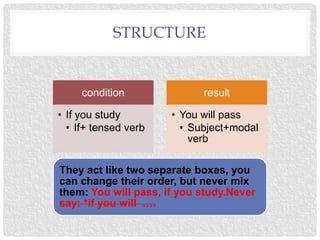
STRUCTURE
condition
• If you study
• If+ tensed verb
result
• You will pass
• Subject+modal
verb
They act like two separate boxes, you
can change their order, but never mix
them: You will pass, if you study.Never
say: *if you will ….
WHAT ARE THEY FOR…?
• THEY EXPRESS CONDITION, THAT IS, THE
PROBABILITY FOR SOMETHING TO HAPPEN.
• HOW? BY USING LINKERS, AND MODAL VERBS (will
would) WHICH EXPRESS PROBABILITY.
• THERE ARE 3 TYPES: first, second and third
• The structure is the same, but second and third
conditionals imply a past tense because, as you know, in
English, using a past/more remote tense, expresses less
possibility.
FIRST CONDITIONAL
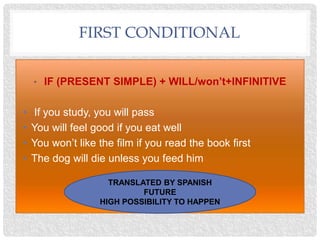
• IF (PRESENT SIMPLE) + WILL/won’t+INFINITIVE
• If you study, you will pass
• You will feel good if you eat well
• You won’t like the film if you read the book first
• The dog will die unless you feed him
TRANSLATED BY SPANISH
FUTURE
HIGH POSSIBILITY TO HAPPEN
SECOND CONDITIONAL
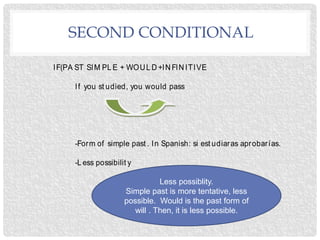
IF(PA ST SIM PL E + WOUL D +INFINITIVE
If you st udied, you would pass
-Form of simple past . In Spanish: si est udiaras aprobarías.
-L ess possibilit y
Less possiblity.
Simple past is more tentative, less
possible. Would is the past form of
will . Then, it is less possible.
THIRD CONDITIONAL
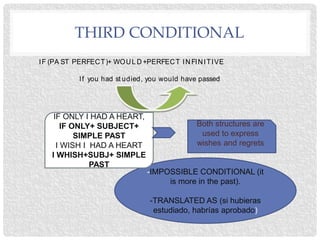
IF (PA ST PERFECT)+ WOUL D +PERFECT INFINITIVE
If you had st udied, you would have passed
-IMPOSSIBLE CONDITIONAL (it
is more in the past).
-TRANSLATED AS (si hubieras
estudiado, habrías aprobado)
IF ONLY I HAD A HEART,
IF ONLY+ SUBJECT+
SIMPLE PAST
I WISH I HAD A HEART
I WHISH+SUBJ+ SIMPLE
PAST
Both structures are
used to express
wishes and regrets
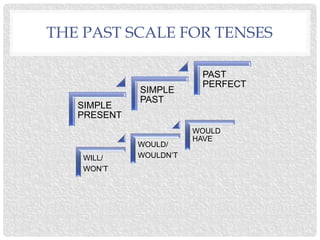
THE PAST SCALE FOR TENSES
SIMPLE
PRESENT
SIMPLE
PAST
PAST
PERFECT
WILL/
WON’T
WOULD/
WOULDN’T
WOULD
HAVE

Conditionals

  • 1.
    J U AN A M O R A L C A M A C H O CONDITIONALS
  • 2.
    INTRODUCTION • DEFINTION: Conditional sentences areused to express the conditions necessary for something to happen: • If you read you will learn • LINKERS: • IF: SI • UNLESS: A MENOS QUE. You dog will die unless you feed him • WHETHER: si (BUT ONLY FOR TWO OPTIONS): I don’t care whether you stay or go away.
  • 3.
    STRUCTURE condition • If youstudy • If+ tensed verb result • You will pass • Subject+modal verb They act like two separate boxes, you can change their order, but never mix them: You will pass, if you study.Never say: *if you will ….
  • 4.
    WHAT ARE THEYFOR…? • THEY EXPRESS CONDITION, THAT IS, THE PROBABILITY FOR SOMETHING TO HAPPEN. • HOW? BY USING LINKERS, AND MODAL VERBS (will would) WHICH EXPRESS PROBABILITY. • THERE ARE 3 TYPES: first, second and third • The structure is the same, but second and third conditionals imply a past tense because, as you know, in English, using a past/more remote tense, expresses less possibility.
  • 5.
    FIRST CONDITIONAL • IF(PRESENT SIMPLE) + WILL/won’t+INFINITIVE • If you study, you will pass • You will feel good if you eat well • You won’t like the film if you read the book first • The dog will die unless you feed him TRANSLATED BY SPANISH FUTURE HIGH POSSIBILITY TO HAPPEN
  • 6.
    SECOND CONDITIONAL IF(PA STSIM PL E + WOUL D +INFINITIVE If you st udied, you would pass -Form of simple past . In Spanish: si est udiaras aprobarías. -L ess possibilit y Less possiblity. Simple past is more tentative, less possible. Would is the past form of will . Then, it is less possible.
  • 7.
    THIRD CONDITIONAL IF (PAST PERFECT)+ WOUL D +PERFECT INFINITIVE If you had st udied, you would have passed -IMPOSSIBLE CONDITIONAL (it is more in the past). -TRANSLATED AS (si hubieras estudiado, habrías aprobado) IF ONLY I HAD A HEART, IF ONLY+ SUBJECT+ SIMPLE PAST I WISH I HAD A HEART I WHISH+SUBJ+ SIMPLE PAST Both structures are used to express wishes and regrets
  • 8.
    THE PAST SCALEFOR TENSES SIMPLE PRESENT SIMPLE PAST PAST PERFECT WILL/ WON’T WOULD/ WOULDN’T WOULD HAVE