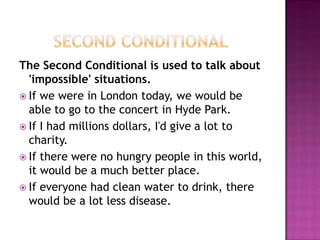
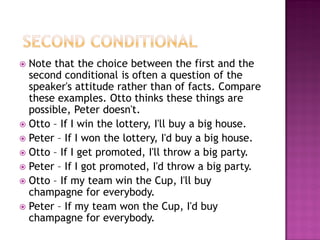
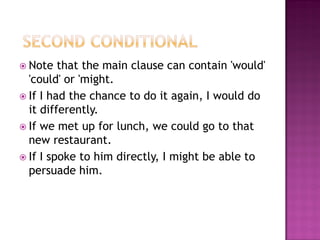
The document discusses the second conditional and how it is used to talk about impossible or unlikely situations. Some key points:
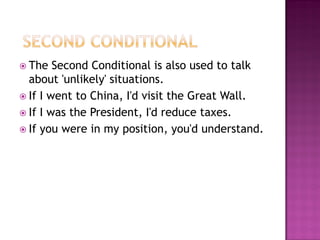
- The second conditional uses "if" clauses with would to describe events that are unlikely or impossible, such as "If I had millions of dollars, I'd give a lot to charity."
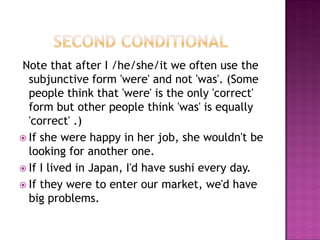
- It often uses "were" instead of "was" after first-person pronouns in the if-clause, like "If she were happy in her job, she wouldn't be looking for another one."
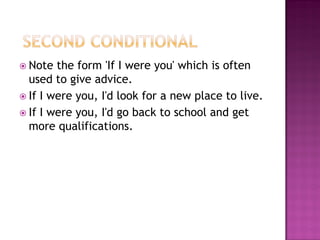
- The second conditional can also be used to give advice by saying "If I were you..."
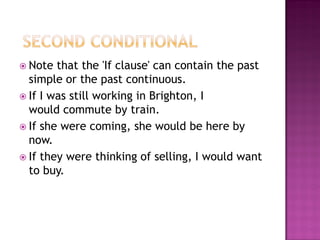
- The if-clause can contain past simple or past continuous tenses.