Novy Tania Mulyawati
15610093
Conditional Sentence
Conditional Sentences are also known as conditional
clauses or if-clause. They are used to express that the
action in the main clause (without if) can only take place if
a certain (in the clause with if) is fulfilled.
Note:clause is the smallest grammar unit that can
express a complete proporsiton. A typical
clause
consist of a Subject and a predicate, where the
predicate, where the
predicate is typically a
verb phrase, a verb together with any objects and
other modifiers.


There are two types :
a. Main clause(or independent clause) Every main
clause will follow this pattern : subject + verb =
complete thought
example: My dog loves pizza crusts.
Dog = subject ; loves = verb
The important point to remember is that every
sentence must have at least one main clause.
b. Subordinate clause will follow this pattern :
subordinate conjunction+subject+verb= incomplete
thought . The subordinate clause is that they can
never stand alone as complete sentence.
Example : Because my dog loves pizza crusts .
Because = subordinate conjunction; Dog = subject;
loves = verb
A conditional sentence typically consists of an ifclause (which present condition) and a result clause.
Example: If it rains, the streets get wet.
 Exercise 1.
Directions: Answer the question with “yes” or “no”.
1. If the weather had been good yesterday, our picnic would
not have been canceled.
a. Was the picnic canceled?___
b. Was the weather good?___
2. If I had an envelope and a stamp, I would mail this letter
right now.
a. Do I have an envelope and a stamp right now?___
b. Do I want to mail this letter right not?___
c. Am I going to mail this letter right now?___
3. If I didn’t haved any friends, I would be lonely.
a. Am I lonely?__
b. Do I have friends?___
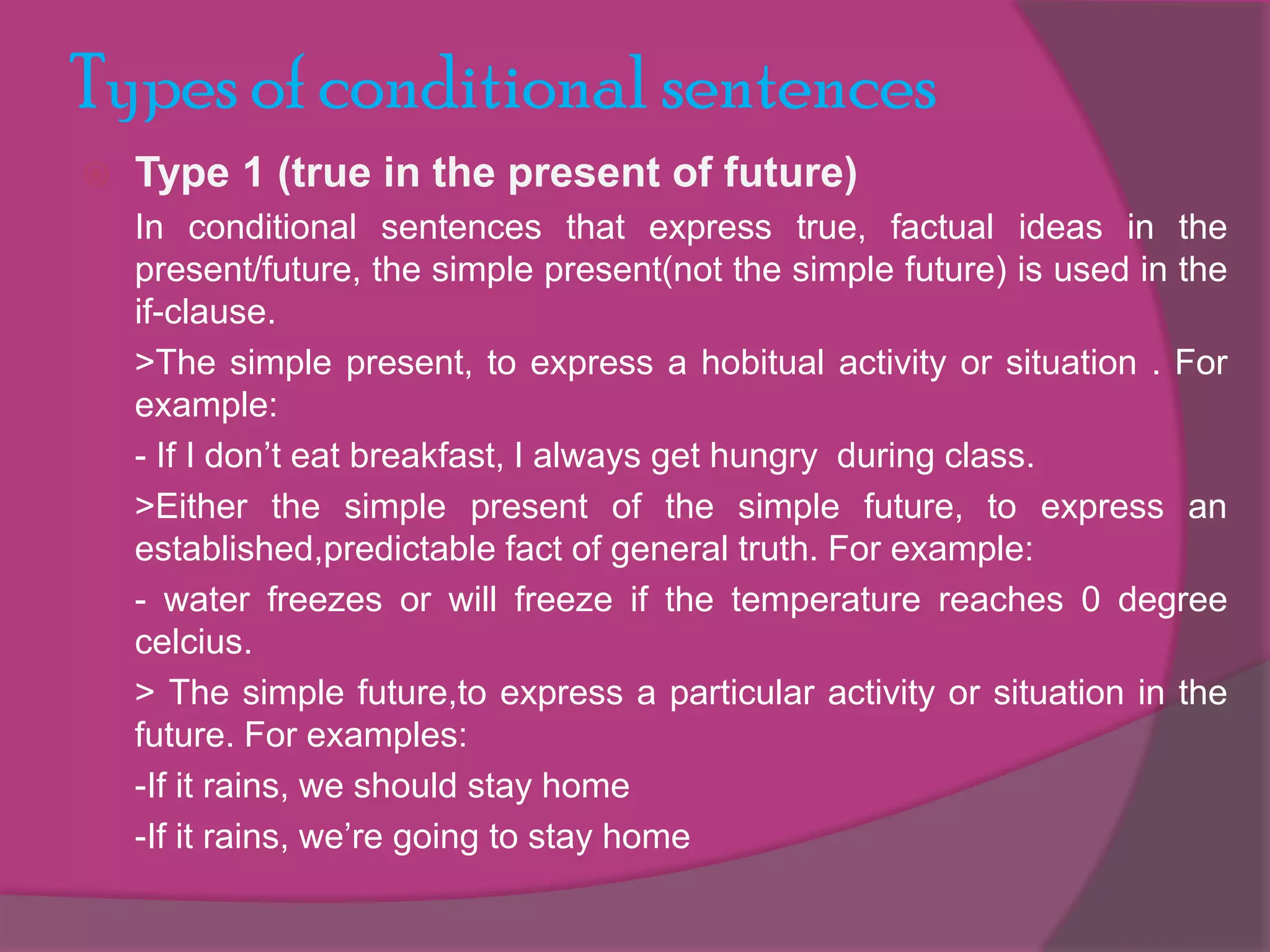
Types of conditional sentences


Type 1 (true in the present of future)
In conditional sentences that express true, factual ideas in the
present/future, the simple present(not the simple future) is used in the
if-clause.
>The simple present, to express a hobitual activity or situation . For
example:
- If I don’t eat breakfast, I always get hungry during class.
>Either the simple present of the simple future, to express an
established,predictable fact of general truth. For example:
- water freezes or will freeze if the temperature reaches 0 degree
celcius.
> The simple future,to express a particular activity or situation in the
future. For examples:
-If it rains, we should stay home
-If it rains, we’re going to stay home
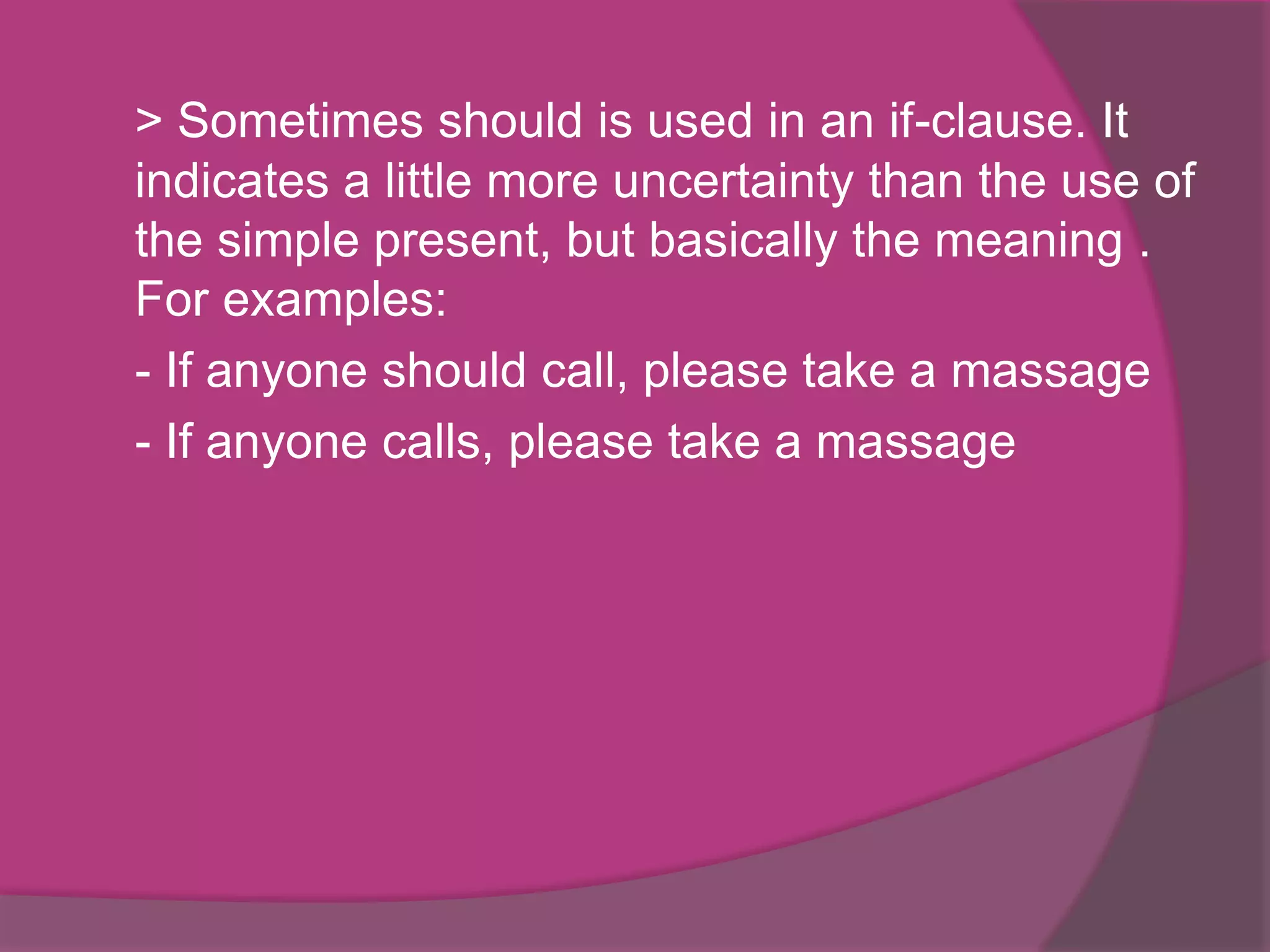
> Sometimes should is used in an if-clause. It
indicates a little more uncertainty than the use of
the simple present, but basically the meaning .
For examples:
- If anyone should call, please take a massage
- If anyone calls, please take a massage
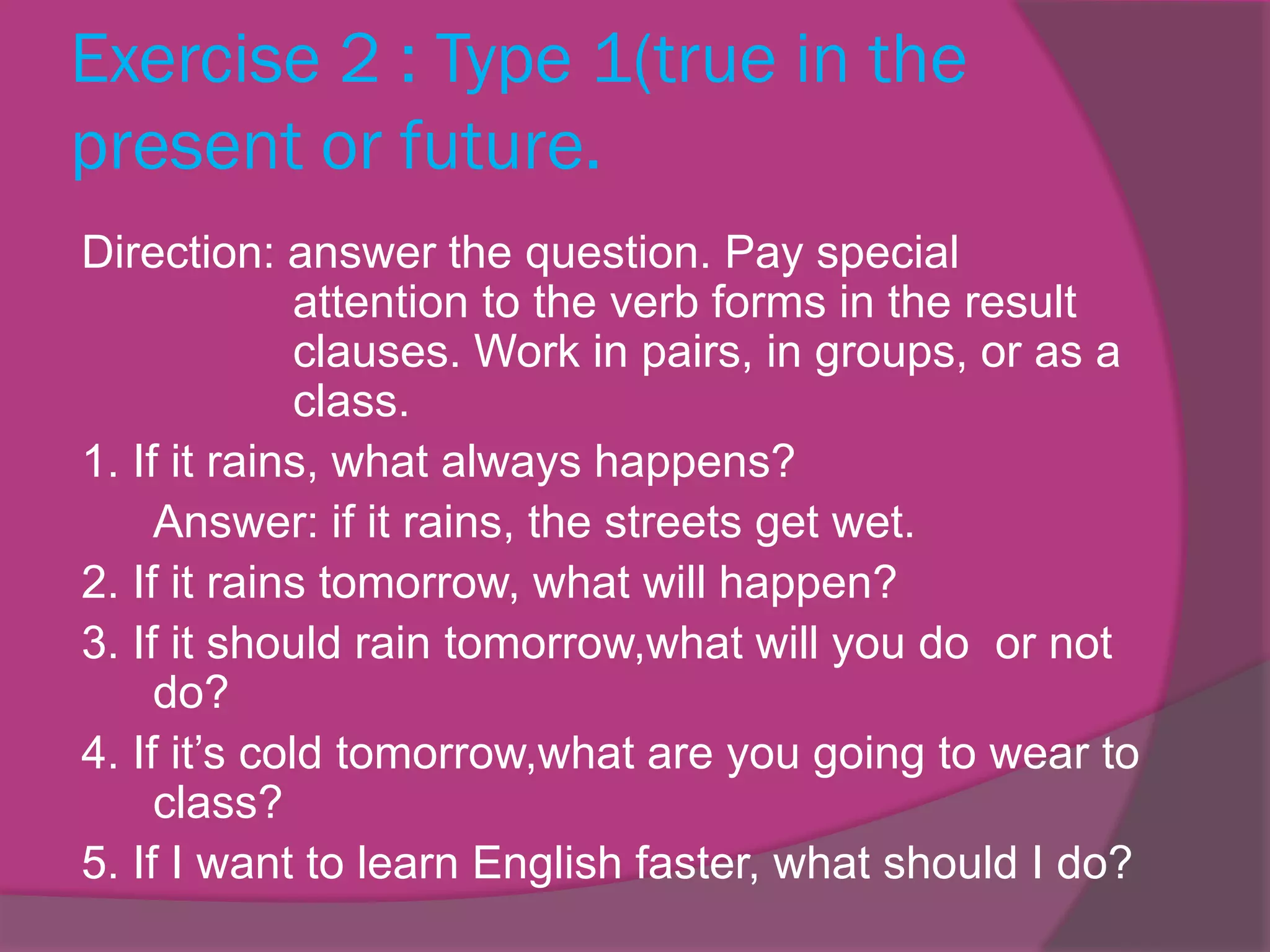
Exercise 2 : Type 1(true in the
present or future.
Direction: answer the question. Pay special
attention to the verb forms in the result
clauses. Work in pairs, in groups, or as a
class.
1. If it rains, what always happens?
Answer: if it rains, the streets get wet.
2. If it rains tomorrow, what will happen?
3. If it should rain tomorrow,what will you do or not
do?
4. If it’s cold tomorrow,what are you going to wear to
class?
5. If I want to learn English faster, what should I do?
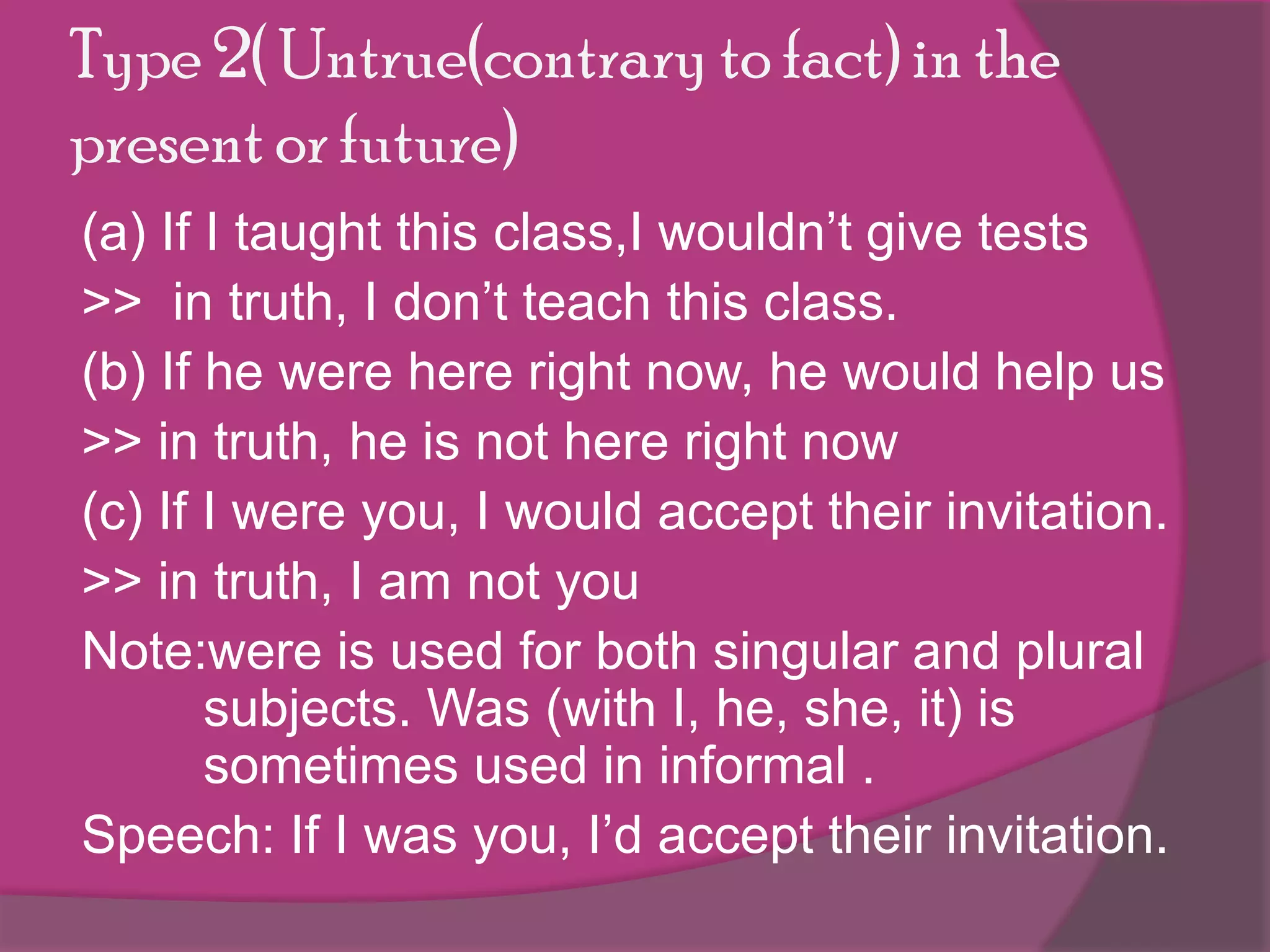
Type 2( Untrue(contrary to fact) in the
present or future)
(a) If I taught this class,I wouldn’t give tests
>> in truth, I don’t teach this class.
(b) If he were here right now, he would help us
>> in truth, he is not here right now
(c) If I were you, I would accept their invitation.
>> in truth, I am not you
Note:were is used for both singular and plural
subjects. Was (with I, he, she, it) is
sometimes used in informal .
Speech: If I was you, I’d accept their invitation.
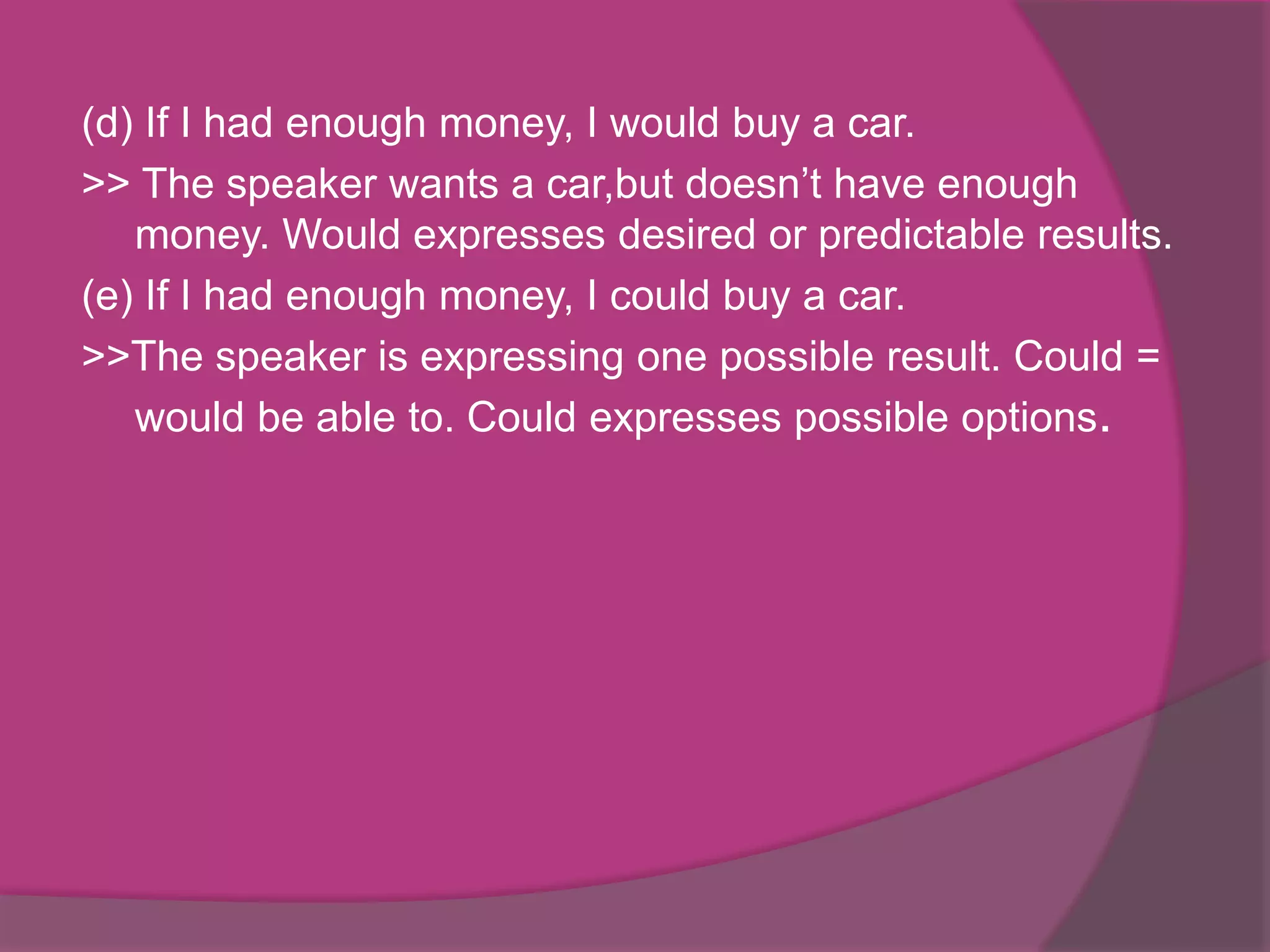
(d) If I had enough money, I would buy a car.
>> The speaker wants a car,but doesn’t have enough
money. Would expresses desired or predictable results.
(e) If I had enough money, I could buy a car.
>>The speaker is expressing one possible result. Could =
would be able to. Could expresses possible options.
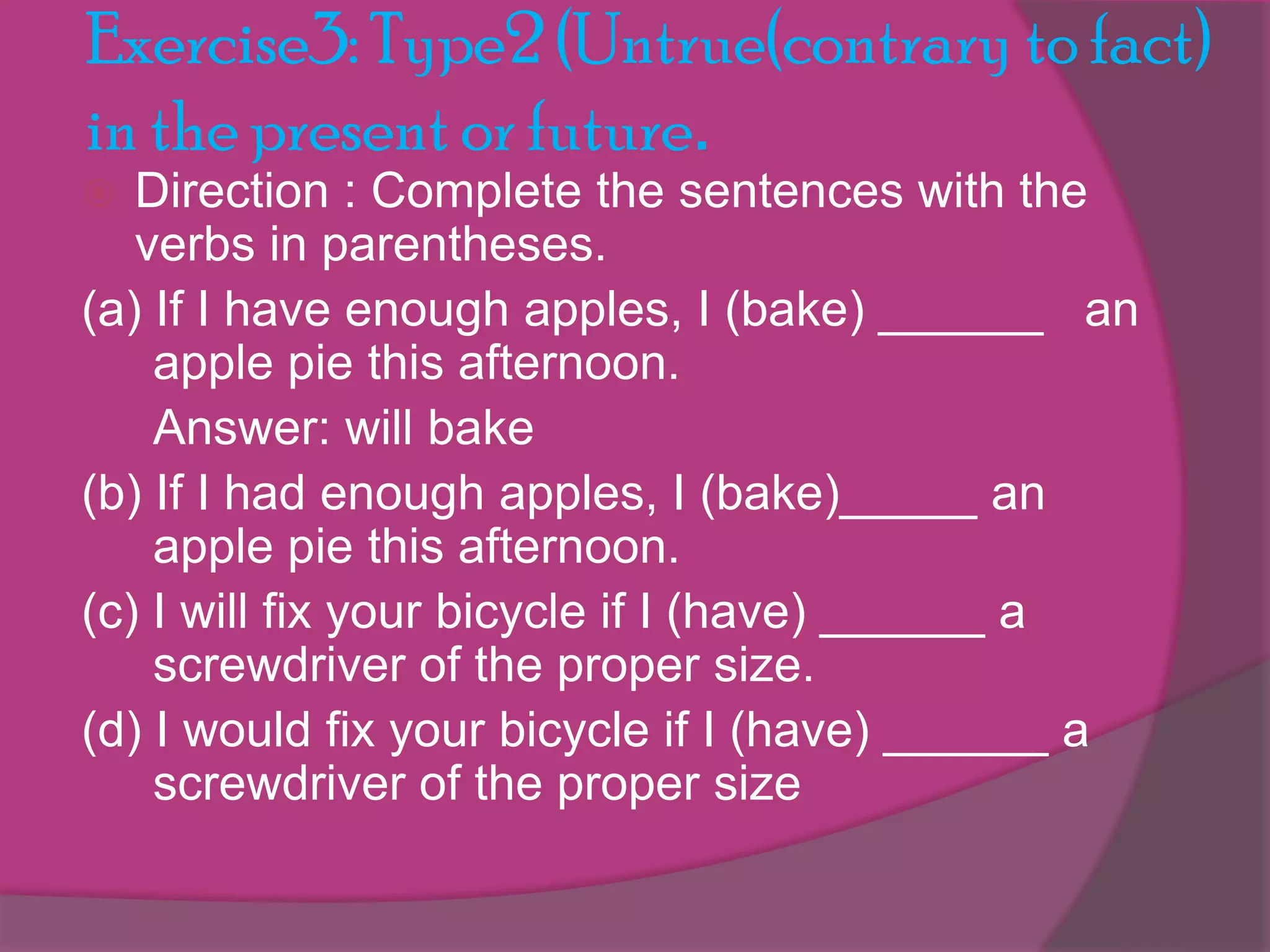
Exercise3: Type2 (Untrue(contrary to fact)
in the present or future.
Direction : Complete the sentences with the
verbs in parentheses.
(a) If I have enough apples, I (bake) ______ an
apple pie this afternoon.
Answer: will bake
(b) If I had enough apples, I (bake)_____ an
apple pie this afternoon.
(c) I will fix your bicycle if I (have) ______ a
screwdriver of the proper size.
(d) I would fix your bicycle if I (have) ______ a
screwdriver of the proper size

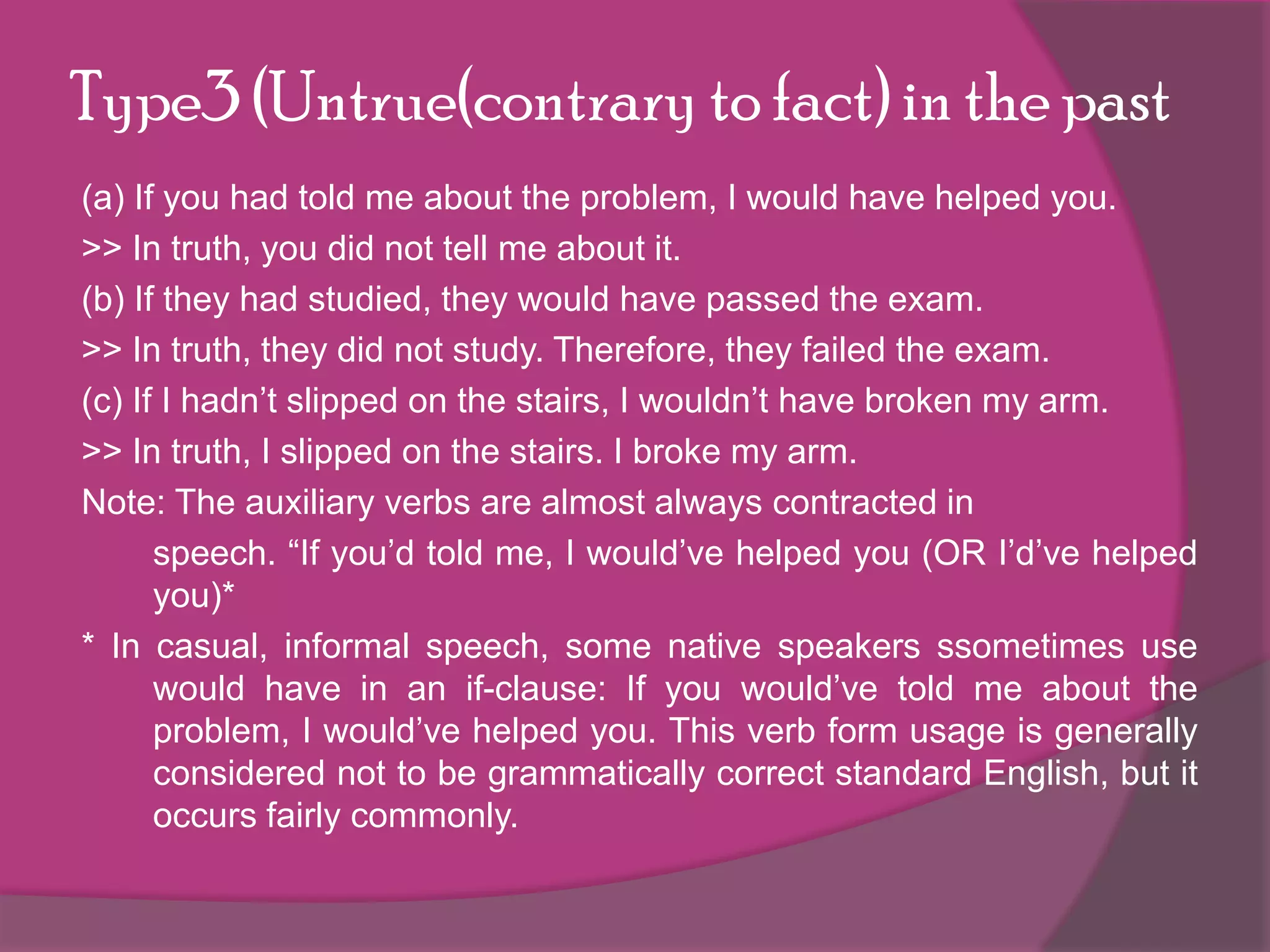
Type3 (Untrue(contrary to fact) in the past
(a) If you had told me about the problem, I would have helped you.
>> In truth, you did not tell me about it.
(b) If they had studied, they would have passed the exam.
>> In truth, they did not study. Therefore, they failed the exam.
(c) If I hadn’t slipped on the stairs, I wouldn’t have broken my arm.
>> In truth, I slipped on the stairs. I broke my arm.
Note: The auxiliary verbs are almost always contracted in
speech. “If you’d told me, I would’ve helped you (OR I’d’ve helped
you)*
* In casual, informal speech, some native speakers ssometimes use
would have in an if-clause: If you would’ve told me about the
problem, I would’ve helped you. This verb form usage is generally
considered not to be grammatically correct standard English, but it
occurs fairly commonly.
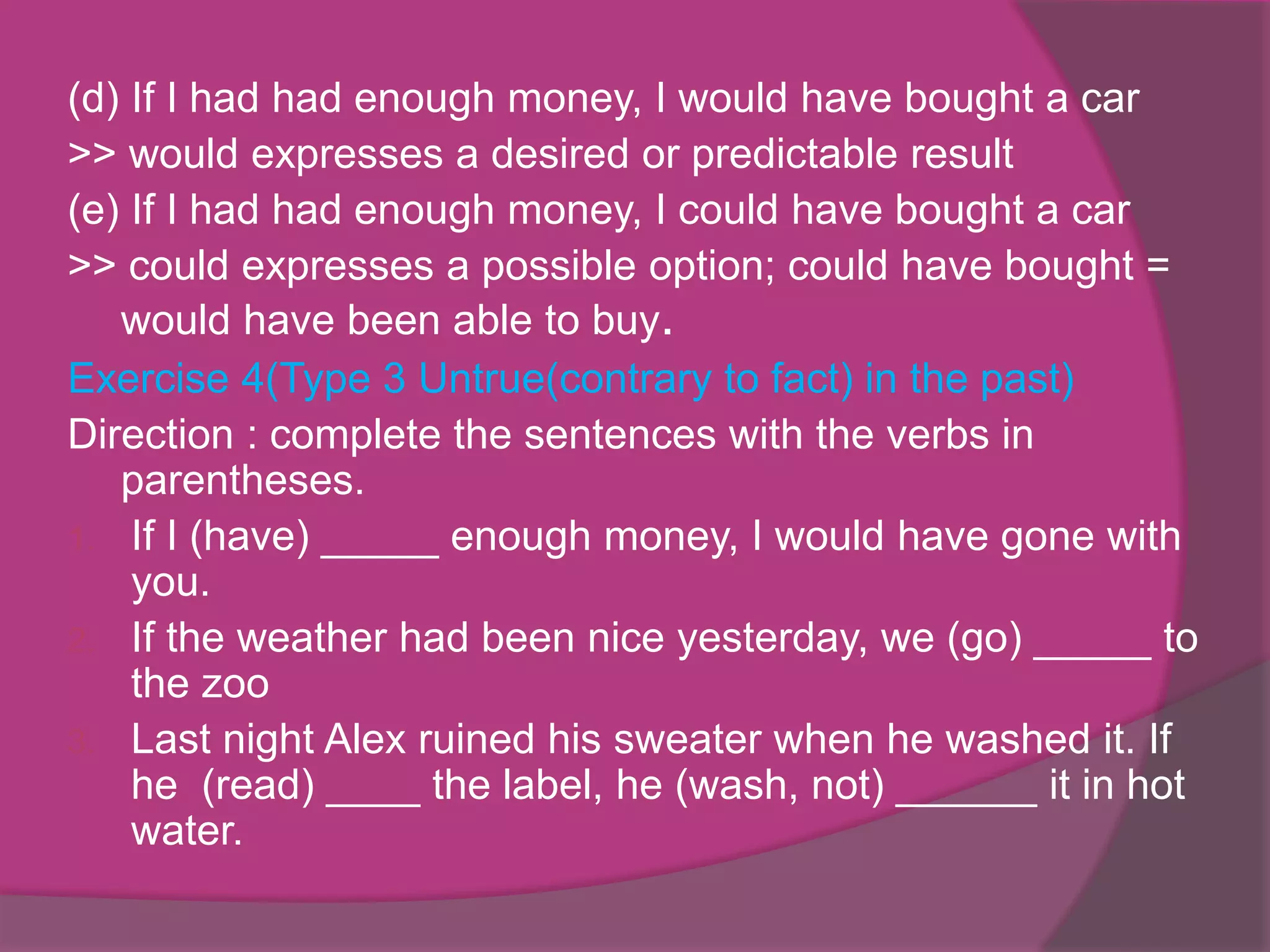
(d) If I had had enough money, I would have bought a car
>> would expresses a desired or predictable result
(e) If I had had enough money, I could have bought a car
>> could expresses a possible option; could have bought =
would have been able to buy.
Exercise 4(Type 3 Untrue(contrary to fact) in the past)
Direction : complete the sentences with the verbs in
parentheses.
1. If I (have) _____ enough money, I would have gone with
you.
2. If the weather had been nice yesterday, we (go) _____ to
the zoo
3. Last night Alex ruined his sweater when he washed it. If
he (read) ____ the label, he (wash, not) ______ it in hot
water.

Conditional sentence shoftskill

  • 1.
  • 2.
    Conditional Sentence Conditional Sentencesare also known as conditional clauses or if-clause. They are used to express that the action in the main clause (without if) can only take place if a certain (in the clause with if) is fulfilled. Note:clause is the smallest grammar unit that can express a complete proporsiton. A typical clause consist of a Subject and a predicate, where the predicate, where the predicate is typically a verb phrase, a verb together with any objects and other modifiers. 
  • 3.
    There are twotypes : a. Main clause(or independent clause) Every main clause will follow this pattern : subject + verb = complete thought example: My dog loves pizza crusts. Dog = subject ; loves = verb The important point to remember is that every sentence must have at least one main clause. b. Subordinate clause will follow this pattern : subordinate conjunction+subject+verb= incomplete thought . The subordinate clause is that they can never stand alone as complete sentence. Example : Because my dog loves pizza crusts . Because = subordinate conjunction; Dog = subject; loves = verb
  • 4.
    A conditional sentencetypically consists of an ifclause (which present condition) and a result clause. Example: If it rains, the streets get wet.  Exercise 1. Directions: Answer the question with “yes” or “no”. 1. If the weather had been good yesterday, our picnic would not have been canceled. a. Was the picnic canceled?___ b. Was the weather good?___ 2. If I had an envelope and a stamp, I would mail this letter right now. a. Do I have an envelope and a stamp right now?___ b. Do I want to mail this letter right not?___ c. Am I going to mail this letter right now?___ 3. If I didn’t haved any friends, I would be lonely. a. Am I lonely?__ b. Do I have friends?___
  • 5.
    Types of conditionalsentences  Type 1 (true in the present of future) In conditional sentences that express true, factual ideas in the present/future, the simple present(not the simple future) is used in the if-clause. >The simple present, to express a hobitual activity or situation . For example: - If I don’t eat breakfast, I always get hungry during class. >Either the simple present of the simple future, to express an established,predictable fact of general truth. For example: - water freezes or will freeze if the temperature reaches 0 degree celcius. > The simple future,to express a particular activity or situation in the future. For examples: -If it rains, we should stay home -If it rains, we’re going to stay home
  • 6.
    > Sometimes shouldis used in an if-clause. It indicates a little more uncertainty than the use of the simple present, but basically the meaning . For examples: - If anyone should call, please take a massage - If anyone calls, please take a massage
  • 7.
    Exercise 2 :Type 1(true in the present or future. Direction: answer the question. Pay special attention to the verb forms in the result clauses. Work in pairs, in groups, or as a class. 1. If it rains, what always happens? Answer: if it rains, the streets get wet. 2. If it rains tomorrow, what will happen? 3. If it should rain tomorrow,what will you do or not do? 4. If it’s cold tomorrow,what are you going to wear to class? 5. If I want to learn English faster, what should I do?
  • 8.
    Type 2( Untrue(contraryto fact) in the present or future) (a) If I taught this class,I wouldn’t give tests >> in truth, I don’t teach this class. (b) If he were here right now, he would help us >> in truth, he is not here right now (c) If I were you, I would accept their invitation. >> in truth, I am not you Note:were is used for both singular and plural subjects. Was (with I, he, she, it) is sometimes used in informal . Speech: If I was you, I’d accept their invitation.
  • 9.
    (d) If Ihad enough money, I would buy a car. >> The speaker wants a car,but doesn’t have enough money. Would expresses desired or predictable results. (e) If I had enough money, I could buy a car. >>The speaker is expressing one possible result. Could = would be able to. Could expresses possible options.
  • 10.
    Exercise3: Type2 (Untrue(contraryto fact) in the present or future. Direction : Complete the sentences with the verbs in parentheses. (a) If I have enough apples, I (bake) ______ an apple pie this afternoon. Answer: will bake (b) If I had enough apples, I (bake)_____ an apple pie this afternoon. (c) I will fix your bicycle if I (have) ______ a screwdriver of the proper size. (d) I would fix your bicycle if I (have) ______ a screwdriver of the proper size 
  • 11.
    Type3 (Untrue(contrary tofact) in the past (a) If you had told me about the problem, I would have helped you. >> In truth, you did not tell me about it. (b) If they had studied, they would have passed the exam. >> In truth, they did not study. Therefore, they failed the exam. (c) If I hadn’t slipped on the stairs, I wouldn’t have broken my arm. >> In truth, I slipped on the stairs. I broke my arm. Note: The auxiliary verbs are almost always contracted in speech. “If you’d told me, I would’ve helped you (OR I’d’ve helped you)* * In casual, informal speech, some native speakers ssometimes use would have in an if-clause: If you would’ve told me about the problem, I would’ve helped you. This verb form usage is generally considered not to be grammatically correct standard English, but it occurs fairly commonly.
  • 12.
    (d) If Ihad had enough money, I would have bought a car >> would expresses a desired or predictable result (e) If I had had enough money, I could have bought a car >> could expresses a possible option; could have bought = would have been able to buy. Exercise 4(Type 3 Untrue(contrary to fact) in the past) Direction : complete the sentences with the verbs in parentheses. 1. If I (have) _____ enough money, I would have gone with you. 2. If the weather had been nice yesterday, we (go) _____ to the zoo 3. Last night Alex ruined his sweater when he washed it. If he (read) ____ the label, he (wash, not) ______ it in hot water.