Conceptual
Framework for
Financial Reporting
Here is where your presentation begins
20XX.XX.XX
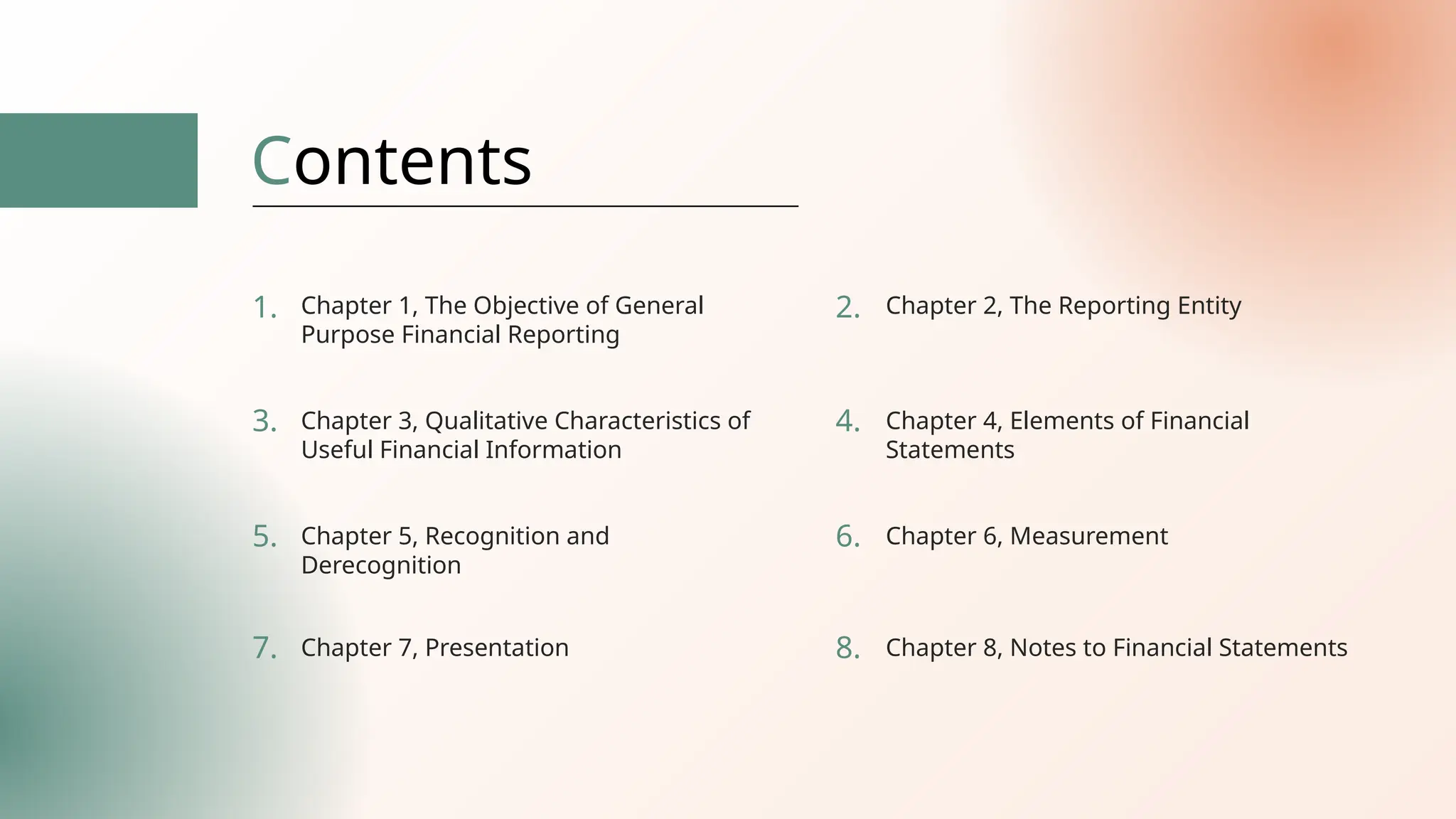
Contents
Chapter 2, The Reporting Entity
2.
1. Chapter 1, The Objective of General
Purpose Financial Reporting
Chapter 4, Elements of Financial
Statements
Chapter 3, Qualitative Characteristics of
Useful Financial Information
3. 4.
Chapter 6, Measurement
Chapter 5, Recognition and
Derecognition
5. 6.
Chapter 8, Notes to Financial Statements
Chapter 7, Presentation
7. 8.
X
Chapter 1, The
Objective of General
Purpose Financial
Reporting
Part 01
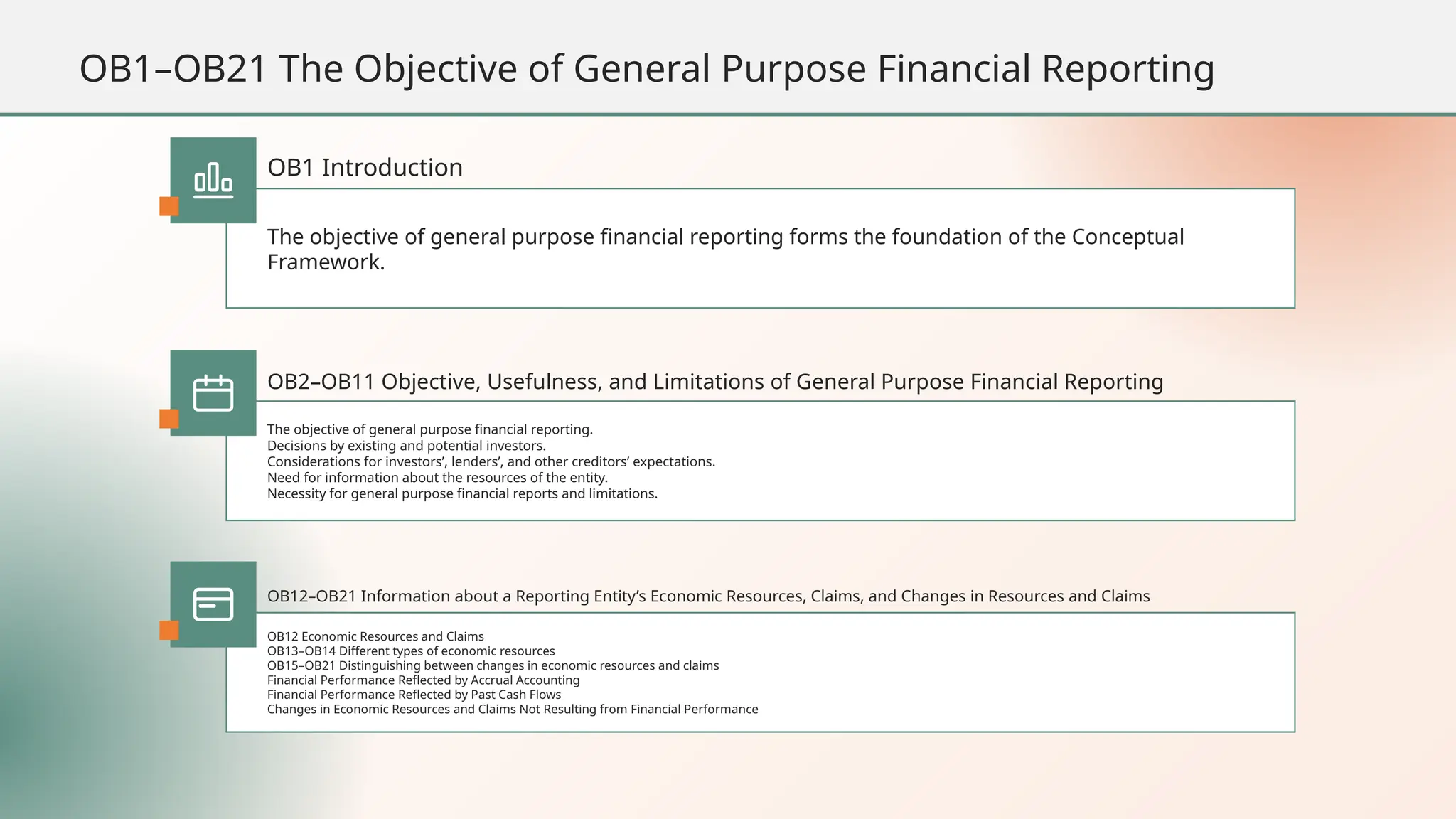
The objective of general purpose financial reporting forms the foundation of the Conceptual
Framework.
OB1 Introduction
The objective of general purpose financial reporting.
Decisions by existing and potential investors.
Considerations for investors’, lenders’, and other creditors’ expectations.
Need for information about the resources of the entity.
Necessity for general purpose financial reports and limitations.
OB2–OB11 Objective, Usefulness, and Limitations of General Purpose Financial Reporting
OB12 Economic Resources and Claims
OB13–OB14 Different types of economic resources
OB15–OB21 Distinguishing between changes in economic resources and claims
Financial Performance Reflected by Accrual Accounting
Financial Performance Reflected by Past Cash Flows
Changes in Economic Resources and Claims Not Resulting from Financial Performance
OB12–OB21 Information about a Reporting Entity’s Economic Resources, Claims, and Changes in Resources and Claims
OB1–OB21 The Objective of General Purpose Financial Reporting
Considerations specific to not- for- profit entities.
OB22 Objective for Not-for-Profit Entities
Receipts of significant amounts of resources.
Operating purposes.
Absence of defined ownership interests.
Major characteristics of not- for- profit entities.
Information for resource providers about a not- for- profit entity’s service
efforts in accomplishing its mission.
Relevance and faithfulness in providing information to resource providers.
OB23–OB28 Characteristics distinguishing not-for-profit entities from
business enterprises
OB22–OB28 Application of the Objective of General Purpose Financial Reporting to Not-for-Profit Entities
X
Chapter 2, The
Reporting Entity
Part 02
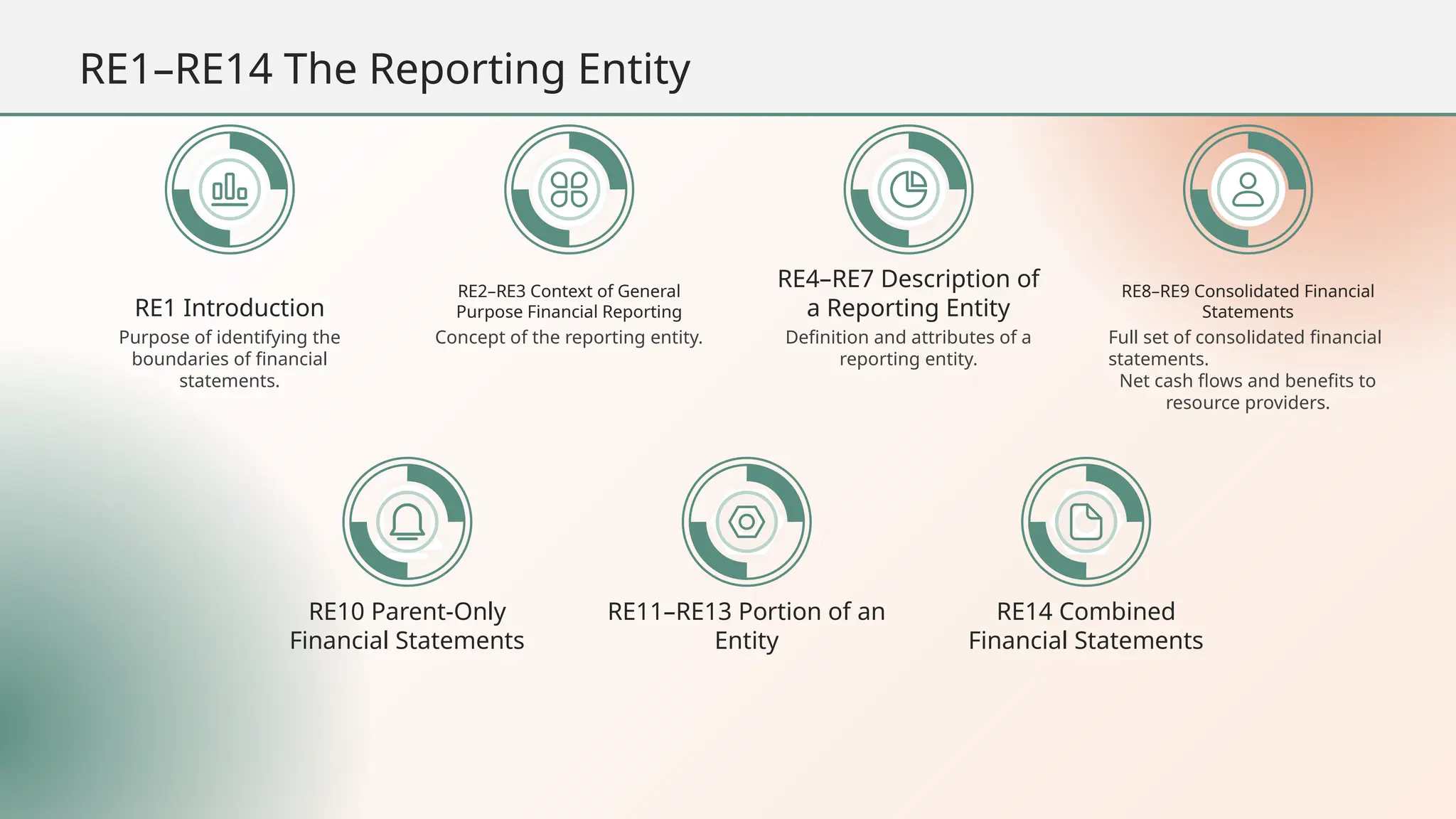
RE1 Introduction
Purpose of identifying the
boundaries of financial
statements.
RE2–RE3 Context of General
Purpose Financial Reporting
Concept of the reporting entity.
RE4–RE7 Description of
a Reporting Entity
Definition and attributes of a
reporting entity.
RE8–RE9 Consolidated Financial
Statements
Full set of consolidated financial
statements.
Net cash flows and benefits to
resource providers.
RE10 Parent-Only
Financial Statements
RE11–RE13 Portion of an
Entity
RE14 Combined
Financial Statements
RE1–RE14 The Reporting Entity
X
Chapter 3, Qualitative
Characteristics of
Useful Financial
Information
Part 03
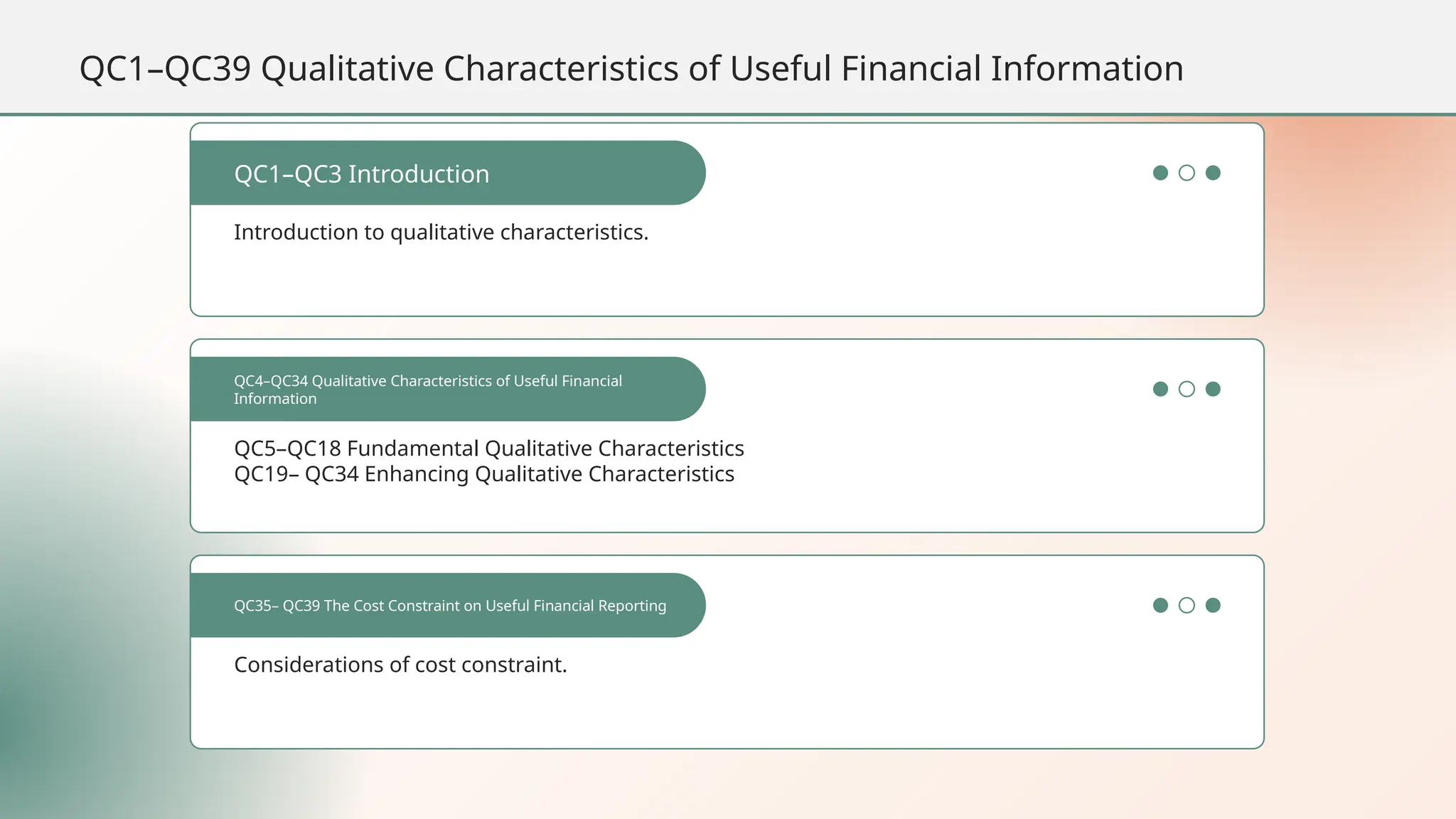
Introduction to qualitative characteristics.
QC1–QC3 Introduction
QC5–QC18 Fundamental Qualitative Characteristics
QC19– QC34 Enhancing Qualitative Characteristics
QC4–QC34 Qualitative Characteristics of Useful Financial
Information
Considerations of cost constraint.
QC35– QC39 The Cost Constraint on Useful Financial Reporting
QC1–QC39 Qualitative Characteristics of Useful Financial Information
X
Chapter 4, Elements of
Financial Statements
Part 04
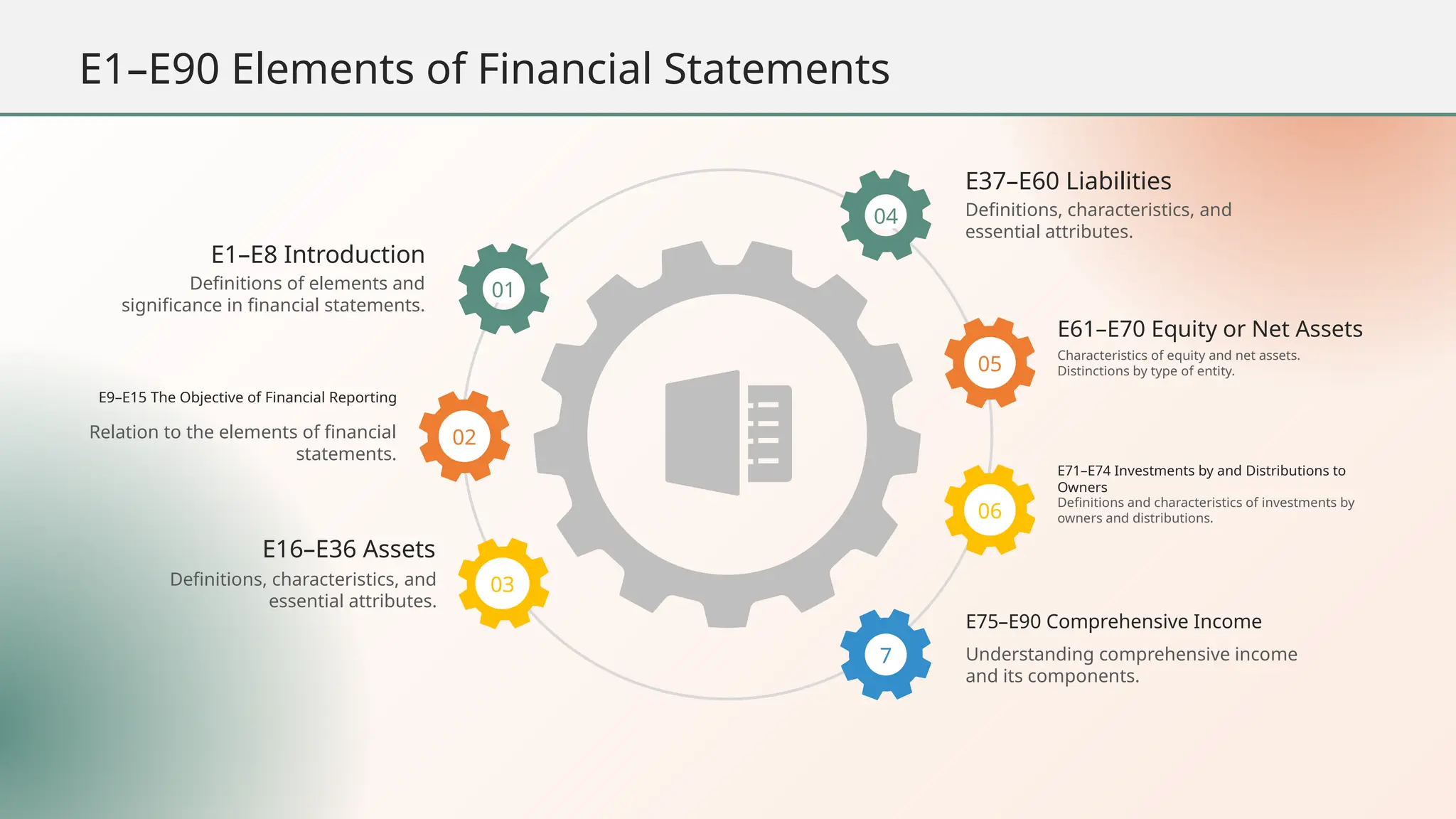
04 Definitions, characteristics, and
essential attributes.
Definitions of elements and
significance in financial statements.
01
E1–E8 Introduction
E37–E60 Liabilities
05
02
Characteristics of equity and net assets.
Distinctions by type of entity.
Relation to the elements of financial
statements.
E9–E15 The Objective of Financial Reporting
E61–E70 Equity or Net Assets
06
Definitions and characteristics of investments by
owners and distributions.
03
Definitions, characteristics, and
essential attributes.
E71–E74 Investments by and Distributions to
Owners
7 Understanding comprehensive income
and its components.
E75–E90 Comprehensive Income
E16–E36 Assets
E1–E90 Elements of Financial Statements
X
Chapter 5, Recognition
and Derecognition
Part 05
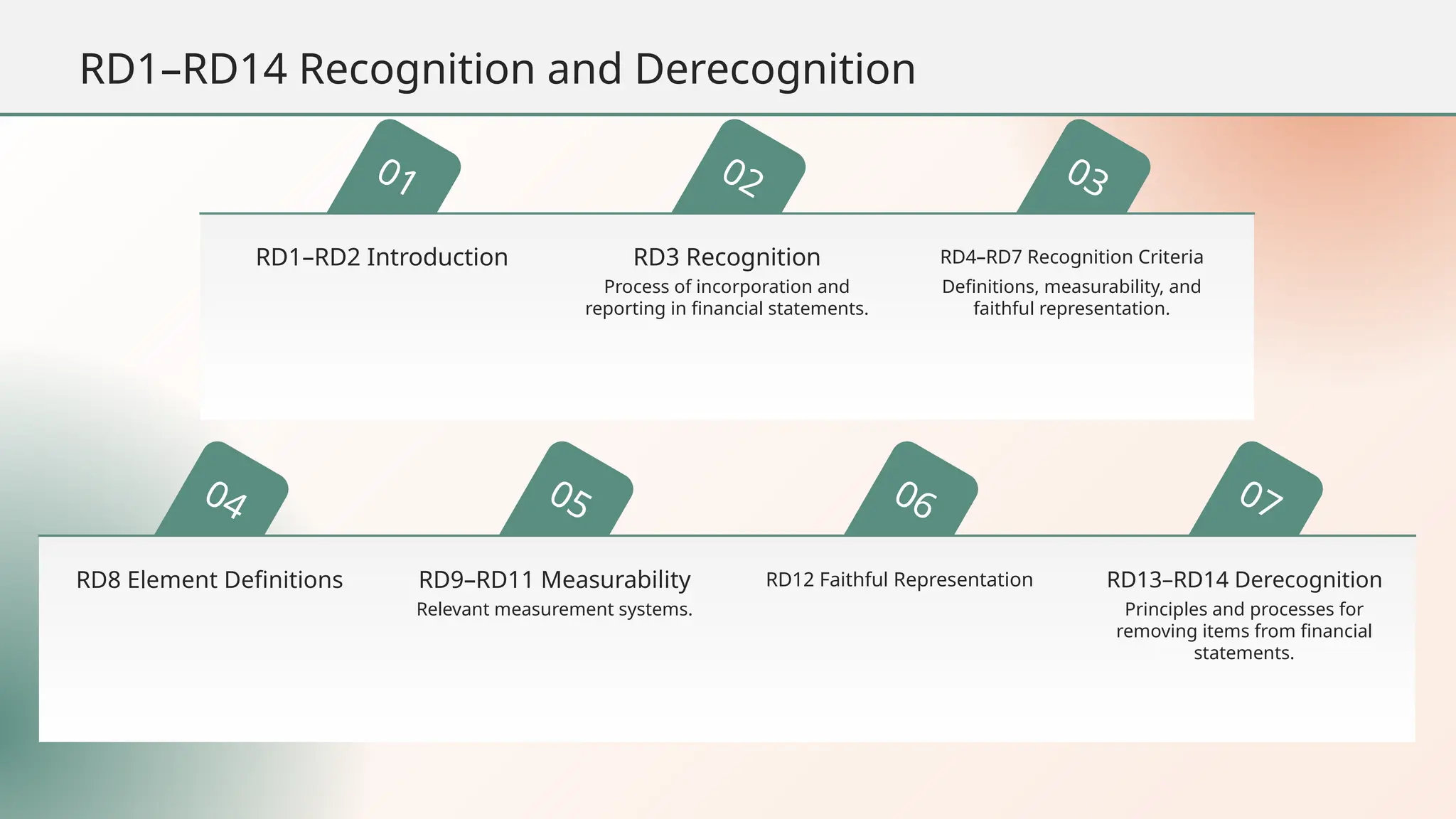
02 03
01
05 06 07
04
RD1–RD2 Introduction
RD8 Element Definitions
RD3 Recognition
Process of incorporation and
reporting in financial statements.
RD9–RD11 Measurability
Relevant measurement systems.
RD4–RD7 Recognition Criteria
Definitions, measurability, and
faithful representation.
RD12 Faithful Representation RD13–RD14 Derecognition
Principles and processes for
removing items from financial
statements.
RD1–RD14 Recognition and Derecognition
X
Chapter 6,
Measurement
Part 06
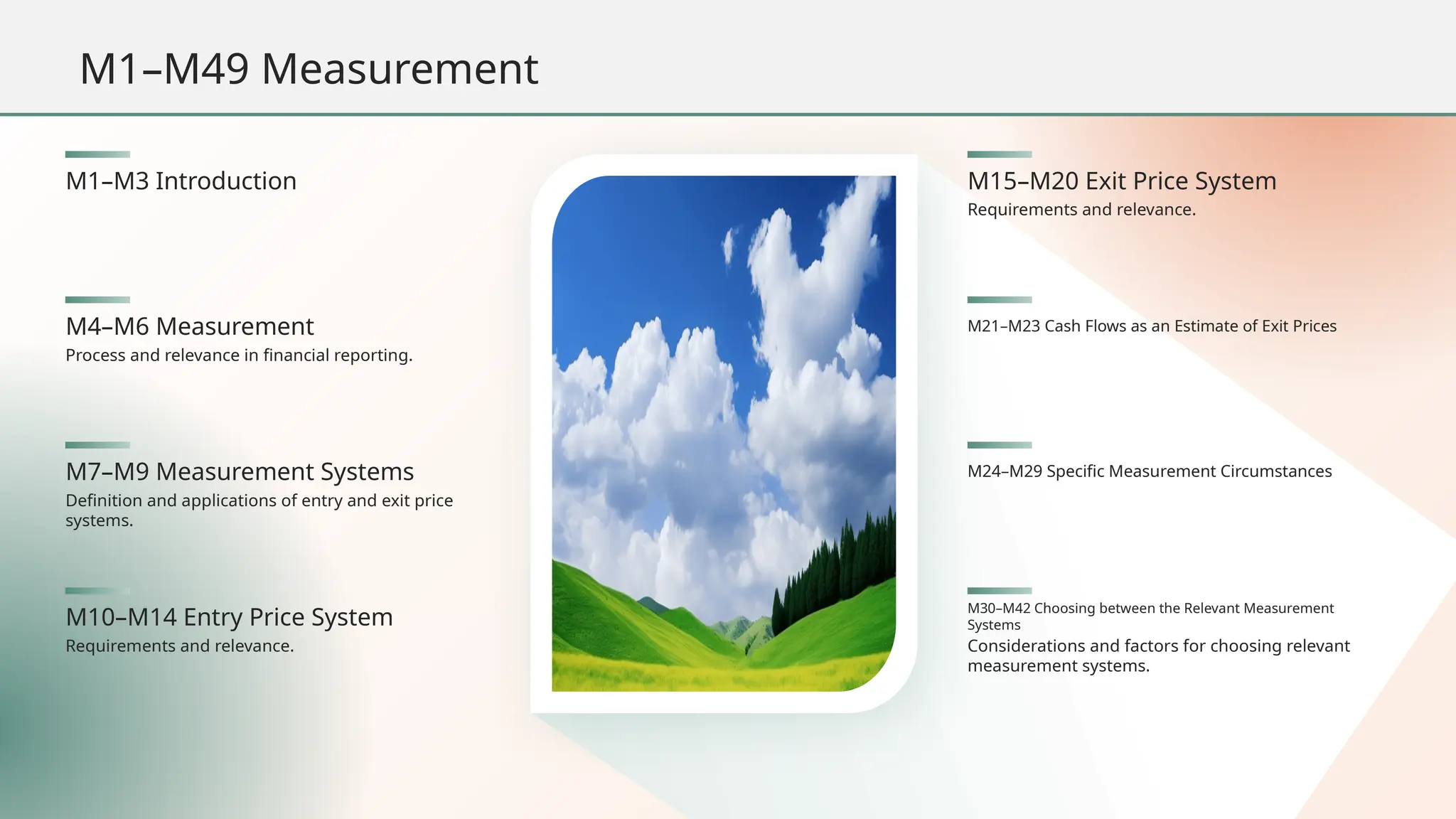
Requirements and relevance.
M15–M20 Exit Price System
M1–M3 Introduction
M21–M23 Cash Flows as an Estimate of Exit Prices
Process and relevance in financial reporting.
M4–M6 Measurement
M24–M29 Specific Measurement Circumstances
Definition and applications of entry and exit price
systems.
M7–M9 Measurement Systems
Considerations and factors for choosing relevant
measurement systems.
M30–M42 Choosing between the Relevant Measurement
Systems
Requirements and relevance.
M10–M14 Entry Price System
M1–M49 Measurement
X
Chapter 7,
Presentation
Part 07
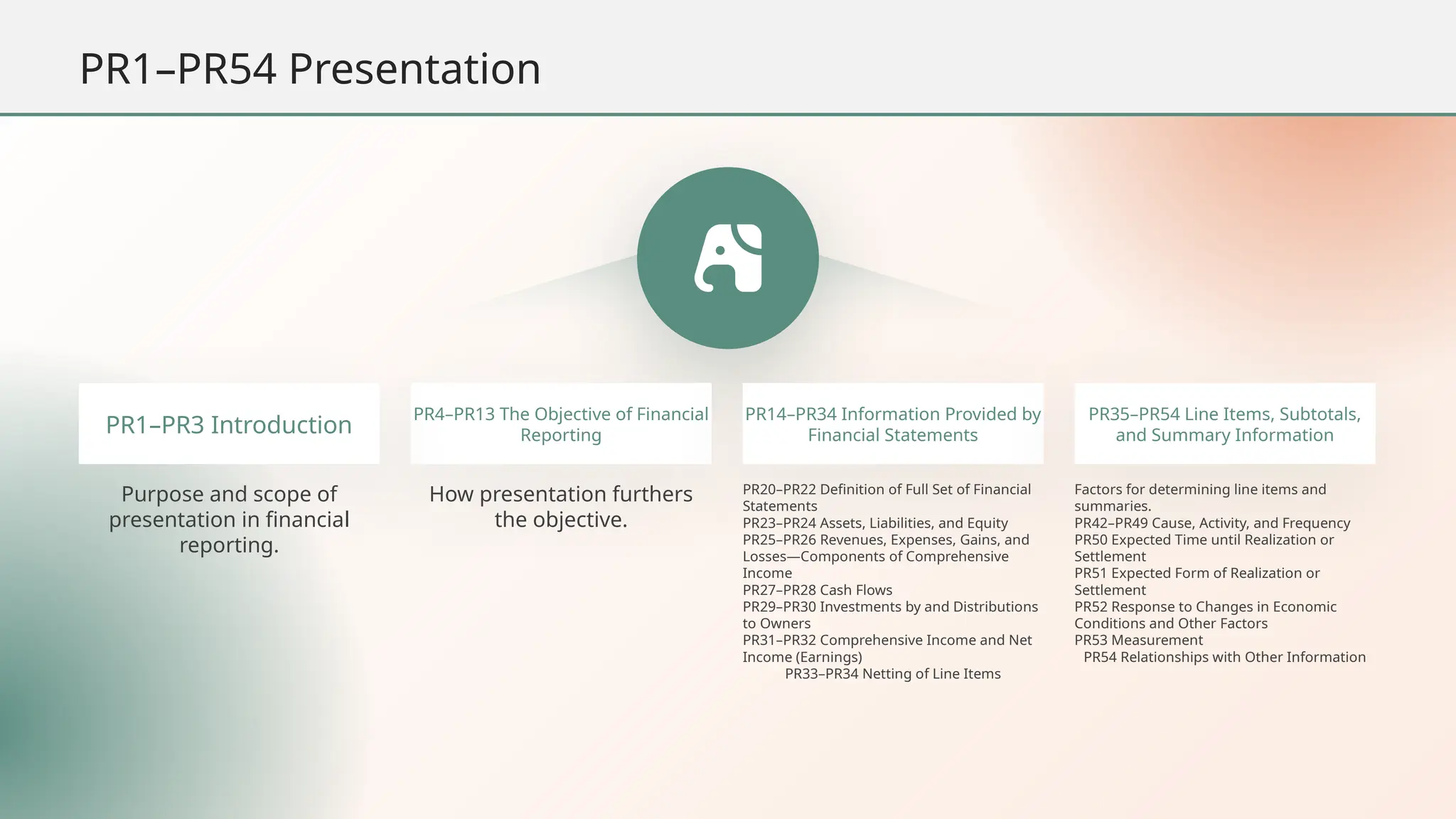
PR4–PR13 The Objective of Financial
Reporting
How presentation furthers
the objective.
PR1–PR3 Introduction
Purpose and scope of
presentation in financial
reporting.
PR14–PR34 Information Provided by
Financial Statements
PR20–PR22 Definition of Full Set of Financial
Statements
PR23–PR24 Assets, Liabilities, and Equity
PR25–PR26 Revenues, Expenses, Gains, and
Losses—Components of Comprehensive
Income
PR27–PR28 Cash Flows
PR29–PR30 Investments by and Distributions
to Owners
PR31–PR32 Comprehensive Income and Net
Income (Earnings)
PR33–PR34 Netting of Line Items
PR35–PR54 Line Items, Subtotals,
and Summary Information
Factors for determining line items and
summaries.
PR42–PR49 Cause, Activity, and Frequency
PR50 Expected Time until Realization or
Settlement
PR51 Expected Form of Realization or
Settlement
PR52 Response to Changes in Economic
Conditions and Other Factors
PR53 Measurement
PR54 Relationships with Other Information
PR1–PR54 Presentation
X
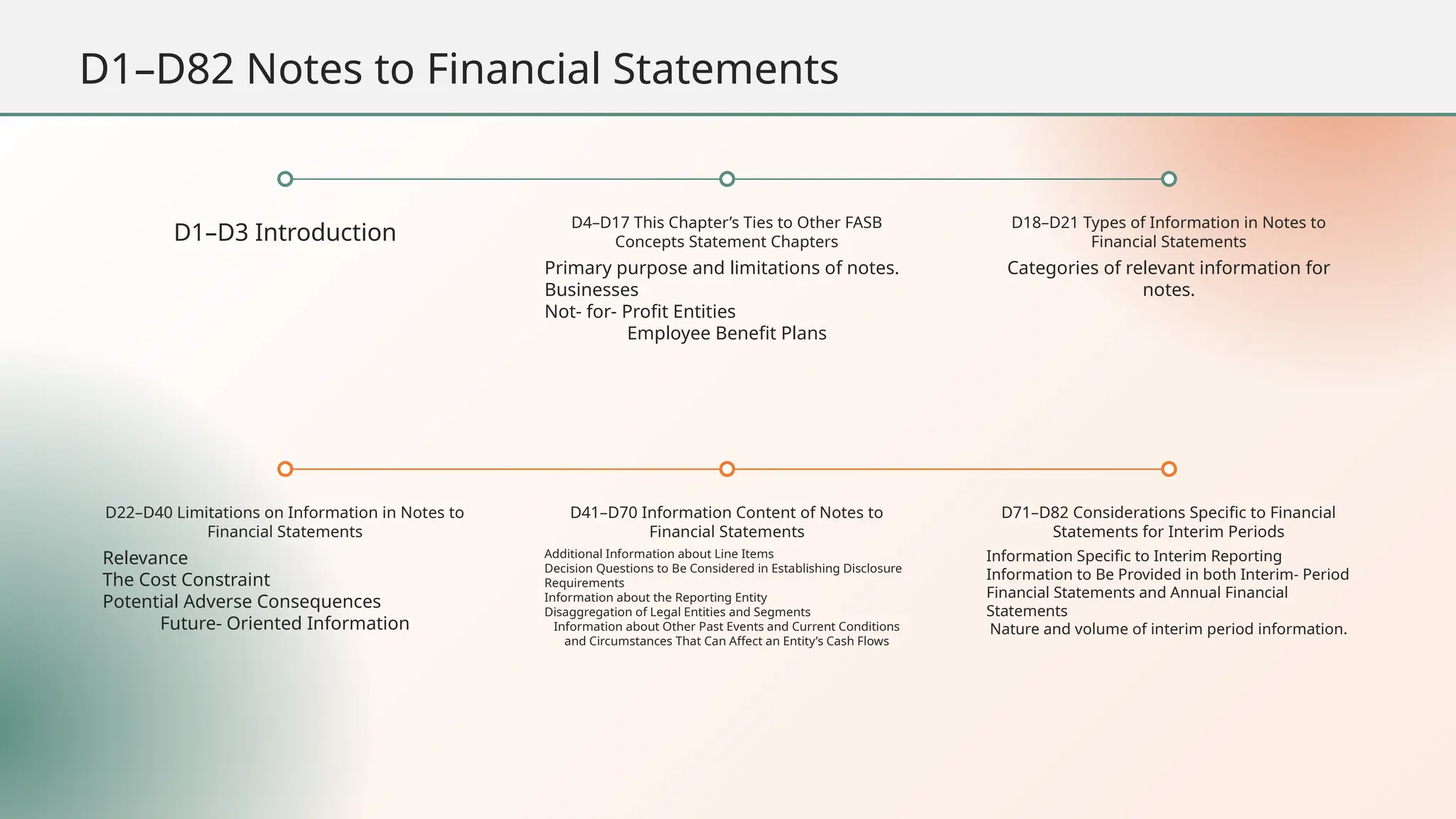
Chapter 8, Notes to
Financial Statements
Part 08
D1–D3 Introduction
D22–D40 Limitations on Information in Notes to
Financial Statements
Relevance
The Cost Constraint
Potential Adverse Consequences
Future- Oriented Information
D4–D17 This Chapter’s Ties to Other FASB
Concepts Statement Chapters
Primary purpose and limitations of notes.
Businesses
Not- for- Profit Entities
Employee Benefit Plans
D41–D70 Information Content of Notes to
Financial Statements
Additional Information about Line Items
Decision Questions to Be Considered in Establishing Disclosure
Requirements
Information about the Reporting Entity
Disaggregation of Legal Entities and Segments
Information about Other Past Events and Current Conditions
and Circumstances That Can Affect an Entity’s Cash Flows
D18–D21 Types of Information in Notes to
Financial Statements
Categories of relevant information for
notes.
D71–D82 Considerations Specific to Financial
Statements for Interim Periods
Information Specific to Interim Reporting
Information to Be Provided in both Interim- Period
Financial Statements and Annual Financial
Statements
Nature and volume of interim period information.
D1–D82 Notes to Financial Statements

Thanks
Edited by Rithwik Reddy
20XX.XX.XX

Conceptual Framework for Financial Reporting.pptx

  • 1.
    Conceptual Framework for Financial Reporting Hereis where your presentation begins 20XX.XX.XX
  • 2.
    Contents Chapter 2, TheReporting Entity 2. 1. Chapter 1, The Objective of General Purpose Financial Reporting Chapter 4, Elements of Financial Statements Chapter 3, Qualitative Characteristics of Useful Financial Information 3. 4. Chapter 6, Measurement Chapter 5, Recognition and Derecognition 5. 6. Chapter 8, Notes to Financial Statements Chapter 7, Presentation 7. 8.
  • 3.
    X Chapter 1, The Objectiveof General Purpose Financial Reporting Part 01
  • 4.
    The objective ofgeneral purpose financial reporting forms the foundation of the Conceptual Framework. OB1 Introduction The objective of general purpose financial reporting. Decisions by existing and potential investors. Considerations for investors’, lenders’, and other creditors’ expectations. Need for information about the resources of the entity. Necessity for general purpose financial reports and limitations. OB2–OB11 Objective, Usefulness, and Limitations of General Purpose Financial Reporting OB12 Economic Resources and Claims OB13–OB14 Different types of economic resources OB15–OB21 Distinguishing between changes in economic resources and claims Financial Performance Reflected by Accrual Accounting Financial Performance Reflected by Past Cash Flows Changes in Economic Resources and Claims Not Resulting from Financial Performance OB12–OB21 Information about a Reporting Entity’s Economic Resources, Claims, and Changes in Resources and Claims OB1–OB21 The Objective of General Purpose Financial Reporting
  • 5.
    Considerations specific tonot- for- profit entities. OB22 Objective for Not-for-Profit Entities Receipts of significant amounts of resources. Operating purposes. Absence of defined ownership interests. Major characteristics of not- for- profit entities. Information for resource providers about a not- for- profit entity’s service efforts in accomplishing its mission. Relevance and faithfulness in providing information to resource providers. OB23–OB28 Characteristics distinguishing not-for-profit entities from business enterprises OB22–OB28 Application of the Objective of General Purpose Financial Reporting to Not-for-Profit Entities
  • 6.
  • 7.
    RE1 Introduction Purpose ofidentifying the boundaries of financial statements. RE2–RE3 Context of General Purpose Financial Reporting Concept of the reporting entity. RE4–RE7 Description of a Reporting Entity Definition and attributes of a reporting entity. RE8–RE9 Consolidated Financial Statements Full set of consolidated financial statements. Net cash flows and benefits to resource providers. RE10 Parent-Only Financial Statements RE11–RE13 Portion of an Entity RE14 Combined Financial Statements RE1–RE14 The Reporting Entity
  • 8.
    X Chapter 3, Qualitative Characteristicsof Useful Financial Information Part 03
  • 9.
    Introduction to qualitativecharacteristics. QC1–QC3 Introduction QC5–QC18 Fundamental Qualitative Characteristics QC19– QC34 Enhancing Qualitative Characteristics QC4–QC34 Qualitative Characteristics of Useful Financial Information Considerations of cost constraint. QC35– QC39 The Cost Constraint on Useful Financial Reporting QC1–QC39 Qualitative Characteristics of Useful Financial Information
  • 10.
    X Chapter 4, Elementsof Financial Statements Part 04
  • 11.
    04 Definitions, characteristics,and essential attributes. Definitions of elements and significance in financial statements. 01 E1–E8 Introduction E37–E60 Liabilities 05 02 Characteristics of equity and net assets. Distinctions by type of entity. Relation to the elements of financial statements. E9–E15 The Objective of Financial Reporting E61–E70 Equity or Net Assets 06 Definitions and characteristics of investments by owners and distributions. 03 Definitions, characteristics, and essential attributes. E71–E74 Investments by and Distributions to Owners 7 Understanding comprehensive income and its components. E75–E90 Comprehensive Income E16–E36 Assets E1–E90 Elements of Financial Statements
  • 12.
    X Chapter 5, Recognition andDerecognition Part 05
  • 13.
    02 03 01 05 0607 04 RD1–RD2 Introduction RD8 Element Definitions RD3 Recognition Process of incorporation and reporting in financial statements. RD9–RD11 Measurability Relevant measurement systems. RD4–RD7 Recognition Criteria Definitions, measurability, and faithful representation. RD12 Faithful Representation RD13–RD14 Derecognition Principles and processes for removing items from financial statements. RD1–RD14 Recognition and Derecognition
  • 14.
  • 15.
    Requirements and relevance. M15–M20Exit Price System M1–M3 Introduction M21–M23 Cash Flows as an Estimate of Exit Prices Process and relevance in financial reporting. M4–M6 Measurement M24–M29 Specific Measurement Circumstances Definition and applications of entry and exit price systems. M7–M9 Measurement Systems Considerations and factors for choosing relevant measurement systems. M30–M42 Choosing between the Relevant Measurement Systems Requirements and relevance. M10–M14 Entry Price System M1–M49 Measurement
  • 16.
  • 17.
    PR4–PR13 The Objectiveof Financial Reporting How presentation furthers the objective. PR1–PR3 Introduction Purpose and scope of presentation in financial reporting. PR14–PR34 Information Provided by Financial Statements PR20–PR22 Definition of Full Set of Financial Statements PR23–PR24 Assets, Liabilities, and Equity PR25–PR26 Revenues, Expenses, Gains, and Losses—Components of Comprehensive Income PR27–PR28 Cash Flows PR29–PR30 Investments by and Distributions to Owners PR31–PR32 Comprehensive Income and Net Income (Earnings) PR33–PR34 Netting of Line Items PR35–PR54 Line Items, Subtotals, and Summary Information Factors for determining line items and summaries. PR42–PR49 Cause, Activity, and Frequency PR50 Expected Time until Realization or Settlement PR51 Expected Form of Realization or Settlement PR52 Response to Changes in Economic Conditions and Other Factors PR53 Measurement PR54 Relationships with Other Information PR1–PR54 Presentation
  • 18.
    X Chapter 8, Notesto Financial Statements Part 08
  • 19.
    D1–D3 Introduction D22–D40 Limitationson Information in Notes to Financial Statements Relevance The Cost Constraint Potential Adverse Consequences Future- Oriented Information D4–D17 This Chapter’s Ties to Other FASB Concepts Statement Chapters Primary purpose and limitations of notes. Businesses Not- for- Profit Entities Employee Benefit Plans D41–D70 Information Content of Notes to Financial Statements Additional Information about Line Items Decision Questions to Be Considered in Establishing Disclosure Requirements Information about the Reporting Entity Disaggregation of Legal Entities and Segments Information about Other Past Events and Current Conditions and Circumstances That Can Affect an Entity’s Cash Flows D18–D21 Types of Information in Notes to Financial Statements Categories of relevant information for notes. D71–D82 Considerations Specific to Financial Statements for Interim Periods Information Specific to Interim Reporting Information to Be Provided in both Interim- Period Financial Statements and Annual Financial Statements Nature and volume of interim period information. D1–D82 Notes to Financial Statements
  • 20.
    Thanks Edited by RithwikReddy 20XX.XX.XX