Conceptual Framework for
financial reporting
1
The Structure and Components of the Conceptual
Framework of Financial Reporting
 The objective of financial reporting;
 Underlying Assumption
The qualitative characteristics of useful financial information;
The definition, recognition and measurement of the elements from which financial
statements are constructed; and
 concepts of capital and capital maintenance.
2
The objective of general
purpose financial reporting
 To provide financial information about
the reporting entity that is useful to
existing and potential investors, lenders
and other creditors in making decisions
about providing resources to the entity.
3
Underlying Assumption
Going Concern
The financial statements are normally prepared on the assumption that an entity is a
going concern and will continue in operation for the foreseeable future.
Hence, it is assumed that the entity has neither the intention nor the need to liquidate or
curtail materially the scale of its operations; if such an intention or need exists, the
financial statements may have to be prepared on a different basis and, if so, the basis
used is disclosed.
4
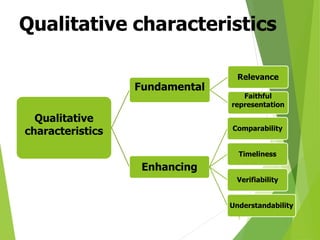
Qualitative characteristics
Qualitative
characteristics
Fundamental
Relevance
Faithful
representation
Enhancing
Comparability
Timeliness
Verifiability
Understandability
5
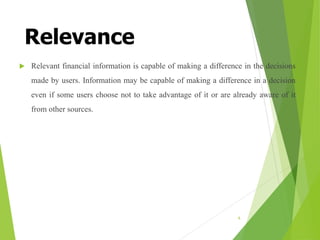
Relevance
 Relevant financial information is capable of making a difference in the decisions
made by users. Information may be capable of making a difference in a decision
even if some users choose not to take advantage of it or are already aware of it
from other sources.
6
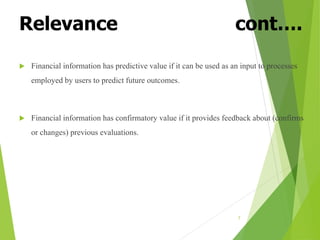
Relevance cont….
 Financial information has predictive value if it can be used as an input to processes
employed by users to predict future outcomes.
 Financial information has confirmatory value if it provides feedback about (confirms
or changes) previous evaluations.
7
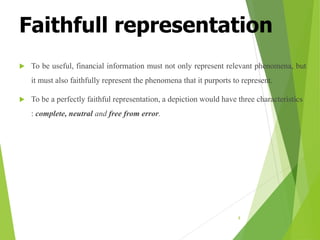
Faithfull representation
 To be useful, financial information must not only represent relevant phenomena, but
it must also faithfully represent the phenomena that it purports to represent.
 To be a perfectly faithful representation, a depiction would have three characteristics
: complete, neutral and free from error.
8
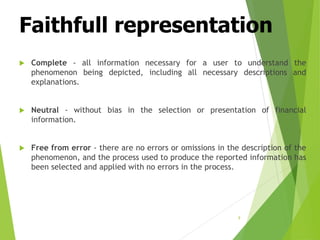
Faithfull representation
 Complete - all information necessary for a user to understand the
phenomenon being depicted, including all necessary descriptions and
explanations.
 Neutral - without bias in the selection or presentation of financial
information.
 Free from error - there are no errors or omissions in the description of the
phenomenon, and the process used to produce the reported information has
been selected and applied with no errors in the process.
9
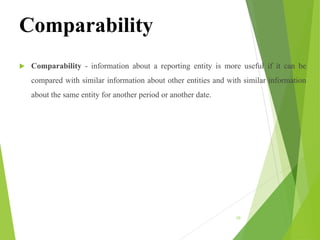
Comparability
 Comparability - information about a reporting entity is more useful if it can be
compared with similar information about other entities and with similar information
about the same entity for another period or another date.
10
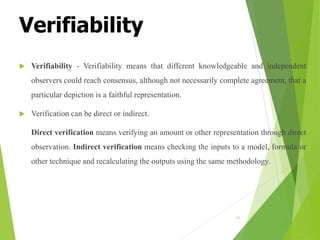
Verifiability
 Verifiability - Verifiability means that different knowledgeable and independent
observers could reach consensus, although not necessarily complete agreement, that a
particular depiction is a faithful representation.
 Verification can be direct or indirect.
Direct verification means verifying an amount or other representation through direct
observation. Indirect verification means checking the inputs to a model, formula or
other technique and recalculating the outputs using the same methodology.
11
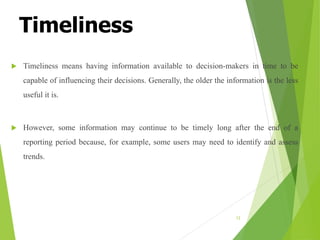
Timeliness
 Timeliness means having information available to decision-makers in time to be
capable of influencing their decisions. Generally, the older the information is the less
useful it is.
 However, some information may continue to be timely long after the end of a
reporting period because, for example, some users may need to identify and assess
trends.
12
Understandability
 Classifying, characterizing and presenting information clearly and concisely
makes it understandable.
 Financial reports are prepared for users who have a reasonable knowledge
of business and economic activities and who review and analyse the
information diligently.
13
Elements of Financial
Statements
Asset
Liability
Equity
Income
Expenses
14
Assets
 An asset is a resource controlled by the entity as a
result of past events and from which future
economic benefits are expected to flow to the
entity.
15
Liability
 A liability is a present obligation of the entity
arising from past events, the settlement of which
is expected to result in an outflow from the entity
of resources embodying economic benefits..
16
Equity
 Equity is the residual interest in the assets of the
entity after deducting all its liabilities.
17
Income
 Income is increases in economic benefits during
the accounting period in the form of inflows or
enhancements of assets or decreases of liabilities
that result in increases in equity, other than those
relating to contributions from equity participants.
18
Expense
 Expenses are decreases in economic benefits during the
accounting period in the form of outflows or depletions
of assets or incurrences of liabilities that result in
decreases in equity, other than those relating to
distributions to equity participants.
19
Recognition of Elements in
the Financial Statements
Recognition is the process of incorporating in the Statement of Financial Position or
Statement of Comprehensive Income an item that meets:
 The definition of an element of the financial statements and
 The criteria for recognition;
 It is probable that any future economic benefit associated with the item will flow to or from an entity.
(The probability of future economic benefit)
 The item has a cost or value that can be measured reliably. (Reliability of measurement)
20
Measurement of the elements of financial
statements
 Historical cost
 Current cost
 Realizable ( settlement) value
 Present value
21
Historical cost
 Assets are recorded at the amount of cash or cash
equivalents paid or the fair value of the consideration
given to acquire them at the time of their acquisition.
Liabilities are recorded at the amount of proceeds
received in exchange for the obligation, or in some
circumstances (for example, income taxes), at the
amounts of cash or cash equivalents expected to be paid
to satisfy the liability in the normal course of business.
22
Current cost
 Assets are carried at the amount of cash or cash
equivalents that would have to be paid if the same
or an equivalent asset was acquired currently.
Liabilities are carried at the undiscounted amount
of cash or cash equivalents that would be required
to settle the obligation currently.
23
Realizable ( Settlement) Value
 Assets are carried at the amount of cash or cash equivalents that could currently be
obtained by selling the asset in an orderly disposal. Liabilities are carried at their
settlement values; that is, the undiscounted amounts of cash or cash equivalents expected
to be paid to satisfy the liabilities in the normal course of business.
24
Present Value
 Assets are carried at the present discounted value of the future net cash inflows that the
item is expected to generate in the normal course of business. Liabilities are carried at
the present discounted value of the future net cash outflows that are expected to be
required to settle the liabilities in the normal course of business.
25
Concepts of capital
A financial concept of capital is adopted by most entities in preparing their financial
statements. Under a financial concept of capital, such as invested money or invested
purchasing power, capital is synonymous with the net assets or equity of the entity.
Under a physical concept of capital, such as operating capability, capital is regarded as
the productive capacity of the entity based on, for example, units of output per day.
26
Concepts of capital maintenance and the
determination of profit
 Financial capital maintenance.
Under this concept a profit is earned only if the financial (or money) amount of the net
assets at the end of the period exceeds the financial (or money) amount of net assets at
the beginning of the period, after excluding any distributions to, and contributions from,
owners during the period. Financial capital maintenance can be measured in either
nominal monetary units or units of constant purchasing power.
27
Concepts of capital maintenance and the
determination of profit
 Physical capital maintenance.
Under this concept a profit is earned only if the physical productive capacity (or
operating capability) of the entity (or the resources or funds needed to achieve that
capacity) at the end of the period exceeds the physical productive capacity at the
beginning of the period, after excluding any distributions to, and contributions from,
owners during the period.
28
Presentation of Financial
Statements
(LKAS 01)
29
Rangajewa Herath
B.Sc. Accountancy and Financial Management(Sp.) (Hons.) (USJ) ,
Master of Business Administration -PIM(USJ)
 LKAS 1 - Presentation of Financial Statements prescribes the basis for the
presentation of general purpose financial statements for public limited
companies.
 It sets out the overall requirements for presentation of financial statements,
guideline for structure
30
General purpose financial
statements
General Purpose Financial Statements are the financial
statements those intended to meet the needs of users who are
not in a position to require an entity to require an entity to
prepare reports tailored to their particular information needs.
31
Objectives of Financial Statements
The objective of financial statements is to provide information
about the financial position, financial performance and cash flows
of an entity to wide range of users in making economic decisions.
32
Financial statements
provides information
about an entity’s
 Assets;
 Liabilities;
 Equity;
 Income and expenses;
 Contribution from and distribution to owners in their capacity
of owners; and
 Cash flows
33
Complete Set of Financial
Statements
The components of a complete set of financial statements are;
 Statement of Financial Position
 Statement of profit or loss and other comprehensive Income
 Statement of Changes in Equity
 Statement of Cash Flows
 Notes, including a summary of significant accounting policies and other
explanatory information
 A statement of financial position at the beginning of the earliest
comparative period when an entity applies an accounting policy
34
Statement of Profit or
Loss and Other
Comprehensive Income
Other comprehensive income comprises items of income
and expenses that are not recognized in profit or loss as
required or permitted by other SLFRS.
Profit or loss is the total income less expenses excluding the
components of other comprehensive income.
35
Other Comprehensive
Income
 Changes in revaluation surplus.
 Gains or losses arising from translating the Financial
Statements of a foreign operation.
 Gains or losses on re-measuring available-for-sale financial
assets.
 The effective portion of gains and losses on hedging
instruments in a cash flow hedges.
 Actuarial gains and losses on defined benefit plans.
36
Total Comprehensive
Income
The change in equity during a period resulting from
transactions and other events, other than those changes
resulting from transactions with owners in their capacity as
owners.
Total Comprehensive = Profit or Loss + OCI
Income
37
Going concern
When preparing financial statements, management shall make
an assessment of the entity’s ability to continue as going
concern. An entity should prepare the financial statements on
going concern basis unless the management either intends to
liquidate the business or cease trading, or has no realistic
alternative but to do so.
38
Accrual Basis of Accounting
An entity should prepare its financial statements, except for the
cash flow information, on accrual basis.
39
Materiality and Aggregation
Each material class of similar items should be separately presented.
Immaterial items can be aggregated and presented according to either
their nature or function.
40
Offsetting
An entity shall not offset assets and liabilities or income and expenses,
unless required or permitted by an SLFRS.
41
Comparative Information
 An entity should disclose comparative information in
respect of the previous period for all amounts reported
in the current period’s Financial Statements.
42
controlled by the
business as a result of
past event of which
future economic benefits
are expected to flow to
the entity.
43

Conceptual Framework.pptx

  • 1.
  • 2.
    The Structure andComponents of the Conceptual Framework of Financial Reporting  The objective of financial reporting;  Underlying Assumption The qualitative characteristics of useful financial information; The definition, recognition and measurement of the elements from which financial statements are constructed; and  concepts of capital and capital maintenance. 2
  • 3.
    The objective ofgeneral purpose financial reporting  To provide financial information about the reporting entity that is useful to existing and potential investors, lenders and other creditors in making decisions about providing resources to the entity. 3
  • 4.
    Underlying Assumption Going Concern Thefinancial statements are normally prepared on the assumption that an entity is a going concern and will continue in operation for the foreseeable future. Hence, it is assumed that the entity has neither the intention nor the need to liquidate or curtail materially the scale of its operations; if such an intention or need exists, the financial statements may have to be prepared on a different basis and, if so, the basis used is disclosed. 4
  • 5.
  • 6.
    Relevance  Relevant financialinformation is capable of making a difference in the decisions made by users. Information may be capable of making a difference in a decision even if some users choose not to take advantage of it or are already aware of it from other sources. 6
  • 7.
    Relevance cont….  Financialinformation has predictive value if it can be used as an input to processes employed by users to predict future outcomes.  Financial information has confirmatory value if it provides feedback about (confirms or changes) previous evaluations. 7
  • 8.
    Faithfull representation  Tobe useful, financial information must not only represent relevant phenomena, but it must also faithfully represent the phenomena that it purports to represent.  To be a perfectly faithful representation, a depiction would have three characteristics : complete, neutral and free from error. 8
  • 9.
    Faithfull representation  Complete- all information necessary for a user to understand the phenomenon being depicted, including all necessary descriptions and explanations.  Neutral - without bias in the selection or presentation of financial information.  Free from error - there are no errors or omissions in the description of the phenomenon, and the process used to produce the reported information has been selected and applied with no errors in the process. 9
  • 10.
    Comparability  Comparability -information about a reporting entity is more useful if it can be compared with similar information about other entities and with similar information about the same entity for another period or another date. 10
  • 11.
    Verifiability  Verifiability -Verifiability means that different knowledgeable and independent observers could reach consensus, although not necessarily complete agreement, that a particular depiction is a faithful representation.  Verification can be direct or indirect. Direct verification means verifying an amount or other representation through direct observation. Indirect verification means checking the inputs to a model, formula or other technique and recalculating the outputs using the same methodology. 11
  • 12.
    Timeliness  Timeliness meanshaving information available to decision-makers in time to be capable of influencing their decisions. Generally, the older the information is the less useful it is.  However, some information may continue to be timely long after the end of a reporting period because, for example, some users may need to identify and assess trends. 12
  • 13.
    Understandability  Classifying, characterizingand presenting information clearly and concisely makes it understandable.  Financial reports are prepared for users who have a reasonable knowledge of business and economic activities and who review and analyse the information diligently. 13
  • 14.
  • 15.
    Assets  An assetis a resource controlled by the entity as a result of past events and from which future economic benefits are expected to flow to the entity. 15
  • 16.
    Liability  A liabilityis a present obligation of the entity arising from past events, the settlement of which is expected to result in an outflow from the entity of resources embodying economic benefits.. 16
  • 17.
    Equity  Equity isthe residual interest in the assets of the entity after deducting all its liabilities. 17
  • 18.
    Income  Income isincreases in economic benefits during the accounting period in the form of inflows or enhancements of assets or decreases of liabilities that result in increases in equity, other than those relating to contributions from equity participants. 18
  • 19.
    Expense  Expenses aredecreases in economic benefits during the accounting period in the form of outflows or depletions of assets or incurrences of liabilities that result in decreases in equity, other than those relating to distributions to equity participants. 19
  • 20.
    Recognition of Elementsin the Financial Statements Recognition is the process of incorporating in the Statement of Financial Position or Statement of Comprehensive Income an item that meets:  The definition of an element of the financial statements and  The criteria for recognition;  It is probable that any future economic benefit associated with the item will flow to or from an entity. (The probability of future economic benefit)  The item has a cost or value that can be measured reliably. (Reliability of measurement) 20
  • 21.
    Measurement of theelements of financial statements  Historical cost  Current cost  Realizable ( settlement) value  Present value 21
  • 22.
    Historical cost  Assetsare recorded at the amount of cash or cash equivalents paid or the fair value of the consideration given to acquire them at the time of their acquisition. Liabilities are recorded at the amount of proceeds received in exchange for the obligation, or in some circumstances (for example, income taxes), at the amounts of cash or cash equivalents expected to be paid to satisfy the liability in the normal course of business. 22
  • 23.
    Current cost  Assetsare carried at the amount of cash or cash equivalents that would have to be paid if the same or an equivalent asset was acquired currently. Liabilities are carried at the undiscounted amount of cash or cash equivalents that would be required to settle the obligation currently. 23
  • 24.
    Realizable ( Settlement)Value  Assets are carried at the amount of cash or cash equivalents that could currently be obtained by selling the asset in an orderly disposal. Liabilities are carried at their settlement values; that is, the undiscounted amounts of cash or cash equivalents expected to be paid to satisfy the liabilities in the normal course of business. 24
  • 25.
    Present Value  Assetsare carried at the present discounted value of the future net cash inflows that the item is expected to generate in the normal course of business. Liabilities are carried at the present discounted value of the future net cash outflows that are expected to be required to settle the liabilities in the normal course of business. 25
  • 26.
    Concepts of capital Afinancial concept of capital is adopted by most entities in preparing their financial statements. Under a financial concept of capital, such as invested money or invested purchasing power, capital is synonymous with the net assets or equity of the entity. Under a physical concept of capital, such as operating capability, capital is regarded as the productive capacity of the entity based on, for example, units of output per day. 26
  • 27.
    Concepts of capitalmaintenance and the determination of profit  Financial capital maintenance. Under this concept a profit is earned only if the financial (or money) amount of the net assets at the end of the period exceeds the financial (or money) amount of net assets at the beginning of the period, after excluding any distributions to, and contributions from, owners during the period. Financial capital maintenance can be measured in either nominal monetary units or units of constant purchasing power. 27
  • 28.
    Concepts of capitalmaintenance and the determination of profit  Physical capital maintenance. Under this concept a profit is earned only if the physical productive capacity (or operating capability) of the entity (or the resources or funds needed to achieve that capacity) at the end of the period exceeds the physical productive capacity at the beginning of the period, after excluding any distributions to, and contributions from, owners during the period. 28
  • 29.
    Presentation of Financial Statements (LKAS01) 29 Rangajewa Herath B.Sc. Accountancy and Financial Management(Sp.) (Hons.) (USJ) , Master of Business Administration -PIM(USJ)
  • 30.
     LKAS 1- Presentation of Financial Statements prescribes the basis for the presentation of general purpose financial statements for public limited companies.  It sets out the overall requirements for presentation of financial statements, guideline for structure 30
  • 31.
    General purpose financial statements GeneralPurpose Financial Statements are the financial statements those intended to meet the needs of users who are not in a position to require an entity to require an entity to prepare reports tailored to their particular information needs. 31
  • 32.
    Objectives of FinancialStatements The objective of financial statements is to provide information about the financial position, financial performance and cash flows of an entity to wide range of users in making economic decisions. 32
  • 33.
    Financial statements provides information aboutan entity’s  Assets;  Liabilities;  Equity;  Income and expenses;  Contribution from and distribution to owners in their capacity of owners; and  Cash flows 33
  • 34.
    Complete Set ofFinancial Statements The components of a complete set of financial statements are;  Statement of Financial Position  Statement of profit or loss and other comprehensive Income  Statement of Changes in Equity  Statement of Cash Flows  Notes, including a summary of significant accounting policies and other explanatory information  A statement of financial position at the beginning of the earliest comparative period when an entity applies an accounting policy 34
  • 35.
    Statement of Profitor Loss and Other Comprehensive Income Other comprehensive income comprises items of income and expenses that are not recognized in profit or loss as required or permitted by other SLFRS. Profit or loss is the total income less expenses excluding the components of other comprehensive income. 35
  • 36.
    Other Comprehensive Income  Changesin revaluation surplus.  Gains or losses arising from translating the Financial Statements of a foreign operation.  Gains or losses on re-measuring available-for-sale financial assets.  The effective portion of gains and losses on hedging instruments in a cash flow hedges.  Actuarial gains and losses on defined benefit plans. 36
  • 37.
    Total Comprehensive Income The changein equity during a period resulting from transactions and other events, other than those changes resulting from transactions with owners in their capacity as owners. Total Comprehensive = Profit or Loss + OCI Income 37
  • 38.
    Going concern When preparingfinancial statements, management shall make an assessment of the entity’s ability to continue as going concern. An entity should prepare the financial statements on going concern basis unless the management either intends to liquidate the business or cease trading, or has no realistic alternative but to do so. 38
  • 39.
    Accrual Basis ofAccounting An entity should prepare its financial statements, except for the cash flow information, on accrual basis. 39
  • 40.
    Materiality and Aggregation Eachmaterial class of similar items should be separately presented. Immaterial items can be aggregated and presented according to either their nature or function. 40
  • 41.
    Offsetting An entity shallnot offset assets and liabilities or income and expenses, unless required or permitted by an SLFRS. 41
  • 42.
    Comparative Information  Anentity should disclose comparative information in respect of the previous period for all amounts reported in the current period’s Financial Statements. 42
  • 43.
    controlled by the businessas a result of past event of which future economic benefits are expected to flow to the entity. 43