CONCEPT OF
LIABILITY
SOHARWARDIA RAWADIA
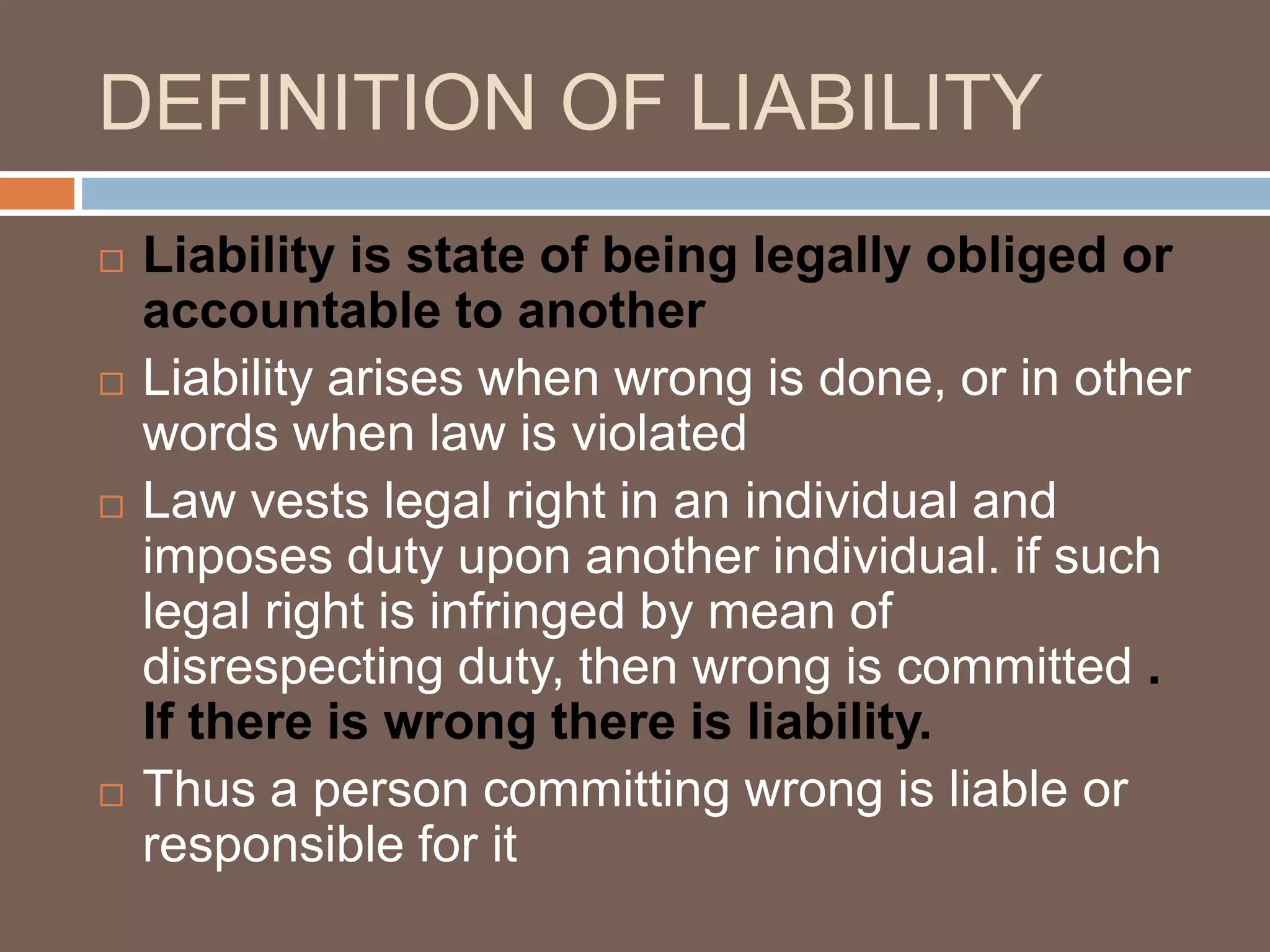
DEFINITION OF LIABILITY
 Liability is state of being legally obliged or
accountable to another
 Liability arises when wrong is done, or in other
words when law is violated
 Law vests legal right in an individual and
imposes duty upon another individual. if such
legal right is infringed by mean of
disrespecting duty, then wrong is committed .
If there is wrong there is liability.
 Thus a person committing wrong is liable or
responsible for it
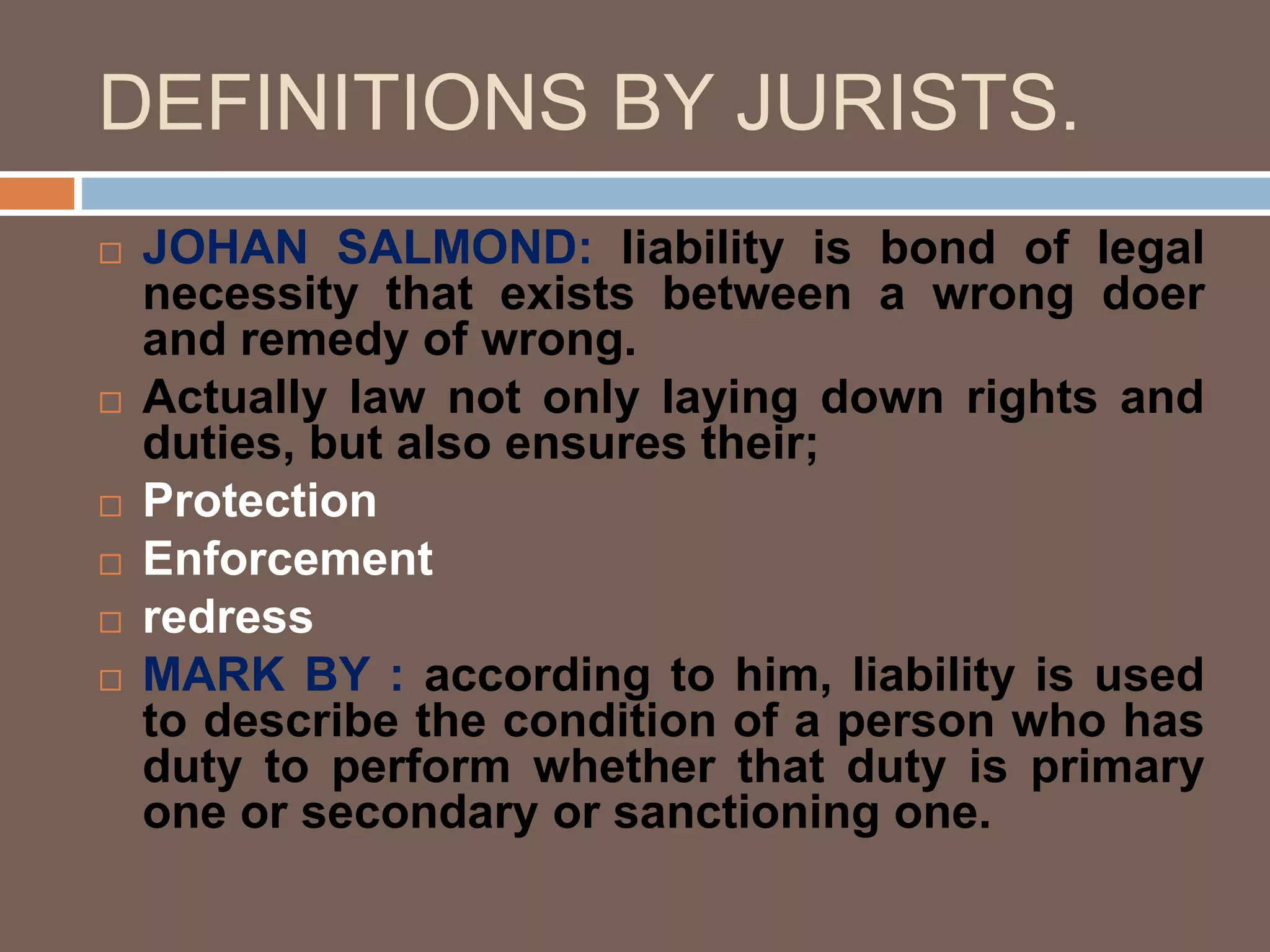
DEFINITIONS BY JURISTS.
 JOHAN SALMOND: liability is bond of legal
necessity that exists between a wrong doer
and remedy of wrong.
 Actually law not only laying down rights and
duties, but also ensures their;
 Protection
 Enforcement
 redress
 MARK BY : according to him, liability is used
to describe the condition of a person who has
duty to perform whether that duty is primary
one or secondary or sanctioning one.
ESSENTIALS
 STANDARD OF CARE
 CAUSATION
 DAMAGES
 DAMAGES TYPES
compensative: can measure the damage in form
of money
Punitive : you don’t measure or have any scale
to measure the damage
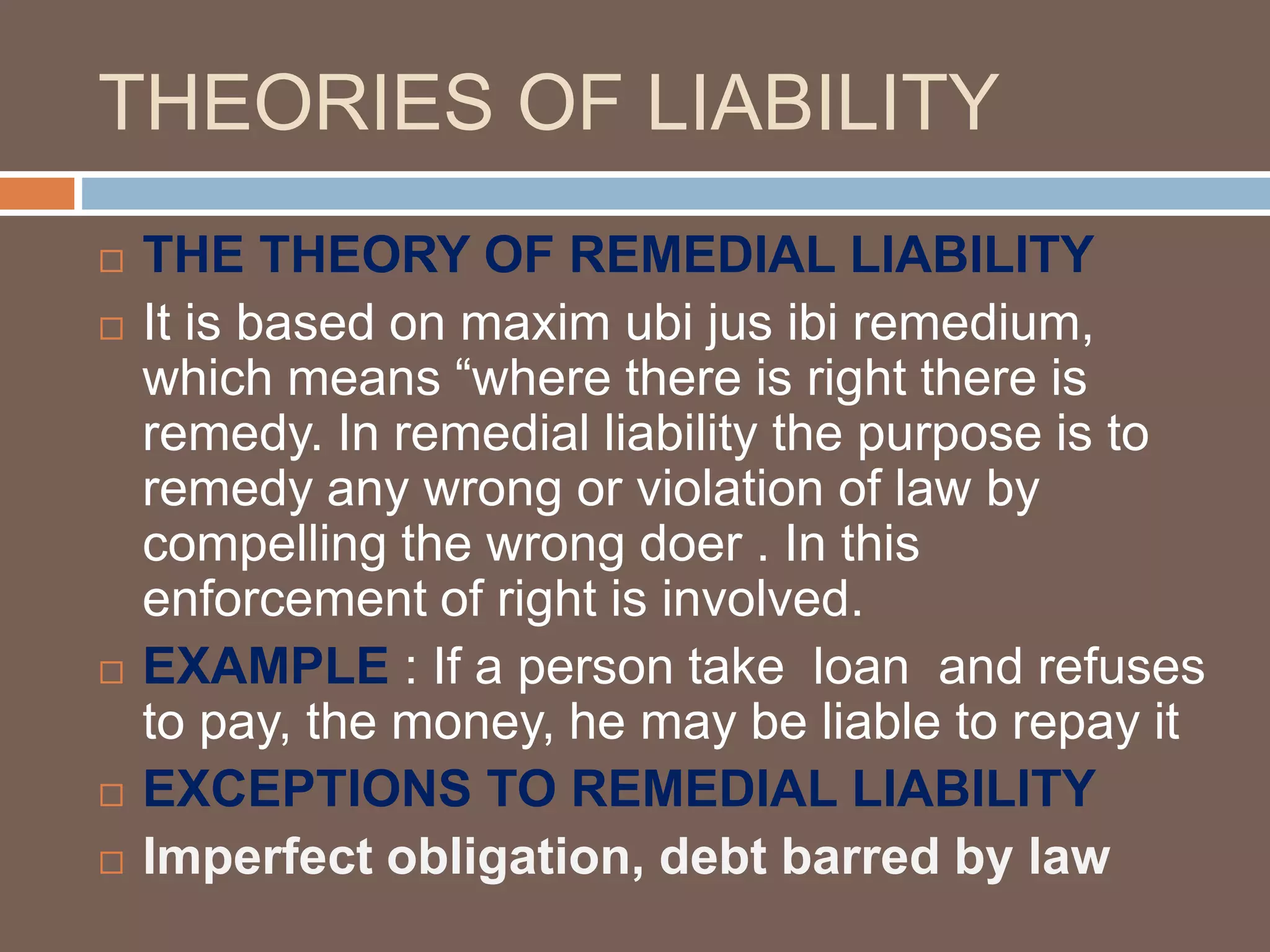
THEORIES OF LIABILITY
 THE THEORY OF REMEDIAL LIABILITY
 It is based on maxim ubi jus ibi remedium,
which means “where there is right there is
remedy. In remedial liability the purpose is to
remedy any wrong or violation of law by
compelling the wrong doer . In this
enforcement of right is involved.
 EXAMPLE : If a person take loan and refuses
to pay, the money, he may be liable to repay it
 EXCEPTIONS TO REMEDIAL LIABILITY
 Imperfect obligation, debt barred by law
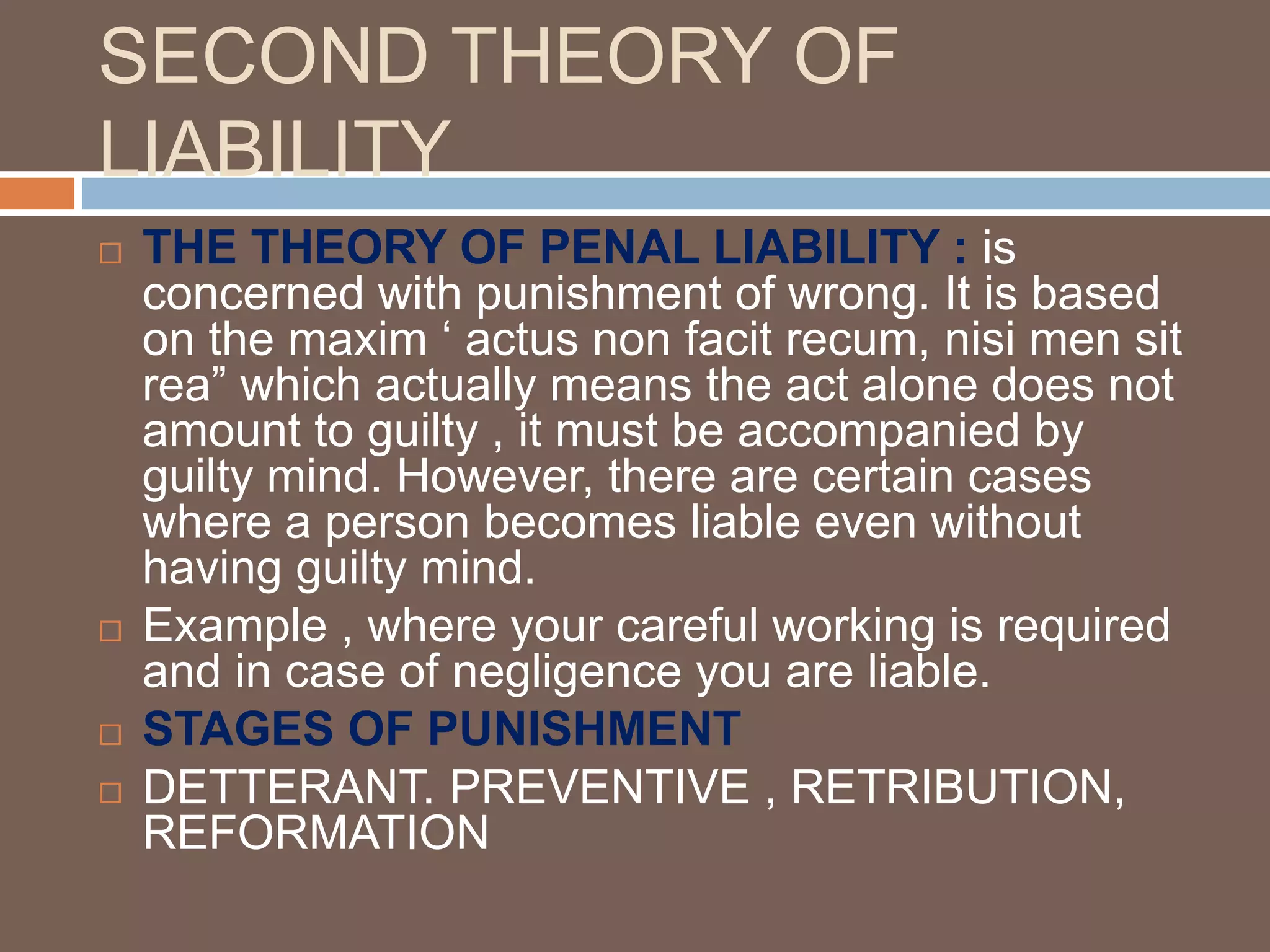
SECOND THEORY OF
LIABILITY
 THE THEORY OF PENAL LIABILITY : is
concerned with punishment of wrong. It is based
on the maxim ‘ actus non facit recum, nisi men sit
rea” which actually means the act alone does not
amount to guilty , it must be accompanied by
guilty mind. However, there are certain cases
where a person becomes liable even without
having guilty mind.
 Example , where your careful working is required
and in case of negligence you are liable.
 STAGES OF PUNISHMENT
 DETTERANT. PREVENTIVE , RETRIBUTION,
REFORMATION
KINDS OF LIABILITIES
CRIMINAL
LIABLILITY
CIVIL
LIABILITY
VICARIOUS
LIABILITY
ABSOLUTE
LIABILITY
 CRIMINAL LIABILITY
 Crime is wrong committed against society, thus
criminal liability arises if crime is committed,
criminal liability gives arise to criminal
proceedings, such as imprisonment fine etc
 CIVIL LIABILITY civil liability arises out of
infringement of rights of individuals. Civil liability
gives arise to civil proceedings. Civil liability may
be remedial or penal, wherein purpose is
enforcement of some rights. Such as recovery of
debt , specific performance, recovery of damages
etc
 Vicarious liability ;
 Vicarious literally means experienced at second hand. It
is the liability of a person for the act of another .generally a
person is liable for his own actions and not for acts of others
but in certain cases a person is held liable for the acts of
another, such as Master and servant liability, responsibility of
living person for act of deceased etc
 ABSOLUTE LIABILITY ;
 Generally mens rea is considered necessary element to hold
a person responsible . However there are some exceptions to
this rule . A person may be held responsible . Irrespective of
the existence of either wrongful intent or negligence .such as
accident. When ever the infringement of the right of person
occurs, the wrong doer will be held liable , irrespective of fact
injury occurs or not.
 There are some good defenses for absolute
liability
 Mistake of fact
 Mistake of law
 Accidental
 Thank you

concept of liability.pptx

  • 1.
  • 2.
    DEFINITION OF LIABILITY Liability is state of being legally obliged or accountable to another  Liability arises when wrong is done, or in other words when law is violated  Law vests legal right in an individual and imposes duty upon another individual. if such legal right is infringed by mean of disrespecting duty, then wrong is committed . If there is wrong there is liability.  Thus a person committing wrong is liable or responsible for it
  • 3.
    DEFINITIONS BY JURISTS. JOHAN SALMOND: liability is bond of legal necessity that exists between a wrong doer and remedy of wrong.  Actually law not only laying down rights and duties, but also ensures their;  Protection  Enforcement  redress  MARK BY : according to him, liability is used to describe the condition of a person who has duty to perform whether that duty is primary one or secondary or sanctioning one.
  • 4.
    ESSENTIALS  STANDARD OFCARE  CAUSATION  DAMAGES  DAMAGES TYPES compensative: can measure the damage in form of money Punitive : you don’t measure or have any scale to measure the damage
  • 5.
    THEORIES OF LIABILITY THE THEORY OF REMEDIAL LIABILITY  It is based on maxim ubi jus ibi remedium, which means “where there is right there is remedy. In remedial liability the purpose is to remedy any wrong or violation of law by compelling the wrong doer . In this enforcement of right is involved.  EXAMPLE : If a person take loan and refuses to pay, the money, he may be liable to repay it  EXCEPTIONS TO REMEDIAL LIABILITY  Imperfect obligation, debt barred by law
  • 6.
    SECOND THEORY OF LIABILITY THE THEORY OF PENAL LIABILITY : is concerned with punishment of wrong. It is based on the maxim ‘ actus non facit recum, nisi men sit rea” which actually means the act alone does not amount to guilty , it must be accompanied by guilty mind. However, there are certain cases where a person becomes liable even without having guilty mind.  Example , where your careful working is required and in case of negligence you are liable.  STAGES OF PUNISHMENT  DETTERANT. PREVENTIVE , RETRIBUTION, REFORMATION
  • 7.
  • 8.
     CRIMINAL LIABILITY Crime is wrong committed against society, thus criminal liability arises if crime is committed, criminal liability gives arise to criminal proceedings, such as imprisonment fine etc  CIVIL LIABILITY civil liability arises out of infringement of rights of individuals. Civil liability gives arise to civil proceedings. Civil liability may be remedial or penal, wherein purpose is enforcement of some rights. Such as recovery of debt , specific performance, recovery of damages etc
  • 9.
     Vicarious liability;  Vicarious literally means experienced at second hand. It is the liability of a person for the act of another .generally a person is liable for his own actions and not for acts of others but in certain cases a person is held liable for the acts of another, such as Master and servant liability, responsibility of living person for act of deceased etc  ABSOLUTE LIABILITY ;  Generally mens rea is considered necessary element to hold a person responsible . However there are some exceptions to this rule . A person may be held responsible . Irrespective of the existence of either wrongful intent or negligence .such as accident. When ever the infringement of the right of person occurs, the wrong doer will be held liable , irrespective of fact injury occurs or not.
  • 10.
     There aresome good defenses for absolute liability  Mistake of fact  Mistake of law  Accidental
  • 11.