Concept and Nature of Juvenile Justice and Delinquency.pptx
1.
Juvenile Justice &Delinquency
College of Criminal Justice Education
Master of Science in Criminal Justice with Specialization in Criminology
2nd
Term, AY 2024-2025
Bonifacio T. Santos Jr.
Reporter
Introduction:
The Philippines haslong recognized the need to address juvenile
delinquency in a manner that balances public safety with the welfare and
rehabilitation of children in conflict with the law (“CICL”). The 1987 Philippine
Constitution lays the groundwork for the State’s duty to protect children, enjoining
all branches of government to provide for their care and development. This
constitutional mandate aligns with the country’s commitments under international
instruments, particularly the United Nations Convention on the Rights of the Child
(UNCRC), which stresses that children accused or found guilty of crimes must be
treated in a manner that promotes their reintegration into society.
The primary legal framework for the juvenile justice system is the Juvenile
Justice and Welfare Act of 2006 (Republic Act [R.A.] No. 9344), as amended
by R.A. No. 10630. It espouses a restorative justice approach, emphasizing
rehabilitation and reintegration.
4.
What is JuvenileJustice?
• system of laws, policies, and procedures intended to regulate
the processing and treatment of nonadult offenders for
violations of law and to provide legal remedies that protect their
interests in situations of conflict or neglect. Punishable offenses
that are classified as criminal offenses for adults (e.g., murder,
robbery, and larceny) are referred to as delinquency when
committed by juveniles, whereas juvenile offenses mandating
legal intervention only (e.g., alcohol and tobacco use, truancy,
and running away from home) are referred to as status offenses.
Children are also subject to specialized laws, procedures, and
policies designed to protect their interests when parents or other
legal guardians are unavailable, negligent, or involved in custodial
disputes.
5.
What is JuvenileDelinquency?
• It refers to an anti-social acts or behaviors committed
by minors which are contrary to the norms of the
society. It involves oftentimes misdemeanors, but may
include also offenses and felonies.
Take Note: Under RA 9344, juvenile delinquent are now called Child-in-
Conflict with the Law. The use of the word “juvenile”, “juvenile delinquent”,
“youthful offender” or other similar terms against the child is labeling or
shaming punishable under this law.
Juvenile Delinquency and Juvenile Justice System (Lian Carla C. Luzong, Instructor 1) power point
https://www.studocu.com/ph/document/dominican-college-of-tarlac/college-of-criminal-justice-education/crim-5-juvenile-delinquency-
and-juvenile-justice-system/67765981
Historical Context andLegislative Foundation
Pre-RA 9344 Regime
• Before the enactment of R.A. No. 9344, juvenile
delinquency was largely addressed under the Revised
Penal Code (RPC) and the Child and Youth Welfare Code
(Presidential Decree No. 603). Children were often
detained with adult offenders due to a lack of separate
juvenile facilities, resulting in significant concerns over
children’s well-being and exposure to hardened criminals.
https://www.respicio.ph/commentaries/juvenile-justice-system-in-the-
philippines
8.
Passage of theJuvenile Justice and Welfare Act (R.A. No.
9344)
• Enacted in 2006 to provide a comprehensive, child-focused
approach, consistent with international standards. Established
the Juvenile Justice and Welfare Council (JJWC) to oversee the
implementation of the law, coordinate with various government
agencies, and recommend reforms.
Amendment through R.A. No. 10630 (2013)
• Strengthened provisions on rehabilitation, diversion, and
aftercare programs. Mandated additional facilities and support
systems, including the Bahay Pag-asa centers for children in
conflict with the law who require intensive intervention and short-
term residential care.
https://www.respicio.ph/commentaries/juvenile-justice-system-in-the-
philippines
9.
1. Code ofHammurabi – Oldest known code for thousand
years ago dating from 2270 B.C used by society to regulate
behavior and at the same time punish those who disobeyed
the rules. It established a social order based on individual
rights. It is the origin of the legal principle of “Lex Talionis” or
“Lex Taliones”, that is, an “Eye for an Eye”. During this
times, in 1641, General Court of Massachusetts passed the
Stubborn Child Law, which stated that children who
disobeyed their parents could be put to death
10.
2. Roman Lawand Canon (Church) Law – Approximately two
thousand years ago, made distinction between juveniles and
adults based on the notion “Age of Responsibility”.
3. Ancient Jewish Law – The Talmud specified condition under
which immaturity was to be considered in imposing punishment.
There was no corporal punishment prior to puberty, which was
considered to be the age of twelve for females and thirteen for
males. In addition, no capital punishment is to be imposed on
those offenders under twenty years of age.
11.
4. Codification ofRoman Law – In 5th century B.C., this law
resulted in the “Twelve Tables”, which made it clear that children
were criminally responsible for violation of law and were to be dealt
with by same criminal justice system as adults. Under this law,
children came to be classified as “Infans,” or “Proximus Infantiae.” In
general. “infans” (7 years old below) were not held criminally
responsible, but those approaching puberty (above 7 to 14 for boys
and above 7 – 12 for girls) liability was based on their capacity to
understand the difference between right and wrong.
12.
5. Anglo SaxonCommon Law (Law based on custom or
usage) - The distinction made between adult and juvenile
offenders in England at this time are most significant. Under
common law, children under the age of 7 were presumed
incapable of forming criminal intent and therefore were not
subject to criminal sanctions . Children between 7 - 14 were
not subject to criminal sanctions unless it could be
demonstrated that they had formed criminal intent,
understood the consequences of their actions, and could
distinguish right from wrong (Blackstone 1803, 22-24).
Children over 14 were treated much the same as adults.
13.
6. Middle of19th century – The middle of the nineteenth century
also included the child-saving movement. Concerned citizens
eventually formed a social activist group called Child Savers, who
believed that children were born good and became bad. Juvenile
children were blamed on bad environments. The best way to save
children was to get them out of “bad” homes and placed in “good”
ones. This lead to the creation of the doctrine Parens Patriae.
Take Note: Parens Patriae is a doctrine that does not consider
delinquent acts as criminal violation, thus making delinquent's
non-criminal persons and cannot be found guilty of a crime and
punished like an adult criminal. This doctrine viewed minors who
violate the law as victims of improper care, custody and treatment
at home. Thus, in parents patriae, the State becomes the father
14.
7. Poor LawAct of 1601 – Provided for involuntary
separation of children from their impoverished parents,
and these children were then placed in bondage to local
residents as apprentices.
FACTORS AFFECTING JUVENILEDELINQUENCY
1. Individual Risk Factors
• Individual psychological or behavioral risk factors that may
make offending more likely include intelligence, impulsiveness
or the inability to delay gratification, aggression, empathy, and
restlessness. Children with low intelligence are likely to do
worse in school. This may increase the chances of offending
because low educational attainment, a low attachment to
school, and low educational aspirations are all risk factors for
offending in themselves. Children who perform poorly at school
are also more likely to truant, which is also linked to offending.
17.
2. Family
• Thefamily is the first and the basic institution in our society for
developing the child’s potential, in all its many aspects like
emotional, intellectual, moral, and spiritual as well as physical
and social. It is within the family that the child must learn to
curb his desires and to accept rules that define the time, place
and circumstances under acceptable ways. The following are
some of the causes why some of the child becomes juvenile
delinquent as influence their own family;
18.
a. the faultydevelopment of a child
b. lack of parental guidance
c. lack of love and the instinct of hate or anger due to unfair
treatment
d. parental rejection
e. broken home
f. parental abuse or neglect
g. criminal parents or sibling
Take Note: Home is referred to as the “cradle of
human personality”.
19.
3. Environment
• Itis where the child influences after his first highly formative
years. Youth in the community turns to become delinquent with
companions. Youth today accuse those ahead of them for
failure to define how to live both honorably and successfully in
a world that is changing too rapidly for anyone to comprehend.
Together they now becomes a victim of their own environment,
their attitudes, dress, taste, ambitions, behavior are imitated or
have been already influence by those anti-social acts
recognized in their environment. Some of these causes are the
following:
20.
a. associations withcriminal groups/gangs
b. alcoholism and drug addiction
c. impulse of fear
d. crime inducing situation that caused criminalistic
tendencies
e. imitated instinct like selfishness, violence and anti-social
wishes.
21.
4. School
• Apublic instrument for training young people. It is more
directly accessible to change through the development
of new resources and policies. And since it is a principal
institution for development of a basic commitment by
young people to the goals and values of our society, it is
imperative that it be provided with the resources to
compete with illegitimate attraction for young people’s
allegiance.
22.
5. Other Departmentor Agencies of the Government
• Some of the department and agencies of the government
also create factors that influence the youth to become
delinquent, such as the following:
a. political interference of the higher positions
b. unfair decisions of the court
c. police carelessness and unfair treatment
d. influence from the newspapers, movies, tv, radio, comic,
and other magazine
23.
How does communityinvolvement affect juvenile justice?
Jail & Prison Insider. (2025, June 19). How does community involvement affect juvenile justice? - Jail &
Prison Insider [Video]. YouTube. https://www.youtube.com/watch?v=VOoB7S6_uNY
24.
How do environmentalfactors influence criminal behavior?
True Crime Lovers. (2025, January 28). How do environmental factors influence criminal behavior? |
True Crime Lovers [Video]. YouTube. https://www.youtube.com/watch?v=ALIJkhWApp8
25.
SIGNIFICANT CASES CONCERNINGJUVENILE
DELINQUENCY
1. In re: Winship
• It established proof beyond a reasonable doubt as the standard for juvenile
adjudication proceedings, eliminating lesser standards such as a
preponderance of the evidence, clear and convincing proof and reasonable
proof. They established that a jury trial is not a required part of due process
in the adjudication of the youth as delinquent by a juvenile court.
2. Breed v. Jones
• It recognized that a juvenile cannot be adjudicated in a juvenile court and
then tried for the same offense in an adult criminal court (double jeopardy).
3. Kent v. United States
• It provided the procedural requirements for waiver to criminal court as
articulated by the U.S. Supreme Court.
26.
4. In reGault (1967)
• The Court held that juvenile courts must provide the basic
procedural protection that the Bill of Rights guarantee to adults,
including timely advance notice of the charges, the right to either
retained or appointed counsel, confrontation and cross-
examination of adverse witnesses, self-incrimination, and the
right to remain silent. The opinion also rejected the basic
premise of juvenile court actions: that the proceedings are civil
in nature and those minors' rights are adequately protected by
the judges acting as substitute parents.
27.
5. 1977, AmericanBar Association
• It endorsed decriminalization of status offenses, urging
that juvenile delinquency liability should include only such
conduct as would be designated a crime if committed by
an adult. In the 1980s many training schools and high-
security institutions were built in rural areas or close to
small rural towns so the inmates could be trained in
agriculture. The hope was that such training would
produce productive citizens.
28.
6. Schall v.Martin (1984)
• The Supreme Court upheld the state's right to place
juveniles in preventive detention. Preventive detention
was perceived as fulfilling a legitimate state interest of
protecting society and juveniles by detaining those who
might be dangerous to society or to themselves.
TYPES OF DELINQUENTYOUTH
1. Social – an aggressive youth who resents the authority of
anyone who make an effort to control his behavior.
2. Neurotic – he has internalized his conflicts and preoccupied
with his own feelings
3. Asocial – his delinquent at have a cold, brutal, fictious
quality for which the youth feels no humors
4. Accidental – he is less identifiable in his character,
essentially socialize law abiding but too happens to be at the
wrongplace at the wrong time and becomes involved in some
delinquent act not typical of his general behavior.
31.
STAGES OF DELINQUENCY
1.Emergence- the child begins with petty larceny between (8 and sometimes the 12th year.)
2. Exploration -he or she then move on to shoplifting and vandalism between (ages 12 to 14.)
3. Explosion - at age (13 up), there is a substantial increase in variety of seriousness.
4. Conflagration - at around (15 up), four or more types of crimes are added.
5. Outburst - Those who continue on adulthood will progress into more sophisticated or more
violent forms of criminal behavior.
CLASSIFICATION OF DELINQUENCY
1. Unsocialized Aggression - Rejected or abandoned, NO parents to imitate and become
aggressive.
2. Socialize Delinquency - Membership of fraternities or groups that advocate bad things.
3. Over-Inhibited – Group secretly trained to do illegal activities, like marijuana cultivation
32.
CAUSES OF BEHAVIORALDISORDERS
1. Predisposing Factor
• Inclinations or inherited propensities, which cannot be,
considered a criminal one unless there is a probability
that a crime will be committed.
2. Precipitating Factor
• Elements which provokes crimes or factors that are
signified to the everyday adjustments of an individual, like
personal problems, necessities, imitation, curiosity,
ignorance, and diseases.
33.
Factors Contributing toJuvenile Delinquency in Schools
1. Poor Teacher-Student Relationships
– The quality of teacher-student relationships significantly affects
student behavior and academic performance. Positive
relationships are associated with lower rates of delinquency, as
they foster a supportive learning environment. Conversely,
strained or negative relationships can lead to disengagement
and increased risk of delinquent behavior.
34.
2. Inadequate SchoolPolicies and Discipline
– School policies and disciplinary practices can either contribute
to or prevent juvenile delinquency. Policies that are overly
punitive or unfair can exacerbate the problem by creating a
hostile school climate. In contrast, balanced and restorative
approaches to discipline can reduce delinquency by addressing
the root causes of misbehavior.
35.
3. Lack ofSupport for Students with Special Needs
– Students with special needs often require additional support to
succeed academically and behaviorally. A lack of adequate
resources and accommodations can lead to frustration and
behavioral issues, potentially resulting in delinquency.
36.
The Role ofSchool Environment in Shaping Youth Behavior
1. Impact of School Climate on Student Behavior
– School climate encompasses various aspects, including safety,
supportiveness, and engagement. A positive school climate is
associated with lower rates of delinquency and improved
academic outcomes.
37.
2. Effects ofBullying and Violence on Delinquency
– Bullying and violence are significant concerns within schools,
contributing to a negative school climate. These behaviors can
lead to increased aggression, anxiety, and delinquency among
students.
38.
3. Importance ofExtracurricular Activities in Promoting
Positive Development
– Extracurricular activities offer numerous benefits, including
improved social skills, academic performance, and reduced risk
of delinquency. These activities provide students with positive
outlets for energy and opportunities for socialization.
39.
Strategies for ReducingJuvenile Delinquency in Schools
1. Implementing Evidence-Based Prevention Programs
– Evidence-based prevention programs are designed to address
specific risk factors for delinquency. These programs have been
shown to reduce delinquent behavior and improve overall
outcomes for youth.
40.
2. Fostering PositiveRelationships between Teachers and
Students
– Building positive teacher-student relationships is fundamental
to creating a supportive learning environment. This can be
achieved through teacher training, mentoring programs, and
practices that promote engagement and respect.
41.
3. Providing SupportServices for At-Risk Students
– Identifying and supporting at-risk students is critical for preventing
delinquency. This includes providing academic support, counseling,
and connecting students with community resources.
• Lee, S. (n.d.). School’s role in juvenile delinquency.
https://www.numberanalytics.com/blog/school-influence-
juvenile-delinquency
GENERAL INFERIORITY THEORY/HOOTON’S THEORY
• Earnest Albert Hooton was an American physical
anthropologist known for his work on racial classification and
applied it to the area of criminal behavior.
• According to Hooton: Criminals are less often married and
more often divorced, Criminals often have tattoos, Criminals
have low sloping foreheads, high nasal bridges, and thin lips
44.
• Based onthese observations Hooton
concluded that the underlying cause of criminal
behavior is to be found in physical
characteristics:
–Tall-slender men- are predisposed for murder and
robbery
–Tall-medium heavy men-for forgery
–Tall-heavy men- for first degree murder
45.
Family System Theory
JenniferMyers. (2016, March 15). Family System’s Theory - EDUC 111 [Video]. YouTube.
https://www.youtube.com/watch?v=vBK_WRrcnfo
46.
Low IQ Theory
JesseLauren. (2020, October 21). The low I.Q. theory [Video]. YouTube.
https://www.youtube.com/watch?v=-w51UjZThV0
47.
1. Cultural DevianceTheory
• Stated that children do not really commit deviant
acts. their behavior may be considered deviant by
larger society, but it is compatible with the
behavior in their neighborhood.
• Personalities Under Cultural Deviance Theory
* Clifford Shaw and Henry Mckay (Neighborhood and
Delinquency) - Blame Delinquency on the neighborhood
where a child lives in.
* Edwin Sutherland (Differential Association Theory/
Social Learning Theory) - Crime is learned behavior
49.
2. Strain Theory
•children are basically good, only under pressure
do they deviate.
• Personalities Under Strain Theory
* Robert Merton strain theory - Blames delinquency
on conformity to conventional cultural values
* Albert Cohen strain theory - Delinquency is the
consequence of childre expressing their frustration
towards middle class norms and institutions.
50.
* Richard Clowardand Lloyd Ohlin strain
theory - Delinquency is blamed on the
pressures to succeed and on the obstacles
lower class child face.
* Robert Agnew strain theory
- Failure to achieve positive valued goals
- denial of previously attained achievements
- exposure to negative stimuli
Social Control Theory
•Assume that children are amoral. without controls on
their behavior, they are incline to break the law.
• personalyties under social control theory
*David Matza Social Control Theory - Matza think that delinquency
theory exaggerated the difference between deliquents and non
delinquents.
* Travis Hirschi Social Control Theory (SocialControl Theory/ Social
Bonding Theory) - Hirschi is not surprised that children commit
deviance. He expects them to, unless obstacles are in their path by a
disapproving society.
54.
Labeling Theory
• believedthat human nature is malleable and that
personalities and behavior are products of social
interaction
• emphasize the power of social response, specially in the
form of social control, to produce delinquents behavior.
56.
B.Concepts of Kaplan’sTheory of Self-Esteem:
1.Self-Esteem as a Core Component of Behavior:
• Kaplan proposed that self-esteem is a central factor
influencing human behavior.
• When individuals perceive themselves as valued,
competent, and accepted, they are more likely to behave
in socially acceptable and adaptive ways.
57.
2.Low Self-Esteem andDeviant Behavior:
• One of Kaplan’s key propositions is that low self-esteem
leads to deviant or antisocial behavior.
• Individuals with low self-esteem may engage in such
behavior to regain a sense of self-worth, especially when
they feel marginalized, rejected, or devalued by society.
58.
3.Self-Rejection Hypothesis:
• Kaplan’sself-rejection hypothesis argues that individuals
who reject themselves (i.e., have low self-esteem) are
more likely to reject the norms and values of society,
leading to deviance.
• This is particularly evident in adolescents who may turn to
gangs, delinquency, or substance use as a way to cope
with poor self-image.
59.
4.Self-Esteem as aMediator:
• In his view, social experiences (like school failure, family
conflict, or peer rejection) affect behavior through their
impact on self-esteem.
• Thus, interventions that enhance self-esteem can reduce
the likelihood of deviant or maladaptive behaviors.
60.
Implications of Kaplan’sTheory:
Prevention and Intervention:
• Programs that promote positive self-esteem, especially
among youth, may reduce deviant behaviors.
• Schools, families, and communities are encouraged to
create environments where individuals feel valued and
capable.
Sociological and Psychological Integration:
• Kaplan’s theory bridges psychological self-concept
theories with sociological understandings of deviance,
making it influential in criminology, education, and youth
development.
61.
Attention-Deficit Hyperactive Theory(ADHDtheory)
• ADHD is caused by genetic and neurobiological factors,
influenced by environmental conditions, and expressed
through cognitive and behavioral symptoms.
• Juvenile delinquency is caused by immaturity and
hyperactivity like grade schoolers characterized by short
attention span, daydreaming, sluggishness,
preoccupation, and impulsiveness.
62.
Genetics Theory
• Thistheory states that people who have abnormal genetic
structure or chromosomal activities commit crimes and
delinquency.
• The theory explains that the behaviour of violent male
criminals is the proposal of a chromosomal abnormality in
which such males have an XXY, instead of the normal XY,
male chromosomal pattern.
63.
• In theTwin studies conducted it was found out that
fraternal twins testified they were reared and treated alike,
hence, delinquency may not be a function of hereditary
but rather of socialization and the environment. This was
supported by the researcher of Karl Christeansen in
Denmark where he found out that identical twin had
similar experience as to no delinquent or delinquent for
both, 35% in his findings for delinquency rates.
• Hereditary influence failed to explain delinquency
because it failed to separate it from the influence of the
environment.
64.
• It wasadvocated by Frederick Thrasher. A gang is a band
of people going about together or working especially for
some criminal purposes.
• Delinquency develops through the following:
– Gangs originated as playgroups.
– Playgroups are transformed into gangs.
– Competition for turf leads to gang conflict
– Delinquent gangs may have complex social structure as any
other social group.
GANG THEORY
65.
DIFFERENTIAL ASSOCIATION THEORY
•It is a symbolic interactionist theory of delinquency
advocated by Edwin Sutherland. He theorized that
criminal behavior is learmed, the leaming includes:
(a) techniques of commtting the crime, which are sometimes
complicated, sometimes simples; (b) the specific direction of
motives, drives, rationalization, and attitudes.
One of the greatest achievement of this theory is when other
advocates Ohlin and Cloward, convinced the (US) administration
of Kennedy and Johnson to organize the American War on
Poverty in the 1960's.
66.
SOCIAL BONDINGICONTROL THEORY
•The bond that keeps the community together in harmony
is broken. It eventually leads to the commission of crimes
and delinquency. When the controlling mechanism of the
society is loose, the children would be free to play around
and will work their own way to delinquency.
67.
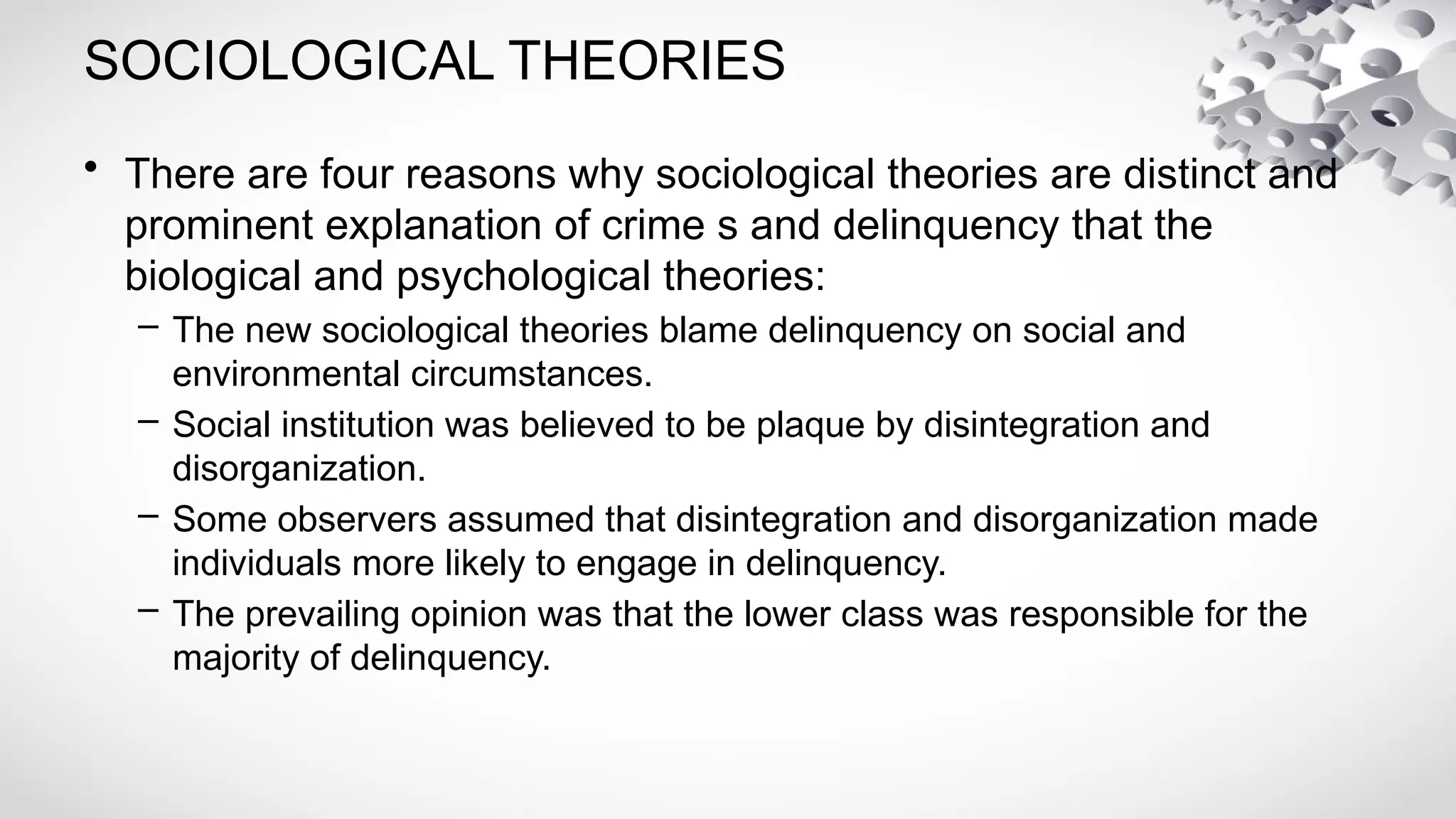
SOCIOLOGICAL THEORIES
• Thereare four reasons why sociological theories are distinct and
prominent explanation of crime s and delinquency that the
biological and psychological theories:
– The new sociological theories blame delinquency on social and
environmental circumstances.
– Social institution was believed to be plaque by disintegration and
disorganization.
– Some observers assumed that disintegration and disorganization made
individuals more likely to engage in delinquency.
– The prevailing opinion was that the lower class was responsible for the
majority of delinquency.
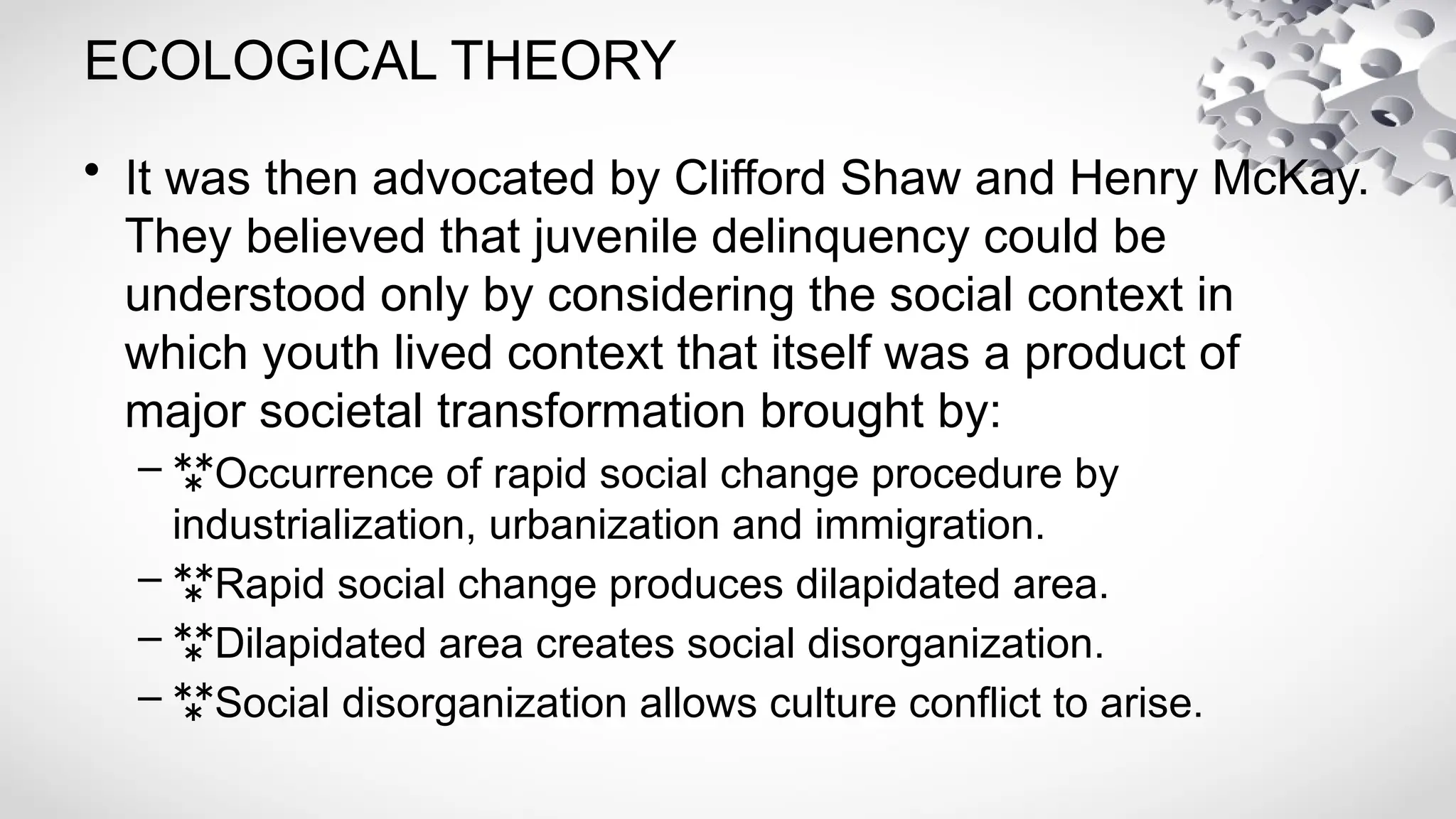
68.
ECOLOGICAL THEORY
• Itwas then advocated by Clifford Shaw and Henry McKay.
They believed that juvenile delinquency could be
understood only by considering the social context in
which youth lived context that itself was a product of
major societal transformation brought by:
– Occurrence of rapid social change procedure by
industrialization, urbanization and immigration.
– Rapid social change produces dilapidated area.
– Dilapidated area creates social disorganization.
– Social disorganization allows culture conflict to arise.
69.
– Cultural conflictallows crime and delinquency to flourish.
– Delinquent behaviors result allowed to flourish delinquency
become a full time job or career.
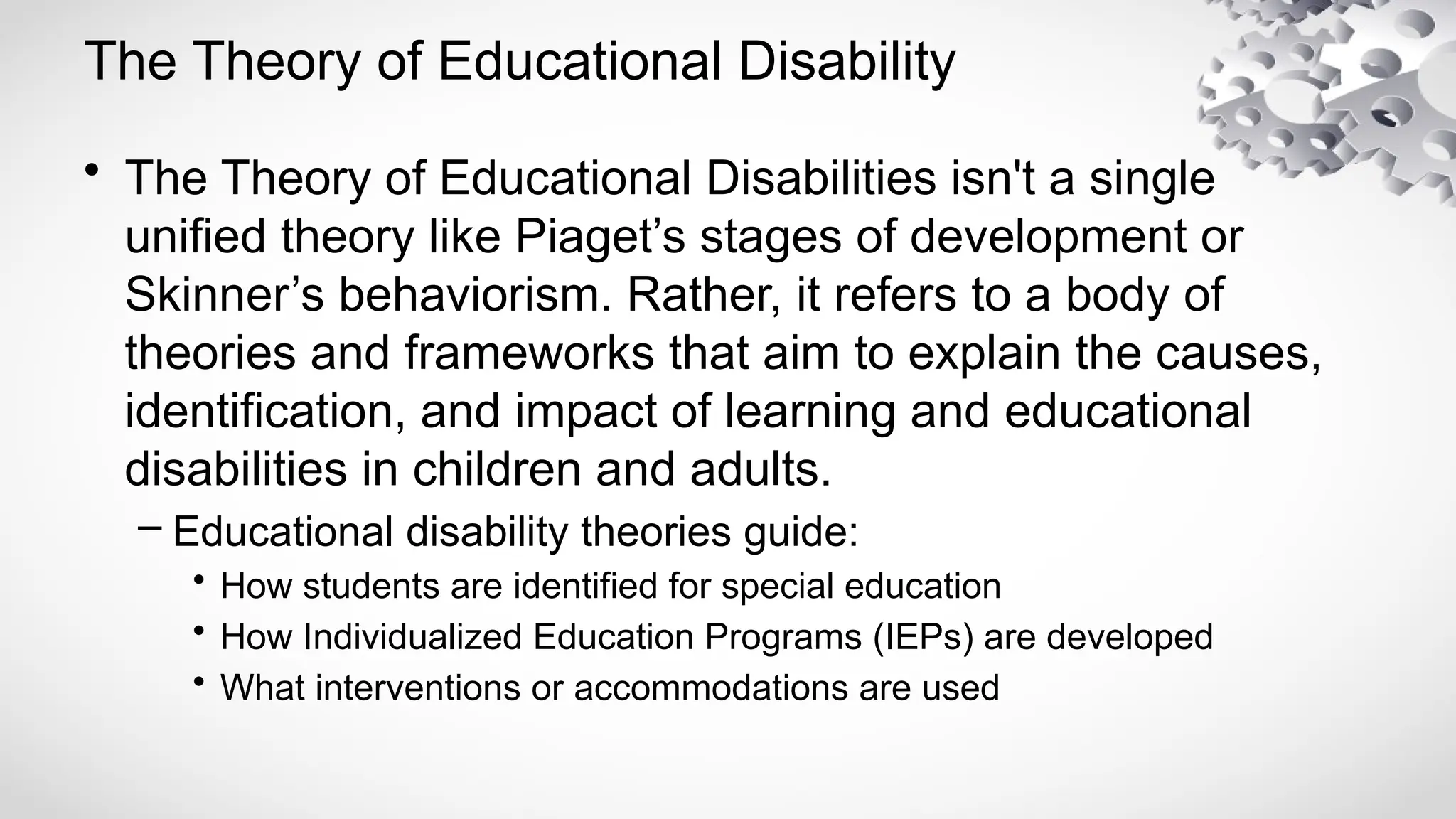
70.
The Theory ofEducational Disability
• The Theory of Educational Disabilities isn't a single
unified theory like Piaget’s stages of development or
Skinner’s behaviorism. Rather, it refers to a body of
theories and frameworks that aim to explain the causes,
identification, and impact of learning and educational
disabilities in children and adults.
– Educational disability theories guide:
• How students are identified for special education
• How Individualized Education Programs (IEPs) are developed
• What interventions or accommodations are used
71.
REFERENCES
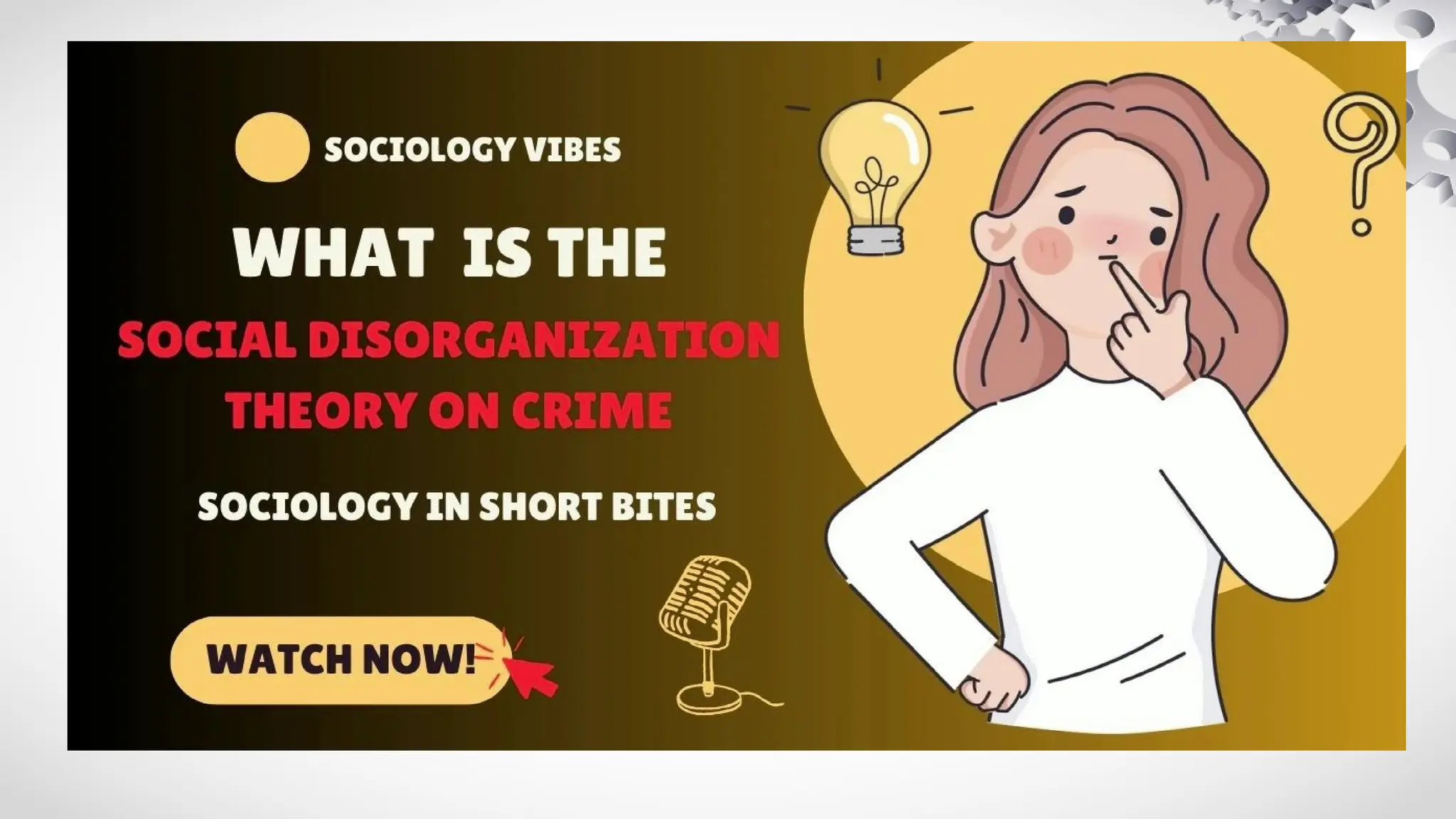
• Sociology Vibes.(2025, February 2). What are Social
Disorganization & Culture of Deviance Theories? | Intro
to Sociology | Crime | [Video]. YouTube.
https://www.youtube.com/watch?v=tFUTcfV-lWs
• Helpful Professor Explains! (2024, October 18). Strain
Theory (Explained in 3 minutes) [Video]. YouTube.
https://www.youtube.com/watch?v=PmWecREyjUc
72.
• Helpful ProfessorExplains! (2024b, December 24). Social
Control Theory (Explained in 4 minutes) [Video]. YouTube.
https://www.youtube.com/watch?v=nFlbMoSKPIo
• Zoe Kelly Emily. (2016, July 19). David Matza’s Theory -
Crime and Deviance [Video]. YouTube.
https://www.youtube.com/watch?v=jV629KK2Xrw
• Tristyn Short. (2017, November 10). Anomie-Strain
Theory [Video]. YouTube.
https://www.youtube.com/watch?v=BR954b9RfNU
73.
• Simplified InShort. (2025, March 14). Social control theory explained
(Simplified) [Video]. YouTube. https://www.youtube.com/watch?v=7t-
4l6gnyTE
• Simplified In Short. (2024, August 18). Labeling theory explained | Sociology
and Criminology [Video]. YouTube. https://www.youtube.com/watch?
v=cgolAR5A6hg
• Badua, B. (2021). Juvenile Delinquency and Juvenile Justice System: A
research-based textbook with normal approach. Quezon City; Wiseman’s
Books Trading, Inc.
• Chavez, C. B., Sarte, E. K., Miguel, M. V., Pioquinto, P. V., Pascual, R. F.,
Millan, A. R., & Landicho, G. P. (2023). Juvenile Delinquency & Juvenile
Justice System. Wiseman's Books Trading, Inc.
#5 mesdemeanors - a minor wrongdoing or less serious than a felony
Punishable offenses that are classified as criminal offenses for adults (e.g., murder, robbery, and larceny)
(e.g., alcohol and tobacco use, truancy, and running away from home) are referred to as status offenses.
![Introduction:
The Philippines has long recognized the need to address juvenile
delinquency in a manner that balances public safety with the welfare and
rehabilitation of children in conflict with the law (“CICL”). The 1987 Philippine
Constitution lays the groundwork for the State’s duty to protect children, enjoining
all branches of government to provide for their care and development. This
constitutional mandate aligns with the country’s commitments under international
instruments, particularly the United Nations Convention on the Rights of the Child
(UNCRC), which stresses that children accused or found guilty of crimes must be
treated in a manner that promotes their reintegration into society.
The primary legal framework for the juvenile justice system is the Juvenile
Justice and Welfare Act of 2006 (Republic Act [R.A.] No. 9344), as amended
by R.A. No. 10630. It espouses a restorative justice approach, emphasizing
rehabilitation and reintegration.](https://image.slidesharecdn.com/conceptandnatureofjuvenilejusticeanddelinquency-250720090533-092990c2/75/Concept-and-Nature-of-Juvenile-Justice-and-Delinquency-pptx-3-2048.jpg)
![How does community involvement affect juvenile justice?
Jail & Prison Insider. (2025, June 19). How does community involvement affect juvenile justice? - Jail &
Prison Insider [Video]. YouTube. https://www.youtube.com/watch?v=VOoB7S6_uNY](https://image.slidesharecdn.com/conceptandnatureofjuvenilejusticeanddelinquency-250720090533-092990c2/75/Concept-and-Nature-of-Juvenile-Justice-and-Delinquency-pptx-23-2048.jpg)
![How do environmental factors influence criminal behavior?
True Crime Lovers. (2025, January 28). How do environmental factors influence criminal behavior? |
True Crime Lovers [Video]. YouTube. https://www.youtube.com/watch?v=ALIJkhWApp8](https://image.slidesharecdn.com/conceptandnatureofjuvenilejusticeanddelinquency-250720090533-092990c2/75/Concept-and-Nature-of-Juvenile-Justice-and-Delinquency-pptx-24-2048.jpg)

![Family System Theory
Jennifer Myers. (2016, March 15). Family System’s Theory - EDUC 111 [Video]. YouTube.
https://www.youtube.com/watch?v=vBK_WRrcnfo](https://image.slidesharecdn.com/conceptandnatureofjuvenilejusticeanddelinquency-250720090533-092990c2/75/Concept-and-Nature-of-Juvenile-Justice-and-Delinquency-pptx-45-2048.jpg)
![Low IQ Theory
Jesse Lauren. (2020, October 21). The low I.Q. theory [Video]. YouTube.
https://www.youtube.com/watch?v=-w51UjZThV0](https://image.slidesharecdn.com/conceptandnatureofjuvenilejusticeanddelinquency-250720090533-092990c2/75/Concept-and-Nature-of-Juvenile-Justice-and-Delinquency-pptx-46-2048.jpg)

![REFERENCES
• Sociology Vibes. (2025, February 2). What are Social
Disorganization & Culture of Deviance Theories? | Intro
to Sociology | Crime | [Video]. YouTube.
https://www.youtube.com/watch?v=tFUTcfV-lWs
• Helpful Professor Explains! (2024, October 18). Strain
Theory (Explained in 3 minutes) [Video]. YouTube.
https://www.youtube.com/watch?v=PmWecREyjUc](https://image.slidesharecdn.com/conceptandnatureofjuvenilejusticeanddelinquency-250720090533-092990c2/75/Concept-and-Nature-of-Juvenile-Justice-and-Delinquency-pptx-71-2048.jpg)
![• Helpful Professor Explains! (2024b, December 24). Social
Control Theory (Explained in 4 minutes) [Video]. YouTube.
https://www.youtube.com/watch?v=nFlbMoSKPIo
• Zoe Kelly Emily. (2016, July 19). David Matza’s Theory -
Crime and Deviance [Video]. YouTube.
https://www.youtube.com/watch?v=jV629KK2Xrw
• Tristyn Short. (2017, November 10). Anomie-Strain
Theory [Video]. YouTube.
https://www.youtube.com/watch?v=BR954b9RfNU](https://image.slidesharecdn.com/conceptandnatureofjuvenilejusticeanddelinquency-250720090533-092990c2/75/Concept-and-Nature-of-Juvenile-Justice-and-Delinquency-pptx-72-2048.jpg)
![• Simplified In Short. (2025, March 14). Social control theory explained
(Simplified) [Video]. YouTube. https://www.youtube.com/watch?v=7t-
4l6gnyTE
• Simplified In Short. (2024, August 18). Labeling theory explained | Sociology
and Criminology [Video]. YouTube. https://www.youtube.com/watch?
v=cgolAR5A6hg
• Badua, B. (2021). Juvenile Delinquency and Juvenile Justice System: A
research-based textbook with normal approach. Quezon City; Wiseman’s
Books Trading, Inc.
• Chavez, C. B., Sarte, E. K., Miguel, M. V., Pioquinto, P. V., Pascual, R. F.,
Millan, A. R., & Landicho, G. P. (2023). Juvenile Delinquency & Juvenile
Justice System. Wiseman's Books Trading, Inc.](https://image.slidesharecdn.com/conceptandnatureofjuvenilejusticeanddelinquency-250720090533-092990c2/75/Concept-and-Nature-of-Juvenile-Justice-and-Delinquency-pptx-73-2048.jpg)