Presentation on Data
Communication
Presented By
Bhoopendra Kumar
B.VOc Software
Development
Roll No.-20202706
• Introduction to data communication
• Components of data communication
• Data Flow - Simplex,Half Duplex,Full Duplex
• Signals : - Analog And Digital Signals.
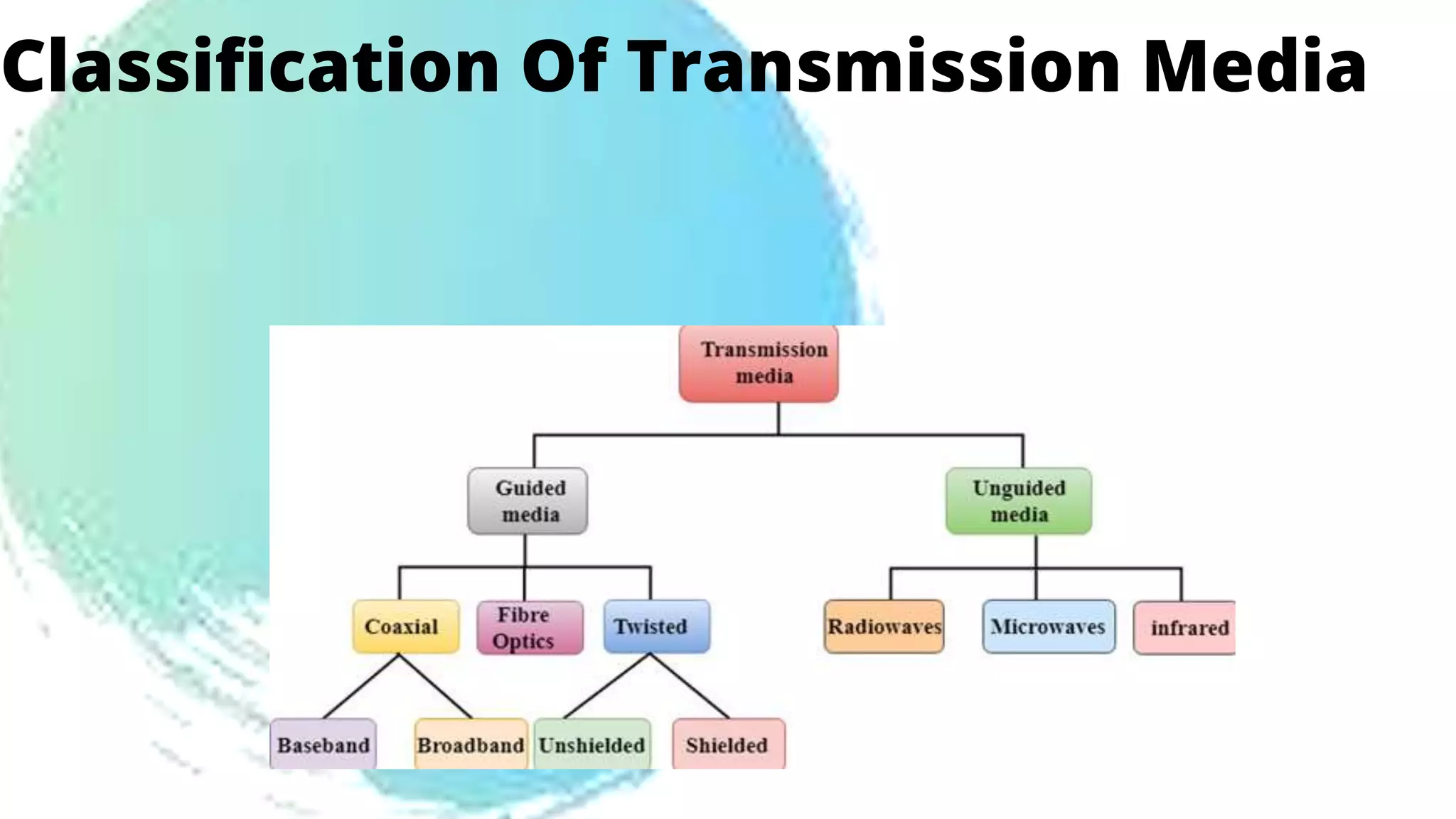
• Transmission Media - Guided and unguided
Media
• References
Contents
Data communicationrefers to the exchange of data between a source and a receiver via form of transmission media such as a wire cable.
The purpose of Data Communications is to provide the rules and regulations that allow
computers with different disk operating systems, languages, cabling and locations to
share resources.
For data communication to occur, the communicating devices must be part of a
communication system made up of a combination of hardware and software.
The effectiveness of a data communication system depends on the three fundamental
characteristics:
• Delivery
• Accuracy
• Timeliness
What Is Data Communications ??
The effectiveness of data communication system depends on four fundamental
characteristics:
1. Delivery: the system must deliver data to correct destination. Data must be received
by the intended device or user.
2. Accuracy: The system must deliver the data accurately. Data that have been altered in
transmission and left uncorrected are unusable.
3. Timeliness: the system must deliver data in a timely manner. Data delivered late are
useless.
4. Jitter: jitter refers to the variation in the packet arrival time. It is the uneven delay in the
delivery of packets.
Characteristics Of DC
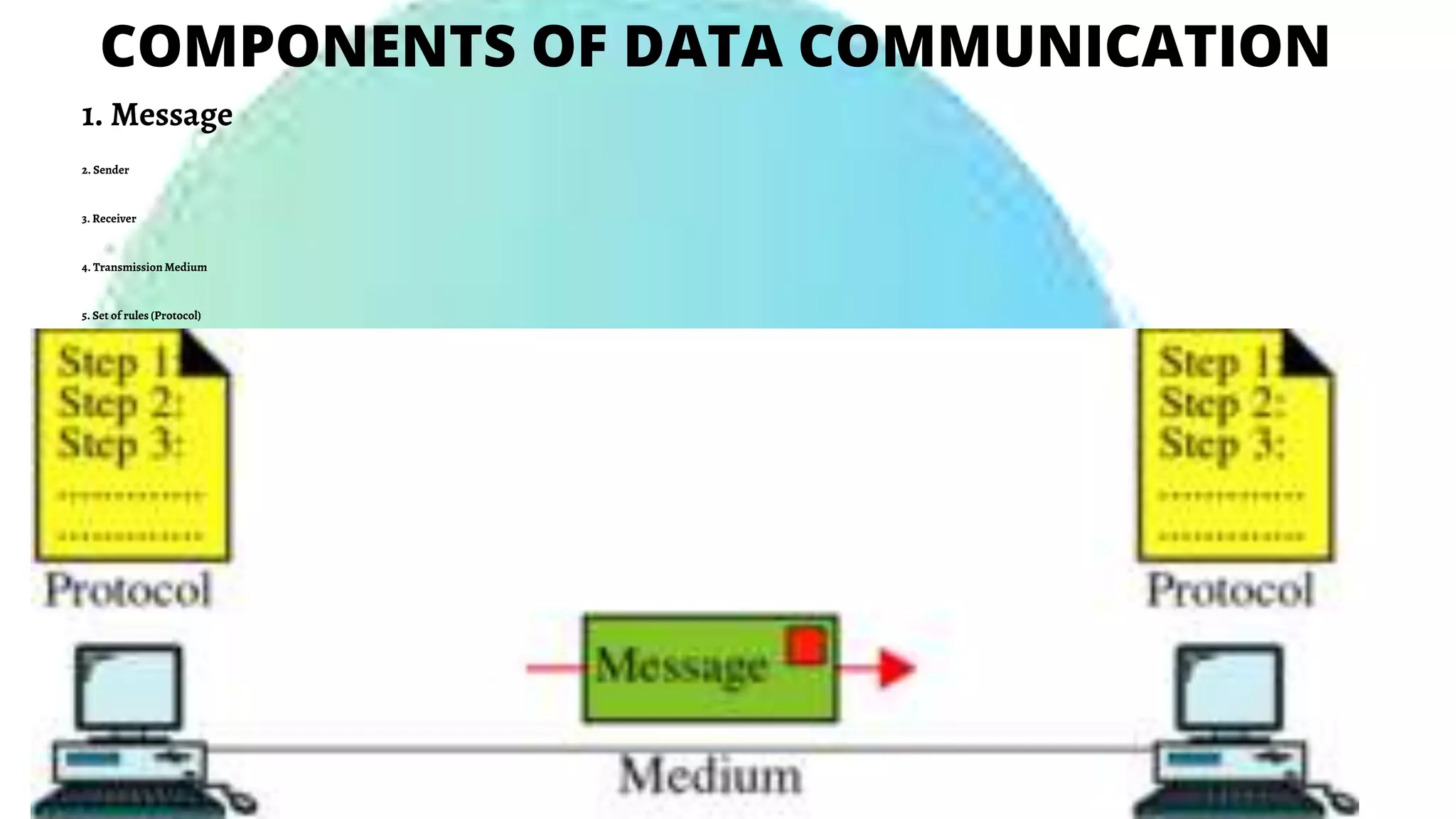
1. Message
2. Sender
3. Receiver
4. TransmissionMedium
5. Set of rules (Protocol)
COMPONENTS OF DATA COMMUNICATION
Types Of
DC
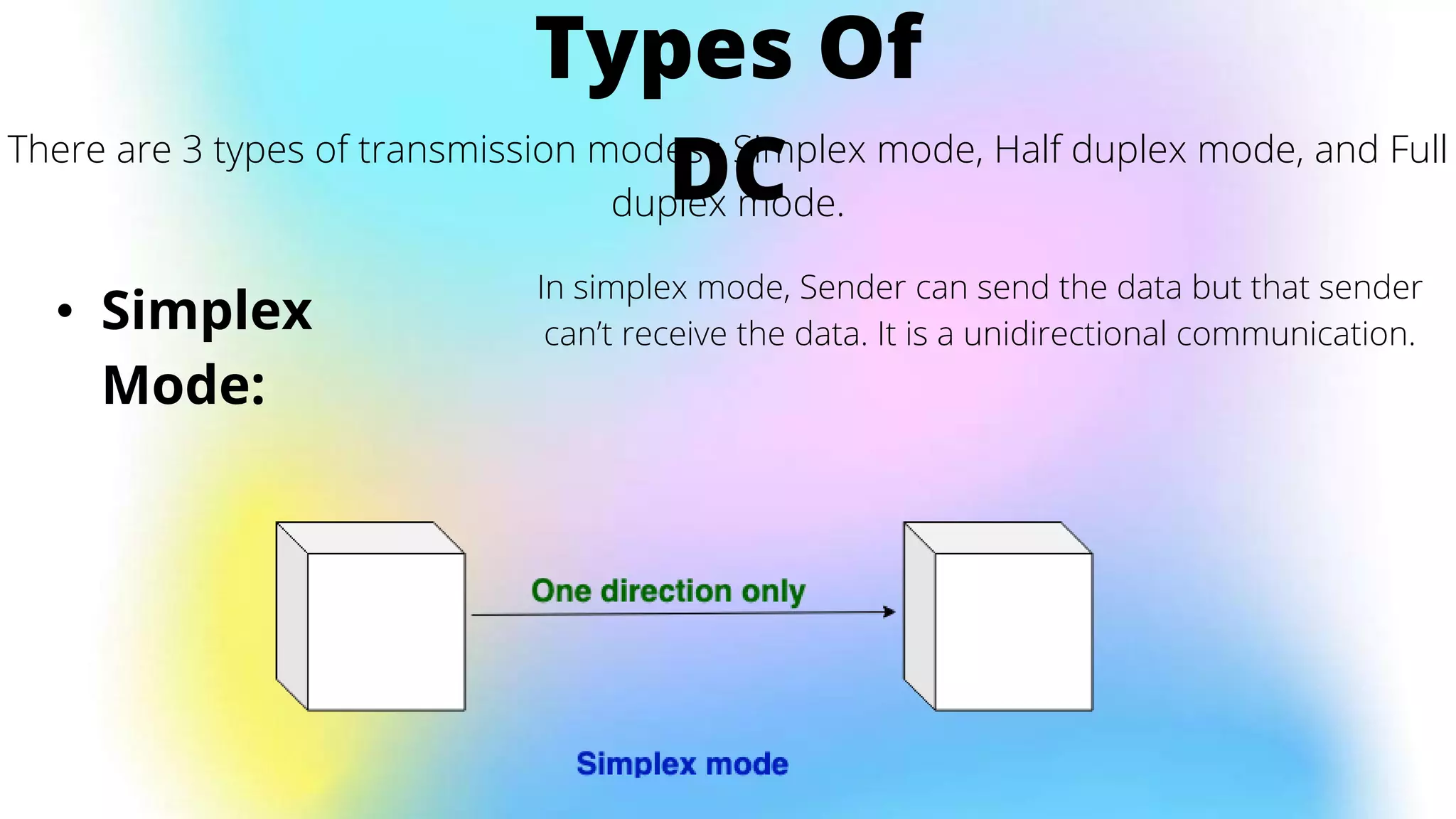
There are 3 types of transmission modes : Simplex mode, Half duplex mode, and Full
duplex mode.
• Simplex
Mode:
In simplex mode, Sender can send the data but that sender
can’t receive the data. It is a unidirectional communication.
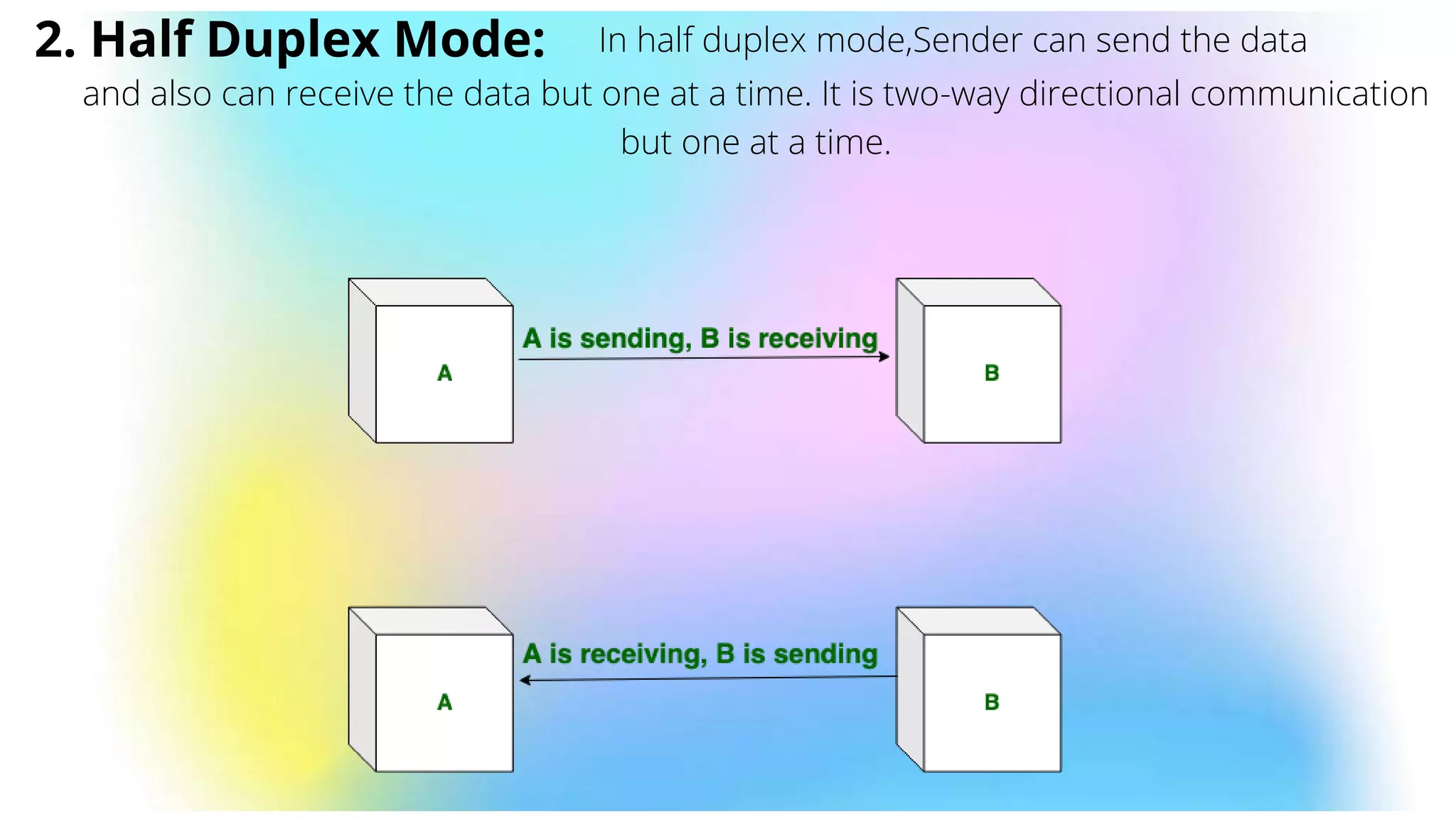
2. Half Duplex Mode: In half duplex mode,Sender can send the data
and also can receive the data but one at a time. It is two-way directional communication
but one at a time.
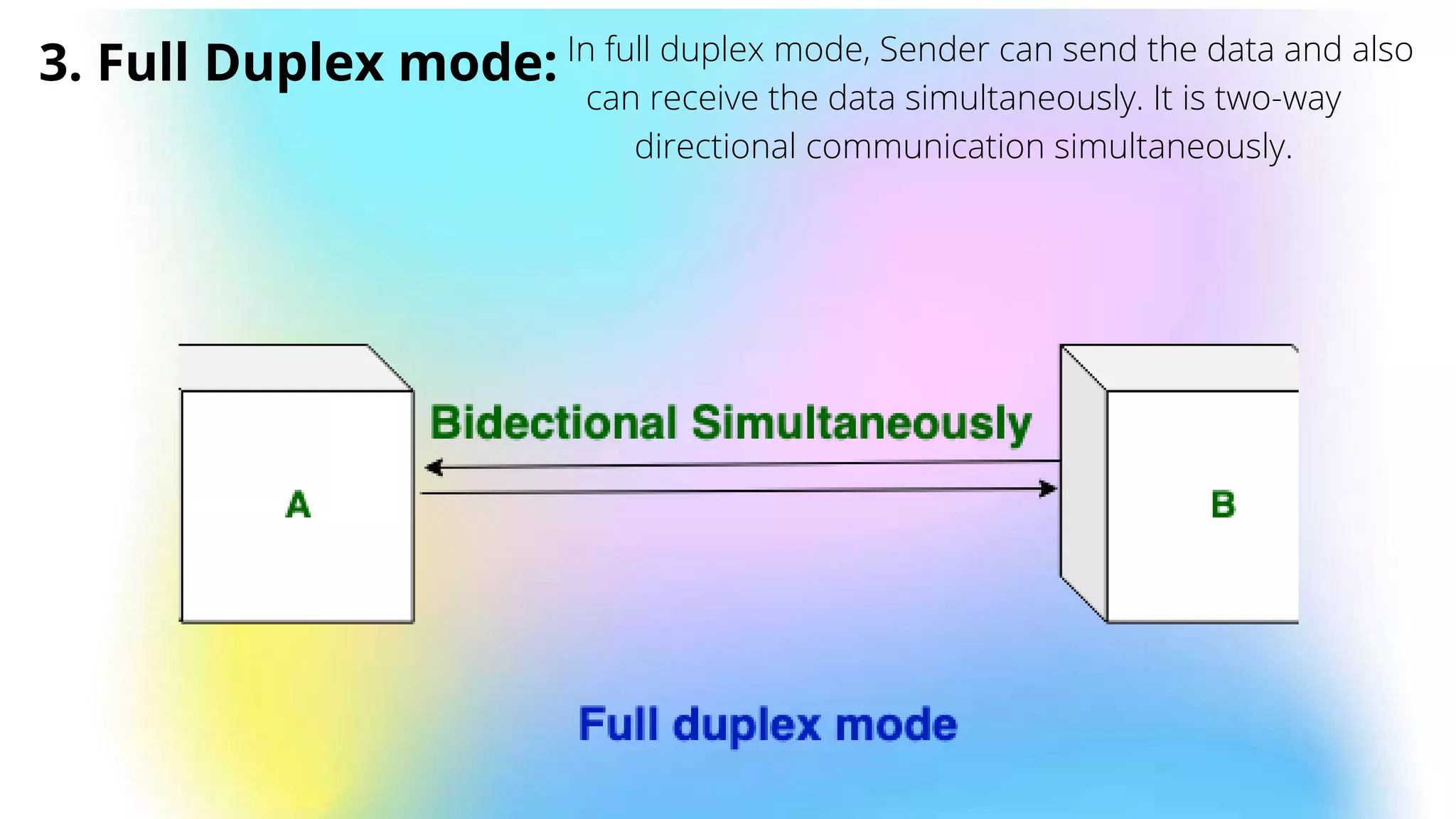
3. Full Duplex mode: In full duplex mode, Sender can send the data and also
can receive the data simultaneously. It is two-way
directional communication simultaneously.
SIGNA
L
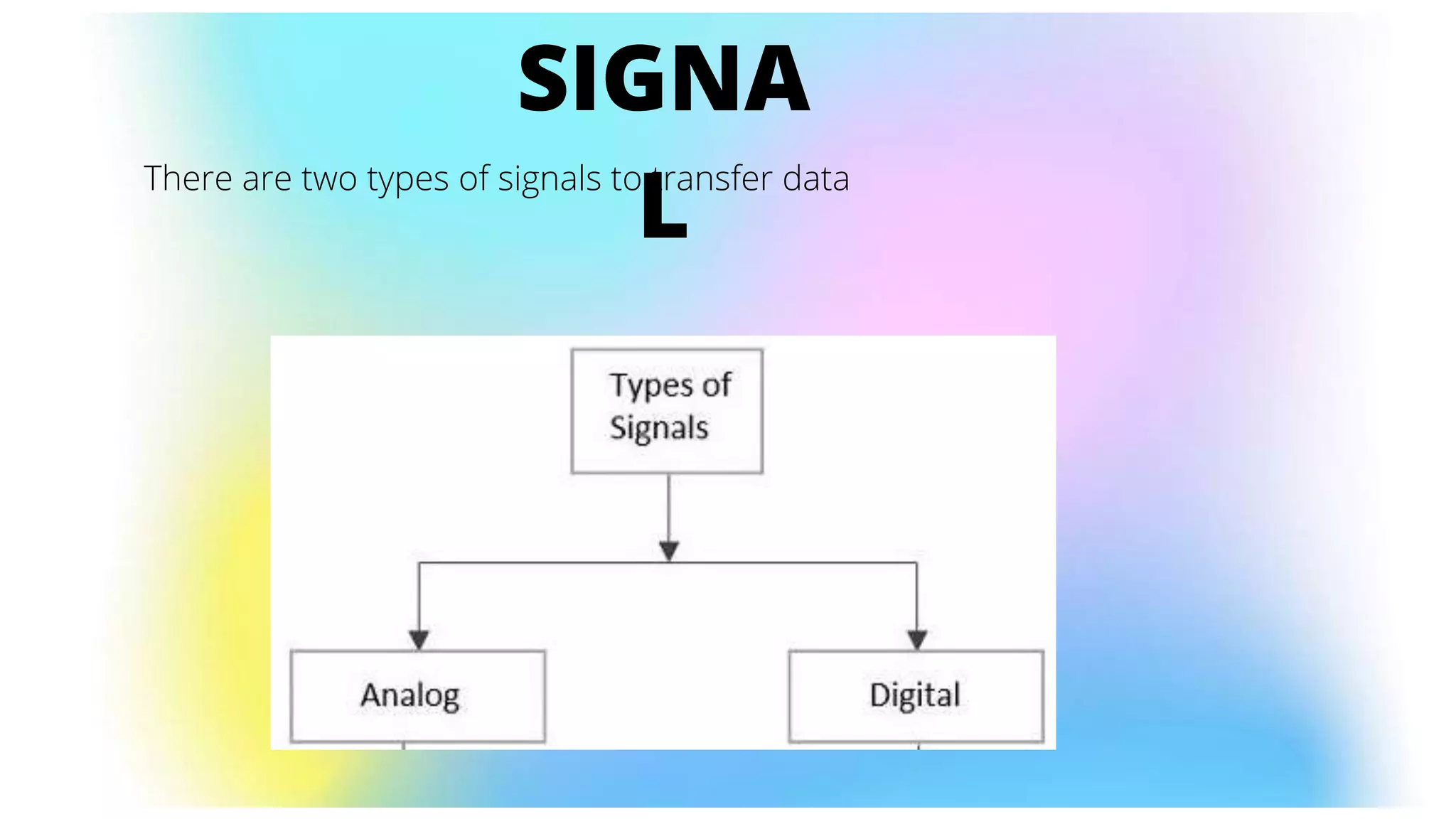
There are two types of signals to transfer data
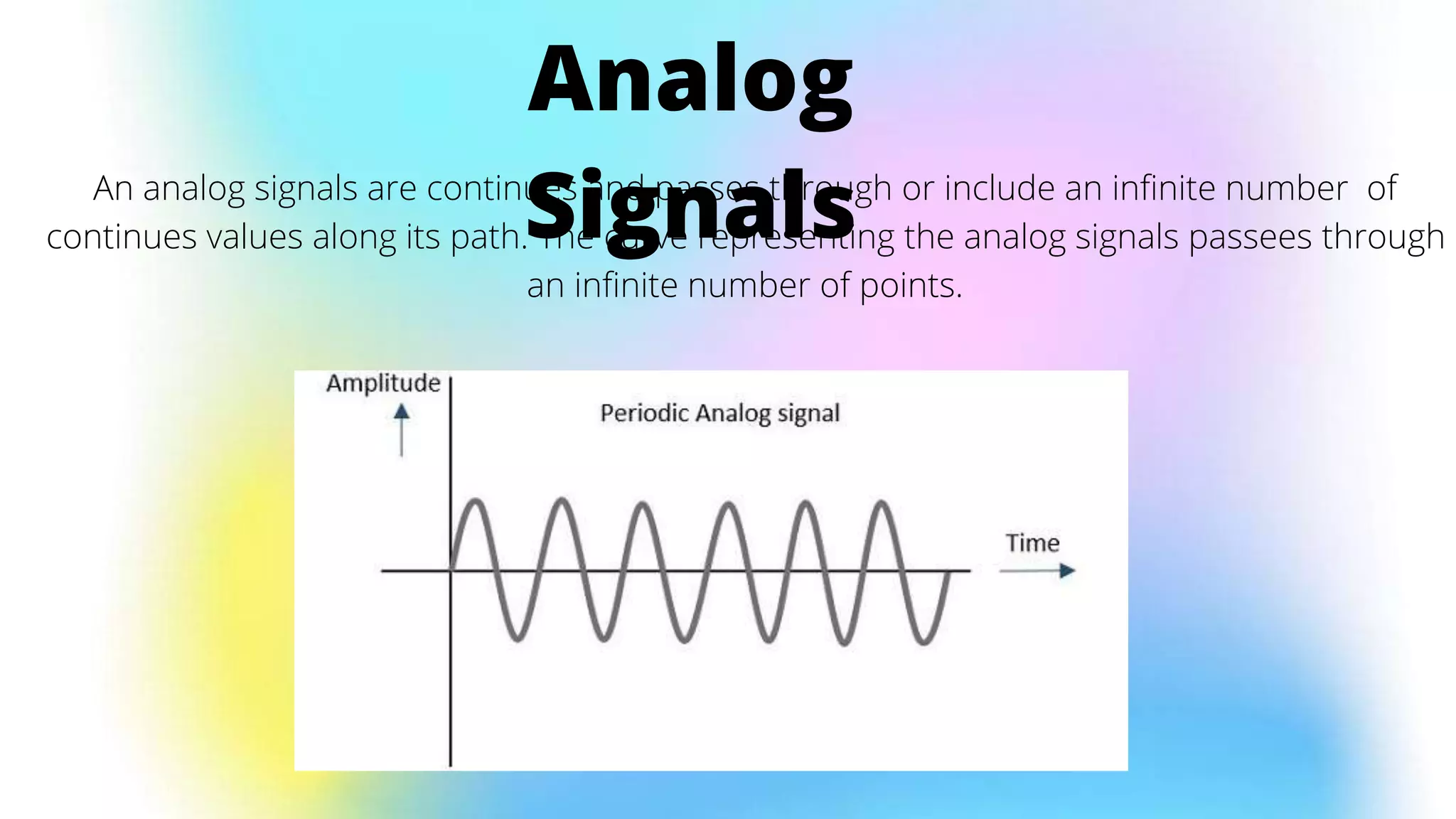
An analog signals are continues and passes through or include an infinite number of
continues values along its path. The curve representing the analog signals passees through
an infinite number of points.
Analog
Signals
DIGITAL
SIGNALS
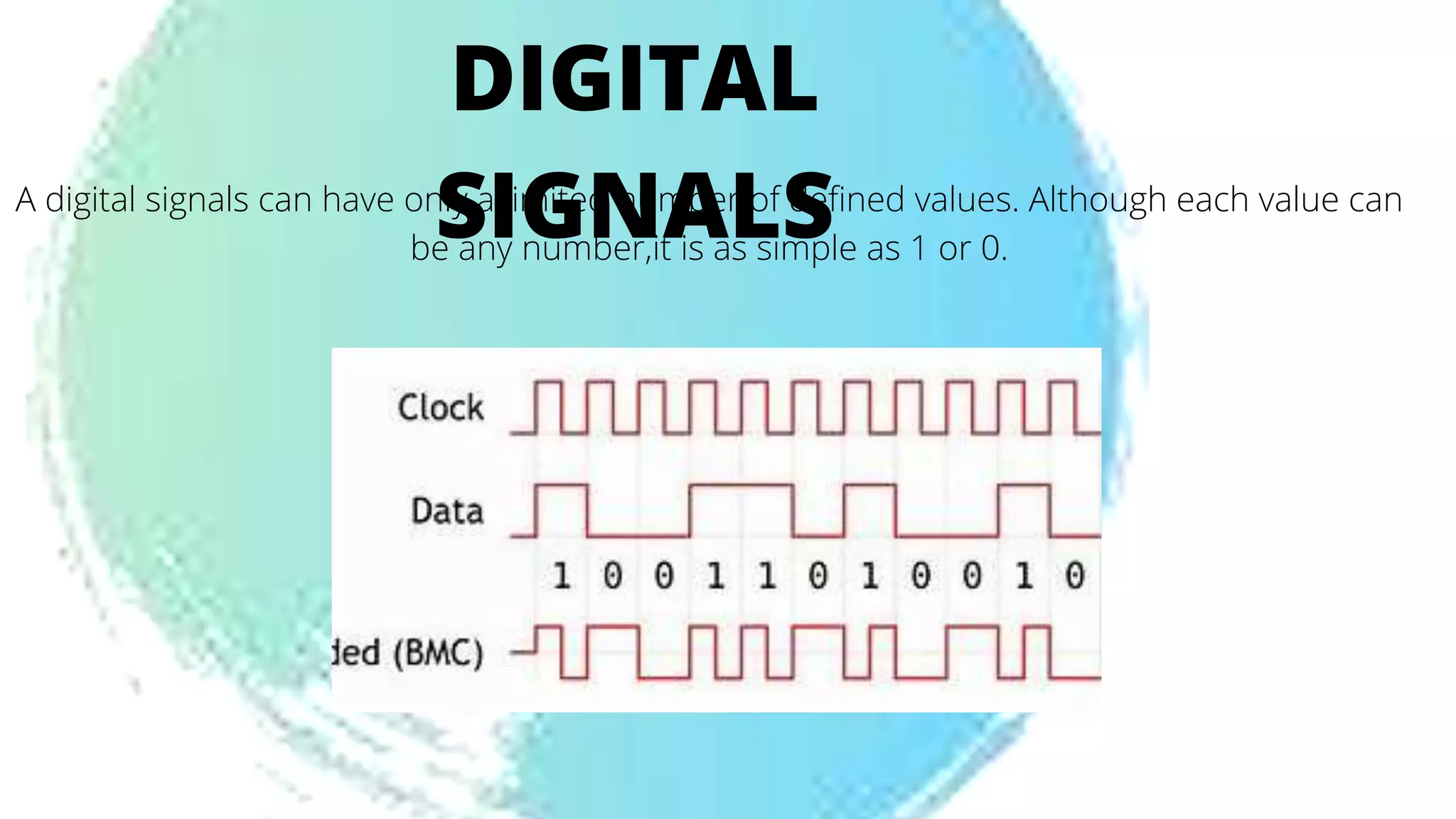
A digital signals can have only a limited number of defined values. Although each value can
be any number,it is as simple as 1 or 0.
• Transmission media is a communication channel that carries the information from
the sender to the receiver. Data is transmitted through the electromagnetic
signals.
• The Main functionality of the transmission media is to carry the information in the
form of bits through LAN(Local Area Network).
• It is a physical path between transmitter and receiver in data communication.
Transmission Media
Classification Of Transmission Media
References
https://ecomputernotes.com/computernetworkingnotes/communication-networks/
https://www.techwalla.com/articles/
https://www.javatpoint.com/transmissionmedia
Thank You

computerNetworks.ppt

  • 1.
    Presentation on Data Communication PresentedBy Bhoopendra Kumar B.VOc Software Development Roll No.-20202706
  • 2.
    • Introduction todata communication • Components of data communication • Data Flow - Simplex,Half Duplex,Full Duplex • Signals : - Analog And Digital Signals. • Transmission Media - Guided and unguided Media • References Contents
  • 3.
    Data communicationrefers tothe exchange of data between a source and a receiver via form of transmission media such as a wire cable. The purpose of Data Communications is to provide the rules and regulations that allow computers with different disk operating systems, languages, cabling and locations to share resources. For data communication to occur, the communicating devices must be part of a communication system made up of a combination of hardware and software. The effectiveness of a data communication system depends on the three fundamental characteristics: • Delivery • Accuracy • Timeliness What Is Data Communications ??
  • 4.
    The effectiveness ofdata communication system depends on four fundamental characteristics: 1. Delivery: the system must deliver data to correct destination. Data must be received by the intended device or user. 2. Accuracy: The system must deliver the data accurately. Data that have been altered in transmission and left uncorrected are unusable. 3. Timeliness: the system must deliver data in a timely manner. Data delivered late are useless. 4. Jitter: jitter refers to the variation in the packet arrival time. It is the uneven delay in the delivery of packets. Characteristics Of DC
  • 5.
    1. Message 2. Sender 3.Receiver 4. TransmissionMedium 5. Set of rules (Protocol) COMPONENTS OF DATA COMMUNICATION
  • 6.
    Types Of DC There are3 types of transmission modes : Simplex mode, Half duplex mode, and Full duplex mode. • Simplex Mode: In simplex mode, Sender can send the data but that sender can’t receive the data. It is a unidirectional communication.
  • 7.
    2. Half DuplexMode: In half duplex mode,Sender can send the data and also can receive the data but one at a time. It is two-way directional communication but one at a time.
  • 8.
    3. Full Duplexmode: In full duplex mode, Sender can send the data and also can receive the data simultaneously. It is two-way directional communication simultaneously.
  • 9.
    SIGNA L There are twotypes of signals to transfer data
  • 10.
    An analog signalsare continues and passes through or include an infinite number of continues values along its path. The curve representing the analog signals passees through an infinite number of points. Analog Signals
  • 11.
    DIGITAL SIGNALS A digital signalscan have only a limited number of defined values. Although each value can be any number,it is as simple as 1 or 0.
  • 12.
    • Transmission mediais a communication channel that carries the information from the sender to the receiver. Data is transmitted through the electromagnetic signals. • The Main functionality of the transmission media is to carry the information in the form of bits through LAN(Local Area Network). • It is a physical path between transmitter and receiver in data communication. Transmission Media
  • 13.
  • 14.
  • 15.