COMPUTER ORGANIZATION AND
ARCHITECTURE
COMPONENTS :
◦ INTRODUCTION
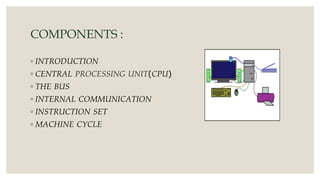
◦ CENTRAL PROCESSING UNIT(CPU)
◦ THE BUS
◦ INTERNAL COMMUNICATION
◦ INSTRUCTION SET
◦ MACHINE CYCLE
INTRODUCTION:
◦ Architecture focuses on the design and structure of the computer system.
◦ Computer organization refers to the physical components and how they interact.
◦ Topics include Central Processing Unit, Internal Communication, Machine Cycle, The
Bus, Instruction Set.
Central Processing Unit:
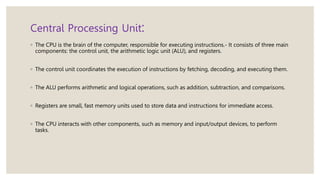
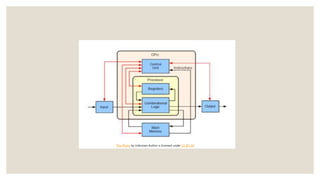
◦ The CPU is the brain of the computer, responsible for executing instructions.- It consists of three main
components: the control unit, the arithmetic logic unit (ALU), and registers.
◦ The control unit coordinates the execution of instructions by fetching, decoding, and executing them.
◦ The ALU performs arithmetic and logical operations, such as addition, subtraction, and comparisons.
◦ Registers are small, fast memory units used to store data and instructions for immediate access.
◦ The CPU interacts with other components, such as memory and input/output devices, to perform
tasks.
This Photo by Unknown Author is licensed under CC BY-SA
The Bus:
◦ The bus is like a highway that allows different components of a computer system to
communicate.
◦ There are different types of buses, such as the address bus, data bus, and control bus.
◦ The address bus connects the CPU, memory, and other major components.
◦ The data bus carries data between the CPU, memory, and input/output devices.
◦ The control bus carries control signals to coordinate the activities of the components.
This Photo by Unknown Author is licensed under CC BY-SA-NC
This Photo by Unknown Author is licensed under CC BY-SA
Internal Communication:
◦ Internal communication refers to the exchange of data and control signals within a computer
system.
◦ It involves the interaction between different components, such as the CPU, memory, and
input/output devices.
◦ Internal communication in computer architecture involves buses, registers, clock signals, control
units, and memory access.
◦ It enables data transfer and coordination within the CPU.
◦ Pipelining improves efficiency.
Instruction Set:
◦ The instruction set is a collection of commands that the CPU can understand and execute.
◦ It defines the operations that the CPU can perform, such as arithmetic, logical, and data
movement.
◦ Instructions are represented in binary format, and each instruction has an opcode and operands
◦ Different CPUs have different instruction sets, such as x86, ARM, and MIPS.
◦ The instruction set architecture (ISA) specifies the interface between software and hardware
This Photo by Unknown Author is licensed under CC BY-NC-ND
Machine Cycle:
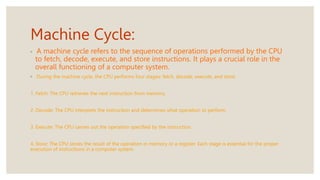
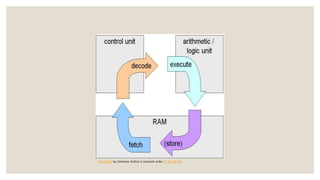
◦ A machine cycle refers to the sequence of operations performed by the CPU
to fetch, decode, execute, and store instructions. It plays a crucial role in the
overall functioning of a computer system.
◦ During the machine cycle, the CPU performs four stages: fetch, decode, execute, and store.
1. Fetch: The CPU retrieves the next instruction from memory.
2. Decode: The CPU interprets the instruction and determines what operation to perform
3. Execute: The CPU carries out the operation specified by the instruction.
4. Store: The CPU stores the result of the operation in memory or a register. Each stage is essential for the proper
execution of instructions in a computer system.
This Photo by Unknown Author is licensed under CC BY-SA-NC

computer organization and architecture.pptx

  • 1.
  • 2.
    COMPONENTS : ◦ INTRODUCTION ◦CENTRAL PROCESSING UNIT(CPU) ◦ THE BUS ◦ INTERNAL COMMUNICATION ◦ INSTRUCTION SET ◦ MACHINE CYCLE
  • 3.
    INTRODUCTION: ◦ Architecture focuseson the design and structure of the computer system. ◦ Computer organization refers to the physical components and how they interact. ◦ Topics include Central Processing Unit, Internal Communication, Machine Cycle, The Bus, Instruction Set.
  • 4.
    Central Processing Unit: ◦The CPU is the brain of the computer, responsible for executing instructions.- It consists of three main components: the control unit, the arithmetic logic unit (ALU), and registers. ◦ The control unit coordinates the execution of instructions by fetching, decoding, and executing them. ◦ The ALU performs arithmetic and logical operations, such as addition, subtraction, and comparisons. ◦ Registers are small, fast memory units used to store data and instructions for immediate access. ◦ The CPU interacts with other components, such as memory and input/output devices, to perform tasks.
  • 5.
    This Photo byUnknown Author is licensed under CC BY-SA
  • 6.
    The Bus: ◦ Thebus is like a highway that allows different components of a computer system to communicate. ◦ There are different types of buses, such as the address bus, data bus, and control bus. ◦ The address bus connects the CPU, memory, and other major components. ◦ The data bus carries data between the CPU, memory, and input/output devices. ◦ The control bus carries control signals to coordinate the activities of the components.
  • 7.
    This Photo byUnknown Author is licensed under CC BY-SA-NC This Photo by Unknown Author is licensed under CC BY-SA
  • 8.
    Internal Communication: ◦ Internalcommunication refers to the exchange of data and control signals within a computer system. ◦ It involves the interaction between different components, such as the CPU, memory, and input/output devices. ◦ Internal communication in computer architecture involves buses, registers, clock signals, control units, and memory access. ◦ It enables data transfer and coordination within the CPU. ◦ Pipelining improves efficiency.
  • 9.
    Instruction Set: ◦ Theinstruction set is a collection of commands that the CPU can understand and execute. ◦ It defines the operations that the CPU can perform, such as arithmetic, logical, and data movement. ◦ Instructions are represented in binary format, and each instruction has an opcode and operands ◦ Different CPUs have different instruction sets, such as x86, ARM, and MIPS. ◦ The instruction set architecture (ISA) specifies the interface between software and hardware
  • 10.
    This Photo byUnknown Author is licensed under CC BY-NC-ND
  • 11.
    Machine Cycle: ◦ Amachine cycle refers to the sequence of operations performed by the CPU to fetch, decode, execute, and store instructions. It plays a crucial role in the overall functioning of a computer system. ◦ During the machine cycle, the CPU performs four stages: fetch, decode, execute, and store. 1. Fetch: The CPU retrieves the next instruction from memory. 2. Decode: The CPU interprets the instruction and determines what operation to perform 3. Execute: The CPU carries out the operation specified by the instruction. 4. Store: The CPU stores the result of the operation in memory or a register. Each stage is essential for the proper execution of instructions in a computer system.
  • 12.
    This Photo byUnknown Author is licensed under CC BY-SA-NC