UNIT ONE: INFORMATION SYSTEMS
Lecturer P.Jovan
What is IS?
 IS – a set of interrelated components working together
to collect, retrieve, process, store, and distribute
information for the purpose of facilitating planning,
control, coordination, analysis, and decision making in
business organizations
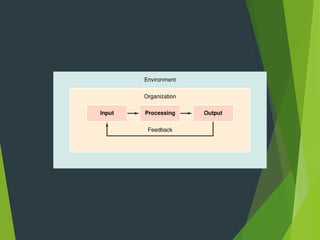
 Input-process-output perspective
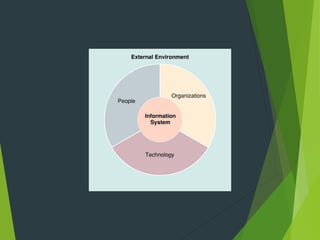
 People-organization-technology perspective
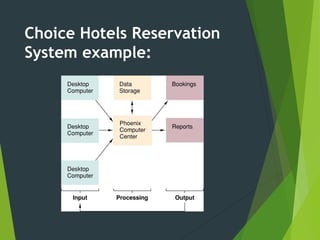
Choice Hotels Reservation
System example:
 Technology – the means by which data is transformed and organized for
business use:
 Hardware
 Software
 Database
 Telecommunication
 People – the users of IS
 Organization -- a collection of functional units working together to
achieve a common goal
Functional units of business
organizations:
production
sales/marketing
finance/accounting
human resources
 maximize profit by
producing goods and/or
services
Functional Areas of Business
 The manufacturing and production function is
responsible for producing the firm's goods and services.
There are three stages of the manufacturing/
production process:
 inbound logistics
 production
 outbound logistics
Functional Areas of Business
 The sales and marketing function is responsible for
finding customers for the firm's product or service and
selling the firm's product or service to those customers.
The sales and marketing process consists of
 identifying and creating markets
 developing markets
 maintaining markets
Functional Areas of Business
 The finance and accounting function is responsible for
managing the firm's financial assets and maintaining the
firm's financial records. The finance process involves
managing the firm's financial assets, whereas the
accounting process is involved primarily in financial
record keeping.
Functional Areas of Business
 The human resource function is responsible for
attracting and maintaining an appropriate work force
for the firm. The human resources process entails
 attracting the work force
 developing the firm's work force to meet the firm's
personnel needs
 maintaining the work force
Computer vs IS literacy
IS in Business
 Business functions
 Business processes
 A series of interrelated activities through which work is
organized and focused to produce a product or service
 Business levels
 Strategic (long range planning)
 Tactical (co-ordinate & supervise)
 Operational (produce product & service)
The order generation and fulfillment process (Fig. 2.2)
Role of IS in Business
Competitive advantage
 Low-cost (value chain)
 Market niche
 Product differentiation
 Customer loyalty
Globalization
 People (language)
 Organization (culture)
 Technology (telecommunication)
The value chain views the firm as a series of basic
activities that add value to a firm's products or services
(Fig. 3-2)
Primary activities
•inbound logistics,
•operations,
•outbound logistics,
•sales and marketing
•service
Support activities
•administration and management
•human resources
•technology and procurement.
Quality
 Process simplification
 Benchmarking
 Customer focus
 Cycle time reduction
 Improve design & production
 Error reduction
Reengineering
 Business processes redesign
Ethical & social responsibility
 Information rights & privacy
 Intellectual property
 Accountability & liability
 Quality of life
IS Approach to Problem Solving
Systems Analysis
Systems Design
Systems Analysis & Design
 Systems Analysis
 Problem analysis (what)
 Information gathering (where & why)
 Decision making (how)
 Establish objectives
 Determine feasibility
 Choose best solution
 Systems Design (Input, Process, Output, Procedures, Control)
 Logical design
Systems Analysis & Design
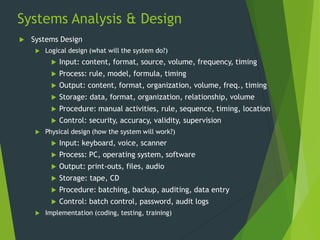
 Systems Design
 Logical design (what will the system do?)
 Input: content, format, source, volume, frequency, timing
 Process: rule, model, formula, timing
 Output: content, format, organization, volume, freq., timing
 Storage: data, format, organization, relationship, volume
 Procedure: manual activities, rule, sequence, timing, location
 Control: security, accuracy, validity, supervision
 Physical design (how the system will work?)
 Input: keyboard, voice, scanner
 Process: PC, operating system, software
 Output: print-outs, files, audio
 Storage: tape, CD
 Procedure: batching, backup, auditing, data entry
 Control: batch control, password, audit logs
 Implementation (coding, testing, training)
Technology perspective
to problem solving
Organizational perspective to
problem solving
People
perspective to
problem solving

Lesson_One_Introduction_to_Computers.pdf

  • 1.
    UNIT ONE: INFORMATIONSYSTEMS Lecturer P.Jovan
  • 2.
    What is IS? IS – a set of interrelated components working together to collect, retrieve, process, store, and distribute information for the purpose of facilitating planning, control, coordination, analysis, and decision making in business organizations  Input-process-output perspective  People-organization-technology perspective
  • 4.
  • 6.
     Technology –the means by which data is transformed and organized for business use:  Hardware  Software  Database  Telecommunication  People – the users of IS  Organization -- a collection of functional units working together to achieve a common goal
  • 7.
    Functional units ofbusiness organizations: production sales/marketing finance/accounting human resources  maximize profit by producing goods and/or services
  • 8.
    Functional Areas ofBusiness  The manufacturing and production function is responsible for producing the firm's goods and services. There are three stages of the manufacturing/ production process:  inbound logistics  production  outbound logistics
  • 9.
    Functional Areas ofBusiness  The sales and marketing function is responsible for finding customers for the firm's product or service and selling the firm's product or service to those customers. The sales and marketing process consists of  identifying and creating markets  developing markets  maintaining markets
  • 10.
    Functional Areas ofBusiness  The finance and accounting function is responsible for managing the firm's financial assets and maintaining the firm's financial records. The finance process involves managing the firm's financial assets, whereas the accounting process is involved primarily in financial record keeping.
  • 11.
    Functional Areas ofBusiness  The human resource function is responsible for attracting and maintaining an appropriate work force for the firm. The human resources process entails  attracting the work force  developing the firm's work force to meet the firm's personnel needs  maintaining the work force
  • 12.
  • 14.
    IS in Business Business functions  Business processes  A series of interrelated activities through which work is organized and focused to produce a product or service  Business levels  Strategic (long range planning)  Tactical (co-ordinate & supervise)  Operational (produce product & service)
  • 15.
    The order generationand fulfillment process (Fig. 2.2)
  • 17.
    Role of ISin Business Competitive advantage  Low-cost (value chain)  Market niche  Product differentiation  Customer loyalty Globalization  People (language)  Organization (culture)  Technology (telecommunication)
  • 18.
    The value chainviews the firm as a series of basic activities that add value to a firm's products or services (Fig. 3-2) Primary activities •inbound logistics, •operations, •outbound logistics, •sales and marketing •service Support activities •administration and management •human resources •technology and procurement.
  • 19.
    Quality  Process simplification Benchmarking  Customer focus  Cycle time reduction  Improve design & production  Error reduction Reengineering  Business processes redesign Ethical & social responsibility  Information rights & privacy  Intellectual property  Accountability & liability  Quality of life
  • 20.
    IS Approach toProblem Solving Systems Analysis Systems Design
  • 21.
    Systems Analysis &Design  Systems Analysis  Problem analysis (what)  Information gathering (where & why)  Decision making (how)  Establish objectives  Determine feasibility  Choose best solution  Systems Design (Input, Process, Output, Procedures, Control)  Logical design
  • 22.
    Systems Analysis &Design  Systems Design  Logical design (what will the system do?)  Input: content, format, source, volume, frequency, timing  Process: rule, model, formula, timing  Output: content, format, organization, volume, freq., timing  Storage: data, format, organization, relationship, volume  Procedure: manual activities, rule, sequence, timing, location  Control: security, accuracy, validity, supervision  Physical design (how the system will work?)  Input: keyboard, voice, scanner  Process: PC, operating system, software  Output: print-outs, files, audio  Storage: tape, CD  Procedure: batching, backup, auditing, data entry  Control: batch control, password, audit logs  Implementation (coding, testing, training)
  • 23.
  • 24.
  • 25.