z
COMPUTER NUMBER
SYSTEM
GRADE 7_LESSON 3
z
The computer number system is fundamental
to understanding how computers process and
store data. For Grade 7 students, this topic
introduces them to the basic concepts of
binary, decimal, octal, and hexadecimal
number systems. These systems are essential
for grasping how computers perform
calculations, store data, and communicate
information.
Introduction
z
z
z
z
z
z
z
z
z
z
z
z
z
z
z
z
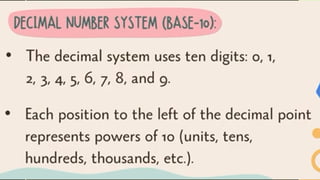
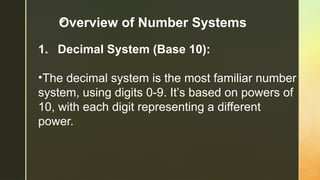
1. Decimal System (Base 10):
•The decimal system is the most familiar number
system, using digits 0-9. It’s based on powers of
10, with each digit representing a different
power.
Overview of Number Systems
z
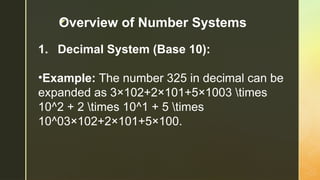
1. Decimal System (Base 10):
•Example: The number 325 in decimal can be
expanded as 3×10²+2×101+5×1003 times
10^2 + 2 times 10^1 + 5 times
10^03×102+2×101+5×100.
Overview of Number Systems
z
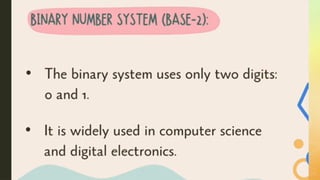
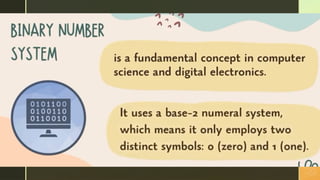
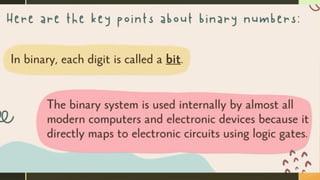
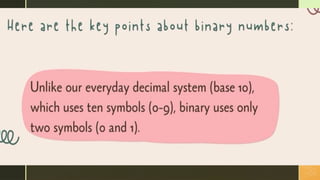
Binary System (Base 2):
•The binary system is the foundation of
computer operations. It uses only two digits: 0
and 1. Each digit represents a power of 2.
Overview of Number Systems
z
The positional notation method is one in which the
value of a digit in a number is determined by a
weight based on its position. The steps to convert
binary to decimal are as follows:
•Step 1: Multiply each digit starting from the
rightmost digit by the powers of 2. Here, we start
with 20
and increase the exponent by 1 as we move
onto the left side.
•Step 2: The sum of all these values obtained for each
digit gives the equivalent value of the given binary
Binary to Decimal Conversion Using Positional Notation
Method
z
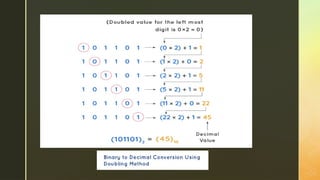
Example: Convert the binary number
1011012 to a decimal number.
Solution: Observe the following steps to
understand the binary to decimal conversion.
In any binary number, the rightmost digit is
called the 'Least Significant Bit' (LSB) and the
left-most digit is called the 'Most Significant
Bit' (MSB). For a binary number with 'n' digits,
the least significant bit has a weight of 20
and
Let us understand this with the help of examples.
z
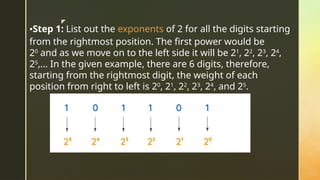
•Step 1: List out the exponents of 2 for all the digits starting
from the rightmost position. The first power would be
20
and as we move on to the left side it will be 21
, 22
, 23
, 24
,
25
,... In the given example, there are 6 digits, therefore,
starting from the rightmost digit, the weight of each
position from right to left is 20
, 21
, 22
, 23
, 24
, and 25
.
z
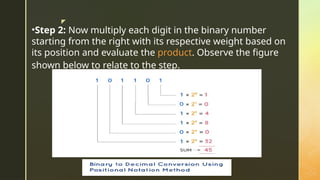
•Step 2: Now multiply each digit in the binary number
starting from the right with its respective weight based on
its position and evaluate the product. Observe the figure
shown below to relate to the step.
z
z
Binary System (Base 2):
•Example: The binary number 1011 can be
expanded as 1×23+0×22+1×21+1×20=111 
times 2^3 + 0 times 2^2 + 1 times 2^1 + 1 
times 2^0 = 111×23+0×22+1×21+1×20=11 in
decimal.
Overview of Number Systems
z
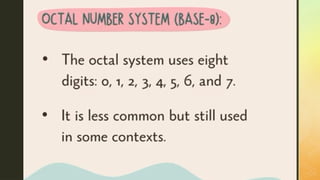
Octal System (Base 8):
•The octal system uses digits from 0 to 7 and is
sometimes used in computing as a more
compact representation of binary numbers.
Overview of Number Systems
z
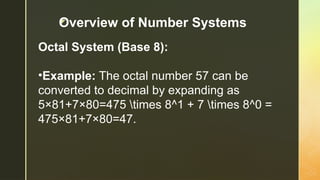
Octal System (Base 8):
•Example: The octal number 57 can be
converted to decimal by expanding as
5×81+7×80=475 times 8^1 + 7 times 8^0 =
475×81+7×80=47.
Overview of Number Systems
z
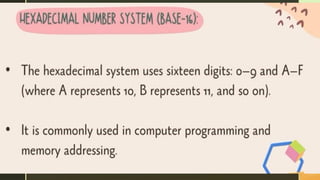
Hexadecimal System (Base 16):
•The hexadecimal system uses digits 0-9 and
letters A-F to represent values. It is commonly
used in computing because it can represent
binary numbers more compactly.
Overview of Number Systems
z
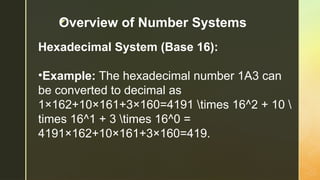
Hexadecimal System (Base 16):
•Example: The hexadecimal number 1A3 can
be converted to decimal as
1×162+10×161+3×160=4191 times 16^2 + 10 
times 16^1 + 3 times 16^0 =
4191×162+10×161+3×160=419.
Overview of Number Systems

COMPUTER NUMBER SYSTEM( ACTIVITIES).pptx

  • 1.
  • 2.
    z The computer numbersystem is fundamental to understanding how computers process and store data. For Grade 7 students, this topic introduces them to the basic concepts of binary, decimal, octal, and hexadecimal number systems. These systems are essential for grasping how computers perform calculations, store data, and communicate information. Introduction
  • 3.
  • 4.
  • 5.
  • 6.
  • 7.
  • 8.
  • 9.
  • 10.
  • 11.
  • 12.
  • 13.
  • 14.
  • 15.
  • 16.
  • 17.
  • 18.
    z 1. Decimal System(Base 10): •The decimal system is the most familiar number system, using digits 0-9. It’s based on powers of 10, with each digit representing a different power. Overview of Number Systems
  • 19.
    z 1. Decimal System(Base 10): •Example: The number 325 in decimal can be expanded as 3×10²+2×101+5×1003 times 10^2 + 2 times 10^1 + 5 times 10^03×102+2×101+5×100. Overview of Number Systems
  • 20.
    z Binary System (Base2): •The binary system is the foundation of computer operations. It uses only two digits: 0 and 1. Each digit represents a power of 2. Overview of Number Systems
  • 21.
    z The positional notationmethod is one in which the value of a digit in a number is determined by a weight based on its position. The steps to convert binary to decimal are as follows: •Step 1: Multiply each digit starting from the rightmost digit by the powers of 2. Here, we start with 20 and increase the exponent by 1 as we move onto the left side. •Step 2: The sum of all these values obtained for each digit gives the equivalent value of the given binary Binary to Decimal Conversion Using Positional Notation Method
  • 22.
    z Example: Convert thebinary number 1011012 to a decimal number. Solution: Observe the following steps to understand the binary to decimal conversion. In any binary number, the rightmost digit is called the 'Least Significant Bit' (LSB) and the left-most digit is called the 'Most Significant Bit' (MSB). For a binary number with 'n' digits, the least significant bit has a weight of 20 and Let us understand this with the help of examples.
  • 23.
    z •Step 1: Listout the exponents of 2 for all the digits starting from the rightmost position. The first power would be 20 and as we move on to the left side it will be 21 , 22 , 23 , 24 , 25 ,... In the given example, there are 6 digits, therefore, starting from the rightmost digit, the weight of each position from right to left is 20 , 21 , 22 , 23 , 24 , and 25 .
  • 24.
    z •Step 2: Nowmultiply each digit in the binary number starting from the right with its respective weight based on its position and evaluate the product. Observe the figure shown below to relate to the step.
  • 25.
  • 26.
    z Binary System (Base2): •Example: The binary number 1011 can be expanded as 1×23+0×22+1×21+1×20=111 times 2^3 + 0 times 2^2 + 1 times 2^1 + 1 times 2^0 = 111×23+0×22+1×21+1×20=11 in decimal. Overview of Number Systems
  • 27.
    z Octal System (Base8): •The octal system uses digits from 0 to 7 and is sometimes used in computing as a more compact representation of binary numbers. Overview of Number Systems
  • 28.
    z Octal System (Base8): •Example: The octal number 57 can be converted to decimal by expanding as 5×81+7×80=475 times 8^1 + 7 times 8^0 = 475×81+7×80=47. Overview of Number Systems
  • 29.
    z Hexadecimal System (Base16): •The hexadecimal system uses digits 0-9 and letters A-F to represent values. It is commonly used in computing because it can represent binary numbers more compactly. Overview of Number Systems
  • 30.
    z Hexadecimal System (Base16): •Example: The hexadecimal number 1A3 can be converted to decimal as 1×162+10×161+3×160=4191 times 16^2 + 10 times 16^1 + 3 times 16^0 = 4191×162+10×161+3×160=419. Overview of Number Systems