Network Topology
Networktopology is the physical and logical arrangement of devices and
connections within a network. It defines how devices such as computers,
routers, and switches are interconnected and how data flows between
them..
the physical topology refers to the actual layout of cables, devices, and
other network components.
The logical topology describes how data is transmitted across the
network, regardless of its physical layout.
3.
Point to PointTopology
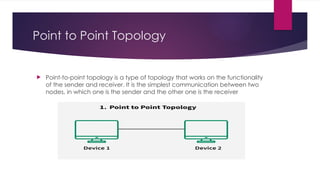
Point-to-point topology is a type of topology that works on the functionality
of the sender and receiver. It is the simplest communication between two
nodes, in which one is the sender and the other one is the receiver
4.
Mesh Topology
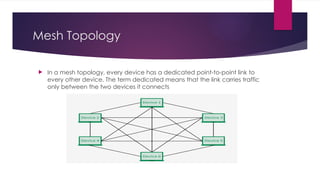
Ina mesh topology, every device has a dedicated point-to-point link to
every other device. The term dedicated means that the link carries traffic
only between the two devices it connects
5.
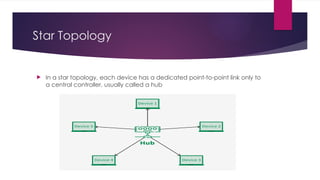
Star Topology
Ina star topology, each device has a dedicated point-to-point link only to
a central controller, usually called a hub
6.
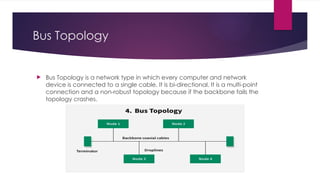
Bus Topology
BusTopology is a network type in which every computer and network
device is connected to a single cable. It is bi-directional. It is a multi-point
connection and a non-robust topology because if the backbone fails the
topology crashes.
7.
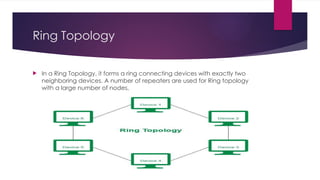
Ring Topology
Ina Ring Topology, it forms a ring connecting devices with exactly two
neighboring devices. A number of repeaters are used for Ring topology
with a large number of nodes,