Computer Memory
Memoryis a place where we can store data,instructionsandresultstemporarilyorpermanently.
Memorycan be classifiedintotwo:primarymemoryandsecondarymemory.Primarymemoryholds
data, intermediate resultsandresultsof ongoingjobstemporarily.Secondarymemoryonthe other
handholdsdata and informationpermanently.Before learningmore aboutmemory,letusdiscussthe
differentmemorymeasuringunits
BinaryDigit= 1 Bit 1 Nibble =4 Bits
1 Byte = 8 Bits 1 KB(KiloByte) = 1024 Bytes 1 MB (Mega Byte) = 1024 KB
1 GB (Giga Byte) = 1024 MB 1 TB (TeraByte) = 1024 GB 1 PB (PetaByte) = 1024 TB
Primary memory
Primarymemoryisa semiconductormemorythatisaccesseddirectlybythe CPU.It iscapable of
sendingandreceivingdataathighspeed.Thisincludesmainlythreetypesof memorysuchasRAM,
ROM andCache memory.
1 Random Access Memory (RAM)
RAM referstothe mainmemorythat microprocessorcanreadfrom and write to.Data can be stored
and retrievedatrandomfromanywhere withinthe RAM,nomatter where the datais.Data or
instructionstobe processedbythe CPU mustbe placedinthe RAM . The contentsof RAMare lostwhen
powerisswitchedoff.Therefore,RAMisa volatile memory.The storage capacityof RAMis2 GB and
above The speedof a RAMrefersto howfast the data inmemoryisaccessed.Itis measuredinMega
Hertz (MHz).Whena computeris inuse,itsRAMcontainsthe following:1.The operatingsystem
software. 2.The applicationsoftwarecurrentlybeingused.3.Anydatathat isbeingprocessed.
2. ReadOnly Memory (ROM)
ROM isa permanentmemorythatcan performonlyreadoperationsanditscontentscannotbe easily
altered.ROMis non-volatile;the contentsare retainedevenafterthe powerisswitchedoff.ROMis
usedinmost computerstoholda small,special piece of 'bootup'programknownas Basic InputOutput
System(BIOS).Thissoftware runswhenthe computerisswitchedonor'bootsup'. It checksthe
computer'shardware andthenloadsthe operatingsystem.ItisslowerthanRAM.
There are some modifiedtypesof ROMthat include:
1. PROM - Programmable ROMwhichcan be programmedonlyonce.PROMsare programmedat the
time of manufacture.
2. EPROM - Erasable Programmable ROMthatcan be erasedusingultravioletradiationandcanbe
programmedusingspecial electroniccircuits.
3. EEPROM - ElectricallyErasable Programmable ROMwhichcanbe erasedandrewrittenelectrically
3 Cache memory
Cache memoryisa small andfast memorybetweenthe processorandRAM(mainmemory).Frequently
accesseddata,instructions,intermediateresults,etc.are storedincache memoryforquickaccess.
Whenthe processorneedstoread fromor write to a locationinRAM, itfirstcheckswhethera copyof
that data isin the cache.If so,the processorimmediatelyreadsthe cache,whichismuchfasterthan
readingfromRAM. Cache is more expensive thanRAM,butit isworthusingit inorderto maximise
systemperformance.Commonlyusedcache memoriesandtheircapacitiesare Level 1Cache (128 KB),
Level 2 Cache (1 MB), Level 3 Cache (8 MB) and Level 4 Cache (128 MB)
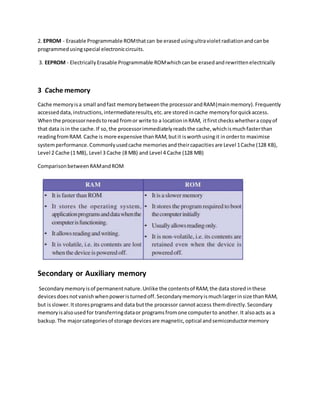
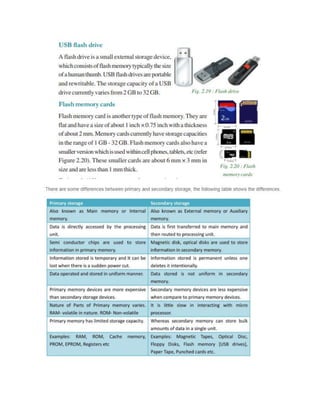
ComparisonbetweenRAMandROM
Secondary or Auxiliary memory
Secondarymemoryisof permanentnature.Unlike the contentsof RAM,the data storedinthese
devicesdoesnotvanishwhenpoweristurnedoff.Secondarymemoryismuchlargerinsize thanRAM,
but isslower.Itstoresprogramsand data butthe processor cannotaccess themdirectly.Secondary
memoryisalsousedfor transferringdataor programsfromone computerto another.It alsoacts as a
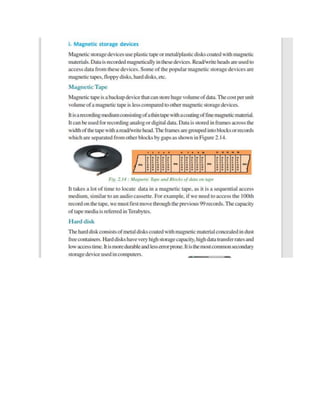
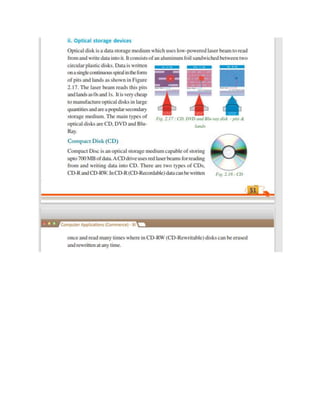
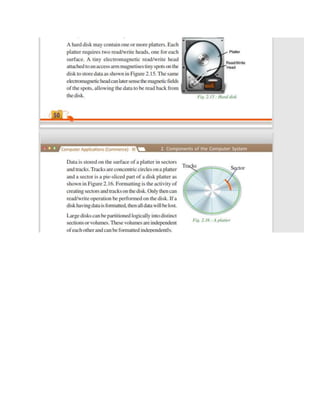
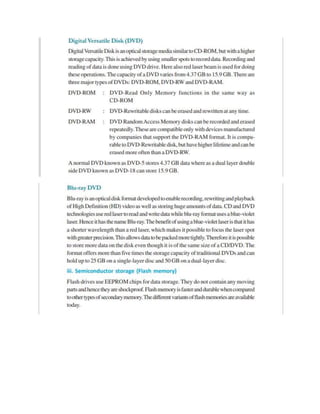
backup.The majorcategoriesof storage devicesare magnetic,optical andsemiconductormemory
Computer Memory.docx

Computer Memory.docx

  • 1.
    Computer Memory Memoryis aplace where we can store data,instructionsandresultstemporarilyorpermanently. Memorycan be classifiedintotwo:primarymemoryandsecondarymemory.Primarymemoryholds data, intermediate resultsandresultsof ongoingjobstemporarily.Secondarymemoryonthe other handholdsdata and informationpermanently.Before learningmore aboutmemory,letusdiscussthe differentmemorymeasuringunits BinaryDigit= 1 Bit 1 Nibble =4 Bits 1 Byte = 8 Bits 1 KB(KiloByte) = 1024 Bytes 1 MB (Mega Byte) = 1024 KB 1 GB (Giga Byte) = 1024 MB 1 TB (TeraByte) = 1024 GB 1 PB (PetaByte) = 1024 TB Primary memory Primarymemoryisa semiconductormemorythatisaccesseddirectlybythe CPU.It iscapable of sendingandreceivingdataathighspeed.Thisincludesmainlythreetypesof memorysuchasRAM, ROM andCache memory. 1 Random Access Memory (RAM) RAM referstothe mainmemorythat microprocessorcanreadfrom and write to.Data can be stored and retrievedatrandomfromanywhere withinthe RAM,nomatter where the datais.Data or instructionstobe processedbythe CPU mustbe placedinthe RAM . The contentsof RAMare lostwhen powerisswitchedoff.Therefore,RAMisa volatile memory.The storage capacityof RAMis2 GB and above The speedof a RAMrefersto howfast the data inmemoryisaccessed.Itis measuredinMega Hertz (MHz).Whena computeris inuse,itsRAMcontainsthe following:1.The operatingsystem software. 2.The applicationsoftwarecurrentlybeingused.3.Anydatathat isbeingprocessed. 2. ReadOnly Memory (ROM) ROM isa permanentmemorythatcan performonlyreadoperationsanditscontentscannotbe easily altered.ROMis non-volatile;the contentsare retainedevenafterthe powerisswitchedoff.ROMis usedinmost computerstoholda small,special piece of 'bootup'programknownas Basic InputOutput System(BIOS).Thissoftware runswhenthe computerisswitchedonor'bootsup'. It checksthe computer'shardware andthenloadsthe operatingsystem.ItisslowerthanRAM. There are some modifiedtypesof ROMthat include: 1. PROM - Programmable ROMwhichcan be programmedonlyonce.PROMsare programmedat the time of manufacture.
  • 2.
    2. EPROM -Erasable Programmable ROMthatcan be erasedusingultravioletradiationandcanbe programmedusingspecial electroniccircuits. 3. EEPROM - ElectricallyErasable Programmable ROMwhichcanbe erasedandrewrittenelectrically 3 Cache memory Cache memoryisa small andfast memorybetweenthe processorandRAM(mainmemory).Frequently accesseddata,instructions,intermediateresults,etc.are storedincache memoryforquickaccess. Whenthe processorneedstoread fromor write to a locationinRAM, itfirstcheckswhethera copyof that data isin the cache.If so,the processorimmediatelyreadsthe cache,whichismuchfasterthan readingfromRAM. Cache is more expensive thanRAM,butit isworthusingit inorderto maximise systemperformance.Commonlyusedcache memoriesandtheircapacitiesare Level 1Cache (128 KB), Level 2 Cache (1 MB), Level 3 Cache (8 MB) and Level 4 Cache (128 MB) ComparisonbetweenRAMandROM Secondary or Auxiliary memory Secondarymemoryisof permanentnature.Unlike the contentsof RAM,the data storedinthese devicesdoesnotvanishwhenpoweristurnedoff.Secondarymemoryismuchlargerinsize thanRAM, but isslower.Itstoresprogramsand data butthe processor cannotaccess themdirectly.Secondary memoryisalsousedfor transferringdataor programsfromone computerto another.It alsoacts as a backup.The majorcategoriesof storage devicesare magnetic,optical andsemiconductormemory