Computer based Cognitive
Rehabilitation
With focus on an Clinical Study by Stroke Patients
March 2024
Pouria Saadat
PhD student of Cognitive Psychology
• PhD Student of Cognitive Psychology (ICBS)
• M.Sc. Cognitive Rehabilitation (ICSS)
• B.Sc. of Psychology (YAZD University)
• Cognitive Rehabilitation Therapist ( Tabassom Stroke
Patients Rehabilitation Center, Tehran)
pouriasaadat76@gmail.com
p_saadat@sbu.ac.ir
https://www.linkedin.com/in/pouria-saadat-79b9b6167/
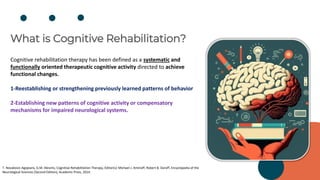
What is Cognitive Rehabilitation?
Cognitive rehabilitation therapy has been defined as a systematic and
functionally oriented therapeutic cognitive activity directed to achieve
functional changes.
1-Reestablishing or strengthening previously learned patterns of behavior
2-Establishing new patterns of cognitive activity or compensatory
mechanisms for impaired neurological systems.
T. Novakovic-Agopians, G.M. Abrams, Cognitive Rehabilitation Therapy, Editor(s): Michael J. Aminoff, Robert B. Daroff, Encyclopedia of the
Neurological Sciences (Second Edition), Academic Press, 2014.
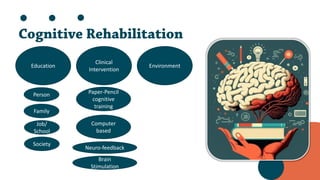
Education
Clinical
Intervention
Environment
Person
Family
Job/
School
Society
Paper-Pencil
cognitive
training
Computer
based
Neuro-feedback
Brain
Stimulation
1-Paper and Pencil
2-Computer_Based
3-Neurofeedback
4-Brain Stimulation
•
•
•
•
•
•
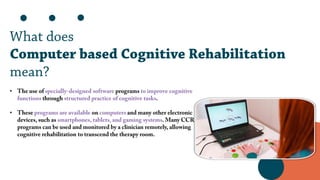
Computer Based Cognitive Rehabilitation;
Hopes & Challenges
•
•
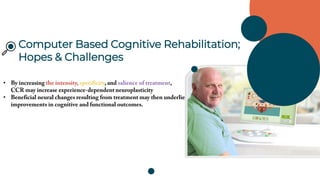
Computer Based Cognitive Rehabilitation;
Hopes & Challenges
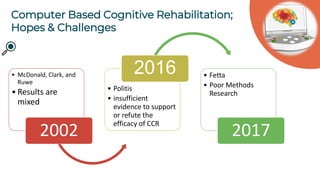
• McDonald, Clark, and
Ruwe
• Results are
mixed
2002
• Politis
• insufficient
evidence to support
or refute the
efficacy of CCR
2016 • Fetta
• Poor Methods
Research
2017
Which factors are weak in researches?
What Should we do?
Optimal format
dosage, timing, and duration of computer-based intervention
prospective, longitudinal, repeated-measures study, with an
adequate number of participants
Rehacom,
Cognitive Training Software
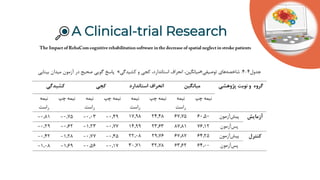
A Clinical-trial Research
Research Method Experimental (Pre-test, Post-test with Control Group)
Population
Patients with stroke referred to the Stroke Rehabilitation Center in Tehran Timeframe:
Bahman 1401 to Mordad 1402
Sampling Method Purposeful sampling
Sample Size
32 individuals Research Groups: Experimental group (16 individuals), Control group (16
individuals)
Assessment Tool RehaCom software's Visual Field Assessment Module
Intervention Program
10 sessions lasting 30 to 45 minutes over 5 weeks Each session included four exercises
from the attention and visual-spatial modules, each lasting 8 to 10 minutes
Alertness (ALTA), Restoration Training (RESE), Saccadic Training (SAKA), and Exploration
Training (EXPL)
A Clinical-trial Research
My Experience Through Research
and Clinical Work
• Rehabilitation is a multi-disciplinary work
• Rehabilitation needs a wide range of knowledge; from current
terminologies in Medicine to some issues in neurology
• Knowledge in Pharmacology
• Knowledge in the interpretation of CT scans, MRI, and EEG(for Stroke
and TBI patients)
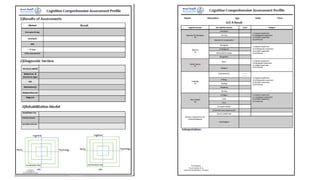
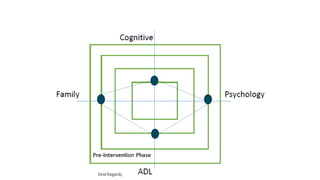
• Make a comprehensive profile for your client
• Observation and clinical work
• There is always a new thing; Don`t worry
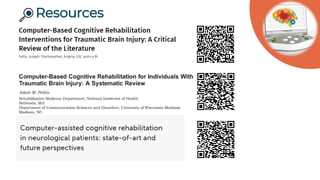
Resources
Resources
Computer based Cognitive Rehabilitation; From introduction to practice

Computer based Cognitive Rehabilitation; From introduction to practice

  • 1.
    Computer based Cognitive Rehabilitation Withfocus on an Clinical Study by Stroke Patients March 2024 Pouria Saadat PhD student of Cognitive Psychology
  • 2.
    • PhD Studentof Cognitive Psychology (ICBS) • M.Sc. Cognitive Rehabilitation (ICSS) • B.Sc. of Psychology (YAZD University) • Cognitive Rehabilitation Therapist ( Tabassom Stroke Patients Rehabilitation Center, Tehran) pouriasaadat76@gmail.com p_saadat@sbu.ac.ir https://www.linkedin.com/in/pouria-saadat-79b9b6167/
  • 3.
    What is CognitiveRehabilitation? Cognitive rehabilitation therapy has been defined as a systematic and functionally oriented therapeutic cognitive activity directed to achieve functional changes. 1-Reestablishing or strengthening previously learned patterns of behavior 2-Establishing new patterns of cognitive activity or compensatory mechanisms for impaired neurological systems. T. Novakovic-Agopians, G.M. Abrams, Cognitive Rehabilitation Therapy, Editor(s): Michael J. Aminoff, Robert B. Daroff, Encyclopedia of the Neurological Sciences (Second Edition), Academic Press, 2014.
  • 4.
  • 5.
  • 6.
  • 7.
  • 8.
    Computer Based CognitiveRehabilitation; Hopes & Challenges • •
  • 9.
    Computer Based CognitiveRehabilitation; Hopes & Challenges • McDonald, Clark, and Ruwe • Results are mixed 2002 • Politis • insufficient evidence to support or refute the efficacy of CCR 2016 • Fetta • Poor Methods Research 2017
  • 10.
    Which factors areweak in researches? What Should we do? Optimal format dosage, timing, and duration of computer-based intervention prospective, longitudinal, repeated-measures study, with an adequate number of participants
  • 14.
  • 15.
  • 16.
    A Clinical-trial Research ResearchMethod Experimental (Pre-test, Post-test with Control Group) Population Patients with stroke referred to the Stroke Rehabilitation Center in Tehran Timeframe: Bahman 1401 to Mordad 1402 Sampling Method Purposeful sampling Sample Size 32 individuals Research Groups: Experimental group (16 individuals), Control group (16 individuals) Assessment Tool RehaCom software's Visual Field Assessment Module Intervention Program 10 sessions lasting 30 to 45 minutes over 5 weeks Each session included four exercises from the attention and visual-spatial modules, each lasting 8 to 10 minutes Alertness (ALTA), Restoration Training (RESE), Saccadic Training (SAKA), and Exploration Training (EXPL)
  • 17.
  • 18.
    My Experience ThroughResearch and Clinical Work • Rehabilitation is a multi-disciplinary work • Rehabilitation needs a wide range of knowledge; from current terminologies in Medicine to some issues in neurology • Knowledge in Pharmacology • Knowledge in the interpretation of CT scans, MRI, and EEG(for Stroke and TBI patients) • Make a comprehensive profile for your client • Observation and clinical work • There is always a new thing; Don`t worry
  • 21.
  • 22.