Computationa
l Thinking
MAYA P GURAV
What is computational thinking?
It’s the process of breaking down a
problem into simple enough steps that a
a computer would understand.
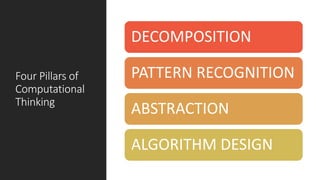
Four Pillars of
Computational
Thinking
DECOMPOSITION
PATTERN RECOGNITION
ABSTRACTION
ALGORITHM DESIGN
Decomposition
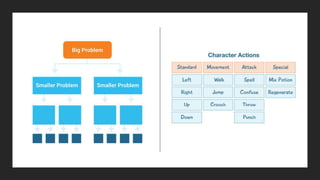
The power of Computational Thinking starts with decomposition, which is the
process of breaking down complex problems into smaller, more manageable
parts.
With decomposition, problems that seem overwhelming at first become much
much more manageable.
“If you can’t solve a problem, then there is an easier problem you can solve: find it.” George
Pólya
Take Problems
Apart
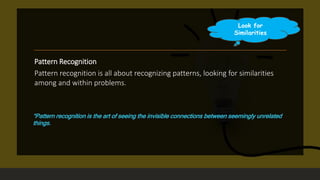
Pattern Recognition
Pattern recognition is all about recognizing patterns, looking for similarities
among and within problems.
“Pattern recognition is the art of seeing the invisible connections between seemingly unrelated
things.
Look for
Similarities
Abstraction
Abstraction in computational thinking is the art of simplification, where
complex problems are distilled into essential components, enabling efficient
problem-solving and the creation of powerful solutions.
“But it is a pipe." "No, it's not," I said. It's a drawing of a pipe. Get it? All representations of a thing
are inherently abstract. It's very clever.”
Focus on what’s
important
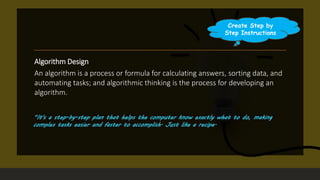
Algorithm Design
An algorithm is a process or formula for calculating answers, sorting data, and
automating tasks; and algorithmic thinking is the process for developing an
algorithm.
“It's a step-by-step plan that helps the computer know exactly what to do, making
complex tasks easier and faster to accomplish. Just like a recipe.
Create Step by
Step Instructions
• Sequence
• Selection
• Iteration
Basic Building
Blocks
Algorithm Design
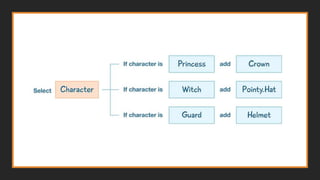
SELECTION
•IF represents the question
•ELSE points to what to do if the answer to the
question is false
Example :
•Ask how old you are
•IF you are 70 or older, say “You are Senior
Citizen”
•ELSE say “You are not a Senior Citizen!”
ITERATION
Why is iteration important?
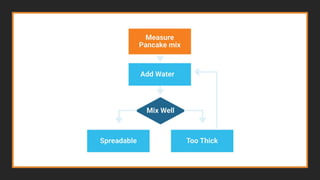
Iteration allows us to simplify our algorithm by stating
that we will repeat certain steps until told otherwise.
For example, a very simple algorithm for eating
breakfast cereal might consist of these steps:
put cereal in bowl
add milk to cereal
spoon cereal and milk into mouth
repeat step 3 until all cereal and milk is eaten
rinse bowl and spoon
Bibliography
https://www.bbc.co.uk/bitesize/guides/zp92mp3/revision/1
https://equip.learning.com/decomposition-computational-
thinking/
https://www.geeksforgeeks.org/fundamentals-of-algorithms/

Computational Thinking - Middle School

  • 1.
  • 2.
    What is computationalthinking? It’s the process of breaking down a problem into simple enough steps that a a computer would understand.
  • 3.
    Four Pillars of Computational Thinking DECOMPOSITION PATTERNRECOGNITION ABSTRACTION ALGORITHM DESIGN
  • 5.
    Decomposition The power ofComputational Thinking starts with decomposition, which is the process of breaking down complex problems into smaller, more manageable parts. With decomposition, problems that seem overwhelming at first become much much more manageable. “If you can’t solve a problem, then there is an easier problem you can solve: find it.” George Pólya Take Problems Apart
  • 8.
    Pattern Recognition Pattern recognitionis all about recognizing patterns, looking for similarities among and within problems. “Pattern recognition is the art of seeing the invisible connections between seemingly unrelated things. Look for Similarities
  • 11.
    Abstraction Abstraction in computationalthinking is the art of simplification, where complex problems are distilled into essential components, enabling efficient problem-solving and the creation of powerful solutions. “But it is a pipe." "No, it's not," I said. It's a drawing of a pipe. Get it? All representations of a thing are inherently abstract. It's very clever.” Focus on what’s important
  • 14.
    Algorithm Design An algorithmis a process or formula for calculating answers, sorting data, and automating tasks; and algorithmic thinking is the process for developing an algorithm. “It's a step-by-step plan that helps the computer know exactly what to do, making complex tasks easier and faster to accomplish. Just like a recipe. Create Step by Step Instructions
  • 17.
    • Sequence • Selection •Iteration Basic Building Blocks Algorithm Design
  • 18.
    SELECTION •IF represents thequestion •ELSE points to what to do if the answer to the question is false Example : •Ask how old you are •IF you are 70 or older, say “You are Senior Citizen” •ELSE say “You are not a Senior Citizen!”
  • 19.
    ITERATION Why is iterationimportant? Iteration allows us to simplify our algorithm by stating that we will repeat certain steps until told otherwise. For example, a very simple algorithm for eating breakfast cereal might consist of these steps: put cereal in bowl add milk to cereal spoon cereal and milk into mouth repeat step 3 until all cereal and milk is eaten rinse bowl and spoon
  • 24.

Editor's Notes

  • #7 English Language Arts Students analyze themes in a text by first answering: Who is the protagonist and antagonist? Where is the setting? What is the conflict? What is the resolution? Mathematics Students find the area of different shapes by decomposing them into triangles. Science Students research the different organs in order to understand how the human body digests food. Social Studies Students explore a different culture by studying the traditions, history, and norms that comprise it. Languages Students learn about sentence structure in a foreign language by breaking it down into different parts like subject, verb, and object.
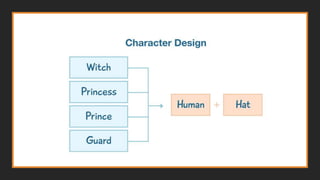
  • #10 English Language Arts Students begin to define sonnets based on similarities in separate examples. Mathematics Students recognize the specific formulas used to calculate slopes and intercepts. Science Students classify animals based on their characteristics and articulate common characteristics for the groupings.
  • #13 English Language Arts Students summarize a novel into a book review. Mathematics Students conduct a survey of peers and analyze the data to note the key findings, create visualizations, and present the results. Science Students develop laws and theorems by looking at similar formulas and equations
  • #16 English Language Arts Students map a flow chart that details directions for determining whether to use a colon or dash in a sentence. Mathematics In a word problem, students develop a step-by-step process for how they answered the question that can then be applied to similar problems. Science Students articulate how to classify elements in the periodic table.
  • #24 Computational thinking is more than just problem solving. As a foundation for coding, computational thinking encourages us to reflect clearly on a problem we’re solving and intentionally program solutions for it. As a foundation for technology integration, computational thinking encourages us to consider how we can leverage technology to aid us in solving these problems – to automate certain tasks. As a foundation for problem solving, computational thinking encourages us to be diligent and organized in our work, to plan from the outset how we want to solve a problem but to embrace the fluidity of the process as we come to more and more understanding of the data and information we’re navigating. As a foundation for thought, computational thinking encourages us to push the bounds of our creativity, to imagine impossible solutions and strive to make these possible, and to think according to potential and not limits.