COMPUTATIONAL BIOLOGISTS –
THE NEXT PHARMA SCIENTISTS ?
Presented by :
DEBARATI ROY
Roll No-20101912020
Reg No-122010210020
BCDA College of Pharmacy & Technology,
Kolkata--700127
Under Guideence of:
SURAJIT GOON,ASSISTANT PROFESSOR
BCDA COLLEGE OF PHARMACY &
TECHNOLOGY,
KOLKATA-700127
What is Computational Biology ?
Prior to the advent of Computational Biology
Impact of Computational Biology
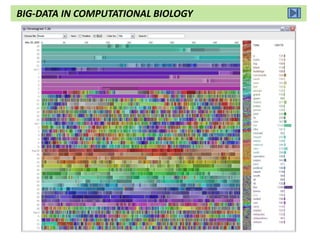
Big-Data in Computational Biology
The Sub-fields of Computational Biology :
1. Computational Bio-Modeling
2. Computational Genomics
3. Computational Neurosciences
4. Computational Evolutionary biology
5. Cancer computational biology
Future scope and impact
KEY FEATURES OF THE SEMINAR
 Computational Biology is also known
as bioinformatics it began to develop in
the early 1970s
 In this field biological data is used to
develop algorithms and relations among
various biological systems
 The various subfields include
computational bio-modeling,
computational genomics, computational
neuroscience, computational
pharmacology, computational
evolutionary biology and cancer
computational biology
WHAT IS COMPUTATIONAL BIOLOGY ?
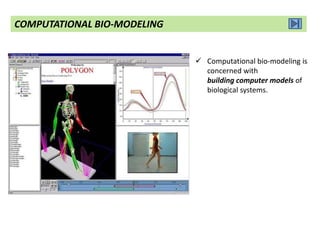
 Computational bio-modeling is
concerned with
building computer models of
biological systems.
COMPUTATIONAL BIO-MODELING
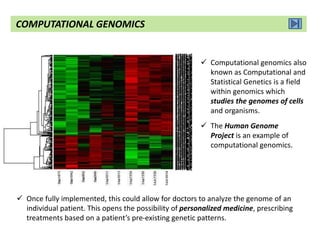
 Computational genomics also
known as Computational and
Statistical Genetics is a field
within genomics which
studies the genomes of cells
and organisms.
 The Human Genome
Project is an example of
computational genomics.
 Once fully implemented, this could allow for doctors to analyze the genome of an
individual patient. This opens the possibility of personalized medicine, prescribing
treatments based on a patient’s pre-existing genetic patterns.
COMPUTATIONAL GENOMICS
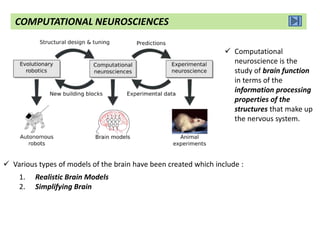
 Various types of models of the brain have been created which include :
1. Realistic Brain Models
2. Simplifying Brain
 Computational
neuroscience is the
study of brain function
in terms of the
information processing
properties of the
structures that make up
the nervous system.
COMPUTATIONAL NEUROSCIENCES
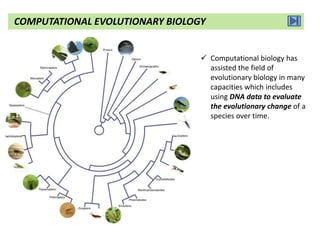
 Computational biology has
assisted the field of
evolutionary biology in many
capacities which includes
using DNA data to evaluate
the evolutionary change of a
species over time.
COMPUTATIONAL EVOLUTIONARY BIOLOGY
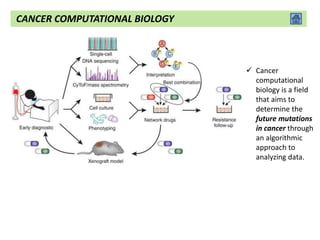
 Cancer
computational
biology is a field
that aims to
determine the
future mutations
in cancer through
an algorithmic
approach to
analyzing data.
CANCER COMPUTATIONAL BIOLOGY
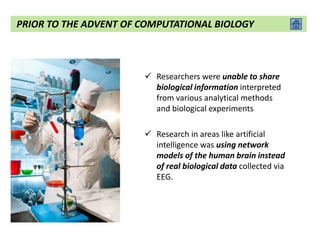
 Researchers were unable to share
biological information interpreted
from various analytical methods
and biological experiments
 Research in areas like artificial
intelligence was using network
models of the human brain instead
of real biological data collected via
EEG.
PRIOR TO THE ADVENT OF COMPUTATIONAL BIOLOGY
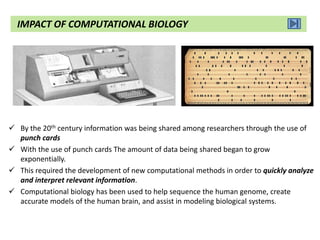
 By the 20th century information was being shared among researchers through the use of
punch cards
 With the use of punch cards The amount of data being shared began to grow
exponentially.
 This required the development of new computational methods in order to quickly analyze
and interpret relevant information.
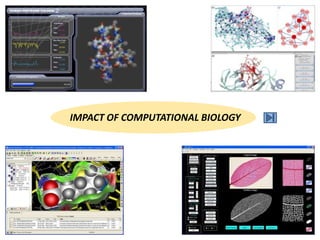
 Computational biology has been used to help sequence the human genome, create
accurate models of the human brain, and assist in modeling biological systems.
IMPACT OF COMPUTATIONAL BIOLOGY
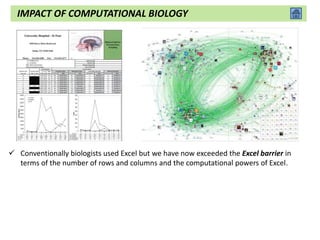
 Conventionally biologists used Excel but we have now exceeded the Excel barrier in
terms of the number of rows and columns and the computational powers of Excel.
IMPACT OF COMPUTATIONAL BIOLOGY
BIG-DATA IN COMPUTATIONAL BIOLOGY
 Computational biology was not in the spotlight earlier as pharmaceutical
companies were not facing the kinds of problems that are best-suited to
computational biologists which include finding useful signals in
tremendously large sets of unsorted and noisy data.
 As the pharmaceutical industry's best selling drugs fall off the markets
there are a few drugs in the pipeline to replace them and hence there are
signs that big-pharma could turn more of its attention to biologically
derived medicines.
 If that happens, computational biologists will likely play a leading role in
the discovery of new drugs.
 In the United States of America, The Big Data Research and Development
Initiative pledges $200 million for NIH, the National Science Foundation to
support data collection, analysis, and dispersion of biological data.
FUTURE SCOPE AND IMPACT
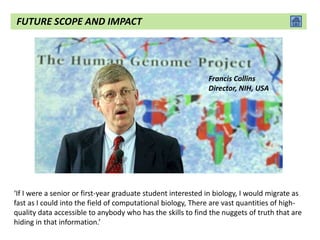
Francis Collins
Director, NIH, USA
‘If I were a senior or first-year graduate student interested in biology, I would migrate as
fast as I could into the field of computational biology, There are vast quantities of high-
quality data accessible to anybody who has the skills to find the nuggets of truth that are
hiding in that information.’
FUTURE SCOPE AND IMPACT
REFERENCES
• International Society for Computational Biology-website
• Introduction of computational Biology-an evalutional approach by
Bernhard Haubold,Thomas wiehe
• Models and algorithms for Genome evaluation by Chauve,cedric,EI
Mabrouk,Nadia,Tannier,Eric
• Computational Biology by Dress,A.,Linial,M.,Troyanskaya,o.,Vingron,M.
Computational Biologist-The Next Pharma Scientist?

Computational Biologist-The Next Pharma Scientist?

  • 1.
    COMPUTATIONAL BIOLOGISTS – THENEXT PHARMA SCIENTISTS ? Presented by : DEBARATI ROY Roll No-20101912020 Reg No-122010210020 BCDA College of Pharmacy & Technology, Kolkata--700127 Under Guideence of: SURAJIT GOON,ASSISTANT PROFESSOR BCDA COLLEGE OF PHARMACY & TECHNOLOGY, KOLKATA-700127
  • 2.
    What is ComputationalBiology ? Prior to the advent of Computational Biology Impact of Computational Biology Big-Data in Computational Biology The Sub-fields of Computational Biology : 1. Computational Bio-Modeling 2. Computational Genomics 3. Computational Neurosciences 4. Computational Evolutionary biology 5. Cancer computational biology Future scope and impact KEY FEATURES OF THE SEMINAR
  • 3.
     Computational Biologyis also known as bioinformatics it began to develop in the early 1970s  In this field biological data is used to develop algorithms and relations among various biological systems  The various subfields include computational bio-modeling, computational genomics, computational neuroscience, computational pharmacology, computational evolutionary biology and cancer computational biology WHAT IS COMPUTATIONAL BIOLOGY ?
  • 4.
     Computational bio-modelingis concerned with building computer models of biological systems. COMPUTATIONAL BIO-MODELING
  • 5.
     Computational genomicsalso known as Computational and Statistical Genetics is a field within genomics which studies the genomes of cells and organisms.  The Human Genome Project is an example of computational genomics.  Once fully implemented, this could allow for doctors to analyze the genome of an individual patient. This opens the possibility of personalized medicine, prescribing treatments based on a patient’s pre-existing genetic patterns. COMPUTATIONAL GENOMICS
  • 6.
     Various typesof models of the brain have been created which include : 1. Realistic Brain Models 2. Simplifying Brain  Computational neuroscience is the study of brain function in terms of the information processing properties of the structures that make up the nervous system. COMPUTATIONAL NEUROSCIENCES
  • 7.
     Computational biologyhas assisted the field of evolutionary biology in many capacities which includes using DNA data to evaluate the evolutionary change of a species over time. COMPUTATIONAL EVOLUTIONARY BIOLOGY
  • 8.
     Cancer computational biology isa field that aims to determine the future mutations in cancer through an algorithmic approach to analyzing data. CANCER COMPUTATIONAL BIOLOGY
  • 9.
     Researchers wereunable to share biological information interpreted from various analytical methods and biological experiments  Research in areas like artificial intelligence was using network models of the human brain instead of real biological data collected via EEG. PRIOR TO THE ADVENT OF COMPUTATIONAL BIOLOGY
  • 10.
     By the20th century information was being shared among researchers through the use of punch cards  With the use of punch cards The amount of data being shared began to grow exponentially.  This required the development of new computational methods in order to quickly analyze and interpret relevant information.  Computational biology has been used to help sequence the human genome, create accurate models of the human brain, and assist in modeling biological systems. IMPACT OF COMPUTATIONAL BIOLOGY
  • 11.
  • 12.
     Conventionally biologistsused Excel but we have now exceeded the Excel barrier in terms of the number of rows and columns and the computational powers of Excel. IMPACT OF COMPUTATIONAL BIOLOGY
  • 13.
  • 14.
     Computational biologywas not in the spotlight earlier as pharmaceutical companies were not facing the kinds of problems that are best-suited to computational biologists which include finding useful signals in tremendously large sets of unsorted and noisy data.  As the pharmaceutical industry's best selling drugs fall off the markets there are a few drugs in the pipeline to replace them and hence there are signs that big-pharma could turn more of its attention to biologically derived medicines.  If that happens, computational biologists will likely play a leading role in the discovery of new drugs.  In the United States of America, The Big Data Research and Development Initiative pledges $200 million for NIH, the National Science Foundation to support data collection, analysis, and dispersion of biological data. FUTURE SCOPE AND IMPACT
  • 15.
    Francis Collins Director, NIH,USA ‘If I were a senior or first-year graduate student interested in biology, I would migrate as fast as I could into the field of computational biology, There are vast quantities of high- quality data accessible to anybody who has the skills to find the nuggets of truth that are hiding in that information.’ FUTURE SCOPE AND IMPACT
  • 16.
    REFERENCES • International Societyfor Computational Biology-website • Introduction of computational Biology-an evalutional approach by Bernhard Haubold,Thomas wiehe • Models and algorithms for Genome evaluation by Chauve,cedric,EI Mabrouk,Nadia,Tannier,Eric • Computational Biology by Dress,A.,Linial,M.,Troyanskaya,o.,Vingron,M.

Editor's Notes

  • #4 Talk about the relation between computational biology and bio-informatics and the sub-fields
  • #5 The picture shows the model of human locomotion using different bones, tendons, joints and ligaments
  • #6 The picture shows the genome data for several thousand people processed using advanced software
  • #7 The picture describes how real data from animal experiments and realistic brain models help in developing next generation robots
  • #8 The picture shows the evolutionary chains between different creatures in the ecosystems
  • #9 The picture describes the role of computational biology in cancer treatment
  • #11 The left picture is a punch card machine of IBM, the right picture is a punch card itself
  • #12 This use of biological data to develop other fields pushed researchers to use computers to evaluate and compare large data sets.
  • #13 The left picture shows data on excel and the right picture shows huge volume of data on advanced softwares
  • #14 Human genome sequences
  • #17 Thank You