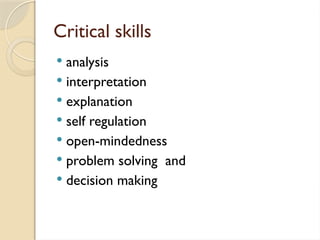
Critical skills
analysis
interpretation
explanation
self regulation
open-mindedness
problem solving and
decision making
7.
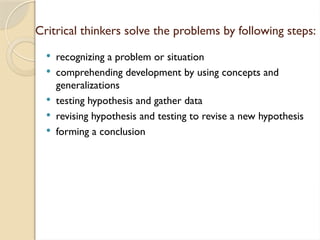
Critrical thinkers solvethe problems by following steps:
recognizing a problem or situation
comprehending development by using concepts and
generalizations
testing hypothesis and gather data
revising hypothesis and testing to revise a new hypothesis
forming a conclusion
8.
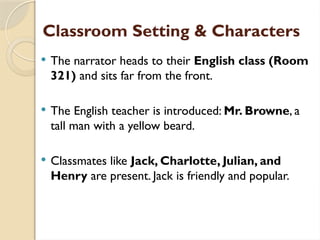
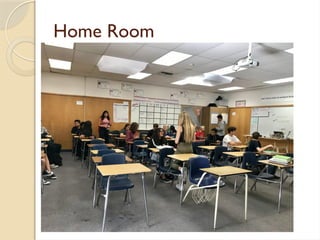
Classroom Setting &Characters
The narrator heads to their English class (Room
321) and sits far from the front.
The English teacher is introduced: Mr. Browne, a
tall man with a yellow beard.
Classmates like Jack, Charlotte, Julian, and
Henry are present. Jack is friendly and popular.
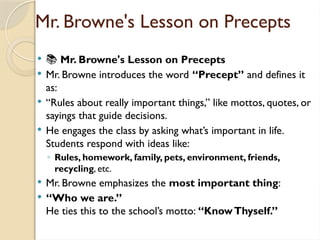
Mr. Browne's Lessonon Precepts
📚 Mr. Browne's Lesson on Precepts
Mr. Browne introduces the word “Precept” and defines it
as:
“Rules about really important things,” like mottos, quotes, or
sayings that guide decisions.
He engages the class by asking what’s important in life.
Students respond with ideas like:
◦ Rules, homework, family, pets, environment, friends,
recycling, etc.
Mr. Browne emphasizes the most important thing:
“Who we are.”
He ties this to the school’s motto: “KnowThyself.”
13.
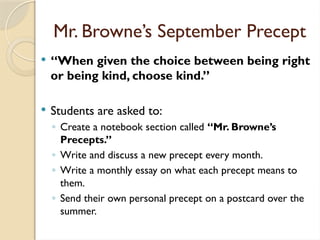
Mr. Browne’s SeptemberPrecept
“When given the choice between being right
or being kind, choose kind.”
Students are asked to:
◦ Create a notebook section called “Mr. Browne’s
Precepts.”
◦ Write and discuss a new precept every month.
◦ Write a monthly essay on what each precept means to
them.
◦ Send their own personal precept on a postcard over the
summer.
15.
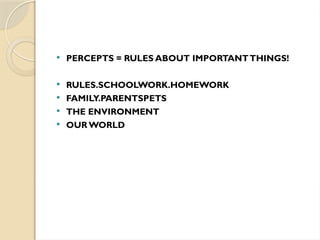
PERCEPTS =RULES ABOUT IMPORTANTTHINGS!
RULES.SCHOOLWORK.HOMEWORK
FAMILY.PARENTSPETS
THE ENVIRONMENT
OUR WORLD
16.
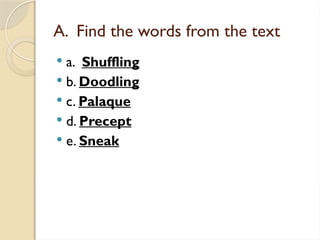
A. Find thewords from the text
a. Shuffling
b. Doodling
c. Palaque
d. Precept
e. Sneak
17.
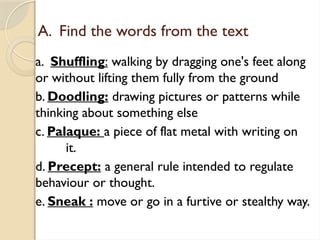
A. Find thewords from the text
a. Shuffling: walking by dragging one's feet along
or without lifting them fully from the ground
b. Doodling: drawing pictures or patterns while
thinking about something else
c. Palaque: a piece of flat metal with writing on
it.
d. Precept: a general rule intended to regulate
behaviour or thought.
e. Sneak : move or go in a furtive or stealthy way.
18.
B. Consult yourteacher and define the following thinking skills.
a. convergent thinking
b. divergent thinking
c. critical thinking
d. creative thinking
19.
a. convergent thinking
Convergentthinking is a type of thinking that focuses on coming up
with the single, well-established answer to problem. It emphasizes
speed, accuracy, and logic and focuses on recognizing the familiar
reapplying techniques and accumulating stored information.
b. divergent thinking
Divergent thinking is a thought process or method used to generate
creative ideas by exploring many possible solutions. It typically occurs in a
spontaneous, free flowing "non-linear manner such that many ideas are
generated in emergent cognitive fashion: Many possible solutions are
explored in a short amount of time, and particular set of logical steps to
arrive one solution, which is some cases is a correct solution.Activities,
meditation, brainstorming, subject mapping, bubble mapping art work,
free writing etc. can be some methods that useful in this context.
20.
c. criticalthinking
Critical thinking is the intellectually disciplined process of activity and
skillfully conceptualizing, applying, analyzing, synthesizing and/or
evaluating information gathered from or generated by observation,
experience, reflection, reasoning or communication, as a guide to
belief and action. In its exemplary form, it is based on universal
intellectual values that transcend subject matter division; clarity,
accuracy, precision, consistency, relevance, sound evidence, good
reasons, depth, breadth and fairness.
d. creative thinking
Creativity is the ability to generate a thought or an idea that is
completely new, appealing and useful. Creative thinking is a skill that
enables you to come up with original and unconventional ideas.
Creative thinking expresses itself in a multitude of ways.A graphic
artist creates a brilliant logo.
Creativity is the ability to generate thought or an idea that is
completely new appealing and useful. Creative thinking is a skill that
enables you to come up with original and unconventional ideas.
21.
a. Whowas Jack? How did he make children
laugh?
b.Why are "Sharks" important to Reid?
c.What does Mr. Browne think about the most
important thing?
d. What is that has not been noticed by the
student?
e. How did Jack make fun of the English class?
f. What were the students going to do at the end
of the month?
g.What particular act of students surprised a girl
student?
22.
Answer thefollowing questions.
a. Who was Jack? How did he make children
laugh?
Ans. Jack was one of the students of the classroom,
who was joking around with some kids who weren't in
our homeroom. He was the kind of kid other kids like.
b.Why are "Sharks" important to Reid?
Ans. Sharks are important to Reid because they eat
dead things in the ocean.
c.What does Mr. Browne think about the most
important thing?
Ans. Mr. Browne thinks that the most important thing
is to know who we are.
23.
d. Whatis that has not been noticed by the
student?
Ans.The plaque next to the door of this school hasn't been
noticed by the student.
e. How did Jack make fun of the English class?
Ans. Jack started telling about all the fun stuff they are going
to be doing this year.
f. What were the students going to do at the end of
the month?
Ans.They were going to have new perception of graduation
from this school.
g.What particular act of students surprised a girl
student?
Ans. Personal percept to write on a postcard and mail it to
the girl from wherever they go on their summer vacation
was the particular act of students that surprised the girl
student.Absurd behaviour of the boy's gesture toward the
girls and his body language gives her trouble.
24.
a. Haveyou made your own precept after you read this
lesson? What is it? Share it with your friends.
Ans. Precept is a guiding principle or rule that is used to
control, influence or regulate conduct.After I read this
lesson, I have made my precept.The precept on my part
is:
When given choice between right or being kind, I
choose kindess.
Exmaple:That I am correct but I don't make a big deal
about that since I know
that some other might not be correct.
25.
b.According toJosh Lanyon, "If there was one life skill everyone on the planet needed,
it was the ability to think with critical objectivity." Justify this statement with your
logic.
Ans.When you live with a potentially life-threatening condition, you might have the
thought of dying.You accept it, you push on. But the thing that scars you is the picture
of dying slowly and painfully, the loss of independence and identity.
To make life easy and successful, everyone needs to think critically.Analyze everything
and avoid the negation.Think about the betterment of others and progress to get
achieving in life. Do effort to meet your goal. Critical thinking is the ability to think
reasonably. Reason is the process.The entire point of critical thinking is to pursue
absolute truth. Reason is the methodology, applying information gathered from or
generate dea by observation, experience, reflection, reasoning etc. are the objectives
į
of critical thinking.Absolute truth is always beyond our reach though we have to
perceive and accept it. Objective truth is always within reach. So, in critical thinking a
person is reason tries to establish objective truth.
We shouldn't feel angry or annoyed when mean, crazy or stupid people violate our
own right path.
Writing
26.
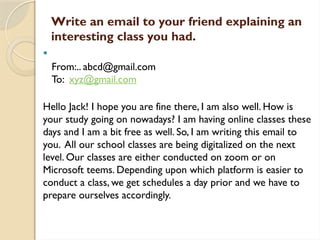
From:.. abcd@gmail.com
To: xyz@gmail.com
HelloJack! I hope you are fine there, I am also well. How is
your study going on nowadays? I am having online classes these
days and I am a bit free as well. So, I am writing this email to
you. All our school classes are being digitalized on the next
level. Our classes are either conducted on zoom or on
Microsoft teems. Depending upon which platform is easier to
conduct a class, we get schedules a day prior and we have to
prepare ourselves accordingly.
Write an email to your friend explaining an
interesting class you had.
27.
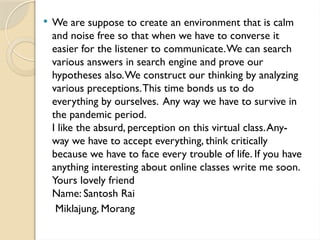
We aresuppose to create an environment that is calm
and noise free so that when we have to converse it
easier for the listener to communicate.We can search
various answers in search engine and prove our
hypotheses also.We construct our thinking by analyzing
various preceptions.This time bonds us to do
everything by ourselves. Any way we have to survive in
the pandemic period.
I like the absurd, perception on this virtual class.Any-
way we have to accept everything, think critically
because we have to face every trouble of life. If you have
anything interesting about online classes write me soon.
Yours lovely friend
Name: Santosh Rai
Miklajung, Morang
28.
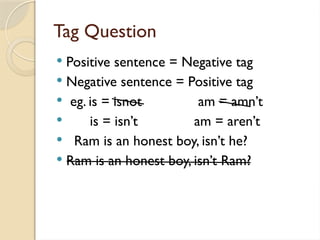
Tag Question
Positivesentence = Negative tag
Negative sentence = Positive tag
eg. is = isnot am = amn’t
is = isn’t am = aren’t
Ram is an honest boy, isn’t he?
Ram is an honest boy, isn’t Ram?
29.
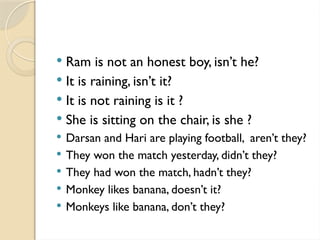
Ram isnot an honest boy, isn’t he?
It is raining, isn’t it?
It is not raining is it ?
She is sitting on the chair, is she ?
Darsan and Hari are playing football, aren’t they?
They won the match yesterday, didn’t they?
They had won the match, hadn’t they?
Monkey likes banana, doesn’t it?
Monkeys like banana, don’t they?
30.
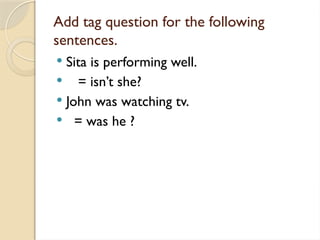
Add tag questionfor the following
sentences.
Sita is performing well.
= isn’t she?
John was watching tv.
= was he ?
31.
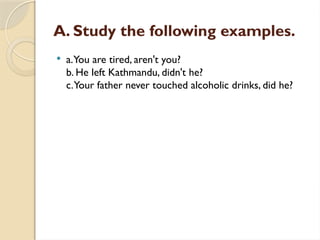
A. Study thefollowing examples.
a.You are tired, aren't you?
b. He left Kathmandu, didn't he?
c.Your father never touched alcoholic drinks, did he?
32.
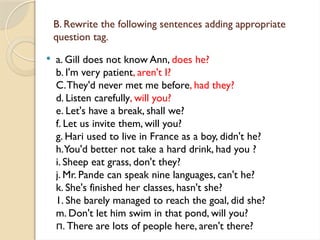
B. Rewrite thefollowing sentences adding appropriate
question tag.
a. Gill does not know Ann, does he?
b. I'm very patient, aren't I?
C.They'd never met me before, had they?
d. Listen carefully, will you?
e. Let's have a break, shall we?
f. Let us invite them, will you?
g. Hari used to live in France as a boy, didn't he?
h.You'd better not take a hard drink, had you ?
i. Sheep eat grass, don't they?
j. Mr. Pande can speak nine languages, can't he?
k. She's finished her classes, hasn't she?
1. She barely managed to reach the goal, did she?
m. Don't let him swim in that pond, will you?
. There are lots of people here, aren't there?
п