2-2-2
Introduction
• Anger isan extremely powerful emotion, and an
inability to keep it under control can lead to
serious problems in relationships, career, and
health.
• Anger management will help you prevent or cope
with anger within yourself and/or in others.
3.
2-2-3
Importance
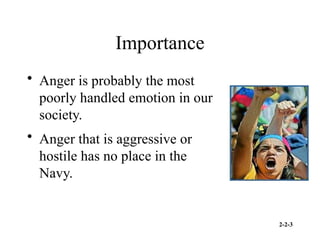
• Anger isprobably the most
poorly handled emotion in our
society.
• Anger that is aggressive or
hostile has no place in the
Navy.
4.
General Military Training-SuicideAwareness 2-2-4
Objective
Upon completion of this lesson, you will be
able to:
– define and explain many aspects of anger.
– explain how to manage anger effectively.
5.
2-2-5
Scenario
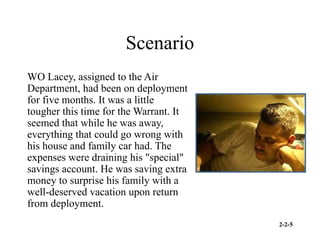
WO Lacey, assignedto the Air
Department, had been on deployment
for five months. It was a little
tougher this time for the Warrant. It
seemed that while he was away,
everything that could go wrong with
his house and family car had. The
expenses were draining his "special"
savings account. He was saving extra
money to surprise his family with a
well-deserved vacation upon return
from deployment.
6.
2-2-6
Scenario Continued
Today heis feeling overwhelmingly frustrated
because he is helpless to take care of the
problems his wife has to handle without him.
He is also feeling increasing disappointment
as he realizes his dream vacation is beginning
to disappear along with the extra money spent
on the house and car.
7.
2-2-7
Scenario Continued
Lacey isvery professional and keeps pressing
on, but seems to be battling exhaustion at the
end of most days. He does not feel like eating.
He just wants to sleep. His performance and
health are both declining. Everyone around
him knows every little annoyance in his life
by his outwardly expressed irritation. His
behavior has changed from pleasant to hostile
toward anyone who crosses his path.
8.
2-2-8
Scenario Continued
One ofhis Sailors is constantly finding ways to get
in trouble. He has stood before the Skipper at mast
on more than one occasion because of this Sailor.
The Leading Petty Officer approaches the WO with
the special Sailor in tow. The LPO informs the WO
the Sailor has been put on report for being
disrespectful to another Officer. In front of division
personnel, WO Lacey unleashed uncontrollable
anger towards the Sailor, screaming at him and
pinning him up against the bulkhead by his throat.
2-2-11
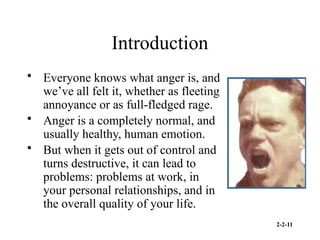
Introduction
• Everyone knowswhat anger is, and
we’ve all felt it, whether as fleeting
annoyance or as full-fledged rage.
• Anger is a completely normal, and
usually healthy, human emotion.
• But when it gets out of control and
turns destructive, it can lead to
problems: problems at work, in
your personal relationships, and in
the overall quality of your life.
12.
2-2-12
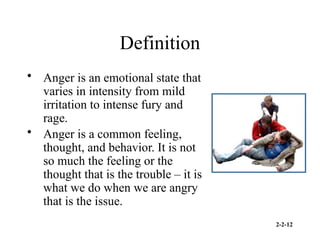
Definition
• Anger isan emotional state that
varies in intensity from mild
irritation to intense fury and
rage.
• Anger is a common feeling,
thought, and behavior. It is not
so much the feeling or the
thought that is the trouble – it is
what we do when we are angry
that is the issue.
13.
2-2-13
What Causes It?
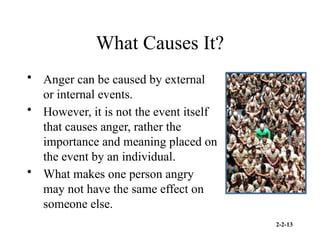
•Anger can be caused by external
or internal events.
• However, it is not the event itself
that causes anger, rather the
importance and meaning placed on
the event by an individual.
• What makes one person angry
may not have the same effect on
someone else.
14.
2-2-14
Problems Caused ByAnger
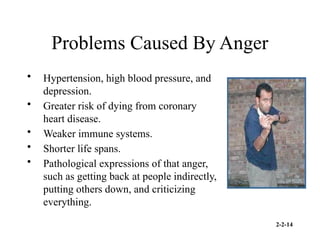
• Hypertension, high blood pressure, and
depression.
• Greater risk of dying from coronary
heart disease.
• Weaker immune systems.
• Shorter life spans.
• Pathological expressions of that anger,
such as getting back at people indirectly,
putting others down, and criticizing
everything.
15.
2-2-15
The emotional statethat varies from
mild irritation to intense fury is
known as _______.
Anger
Annoyance
Bliss
Desperation
2-2-21
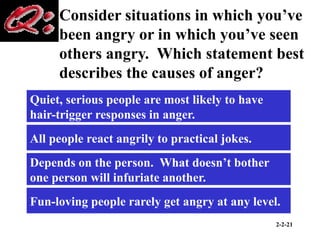
Consider situations inwhich you’ve
been angry or in which you’ve seen
others angry. Which statement best
describes the causes of anger?
Quiet, serious people are most likely to have
hair-trigger responses in anger.
All people react angrily to practical jokes.
Depends on the person. What doesn’t bother
one person will infuriate another.
Fun-loving people rarely get angry at any level.
2-2-25
Introduction
• The instinctive,natural way to express anger is to
respond aggressively.
• A certain amount of anger is necessary to our
survival.
• People use a variety of both conscious and
unconscious processes to deal with their angry
feelings.
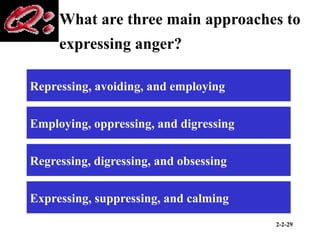
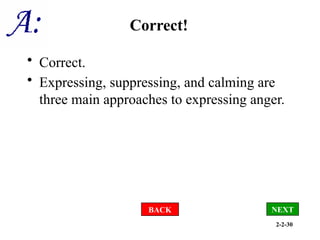
• The three main approaches are expressing,
suppressing, and calming.
26.
2-2-26
Expressing Anger
• Expressingyour angry feelings in an
assertive – not aggressive – manner is the
healthiest way to express anger.
• To do this, you have to learn how to make
clear what your needs are, and how to get
them met, without hurting others.
27.
2-2-27
Suppressing Anger
• Anotherapproach is to suppress anger and then
convert or redirect it. This happens when you
hold in your anger, stop thinking about it, and
focus on something positive instead.
• The aim is to inhibit or suppress your anger and
convert it into more constructive behavior.
• The danger in this type of response is that if it
isn’t allowed outward expression, your anger can
turn inward – on yourself.
28.
2-2-28
Calming Down YourAnger
• Finally, you can calm down inside.
• This means not just controlling your
outward behavior, but also controlling your
internal responses, taking steps to lower
your heart rate, calm yourself down, and let
the feelings subside.
29.
2-2-29
What are threemain approaches to
expressing anger?
Repressing, avoiding, and employing
Employing, oppressing, and digressing
Regressing, digressing, and obsessing
Expressing, suppressing, and calming
2-2-33
Introduction
• The goalof anger management
is to reduce both your emotional
feelings and the physiological
arousal that anger causes.
• You can’t get rid of, or avoid,
the things or people that enrage
you, nor can you change them,
but you can learn to control your
reactions.
34.
2-2-34
Are You TooAngry?
• There are psychological tests that measure the
intensity of angry feelings, how prone to anger
you are, and how well you handle it. But chances
are good that if you do have a problem with
anger, you already know it.
• If you find yourself acting in ways that seem out
of control and frightening, you might need help
finding better ways to deal with this emotion.
35.
2-2-35
Why Some PeopleAre More
Angry Than Others
• Genetic or physiological: There is evidence that some
children are born irritable, touchy, and easily angered, and
that these signs are present from a very early age.
• Sociocultural. Anger is often regarded as negative; we’re
taught that it’s all right to express anxiety, depression, or
other emotions but not to express anger. As a result, we
don’t learn how to handle it or channel it constructively.
• Family background plays a role. Typically, people who
are easily angered come from families that are disruptive,
chaotic, and not skilled at emotional communications.
36.
2-2-36
Relaxation
• Breathe deeply,from your diaphragm; breathing from your
chest won’t relax you. Picture your breath coming up from
your “gut.”
• Slowly repeat a calm word or phrase such as “relax,” “take
it easy.” Repeat it to yourself while breathing deeply.
• Use imagery; visualize a relaxing experience, from either
your memory or your imagination.
• Nonstrenuous, slow yoga-like exercises can relax your
muscles and make you feel much calmer.
37.
2-2-37
Cognitive Restructuring
• Cognitiverestructuring means changing the way
you think.
• Logic defeats anger, because anger, even when
it’s justified, can quickly become irrational. So
use cold hard logic on yourself.
• Angry people need to become aware of their
demanding nature and translate their expectations
into desires.
38.
2-2-38
Problem Solving
• Sometimes,our anger and frustration
are caused by very real and
inescapable problems in our lives.
• The best attitude to bring to such a
situation, then, is not to focus on
finding the solution, but rather on how
you handle and face the problem.
• Make a plan, and check and progress
along the way.
39.
2-2-39
Better Communication
• Thefirst thing to do if you’re in a heated
discussion is slow down and think through
your responses.
• Don’t say the first thing that comes into your
head, but slow down and think carefully
about what you want to say.
• At the same time, listen carefully to what the
other person is saying and take your time
before answering.
• Listen, also, for what is underlying the anger.
40.
2-2-40
Using Humor
• “Sillyhumor” can help defuse rage in a number
of ways.
• It can help you get a more balanced perspective.
• What these “humor” techniques have in common
is a refusal to take yourself too seriously.
• Anger is a serious emotion, but it’s often
accompanied by ideas that, if examined, can
make you laugh.
41.
2-2-41
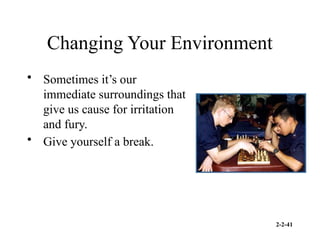
Changing Your Environment
•Sometimes it’s our
immediate surroundings that
give us cause for irritation
and fury.
• Give yourself a break.
42.
2-2-42
Counseling
• If youfeel that your anger is really out of control,
if it is having an impact on your relationships and
on important parts of your life, you might
consider counseling to learn how to handle it
better.
• When you talk to a prospective therapist, tell her
or him that you have problems with anger that
you want to work on, and ask about his or her
approach to anger management.
43.
2-2-43
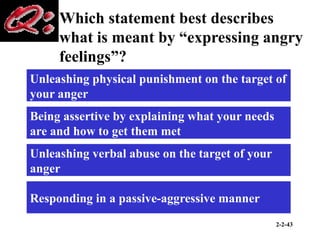
Which statement bestdescribes
what is meant by “expressing angry
feelings”?
Unleashing physical punishment on the target of
your anger
Being assertive by explaining what your needs
are and how to get them met
Unleashing verbal abuse on the target of your
anger
Responding in a passive-aggressive manner
44.
2-2-44
Correct!
• Correct.
• Beingassertive by explaining what your
needs and how to get them met describes
what is meant by “expressing angry
feelings.”
BACK NEXT
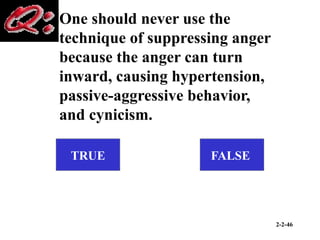
2-2-46
One should neveruse the
technique of suppressing anger
because the anger can turn
inward, causing hypertension,
passive-aggressive behavior,
and cynicism.
TRUE FALSE
47.
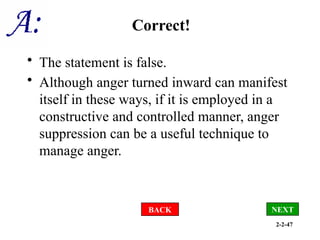
2-2-47
Correct!
• The statementis false.
• Although anger turned inward can manifest
itself in these ways, if it is employed in a
constructive and controlled manner, anger
suppression can be a useful technique to
manage anger.
BACK NEXT
48.
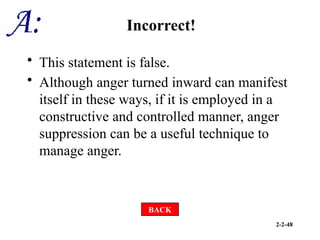
2-2-48
Incorrect!
• This statementis false.
• Although anger turned inward can manifest
itself in these ways, if it is employed in a
constructive and controlled manner, anger
suppression can be a useful technique to
manage anger.
BACK
49.
2-2-49
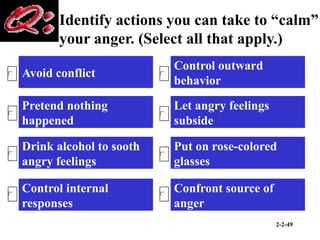
Identify actions youcan take to “calm”
your anger. (Select all that apply.)
Avoid conflict
Control internal
responses
Drink alcohol to sooth
angry feelings
Control outward
behavior
Put on rose-colored
glasses
Confront source of
anger
Pretend nothing
happened
Let angry feelings
subside
50.
2-2-50
Correct!
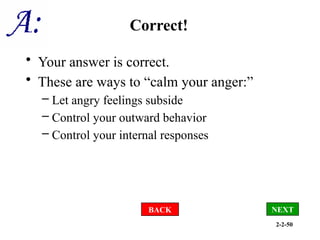
• Your answeris correct.
• These are ways to “calm your anger:”
– Let angry feelings subside
– Control your outward behavior
– Control your internal responses
BACK NEXT
51.
2-2-51
Incorrect!
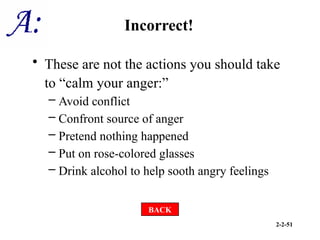
• These arenot the actions you should take
to “calm your anger:”
– Avoid conflict
– Confront source of anger
– Pretend nothing happened
– Put on rose-colored glasses
– Drink alcohol to help sooth angry feelings
BACK