Grazia Vavalle
Literate Environment Analysis
Walden University
Dr. Phyllis P. McCully
EDUC­6706R
August 18, 2013
Literate Environment
What is a literate environment?
A classroom that is a literate environment is one that consists of many
print rich displays and many opportunities to engage in language arts
through different content area themes. In order for a classroom to be literate,
it should include many varieties of texts that cater to the developmental and
personal needs of the students in the classroom.
“Together, students and their teacher create their classroom community,
and the type of community they create strongly influences the learning that
takes place” (Tompkins, 2010, p. 16).
Getting to Know Literacy Learners, P-3
It is very important for teachers to get to know their students’ interests
when it comes to reading.
If the teacher would have taken the time to get to know the students and
what books or topics they were interested in, then the students would not
be bored or distracted during reading.
Teachers can work with parents to help gain some insight about their
child’s reading interests.
Getting to Know Literacy Learners, P-3,
continued...
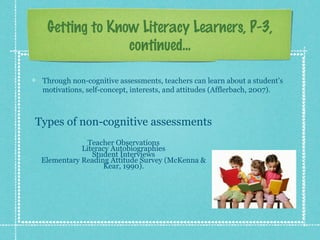
Through non-cognitive assessments, teachers can learn about a student’s
motivations, self-concept, interests, and attitudes (Afflerbach, 2007).
Types of non-cognitive assessments
Teacher Observations
Literacy Autobiographies
Student Interviews
Elementary Reading Attitude Survey (McKenna &
Kear, 1990).
Getting to Know Literacy Learners, P-3,
continued...
“Teachers use diagnostic reading assessments to identify students’ strengths
and weaknesses, examine any area of difficulty in more detail, and decide how
to modify instruction to meet students’ needs” (Tompkins, 2010, p. 86).
Types of cognitive assessments
Reading Inventories
Running Records
Checklists
Getting to Know Literacy Learners, P-3,
continued...
“No method or combination of methods an teach all children to read; rather,
it is the excellent teacher who knows his or her children from a social,
emotional, physical, and intellectual perspective who creates reading
success” (Morrow, 2011, p. 90).
Assessing students can offer a great deal of knowledge to the teacher.
Teachers can determine which level a student is reading on, whether he or
she lacks in a certain literacy skill, and how they feel about reading. This
information can help the teacher modify instruction for the student which
will ultimately lead to the student become a better reader.
Once teachers are able to determine what students are interested in, he or
she can then figure out what kind of texts the students will enjoy reading.
Selecting Texts
Early literacy learning leads to success in the later grades (Laureate
Education Inc., 2010).
When selecting texts for students, Dr. Hartman suggests using a Literacy
Matrix (Laureate Education Inc., 2010).
Linguistic
Narrative Informational
Semiotic
There are many things to take into
consideration when selecting texts for
students. The matrix on the left shows the
four types of texts. Linguistic is a text that
generally consists of a lot of words. Semiotic
texts are more picture oriented. Narrative
texts are story books. Informational texts
are non-fiction.
Selecting Texts, continued...
It is the teacher’s job to select and analyze texts that are developmentally
appropriate for the students in his or her classroom. Once the “just right”
text is chosen, the teacher can instruct the students on the specific factors
that may make a text too easy or too hard.
“When students understand how authors organize and present their ideas
in texts, this knowledge about text factors serves as a scaffold, making
comprehension easier” (Tompkins, 2010, p. 290).
Selecting Texts, continued...
The Pout-Pout Fish in the Big-Big Dark by Deborah Diesen (Narrative)
Fish by Steve Parker (Informational)
Fishy Tales by DK Readers (Online, semiotic, informational)
Interactive Perspective
Interactive lesson plans help student become strategic processors.
Strategic processing encourages teachers to use metacognition strategies
in their lessons.
“Metacognition strategies, such as monitoring, repairing, and evaluating,
regulate students’ thinking and their use of cognitive strategies”
(Tompkins, 2010 , p. 12).
Interactive Perspective, continued...
Teachers can use a variety
of teaching strategies to
incorporate into an
Interactive Perspective
focused lesson. They
include:
Hot Seat
KWL Chart
Grand Conversation
Learning Logs
The lesson I chose to reinforce the
Interactive Perspective focused on
learning short and long “a” vowel
sounds and words. I began with a
poem to bring out the students’
schema about the letter we were
focusing on. The students were
encourages to be interactive by
participating in completing a “T”
chart. The students were able to
recall from the book various
words that were either short or
long “a” vowel.
Critical and Response Perspectives
Choosing texts that students have some sort of personal connection to
will generally produce a greater response and interest while reading.
They can easily make judgements and evaluate the texts (Laureate
Education Inc., 2010a).
By responding to the texts, the students can make a text-to-self
connection by telling everyone how the text made them feel (Laureate
Education Inc., 2010b).
Critical and Response Perspectives,
continued...
Teachers can use a variety
of teaching strategies to
incorporate into an Critical
and Response Perspective
focused lesson. They
include:
Think aloud
Grand conversations
Questioning the Author
Reading Logs
The reading strategy that would best tie in the
critical and response perspective into the lesson
is a think-aloud. “Teachers think aloud or
explain what they’re thinking while they’re
reading so that students become more aware of
how capable readers think; in the process,
students also learn to think aloud about their
use of strategies” (Tompkins, 2010, p. 51).
While I was reading, I asked the students to
turn and talk to their partner about their
response to a particular question I posed during
the lesson. This strategy ultimately makes
students more active readers. It teaches
students “how to think metacognitively and to
regulate their own cognitive process”
(Tompkins, 2010, p. 474). Reading
comprehension depends upon the students’
ability to successfully use strategies to monitor
and control their own comprehension
(Migyanka, Policastro, & Lui, 2005, p. 171).
Feedback from Colleagues and Family Members
What insight did you gain about literacy and literacy instruction from
viewing this presentation?
How might the information presented change your literacy practices
and/or your literacy interaction with students?
In what ways can I support you in the literacy development of your
students or your children?
What questions do you have?
References
Afflerbach, P. (2007). Understanding and using reading assessment. Newark, DE: International Reading Association, Inc.
Diesen, D. (2010). The Pout­Pout Fish in the Big­Big Dark. Farrar, Straus and Giroux.
Laureate Education, Inc. (2010). Analyzing and Selecting Texts. The Beginning Reader, Pre K-3. Baltimore, MD: Author.
Laureate Education Inc. (2010a). Critical Perspective. The Beginning Reader, Pre K-3. Baltimore, MD: Author.
Laureate Education Inc. (2010b). Response Perspective. The Beginning Reader, Pre K-3. Baltimore, MD: Author.
Lock, D. (2009). Fishy Tales. Retrieved from http://www.wegivebooks.org/books/dk-readers-fishy-tales/reader
•
McKenna, M. C., & Kear, D. J. (1990). Measuring attitude toward reading: A new tool for teachers. Reading Teacher, 43(9), 626-639.
•
Migyanka, J., Policastro, C., & Lui, G. (2005). Using a think­aloud with diverse students: Three primary grade students experience Chrysanthemum.
Retrieved August 6, 2013, From http://pan.intrasun.tcnj.edu/694/Think_Alouds.pdf
Parker, S. (2005.). Fish. DK Publishing.
Tompkins, G. E. (2010). Literacy for the 21st century: A balanced approach (5th ed.). Boston: Allyn & Bacon.

Literate Environment Analysis Presentation

  • 1.
  • 2.
    Literate Environment What isa literate environment? A classroom that is a literate environment is one that consists of many print rich displays and many opportunities to engage in language arts through different content area themes. In order for a classroom to be literate, it should include many varieties of texts that cater to the developmental and personal needs of the students in the classroom. “Together, students and their teacher create their classroom community, and the type of community they create strongly influences the learning that takes place” (Tompkins, 2010, p. 16).
  • 3.
    Getting to KnowLiteracy Learners, P-3 It is very important for teachers to get to know their students’ interests when it comes to reading. If the teacher would have taken the time to get to know the students and what books or topics they were interested in, then the students would not be bored or distracted during reading. Teachers can work with parents to help gain some insight about their child’s reading interests.
  • 4.
    Getting to KnowLiteracy Learners, P-3, continued... Through non-cognitive assessments, teachers can learn about a student’s motivations, self-concept, interests, and attitudes (Afflerbach, 2007). Types of non-cognitive assessments Teacher Observations Literacy Autobiographies Student Interviews Elementary Reading Attitude Survey (McKenna & Kear, 1990).
  • 5.
    Getting to KnowLiteracy Learners, P-3, continued... “Teachers use diagnostic reading assessments to identify students’ strengths and weaknesses, examine any area of difficulty in more detail, and decide how to modify instruction to meet students’ needs” (Tompkins, 2010, p. 86). Types of cognitive assessments Reading Inventories Running Records Checklists
  • 6.
    Getting to KnowLiteracy Learners, P-3, continued... “No method or combination of methods an teach all children to read; rather, it is the excellent teacher who knows his or her children from a social, emotional, physical, and intellectual perspective who creates reading success” (Morrow, 2011, p. 90). Assessing students can offer a great deal of knowledge to the teacher. Teachers can determine which level a student is reading on, whether he or she lacks in a certain literacy skill, and how they feel about reading. This information can help the teacher modify instruction for the student which will ultimately lead to the student become a better reader. Once teachers are able to determine what students are interested in, he or she can then figure out what kind of texts the students will enjoy reading.
  • 7.
    Selecting Texts Early literacylearning leads to success in the later grades (Laureate Education Inc., 2010). When selecting texts for students, Dr. Hartman suggests using a Literacy Matrix (Laureate Education Inc., 2010). Linguistic Narrative Informational Semiotic There are many things to take into consideration when selecting texts for students. The matrix on the left shows the four types of texts. Linguistic is a text that generally consists of a lot of words. Semiotic texts are more picture oriented. Narrative texts are story books. Informational texts are non-fiction.
  • 8.
    Selecting Texts, continued... Itis the teacher’s job to select and analyze texts that are developmentally appropriate for the students in his or her classroom. Once the “just right” text is chosen, the teacher can instruct the students on the specific factors that may make a text too easy or too hard. “When students understand how authors organize and present their ideas in texts, this knowledge about text factors serves as a scaffold, making comprehension easier” (Tompkins, 2010, p. 290).
  • 9.
    Selecting Texts, continued... ThePout-Pout Fish in the Big-Big Dark by Deborah Diesen (Narrative) Fish by Steve Parker (Informational) Fishy Tales by DK Readers (Online, semiotic, informational)
  • 10.
    Interactive Perspective Interactive lessonplans help student become strategic processors. Strategic processing encourages teachers to use metacognition strategies in their lessons. “Metacognition strategies, such as monitoring, repairing, and evaluating, regulate students’ thinking and their use of cognitive strategies” (Tompkins, 2010 , p. 12).
  • 11.
    Interactive Perspective, continued... Teacherscan use a variety of teaching strategies to incorporate into an Interactive Perspective focused lesson. They include: Hot Seat KWL Chart Grand Conversation Learning Logs The lesson I chose to reinforce the Interactive Perspective focused on learning short and long “a” vowel sounds and words. I began with a poem to bring out the students’ schema about the letter we were focusing on. The students were encourages to be interactive by participating in completing a “T” chart. The students were able to recall from the book various words that were either short or long “a” vowel.
  • 12.
    Critical and ResponsePerspectives Choosing texts that students have some sort of personal connection to will generally produce a greater response and interest while reading. They can easily make judgements and evaluate the texts (Laureate Education Inc., 2010a). By responding to the texts, the students can make a text-to-self connection by telling everyone how the text made them feel (Laureate Education Inc., 2010b).
  • 13.
    Critical and ResponsePerspectives, continued... Teachers can use a variety of teaching strategies to incorporate into an Critical and Response Perspective focused lesson. They include: Think aloud Grand conversations Questioning the Author Reading Logs The reading strategy that would best tie in the critical and response perspective into the lesson is a think-aloud. “Teachers think aloud or explain what they’re thinking while they’re reading so that students become more aware of how capable readers think; in the process, students also learn to think aloud about their use of strategies” (Tompkins, 2010, p. 51). While I was reading, I asked the students to turn and talk to their partner about their response to a particular question I posed during the lesson. This strategy ultimately makes students more active readers. It teaches students “how to think metacognitively and to regulate their own cognitive process” (Tompkins, 2010, p. 474). Reading comprehension depends upon the students’ ability to successfully use strategies to monitor and control their own comprehension (Migyanka, Policastro, & Lui, 2005, p. 171).
  • 14.
    Feedback from Colleaguesand Family Members What insight did you gain about literacy and literacy instruction from viewing this presentation? How might the information presented change your literacy practices and/or your literacy interaction with students? In what ways can I support you in the literacy development of your students or your children? What questions do you have?
  • 15.
    References Afflerbach, P. (2007).Understanding and using reading assessment. Newark, DE: International Reading Association, Inc. Diesen, D. (2010). The Pout­Pout Fish in the Big­Big Dark. Farrar, Straus and Giroux. Laureate Education, Inc. (2010). Analyzing and Selecting Texts. The Beginning Reader, Pre K-3. Baltimore, MD: Author. Laureate Education Inc. (2010a). Critical Perspective. The Beginning Reader, Pre K-3. Baltimore, MD: Author. Laureate Education Inc. (2010b). Response Perspective. The Beginning Reader, Pre K-3. Baltimore, MD: Author. Lock, D. (2009). Fishy Tales. Retrieved from http://www.wegivebooks.org/books/dk-readers-fishy-tales/reader • McKenna, M. C., & Kear, D. J. (1990). Measuring attitude toward reading: A new tool for teachers. Reading Teacher, 43(9), 626-639. • Migyanka, J., Policastro, C., & Lui, G. (2005). Using a think­aloud with diverse students: Three primary grade students experience Chrysanthemum. Retrieved August 6, 2013, From http://pan.intrasun.tcnj.edu/694/Think_Alouds.pdf Parker, S. (2005.). Fish. DK Publishing. Tompkins, G. E. (2010). Literacy for the 21st century: A balanced approach (5th ed.). Boston: Allyn & Bacon.