
Composite End Points
Kyle Gennaro
Overview
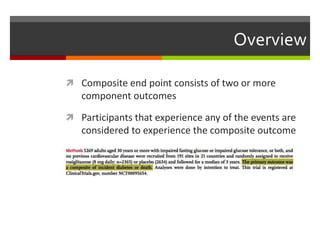
 Composite end point consists of two or more
component outcomes
 Participants that experience any of the events are
considered to experience the composite outcome
Advantages
 Statistical efficiency
 Prevents arbitrary selection between different
outcomes from a single disease process
 Broader evaluation of clinical benefit from an
intervention
Disadvantages
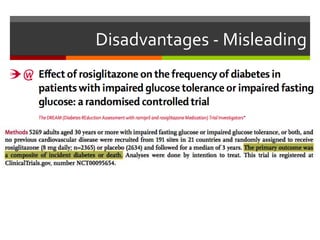
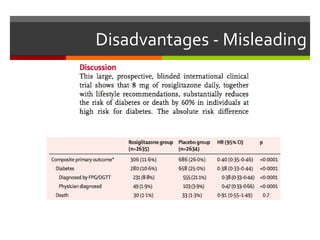
 Misleading – assumes the effect on the composite
outcome is similar amongst components
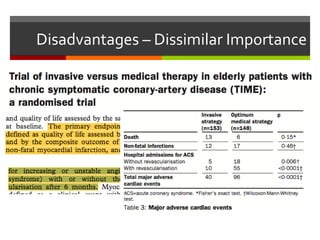
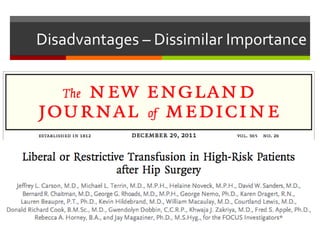
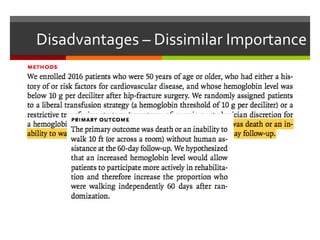
 Components can be of dissimilar importance
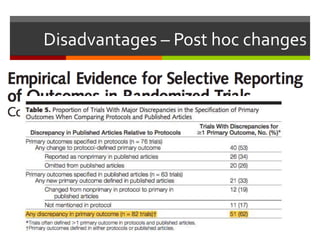
 Post hoc changes to the composite
Disadvantages - Misleading
Disadvantages – Dissimilar Importance
Disadvantages – Post hoc changes
Critically assessing composite endpoints
 Components are of similar importance to the
patient
 Components occur with similar frequency
 Components are affected to a similar degree
Sources
 Carson JL, Terrin ML, Noveck H, et al. Liberal or restrictive transfusion in high-risk patients after hip surgery. N Engl J
Med. 2011;365(26):2453-62.
 Chan AW, Hróbjartsson A, Haahr MT, Gøtzsche PC, Altman DG. Empirical evidence for selective reporting of outcomes
in randomized trials: comparison of protocols to published articles. JAMA. 2004;291(20):2457-65.
 Cordoba G, Schwartz L, Woloshin S, Bae H, Gøtzsche PC. Definition, reporting, and interpretation of composite
outcomes in clinical trials: systematic review. BMJ. 2010;341:c3920.
 Gever J. Debate Surges on Composite Endpoints. MedPage Today. http://webcache.googleusercontent.com/search?
q=cache:KtUYRHXvqQQJ:www.medpagetoday.com/publichealthpolicy/clinicaltrials/18046
&cd=13&hl=en&ct=clnk&gl=us. Published January 19, 2010. Accessed February 12, 2017.
 Kleist P. Composite Endpoints: Proceed with Caution. Applied Clinical Trials. http://
www.appliedclinicaltrialsonline.com/composite-endpoints-proceed-caution?id=&pageID=1&sk=&date=.
Published May 1, 2006. Accessed February 13, 2017.Montori VM, Jaeschke R, Schünemann HJ, et al. Users'
guide to detecting misleading claims in clinical research reports. BMJ. 2004;329(7474):1093-6.
 Pearce W, Raman S, Turner A. Randomised trials in context: practical problems and social aspects of evidence-based
medicine and policy. Trials. 2015;16:394.
 Rind D. Composite Endpoints and the CREST Trial. Evidence in Medicine. http://www.evidenceinmedicine.org/
2010/05/composite-endpoints-and-the-crest-trial.html. Published May 30, 2010. Accessed February 12, 2017.
 Sankoh AJ, Li H, D'agostino RB. Use of composite endpoints in clinical trials. Stat Med. 2014;33(27):4709-14.
 Tomlinson G, Detsky AS. Composite end points in randomized trials: there is no free lunch. JAMA. 2010;303(3):267-8.
 Trial of invasive versus medical therapy in elderly patients with chronic symptomatic coronary-artery disease (TIME): a
randomised trial. Lancet. 2001;358(9286):951-7.

Composite End Points

  • 1.
  • 2.
    Overview  Composite endpoint consists of two or more component outcomes  Participants that experience any of the events are considered to experience the composite outcome
  • 3.
    Advantages  Statistical efficiency Prevents arbitrary selection between different outcomes from a single disease process  Broader evaluation of clinical benefit from an intervention
  • 4.
    Disadvantages  Misleading –assumes the effect on the composite outcome is similar amongst components  Components can be of dissimilar importance  Post hoc changes to the composite
  • 5.
  • 6.
  • 7.
  • 8.
  • 9.
  • 10.
  • 11.
    Critically assessing compositeendpoints  Components are of similar importance to the patient  Components occur with similar frequency  Components are affected to a similar degree
  • 12.
    Sources  Carson JL,Terrin ML, Noveck H, et al. Liberal or restrictive transfusion in high-risk patients after hip surgery. N Engl J Med. 2011;365(26):2453-62.  Chan AW, Hróbjartsson A, Haahr MT, Gøtzsche PC, Altman DG. Empirical evidence for selective reporting of outcomes in randomized trials: comparison of protocols to published articles. JAMA. 2004;291(20):2457-65.  Cordoba G, Schwartz L, Woloshin S, Bae H, Gøtzsche PC. Definition, reporting, and interpretation of composite outcomes in clinical trials: systematic review. BMJ. 2010;341:c3920.  Gever J. Debate Surges on Composite Endpoints. MedPage Today. http://webcache.googleusercontent.com/search? q=cache:KtUYRHXvqQQJ:www.medpagetoday.com/publichealthpolicy/clinicaltrials/18046 &cd=13&hl=en&ct=clnk&gl=us. Published January 19, 2010. Accessed February 12, 2017.  Kleist P. Composite Endpoints: Proceed with Caution. Applied Clinical Trials. http:// www.appliedclinicaltrialsonline.com/composite-endpoints-proceed-caution?id=&pageID=1&sk=&date=. Published May 1, 2006. Accessed February 13, 2017.Montori VM, Jaeschke R, Schünemann HJ, et al. Users' guide to detecting misleading claims in clinical research reports. BMJ. 2004;329(7474):1093-6.  Pearce W, Raman S, Turner A. Randomised trials in context: practical problems and social aspects of evidence-based medicine and policy. Trials. 2015;16:394.  Rind D. Composite Endpoints and the CREST Trial. Evidence in Medicine. http://www.evidenceinmedicine.org/ 2010/05/composite-endpoints-and-the-crest-trial.html. Published May 30, 2010. Accessed February 12, 2017.  Sankoh AJ, Li H, D'agostino RB. Use of composite endpoints in clinical trials. Stat Med. 2014;33(27):4709-14.  Tomlinson G, Detsky AS. Composite end points in randomized trials: there is no free lunch. JAMA. 2010;303(3):267-8.  Trial of invasive versus medical therapy in elderly patients with chronic symptomatic coronary-artery disease (TIME): a randomised trial. Lancet. 2001;358(9286):951-7.

Editor's Notes

  • #4 Higher event rates reduce the sample size requirement, cost, and time Hypertension – can cause MI, CVA, etc