Chapter 4 Objectives
Differentiateamong various styles
of system units
Identify chips, adapter cards, and other
components of a motherboard
Describe the components of a processor and how
they complete a machine cycle
Identify characteristics of various personal
computer processors on the market today
Define a bit and describe how a series of bits
represents data
Explain how programs transfer in
and out of memory
Differentiate among the various
types of memory
Describe the types of expansion slots and
adapter cards
Explain the difference among a serial port, a
parallel port, a USB port, and other ports
Describe how buses contribute to a
computer’s processing speed
Identify components in mobile computers
and mobile devices
Next
3.
The System Unit
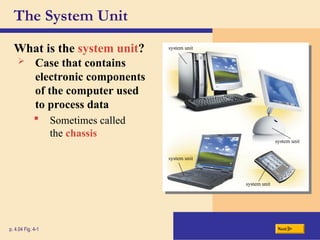
Whatis the system unit?
p. 4.04 Fig. 4-1 Next
Case that contains
electronic components
of the computer used
to process data
Sometimes called
the chassis
system unit
system unit
system unit
system unit
4.
The System Unit
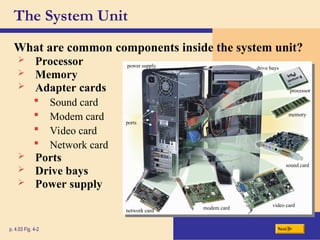
Whatare common components inside the system unit?
p. 4.03 Fig. 4-2 Next
Processor
Memory
Adapter cards
Sound card
Modem card
Video card
Network card
Ports
Drive bays
Power supply
power supply
ports
drive bays
processor
memory
sound card
video card
modem card
network card
5.
The System Unit
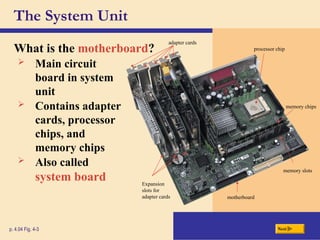
Whatis the motherboard?
p. 4.04 Fig. 4-3 Next
Main circuit
board in system
unit
Contains adapter
cards, processor
chips, and
memory chips
Also called
system board
processor chip
adapter cards
memory chips
memory slots
motherboard
Expansion
slots for
adapter cards
6.
The System Unit
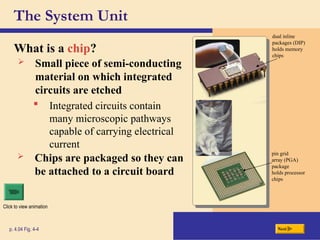
Whatis a chip?
p. 4.04 Fig. 4-4 Next
dual inline
packages (DIP)
holds memory
chips
pin grid
array (PGA)
package
holds processor
chips
Small piece of semi-conducting
material on which integrated
circuits are etched
Click to view animation
Integrated circuits contain
many microscopic pathways
capable of carrying electrical
current
Chips are packaged so they can
be attached to a circuit board
7.
Processor
Processor
Control
Control
Unit
Unit
Arithmetic
Arithmetic
Logic Unit (ALU)
LogicUnit (ALU)
Arithmetic
Arithmetic
Logic Unit (ALU)
Logic Unit (ALU)
Central Processing Unit
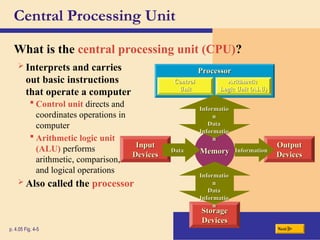
What is the central processing unit (CPU)?
p. 4.05 Fig. 4-5 Next
Input
Input
Devices
Devices
Storage
Storage
Devices
Devices
Output
Output
Devices
Devices
Interprets and carries
out basic instructions
that operate a computer
Memory
Memory
Data
Data Information
Information
Informatio
Informatio
n
n
Data
Data
Informatio
Informatio
n
n
Informatio
Informatio
n
n
Data
Data
Informatio
Informatio
n
n
Control
Control
Unit
Unit
Control unit directs and
coordinates operations in
computer
Arithmetic logic unit
(ALU) performs
arithmetic, comparison,
and logical operations
Also called the processor
8.
Processor
Control Unit
Memory
ALU
Central ProcessingUnit
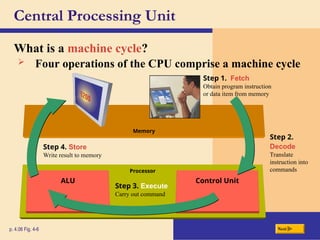
What is a machine cycle?
p. 4.06 Fig. 4-6 Next
Step 1. Fetch
Obtain program instruction
or data item from memory
Step 2.
Decode
Translate
instruction into
commands
Step 4. Store
Write result to memory
Step 3. Execute
Carry out command
Four operations of the CPU comprise a machine cycle
9.
Central Processing Unit
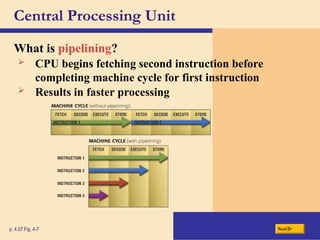
Whatis pipelining?
p. 4.07 Fig. 4-7 Next
CPU begins fetching second instruction before
completing machine cycle for first instruction
Results in faster processing
10.
Stores location
Stores location
fromwhere instruction
from where instruction
was fetched
was fetched
Central Processing Unit
Stores
Stores
instruction while it is
instruction while it is
being decoded
being decoded
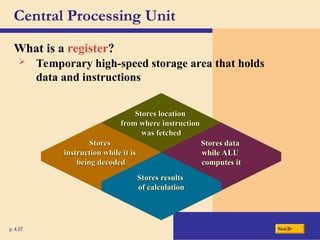
What is a register?
p. 4.07 Next
Stores data
Stores data
while ALU
while ALU
computes it
computes it
Stores results
Stores results
of calculation
of calculation
Temporary high-speed storage area that holds
data and instructions
11.
Central Processing Unit
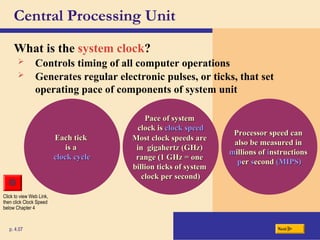
Whatis the system clock?
p. 4.07
Click to view Web Link,
then click Clock Speed
below Chapter 4
Next
Each tick
Each tick
is a
is a
clock cycle
clock cycle
Pace of system
Pace of system
clock is
clock is clock speed
clock speed
Most clock speeds are
Most clock speeds are
in gigahertz (GHz)
in gigahertz (GHz)
range (1 GHz = one
range (1 GHz = one
billion ticks of system
billion ticks of system
clock per second)
clock per second)
Processor speed can
Processor speed can
also be measured in
also be measured in
m
millions of
illions of i
instructions
nstructions
p
per
er s
second
econd (MIPS)
(MIPS)
Controls timing of all computer operations
Generates regular electronic pulses, or ticks, that set
operating pace of components of system unit
12.
Central Processing Unit
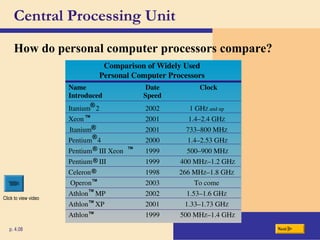
Howdo personal computer processors compare?
p. 4.08 Next
Comparison of Widely Used
Personal Computer Processors
Name Date Clock
Introduced Speed
Itanium 2 2002 1 GHZ and up
Xeon 2001 1.4–2.4 GHZ
Itanium 2001 733–800 MHZ
Pentium 4 2000 1.4–2.53 GHZ
Pentium III Xeon 1999 500–900 MHZ
Pentium III 1999 400 MHZ–1.2 GHZ
Celeron 1998 266 MHZ–1.8 GHZ
Operon 2003 To come
Athlon MP 2002 1.53–1.6 GHZ
Athlon XP 2001 1.33–1.73 GHZ
Athlon 1999 500 MHZ–1.4 GHZ
®
™
®
®
® ™
®
®
™
™
™
™
Click to view video
13.
Central Processing Unit
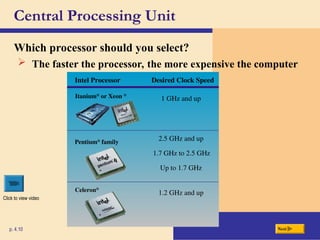
Whichprocessor should you select?
p. 4.10 Next
The faster the processor, the more expensive the computer
Celeron®
Itanium®
or Xeon ®
Pentium®
family
1 GHz and up
2.5 GHz and up
1.7 GHz to 2.5 GHz
Up to 1.7 GHz
1.2 GHz and up
Intel Processor Desired Clock Speed
Click to view video
14.
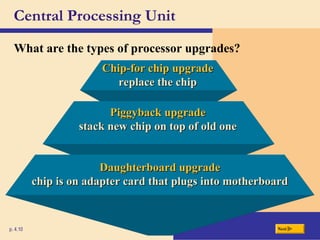
Chip-for chip upgrade
Chip-forchip upgrade
replace the chip
replace the chip
Central Processing Unit
What are the types of processor upgrades?
p. 4.10 Next
Piggyback upgrade
Piggyback upgrade
stack new chip on top of old one
stack new chip on top of old one
Daughterboard upgrade
Daughterboard upgrade
chip is on adapter card that plugs into motherboard
chip is on adapter card that plugs into motherboard
15.
Central Processing Unit
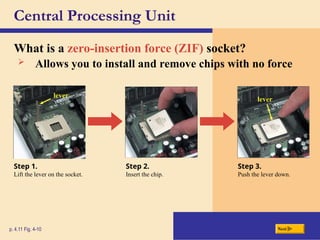
Whatis a zero-insertion force (ZIF) socket?
p. 4.11 Fig. 4-10 Next
Step 2.
Insert the chip.
Step 1.
Lift the lever on the socket.
lever
Step 3.
Push the lever down.
lever
Allows you to install and remove chips with no force
16.
Central Processing Unit
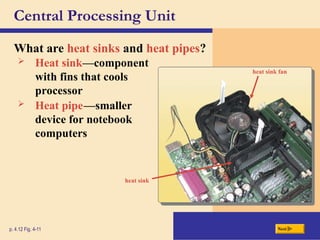
Whatare heat sinks and heat pipes?
p. 4.12 Fig. 4-11 Next
Heat sink—component
with fins that cools
processor
heat sink fan
heat sink
Heat pipee—smaller
device for notebook
computers
17.
Central Processing Unit
Whatis a coprocessor?
p. 4.12 Next
Chip that assists processor in
performing specific tasks
One type is a floating-point coprocessor
floating-point coprocessor, also
known as a math or numeric coprocessor
18.
Central Processing Unit
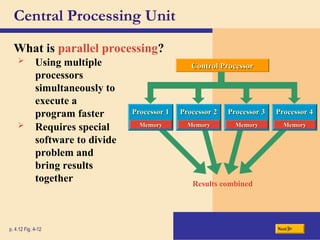
Whatis parallel processing?
p. 4.12 Fig. 4-12 Next
Control Processor
Control Processor
Processor 1
Processor 1
Memory
Memory
Processor 2
Processor 2
Memory
Memory
Processor 3
Processor 3
Memory
Memory
Processor 4
Processor 4
Memory
Memory
Results combined
Using multiple
processors
simultaneously to
execute a
program faster
Requires special
software to divide
problem and
bring results
together
19.
Data Representation
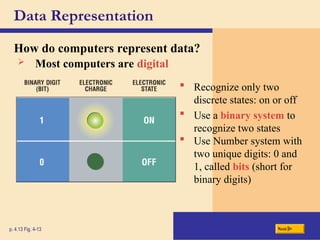
How docomputers represent data?
p. 4.13 Fig. 4-13 Next
Recognize only two
discrete states: on or off
Use a binary system to
recognize two states
Use Number system with
two unique digits: 0 and
1, called bits (short for
binary digits)
Most computers are digital
20.
Data Representation
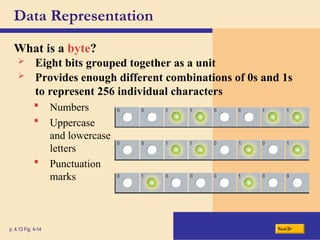
What isa byte?
p. 4.13 Fig. 4-14 Next
Eight bits grouped together as a unit
Provides enough different combinations of 0s and 1s
to represent 256 individual characters
Numbers
Uppercase
and lowercase
letters
Punctuation
marks
21.
Data Representation
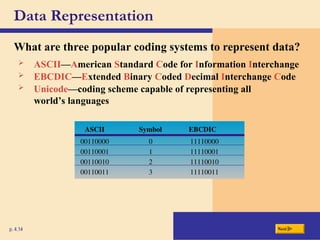
What arethree popular coding systems to represent data?
p. 4.14 Next
ASCII—American Standard Code for Information Interchange
EBCDIC—Extended Binary Coded Decimal Interchange Code
Unicode—coding scheme capable of representing all
world’s languages
ASCII Symbol EBCDIC
00110000 0 11110000
00110001 1 11110001
00110010 2 11110010
00110011 3 11110011
22.
Data Representation
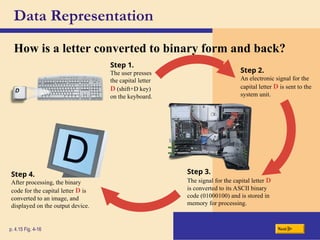
How isa letter converted to binary form and back?
p. 4.15 Fig. 4-16 Next
Step 1.
The user presses
the capital letter
D (shift+D key)
on the keyboard.
Step 2.
An electronic signal for the
capital letter D is sent to the
system unit.
Step 3.
The signal for the capital letter D
is converted to its ASCII binary
code (01000100) and is stored in
memory for processing.
Step 4.
After processing, the binary
code for the capital letter D is
converted to an image, and
displayed on the output device.
23.
Memory
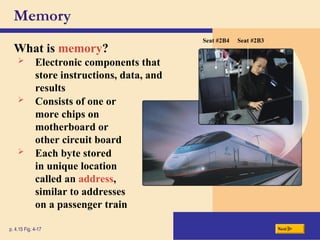
What is memory?
p.4.15 Fig. 4-17 Next
Electronic components that
store instructions, data, and
results
Consists of one or
more chips on
motherboard or
other circuit board
Each byte stored
in unique location
called an address,
similar to addresses
on a passenger train
Seat #2B4 Seat #2B3
24.
Memory
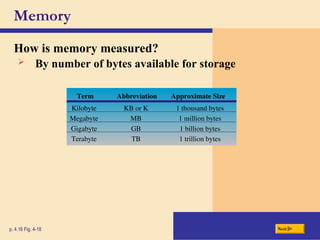
How is memorymeasured?
p. 4.16 Fig. 4-18 Next
Term Abbreviation Approximate Size
Kilobyte KB or K 1 thousand bytes
Megabyte MB 1 million bytes
Gigabyte GB 1 billion bytes
Terabyte TB 1 trillion bytes
By number of bytes available for storage
25.
Memory
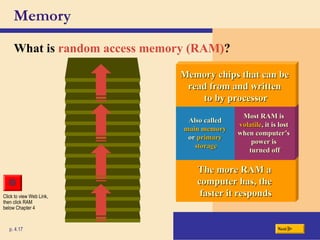
What is randomaccess memory (RAM)?
p. 4.17 Next
The more RAM a
The more RAM a
computer has, the
computer has, the
faster it responds
faster it responds
Also called
Also called
main memory
main memory
or
or primary
primary
storage
storage
Most RAM is
Most RAM is
volatile
volatile, it is lost
, it is lost
when computer’s
when computer’s
power is
power is
turned off
turned off
Memory chips that can be
Memory chips that can be
read from and written
read from and written
to by processor
to by processor
Click to view Web Link,
then click RAM
below Chapter 4
26.
Memory
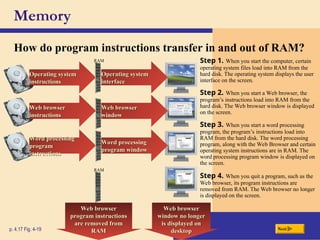
How do programinstructions transfer in and out of RAM?
p. 4.17 Fig. 4-19 Next
Step 1. When you start the computer, certain
operating system files load into RAM from the
hard disk. The operating system displays the user
interface on the screen.
Operating system
Operating system
instructions
instructions
Web browser
Web browser
instructions
instructions
Word processing
Word processing
program
program
instructions
instructions
Operating system
Operating system
interface
interface
Web browser
Web browser
window
window
Word processing
Word processing
program window
program window
RAM
RAM
Web browser
Web browser
program instructions
program instructions
are removed from
are removed from
RAM
RAM
Web browser
Web browser
window no longer
window no longer
is displayed on
is displayed on
desktop
desktop
Step 2. When you start a Web browser, the
program’s instructions load into RAM from the
hard disk. The Web browser window is displayed
on the screen.
Step 3. When you start a word processing
program, the program’s instructions load into
RAM from the hard disk. The word processing
program, along with the Web Browser and certain
operating system instructions are in RAM. The
word processing program window is displayed on
the screen.
Step 4. When you quit a program, such as the
Web browser, its program instructions are
removed from RAM. The Web browser no longer
is displayed on the screen.
27.
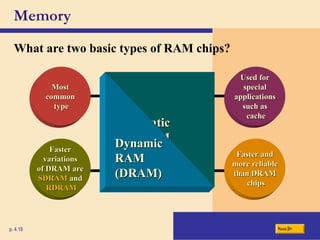
Faster
Faster
variations
variations
of DRAM are
ofDRAM are
SDRAM
SDRAM and
and
RDRAM
RDRAM
Used for
Used for
special
special
applications
applications
such as
such as
cache
cache
Most
Most
common
common
type
type
Faster and
Faster and
more reliable
more reliable
than DRAM
than DRAM
chips
chips
Memory
What are two basic types of RAM chips?
p. 4.18 Next
Static
Static
RAM
RAM
(SRAM)
(SRAM)
Dynamic
Dynamic
RAM
RAM
(DRAM)
(DRAM)
28.
Memory
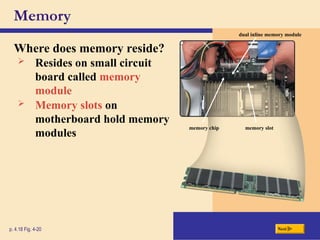
Where does memoryreside?
p. 4.18 Fig. 4-20 Next
Resides on small circuit
board called memory
module
Memory slots on
motherboard hold memory
modules
memory chip memory slot
dual inline memory module
29.
Memory
p. 4.19 Fig.4-21 Next
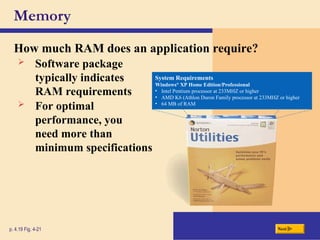
How much RAM does an application require?
Software package
typically indicates
RAM requirements
For optimal
performance, you
need more than
minimum specifications
System Requirements
Windows®
XP Home Edition/Professional
• Intel Pentium processor at 233MHZ or higher
• AMD K6 (Athlon Duron Family processor at 233MHZ or higher
• 64 MB of RAM
30.
Memory
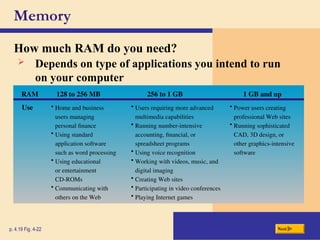
How much RAMdo you need?
p. 4.19 Fig. 4-22 Next
Depends on type of applications you intend to run
on your computer
RAM
Use
128 to 256 MB 256 to 1 GB 1 GB and up
• Home and business
users managing
personal finance
• Using standard
application software
such as word processing
• Using educational
or entertainment
CD-ROMs
• Communicating with
others on the Web
• Users requiring more advanced
multimedia capabilities
• Running number-intensive
accounting, financial, or
spreadsheet programs
• Using voice recognition
• Working with videos, music, and
digital imaging
• Creating Web sites
• Participating in video conferences
• Playing Internet games
• Power users creating
professional Web sites
• Running sophisticated
CAD, 3D design, or
other graphics-intensive
software
31.
Memory
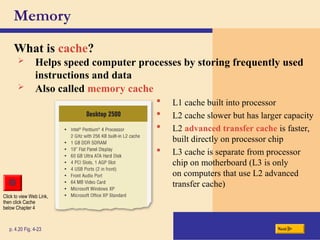
What is cache?
p.4.20 Fig. 4-23 Next
L1 cache built into processor
L2 cache slower but has larger capacity
L2 advanced transfer cache is faster,
built directly on processor chip
L3 cache is separate from processor
chip on motherboard (L3 is only
on computers that use L2 advanced
transfer cache)
Helps speed computer processes by storing frequently used
instructions and data
Also called memory cache
Click to view Web Link,
then click Cache
below Chapter 4
32.
Memory
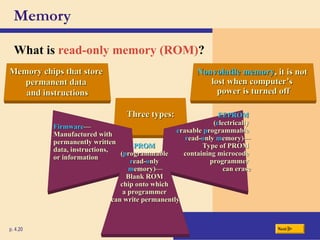
What is read-onlymemory (ROM)?
p. 4.20 Next
Memory chips that store
Memory chips that store
permanent data
permanent data
and instructions
and instructions
Nonvolatile memory
Nonvolatile memory, it is not
, it is not
lost when computer’s
lost when computer’s
power is turned off
power is turned off
Three types:
Three types:
Firmware
Firmware—
—
Manufactured with
Manufactured with
permanently written
permanently written
data, instructions,
data, instructions,
or information
or information
EEPROM
EEPROM
(
(e
electrically
lectrically
e
erasable
rasable p
programmable
rogrammable
r
read-
ead-o
only
nly m
memory)—
emory)—
Type of PROM
Type of PROM
containing microcode
containing microcode
programmer
programmer
can erase
can erase
PROM
PROM
(
(p
programmable
rogrammable
r
read-
ead-o
only
nly
m
memory)—
emory)—
Blank ROM
Blank ROM
chip onto which
chip onto which
a programmer
a programmer
can write permanently
can write permanently
33.
Memory
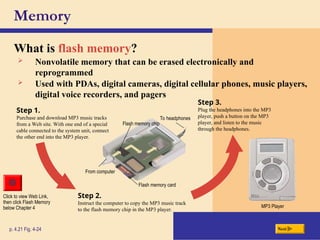
What is flashmemory?
p. 4.21 Fig. 4-24 Next
Step 1.
Purchase and download MP3 music tracks
from a Web site. With one end of a special
cable connected to the system unit, connect
the other end into the MP3 player.
Step 2.
Instruct the computer to copy the MP3 music track
to the flash memory chip in the MP3 player.
Step 3.
Plug the headphones into the MP3
player, push a button on the MP3
player, and listen to the music
through the headphones.
MP3 Player
Flash memory chip
Flash memory card
From computer
To headphones
Nonvolatile memory that can be erased electronically and
reprogrammed
Used with PDAs, digital cameras, digital cellular phones, music players,
digital voice recorders, and pagers
Click to view Web Link,
then click Flash Memory
below Chapter 4
34.
Memory
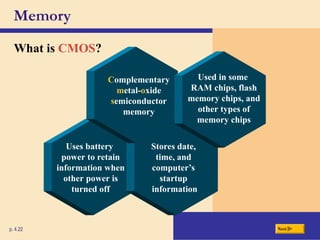
What is CMOS?
p.4.22 Next
Uses battery
power to retain
information when
other power is
turned off
Stores date,
time, and
computer’s
startup
information
Complementary
metal-oxide
semiconductor
memory
Used in some
RAM chips, flash
memory chips, and
other types of
memory chips
35.
Memory
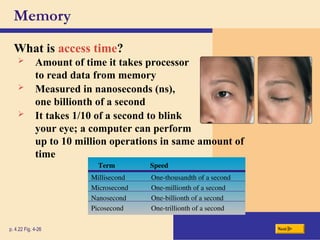
What is accesstime?
p. 4.22 Fig. 4-26 Next
Amount of time it takes processor
to read data from memory
Measured in nanoseconds (ns),
one billionth of a second
It takes 1/10 of a second to blink
your eye; a computer can perform
up to 10 million operations in same amount of
time
Term Speed
Millisecond One-thousandth of a second
Microsecond One-millionth of a second
Nanosecond One-billionth of a second
Picosecond One-trillionth of a second
36.
Expansion Slots andExpansion Cards
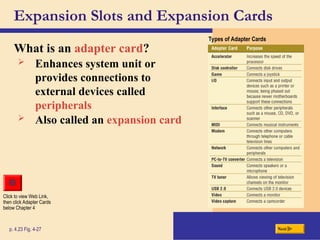
What is an adapter card?
p. 4.23 Fig. 4-27 Next
Types of Adapter Cards
Enhances system unit or
provides connections to
external devices called
peripherals
Also called an expansion card
Click to view Web Link,
then click Adapter Cards
below Chapter 4
37.
Expansion Slots andExpansion Cards
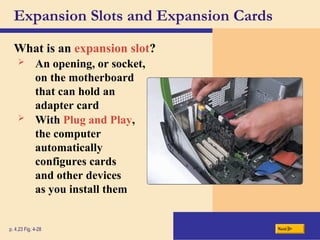
What is an expansion slot?
p. 4.23 Fig. 4-28 Next
An opening, or socket,
on the motherboard
that can hold an
adapter card
With Plug and Play,
the computer
automatically
configures cards
and other devices
as you install them
38.
Expansion Slots andExpansion Cards
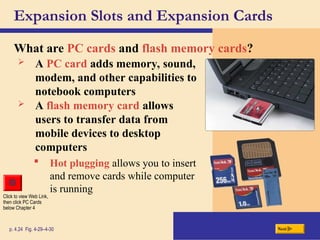
What are PC cards and flash memory cards?
p. 4.24 Fig. 4-29–4-30 Next
A PC card adds memory, sound,
modem, and other capabilities to
notebook computers
A flash memory card allows
users to transfer data from
mobile devices to desktop
computers
Click to view Web Link,
then click PC Cards
below Chapter 4
Hot plugging allows you to insert
and remove cards while computer
is running
39.
Ports
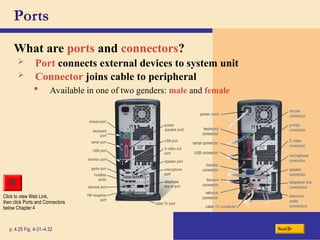
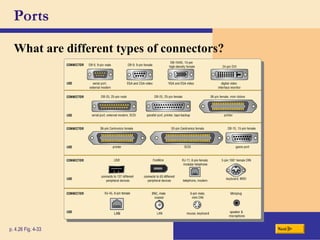
What are portsand connectors?
p. 4.25 Fig. 4-31–4.32 Next
Port connects external devices to system unit
Connector joins cable to peripheral
Available in one of two genders: male and female
Click to view Web Link,
then click Ports and Connectors
below Chapter 4
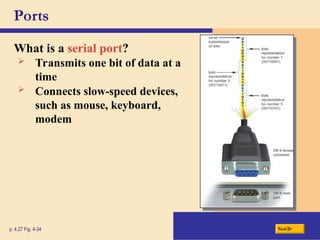
Ports
What is aserial port?
p. 4.27 Fig. 4-34 Next
Transmits one bit of data at a
time
Connects slow-speed devices,
such as mouse, keyboard,
modem
42.
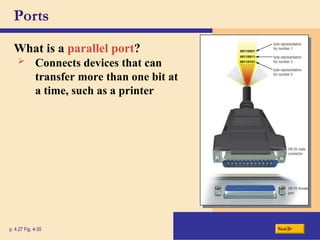
Ports
What is aparallel port?
p. 4.27 Fig. 4-35 Next
Connects devices that can
transfer more than one bit at
a time, such as a printer
43.
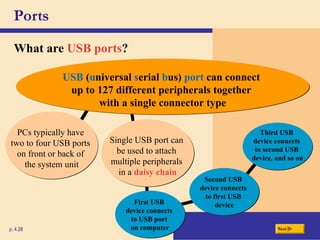
Third USB
device connects
tosecond USB
device, and so on
Second USB
device connects
to first USB
device
First USB
device connects
to USB port
on computer
Single USB port can
be used to attach
multiple peripherals
in a daisy chain
PCs typically have
two to four USB ports
on front or back of
the system unit
Ports
What are USB ports?
p. 4.28 Next
USB (universal serial bus) port can connect
up to 127 different peripherals together
with a single connector type
44.
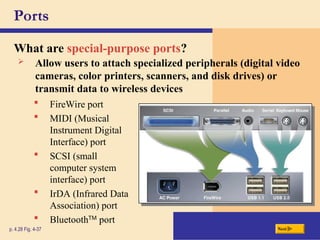
Ports
What are special-purposeports?
p. 4.28 Fig. 4-37 Next
FireWire port
MIDI (Musical
Instrument Digital
Interface) port
SCSI (small
computer system
interface) port
IrDA (Infrared Data
Association) port
BluetoothTM
port
Allow users to attach specialized peripherals (digital video
cameras, color printers, scanners, and disk drives) or
transmit data to wireless devices
45.
Buses
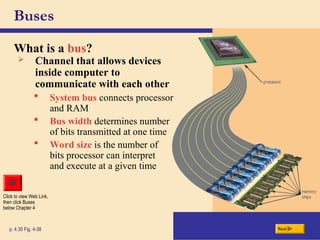
What is abus?
p. 4.30 Fig. 4-38 Next
Channel that allows devices
inside computer to
communicate with each other
System bus connects processor
and RAM
Bus width determines number
of bits transmitted at one time
Word size is the number of
bits processor can interpret
and execute at a given time
Click to view Web Link,
then click Buses
below Chapter 4
46.
Buses
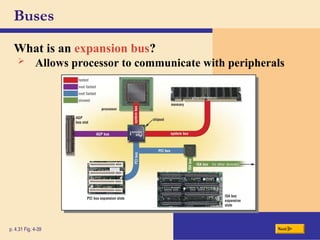
What is anexpansion bus?
p. 4.31 Fig. 4-39 Next
Allows processor to communicate with peripherals
47.
Bays
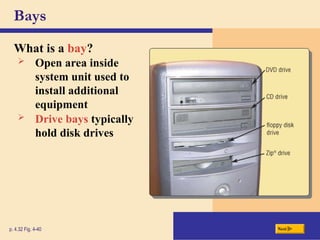
What is abay?
p. 4.32 Fig. 4-40 Next
Open area inside
system unit used to
install additional
equipment
Drive bays typically
hold disk drives
48.
Mobile Computers
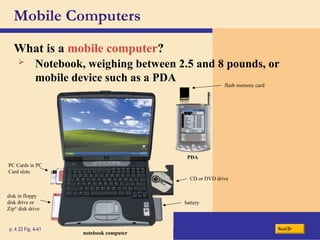
What isa mobile computer?
p. 4.33 Fig. 4-41 Next
PDA
flash memory card
notebook computer
PC Cards in PC
Card slots
disk in floppy
disk drive or
Zip®
disk drive
battery
CD or DVD drive
Notebook, weighing between 2.5 and 8 pounds, or
mobile device such as a PDA
49.
Mobile Computers
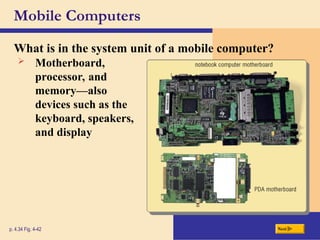
What isin the system unit of a mobile computer?
p. 4.34 Fig. 4-42 Next
Motherboard,
processor, and
memory—also
devices such as the
keyboard, speakers,
and display
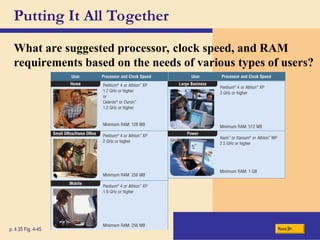
Putting It AllTogether
What are suggested processor, clock speed, and RAM
requirements based on the needs of various types of users?
p. 4.35 Fig. 4-45 Next
53.
Summary of theComponents of the System Unit
Components of the system unit
How memory stores data, instructions,
and information
Sequence of operations that occur when a
computer executes an instruction
Comparison of various personal computer
processors on the market today
Chapter 4 Complete



![Lecture_2_-_Looking_Inside_the_CPU[1].ppt](https://cdn.slidesharecdn.com/ss_thumbnails/lecture2-lookinginsidethecpu1-250528091117-adfe95d0-thumbnail.jpg?width=640&height=640&fit=bounds)


