Components of the Central
Nervous System
Dr Priyanka(PT)
BPT,MPT(Neurological disorders)
Assistant Professor(SIMS College,
Dehradun)
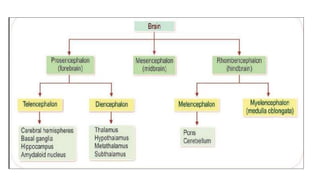
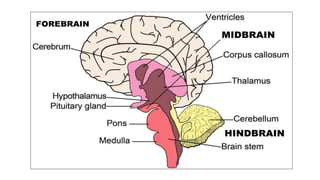
Various Parts of Brain
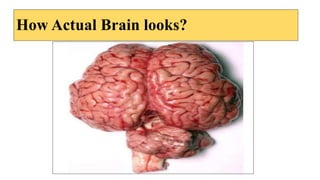
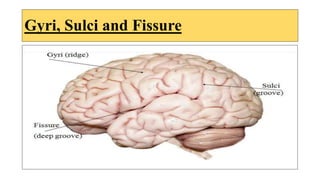
How Actual Brain looks?
Gyri, Sulci and Fissure
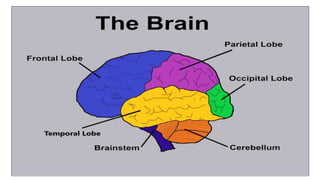
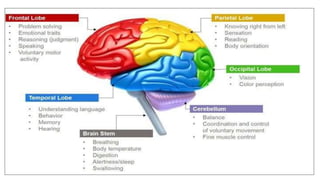
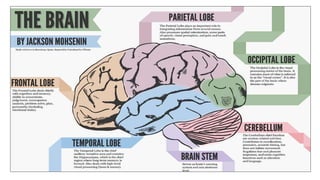
Cerebrum
1. The cerebrum is the largest portion of the brain
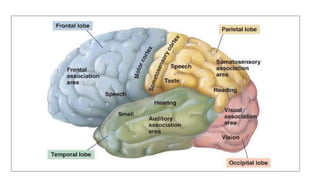
2. It is divided into four sections:
• Temporal lobe,
• Occipital lobe,
• Parietal lobe,
• Frontal lobe.
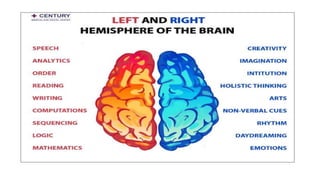
3. The cerebrum is divided into a right and left hemisphere
which are connected by axons that relay messages from one to the
other.
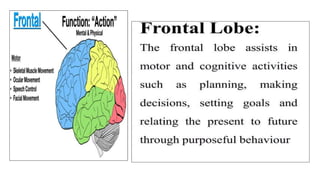
I. Frontal Lobe:
The frontal lobe is one of four lobes in the cerebral hemisphere.
This lobe controls several elements including creative thought, problem-solving,
intellect, judgment, behavior, attention, abstract thinking, physical reactions, muscle
movements, coordinated movements, smell, and personality.
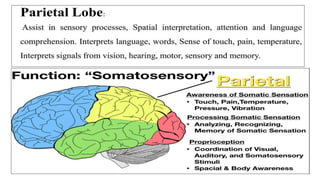
II. Parietal Lobe
Located in the cerebral hemisphere.
This lobe focuses on comprehension.
Visual functions, language, reading, internal stimuli, tactile sensation, and sensory
comprehension will be monitored here.
Occipital Lobe
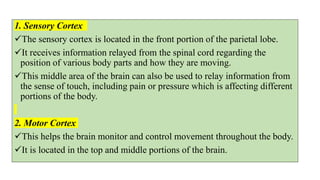
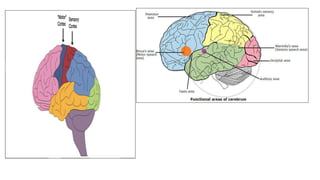
1. Sensory Cortex
The sensory cortex is located in the front portion of the parietal lobe.
It receives information relayed from the spinal cord regarding the
position of various body parts and how they are moving.
This middle area of the brain can also be used to relay information from
the sense of touch, including pain or pressure which is affecting different
portions of the body.
2. Motor Cortex
This helps the brain monitor and control movement throughout the body.
It is located in the top and middle portions of the brain.
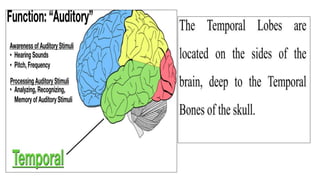
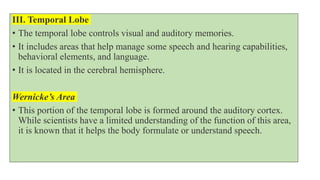
III. Temporal Lobe
• The temporal lobe controls visual and auditory memories.
• It includes areas that help manage some speech and hearing capabilities,
behavioral elements, and language.
• It is located in the cerebral hemisphere.
Wernicke’s Area
• This portion of the temporal lobe is formed around the auditory cortex.
While scientists have a limited understanding of the function of this area,
it is known that it helps the body formulate or understand speech.
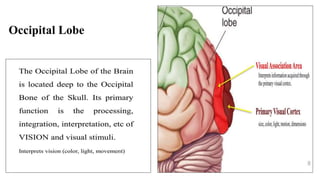
IV. Occipital Lobe
The optical lobe is located in the cerebral hemisphere at the back of the
head. It helps to control vision.
Broca’s Area
This area of the brain controls the facial neurons as well as the
understanding of speech and language.
It is located in the triangular and opercular section of the inferior
frontal gyrus.
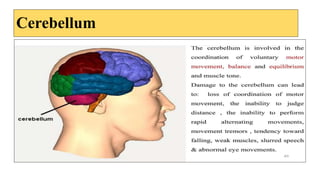
Cerebellum
Cerebellum
This is commonly referred to as “the little brain.”
It is considered to be older than the cerebrum on the
evolutionary scale.
The cerebellum controls essential body functions such
as balance, posture, and coordination, allowing humans
to move properly and maintain their structure.
Brain stem
This is commonly referred to as the simplest part of the brain.
The brain stem consists of the midbrain, pons, and medulla.
i. Midbrain
The midbrain, also known as the mesencephalon is made up of the tegmentum and tectum.
These parts of the brain help regulate body movement, vision, and hearing.
The anterior portion of the midbrain contains the cerebral peduncle which contains the axons
that transfer messages from the cerebral cortex down the brain stem, which allows voluntary
motor function to take place.
ii. Pons
This portion of the metencephalon is located in the hindbrain.
It links to the cerebellum to help with posture and movement.
It interprets information that is used in sensory analysis or motor control.
The pons also create the level of consciousness necessary for sleep.
iii. Medulla
The medulla or medulla oblongata is an essential portion of the brain stem that maintains
vital body functions such as heart rate and breathing.
Spinal Cord
It extends from the base of the skull to the lower border of first lumbar
vertebrae in an adult.
The spinal cord receives sensory information from the skin ,joints, and
muscles of the trunk and limbs and contain motor neurons responsible for
both voluntary and reflex movements.
The spinal cord contains ascending pathway through which sensory
information reaches the brain.
Descending pathway that relay motor command from the brain to motor
neurons.
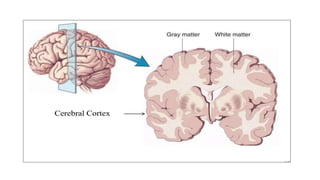
Grey matter is in the center and white matter is at the periphery.
Thank You

Components of Central Nervous System.pptx

  • 1.
    Components of theCentral Nervous System Dr Priyanka(PT) BPT,MPT(Neurological disorders) Assistant Professor(SIMS College, Dehradun)
  • 2.
  • 3.
  • 5.
  • 8.
    Cerebrum 1. The cerebrumis the largest portion of the brain 2. It is divided into four sections: • Temporal lobe, • Occipital lobe, • Parietal lobe, • Frontal lobe. 3. The cerebrum is divided into a right and left hemisphere which are connected by axons that relay messages from one to the other.
  • 10.
    I. Frontal Lobe: Thefrontal lobe is one of four lobes in the cerebral hemisphere. This lobe controls several elements including creative thought, problem-solving, intellect, judgment, behavior, attention, abstract thinking, physical reactions, muscle movements, coordinated movements, smell, and personality. II. Parietal Lobe Located in the cerebral hemisphere. This lobe focuses on comprehension. Visual functions, language, reading, internal stimuli, tactile sensation, and sensory comprehension will be monitored here.
  • 14.
  • 15.
    1. Sensory Cortex Thesensory cortex is located in the front portion of the parietal lobe. It receives information relayed from the spinal cord regarding the position of various body parts and how they are moving. This middle area of the brain can also be used to relay information from the sense of touch, including pain or pressure which is affecting different portions of the body. 2. Motor Cortex This helps the brain monitor and control movement throughout the body. It is located in the top and middle portions of the brain.
  • 16.
    III. Temporal Lobe •The temporal lobe controls visual and auditory memories. • It includes areas that help manage some speech and hearing capabilities, behavioral elements, and language. • It is located in the cerebral hemisphere. Wernicke’s Area • This portion of the temporal lobe is formed around the auditory cortex. While scientists have a limited understanding of the function of this area, it is known that it helps the body formulate or understand speech.
  • 17.
    IV. Occipital Lobe Theoptical lobe is located in the cerebral hemisphere at the back of the head. It helps to control vision. Broca’s Area This area of the brain controls the facial neurons as well as the understanding of speech and language. It is located in the triangular and opercular section of the inferior frontal gyrus.
  • 19.
  • 20.
    Cerebellum This is commonlyreferred to as “the little brain.” It is considered to be older than the cerebrum on the evolutionary scale. The cerebellum controls essential body functions such as balance, posture, and coordination, allowing humans to move properly and maintain their structure.
  • 25.
    Brain stem This iscommonly referred to as the simplest part of the brain. The brain stem consists of the midbrain, pons, and medulla. i. Midbrain The midbrain, also known as the mesencephalon is made up of the tegmentum and tectum. These parts of the brain help regulate body movement, vision, and hearing. The anterior portion of the midbrain contains the cerebral peduncle which contains the axons that transfer messages from the cerebral cortex down the brain stem, which allows voluntary motor function to take place. ii. Pons This portion of the metencephalon is located in the hindbrain. It links to the cerebellum to help with posture and movement. It interprets information that is used in sensory analysis or motor control. The pons also create the level of consciousness necessary for sleep. iii. Medulla The medulla or medulla oblongata is an essential portion of the brain stem that maintains vital body functions such as heart rate and breathing.
  • 26.
    Spinal Cord It extendsfrom the base of the skull to the lower border of first lumbar vertebrae in an adult. The spinal cord receives sensory information from the skin ,joints, and muscles of the trunk and limbs and contain motor neurons responsible for both voluntary and reflex movements. The spinal cord contains ascending pathway through which sensory information reaches the brain. Descending pathway that relay motor command from the brain to motor neurons. Grey matter is in the center and white matter is at the periphery.
  • 27.