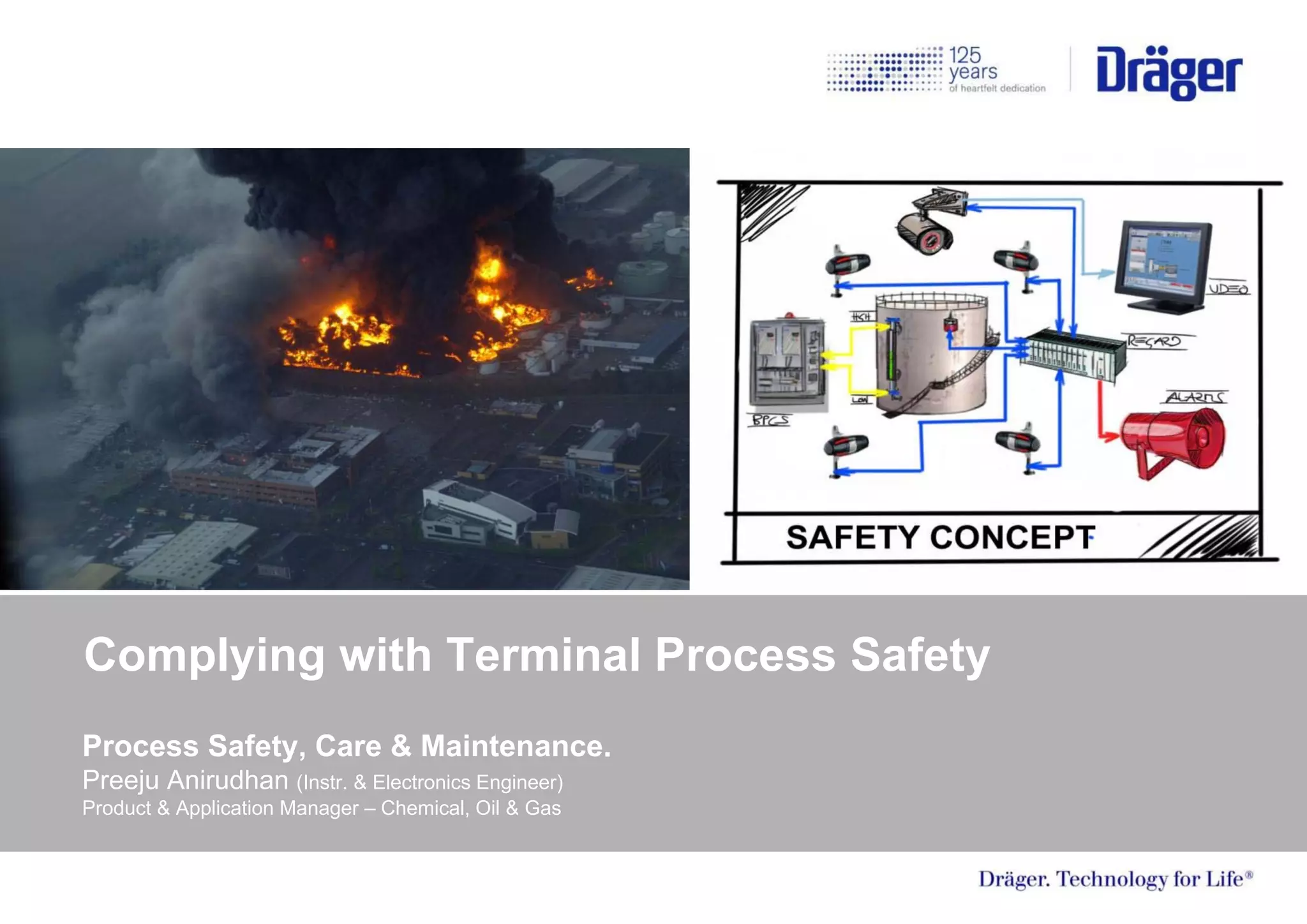
Complying with Terminal Process Safety
Process Safety, Care & Maintenance.
Preeju Anirudhan (Instr. & Electronics Engineer)
Product & Application Manager – Chemical, Oil & Gas
Terminal Process Safety
Expectations & Standards
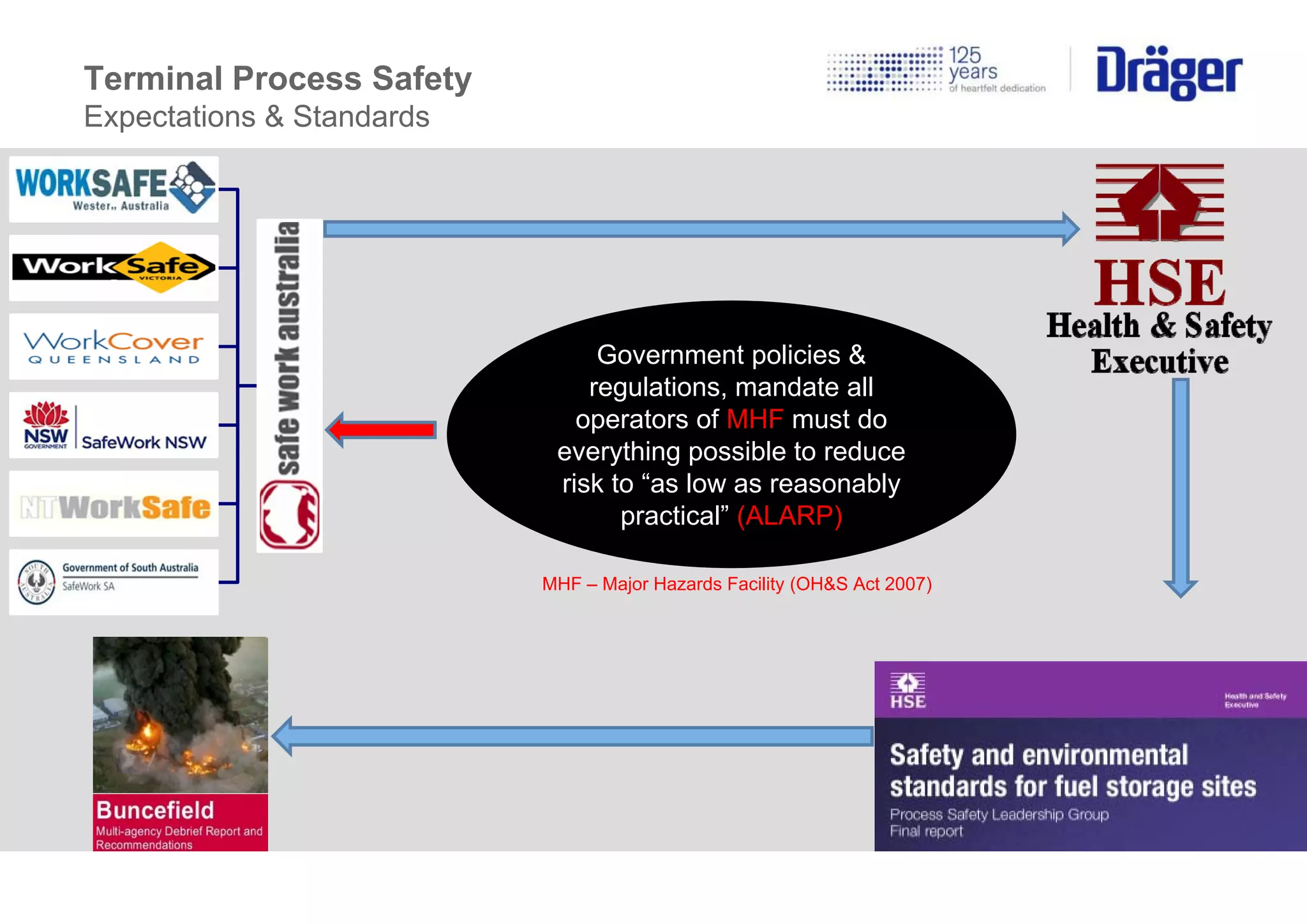
Government policies &
regulations, mandate all
operators of MHF must do
everything possible to reduce
risk to “as low as reasonably
practical” (ALARP)
.
.
.
.
MHF – Major Hazards Facility (OH&S Act 2007)
Terminal Process Safety
ALARP - Regions
Source – Guidance for MHF facilities (Work Safe / HSE UK)
License to operate does not mean you comply with ALARP
Terminal Process Safety
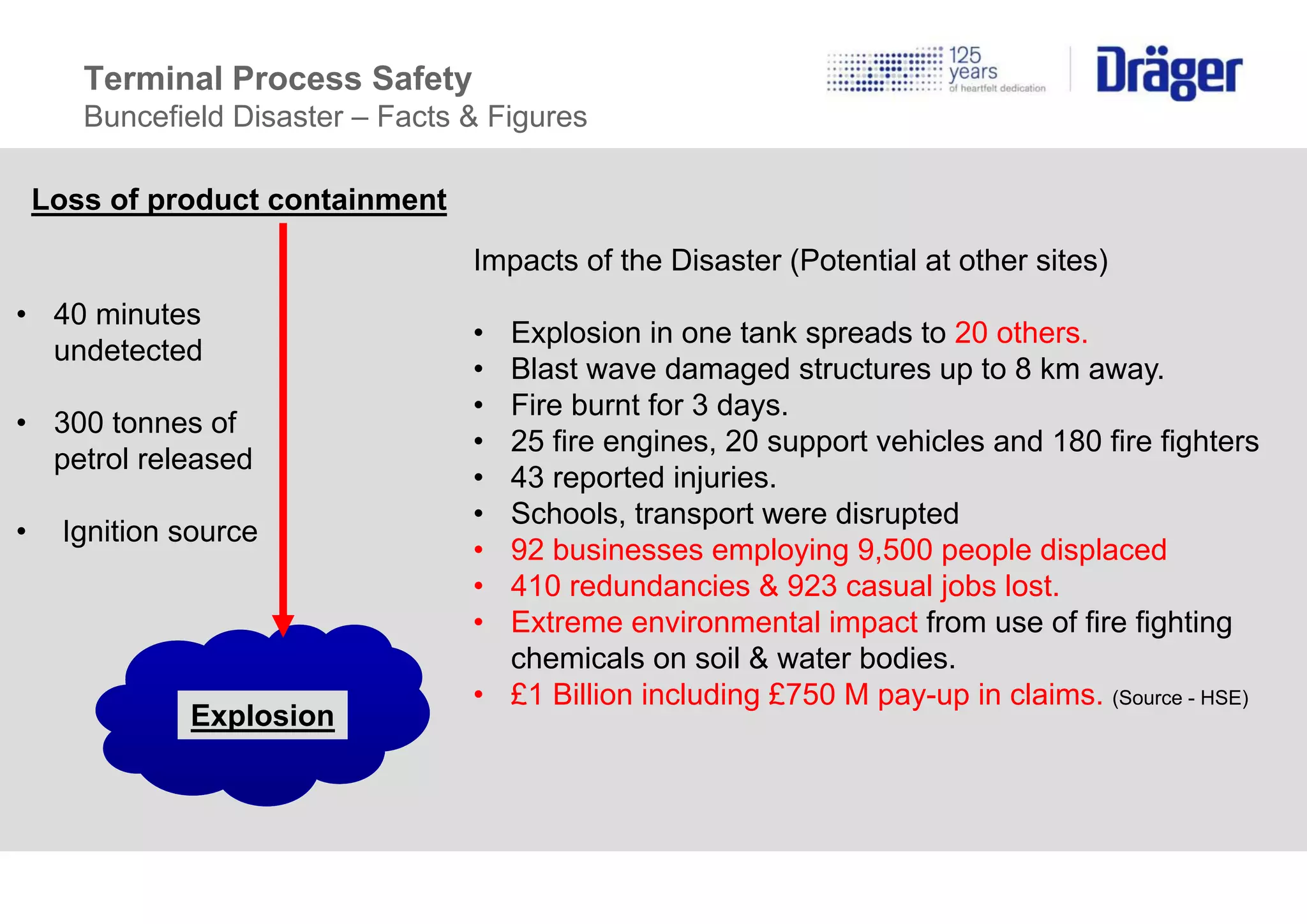
Tank Overfill & Ignition – Chronology
Loss of product containment
Explosion
• 40 minutes
undetected
• 300 tonnes of
petrol released
• Ignition source
Impacts of the Disaster (Potential at other sites)
• Explosion in one tank spreads to 20 others.
• Blast wave damaged structures up to 8 km away.
• Fire burnt for 3 days.
• 25 fire engines, 20 support vehicles and 180 fire fighters
• 43 reported injuries.
• Schools, transport were disrupted
• 92 businesses employing 9,500 people displaced
• 410 redundancies & 923 casual jobs lost.
• Extreme environmental impact from use of fire fighting
chemicals on soil & water bodies.
• £1 Billion including £750 M pay-up in claims. (Source - HSE)
Terminal Process Safety
Buncefield Disaster – Facts & Figures
Immediate Causes
• Failure of primary containment due to inoperability and/or malfunction of the
automatic tank gauging system (ATGS) and the independent high-level switch (IHLS)
• Insufficiently designed secondary (Bunds) and non-existent tertiary containment
Wider Underlying Causes
• Buncefield operators had little control over the two remotely operated UKOP
pipelines
• Inadequate shift handover
Terminal Process Safety
Buncefield Disaster – Causes
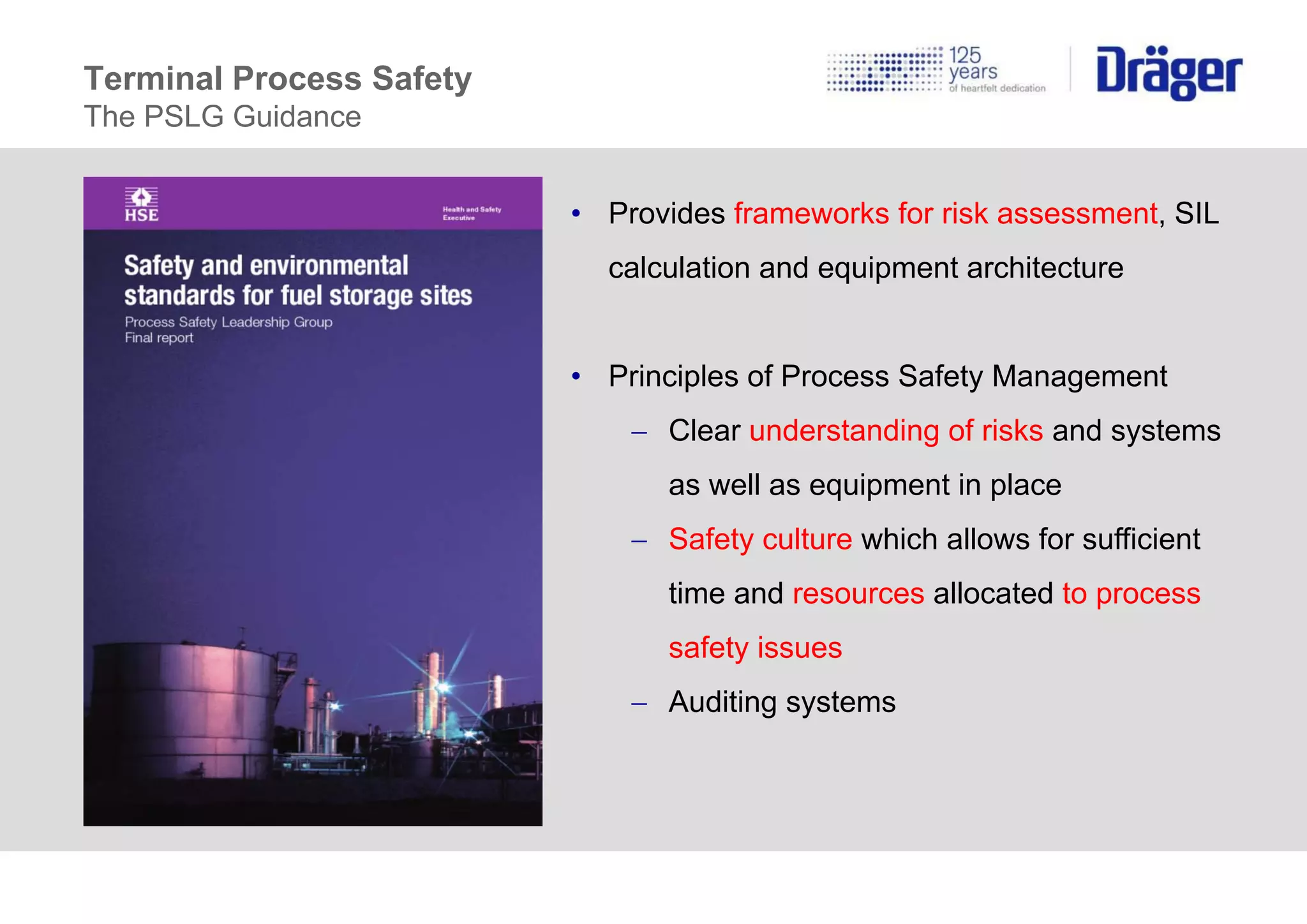
• Provides frameworks for risk assessment, SIL
calculation and equipment architecture
• Principles of Process Safety Management
 Clear understanding of risks and systems
as well as equipment in place
 Safety culture which allows for sufficient
time and resources allocated to process
safety issues
 Auditing systems
Terminal Process Safety
The PSLG Guidance
Terminal Process Safety
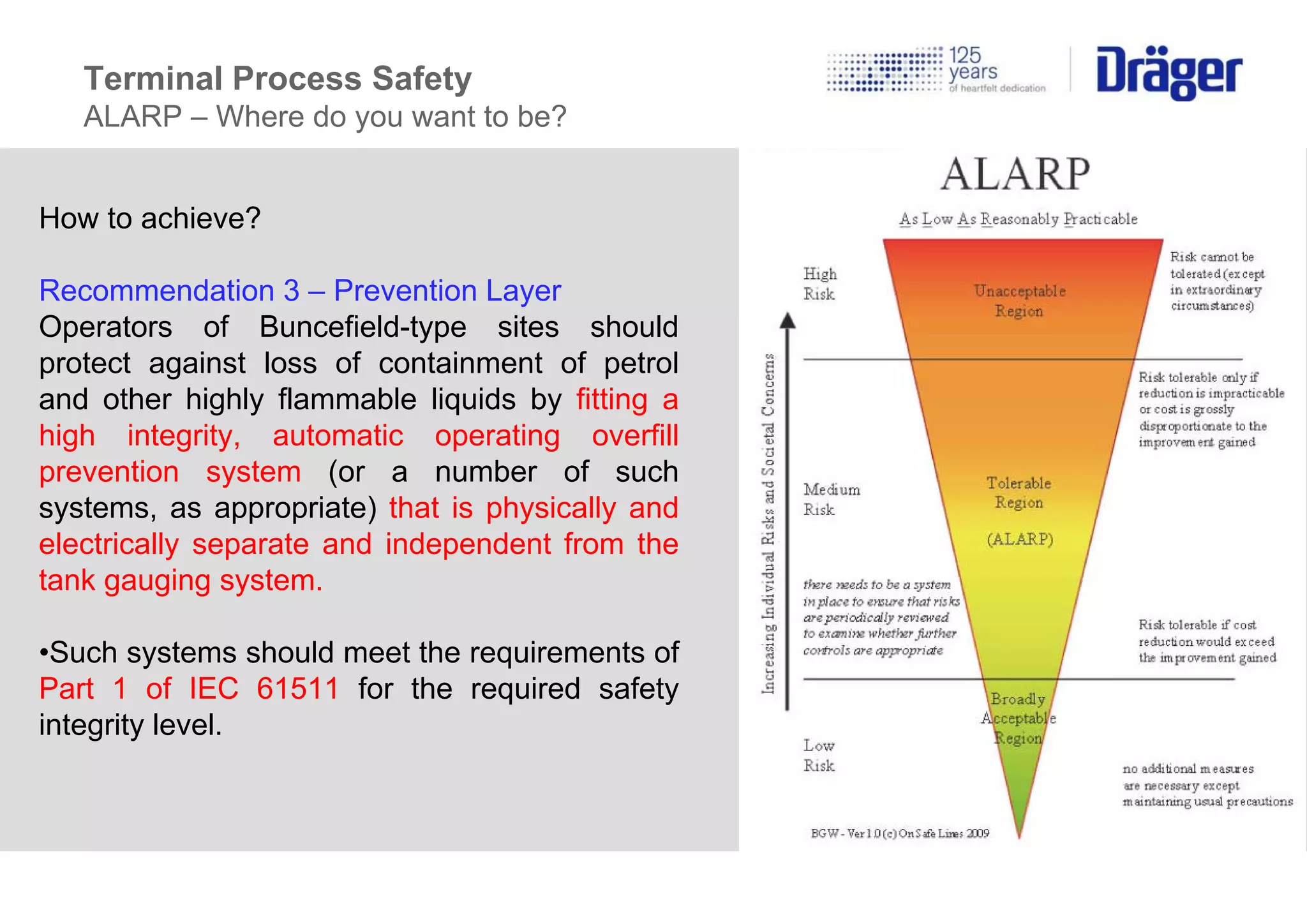
ALARP – Where do you want to be?
How to achieve?
Recommendation 3 – Prevention Layer
Operators of Buncefield-type sites should
protect against loss of containment of petrol
and other highly flammable liquids by fitting a
high integrity, automatic operating overfill
prevention system (or a number of such
systems, as appropriate) that is physically and
electrically separate and independent from the
tank gauging system.
•Such systems should meet the requirements of
Part 1 of IEC 61511 for the required safety
integrity level.
Terminal Process Safety
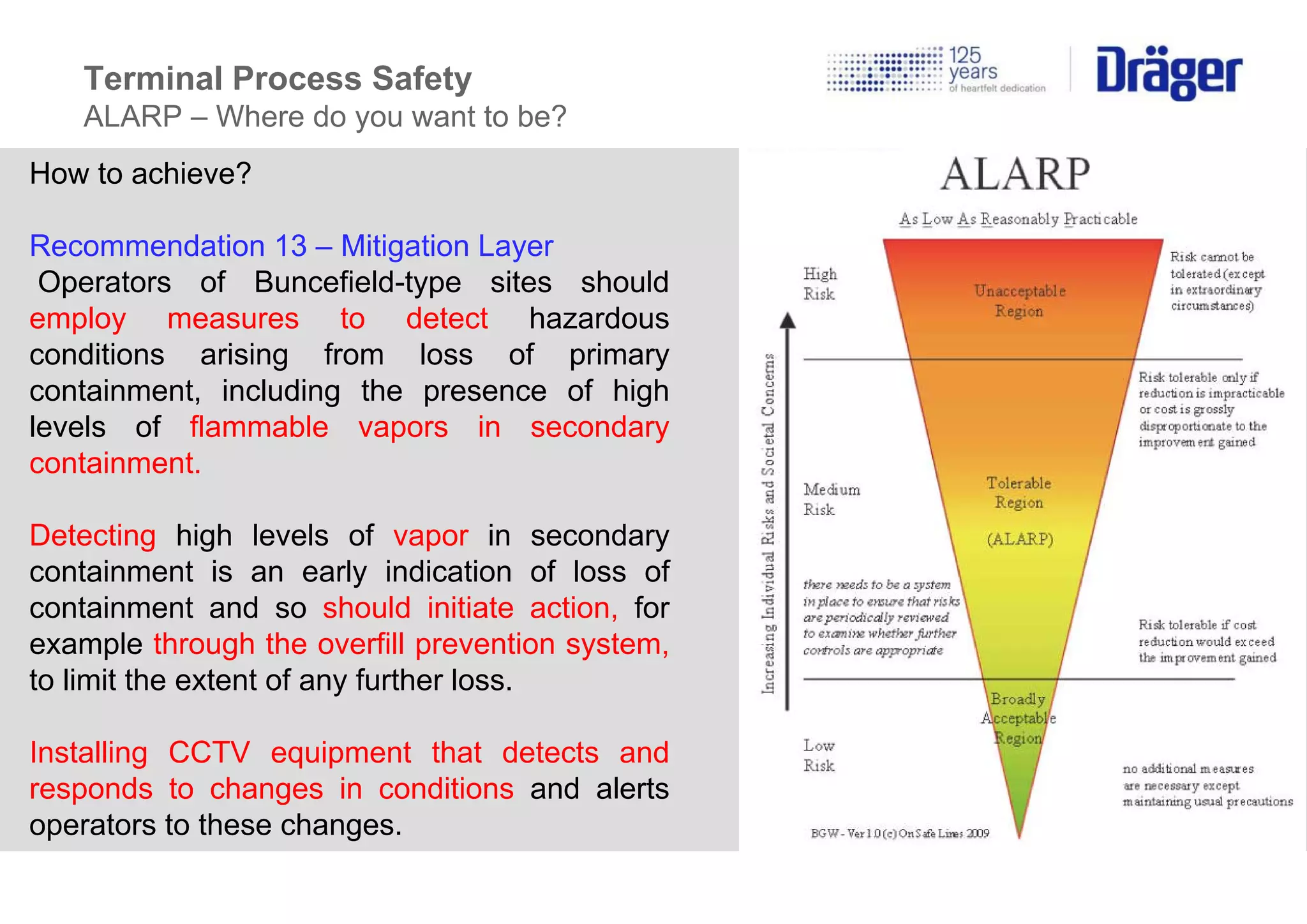
ALARP – Where do you want to be?
How to achieve?
Recommendation 13 – Mitigation Layer
Operators of Buncefield-type sites should
employ measures to detect hazardous
conditions arising from loss of primary
containment, including the presence of high
levels of flammable vapors in secondary
containment.
Detecting high levels of vapor in secondary
containment is an early indication of loss of
containment and so should initiate action, for
example through the overfill prevention system,
to limit the extent of any further loss.
Installing CCTV equipment that detects and
responds to changes in conditions and alerts
operators to these changes.
Terminal Process Safety
How to Design a Plant Safety System (PSLG)
Tank Gauging
Safety control
BPCS and Recommendation 3 & 13 - Concept
ZZZZZZ
Recommendation 13- Detection of Flammable vapours
SIL2 Including communication
approval covers hardware, software
and wireless communication
No Calibration evert
ensuring lifetime detection
stability, with no need for re-
calibration
60~80% savings on
total project cost due to
reduced engineering;
wiring, installation and
documentation demand
Truly wireless, no cables:
Ultra-low power consumption
of 5 mW on average allows
for typical battery life of 24
months
Fast Response (5S)
Reliable IR Technology
Intrinsic safety
approval with field-
replaceable battery
packs
Terminal Process Safety
Mitigation using Wireless GasSecure GS01
Major successes in ANZ region (8 sites)
140 GS01 installed at seven sites (Australia)
11 GS01 installed at NZOSL Napier (NZ)
Terminal Process Safety
Mitigation using Wireless GasSecure GS01
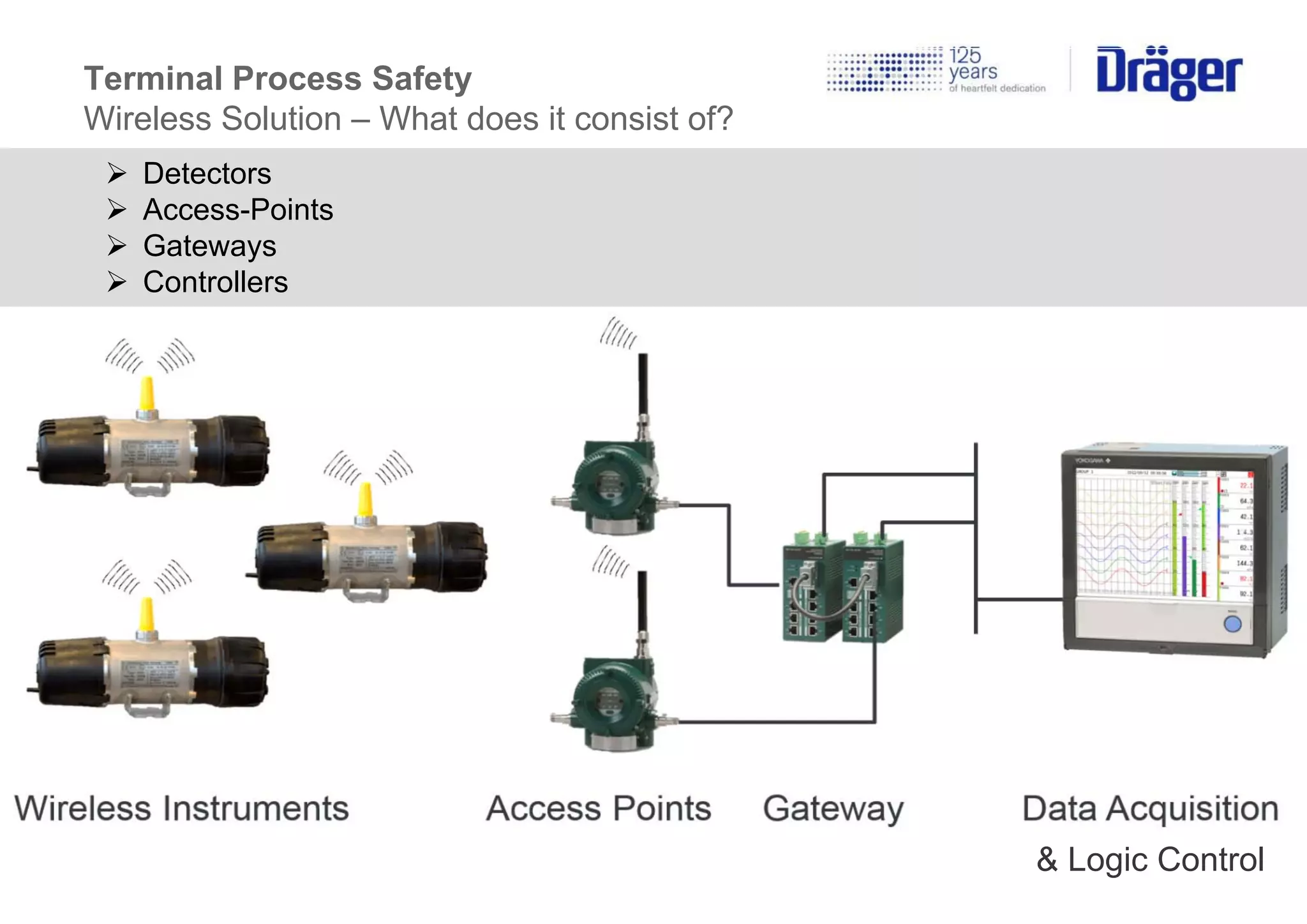
 Detectors
 Access-Points
 Gateways
 Controllers
& Logic Control
Terminal Process Safety
Wireless Solution – What does it consist of?
Level
Gas
CCTV
Independent
safety control
Real-time video
Shutdown
Terminal Process Safety
Plant Safety Solutions for Non-Fuel Storage (PSLG)
Terminal Safety
Care & Maintenance
Explosions, e.g. ignited during
work by sparks or high
temperatures
Explosions due to the inherently
unstable character of some
chemicals (e.g. explosives)
Serious effects from toxic gases,
vapors, or liquids via skin contact,
ingestion, or inhalation
Exposure to corrosive/
caustic substances
Serious effects (carcinogenic,
genetic, mutagenic) from long
term exposure
to certain toxins
Reaction of substances coming
in contact with catalytic materials
becoming dangerous
Potential dangers due to ...
ZZZZZZ
Risks
Flammable gases
and vapors
Toxic liquids and gases
(Chlorine (Cl2), Ammonia (NH3 ),
Hydrogen chloride (HCl)
Toxic organic substances
(e.g. Benzene, Methanol,
Ethylene, Butadiene)
Particles (e.g. dust and
combustible particulates)
Many more HAZMATs
in different processes
Terminal Safety – Care & Maintenance
Confined Space Entry - Risks
Pre-entry check and
personal air monitoring
Area monitoring
Head & body protection Training & services
Breathing protection
Escape equipment
ZZZZZZ
Terminal Safety – Care & Maintenance
Confined Space Entry - Solutions
Particles
(e.g. dust and combustible
particulates)
High risk of explosions,
e.g. ignited during hot work by
sparks or high temperatures
High risk of explosions due
to the inherently unstable character
of some chemicals (e.g. explosives)
Risk of serious effects from toxic
gases, vapors or liquids via skin
contact, ingestion or inhalation
Risk of exposure to corrosive/
caustic substances
Risk of serious effects (carcinogenic,
genetic, mutagenic) from long-term
exposure to certain toxins
Reaction of substances coming
in contact with catalytic materials
becoming dangerous
Potential dangers due to ...
ZZZZZZ
Risks
Flammable gases
and vapors
Toxic liquids and gases
 Chlorine (Cl2)
 Ammonia (NH3 )
 Hydrogen chloride (HCl)
Many more HAZMATs
in different processes
 Organic substances
(e.g. Benzene,
Methanol, Ethylene,
Butadiene)
Terminal Safety – Care & Maintenance
Shutdowns and Turnarounds - Risks
Personal Air Monitoring
Head & Body
Protection
Area Monitoring
& Access Control
Rental Shop, Gas
Testers, Training &
Safety Services
Breathing Protection
Escape & Rescue
Equipment
ZZZZZZ
Terminal Safety – Care & Maintenance
Shutdowns and Turnarounds - Solutions
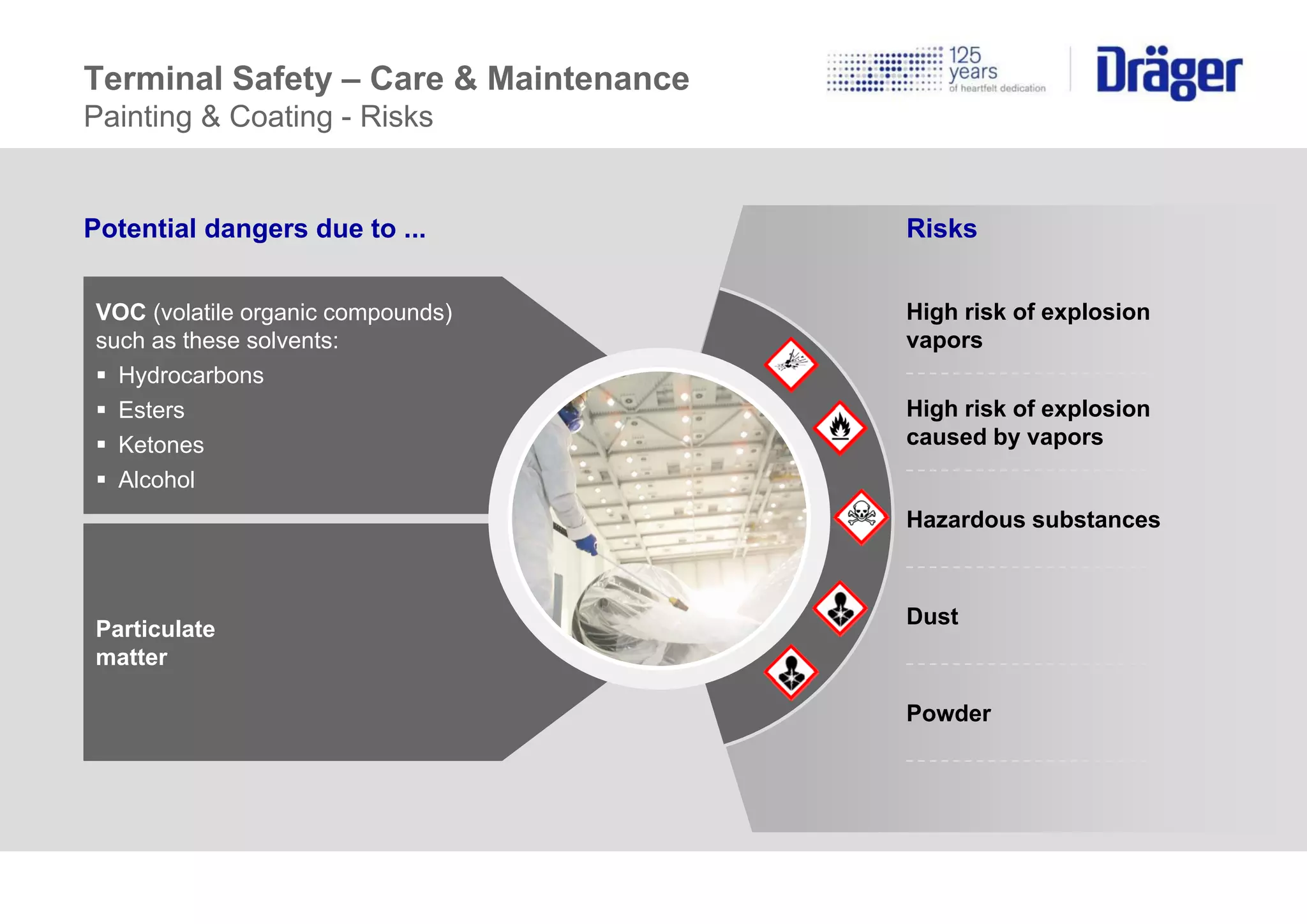
Particulate
matter
High risk of explosion
vapors
High risk of explosion
caused by vapors
Hazardous substances
Dust
Powder
Potential dangers due to ...
ZZZZZZ
Risks
VOC (volatile organic compounds)
such as these solvents:
 Hydrocarbons
 Esters
 Ketones
 Alcohol
Terminal Safety – Care & Maintenance
Painting & Coating - Risks
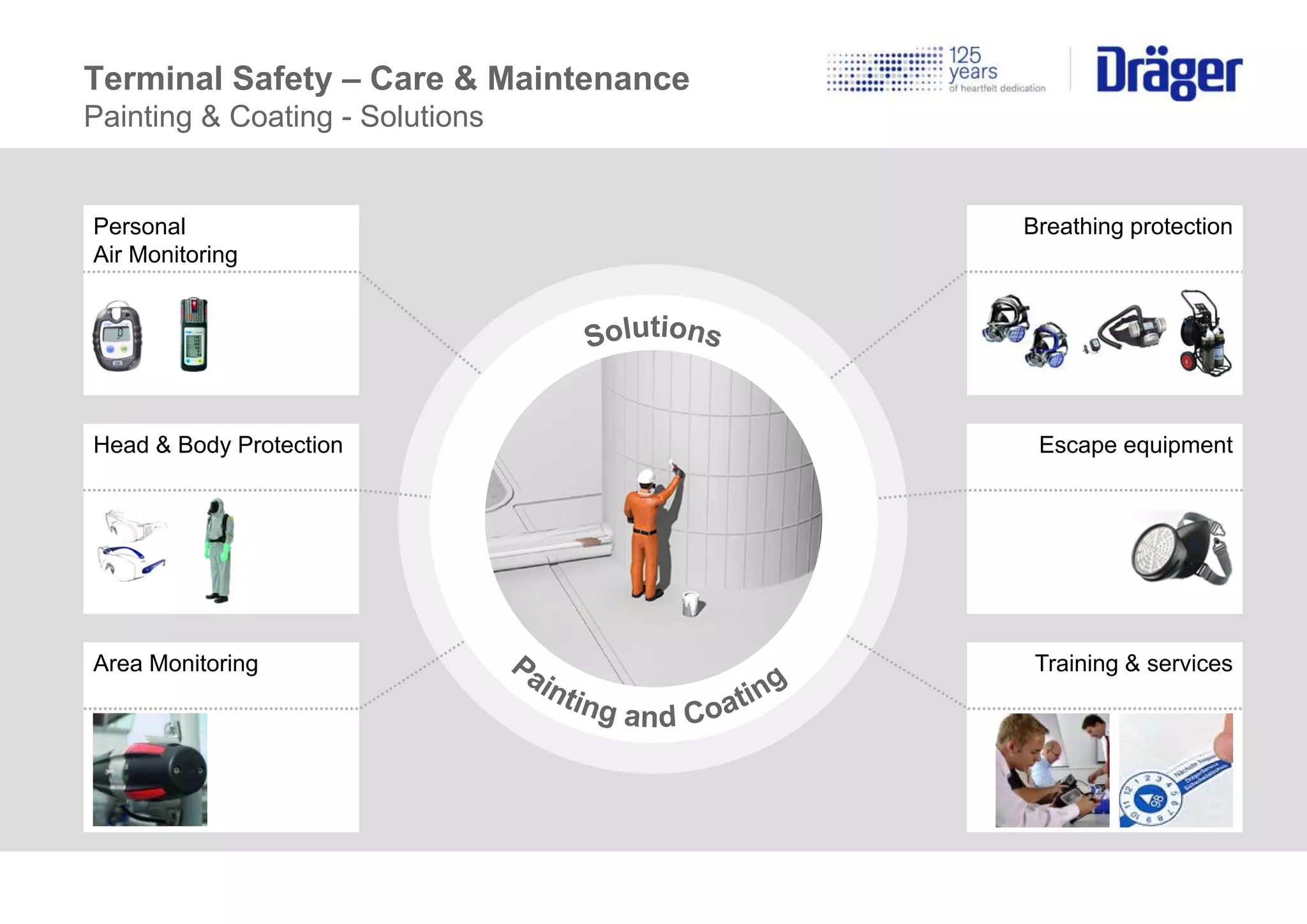
Personal
Air Monitoring
Head & Body Protection
Area Monitoring Training & services
Breathing protection
Escape equipment
ZZZZZZ
Terminal Safety – Care & Maintenance
Painting & Coating - Solutions
Any Questions? – Visit us @ Booth 15
• Detection
• Protection
• Service & Training.
• Shutdown & Rental
• Total Care Solutions

Compling with terminal process safety

  • 1.
    Complying with TerminalProcess Safety Process Safety, Care & Maintenance. Preeju Anirudhan (Instr. & Electronics Engineer) Product & Application Manager – Chemical, Oil & Gas
  • 2.
    Terminal Process Safety Expectations& Standards Government policies & regulations, mandate all operators of MHF must do everything possible to reduce risk to “as low as reasonably practical” (ALARP) . . . . MHF – Major Hazards Facility (OH&S Act 2007)
  • 3.
    Terminal Process Safety ALARP- Regions Source – Guidance for MHF facilities (Work Safe / HSE UK) License to operate does not mean you comply with ALARP
  • 4.
    Terminal Process Safety TankOverfill & Ignition – Chronology
  • 5.
    Loss of productcontainment Explosion • 40 minutes undetected • 300 tonnes of petrol released • Ignition source Impacts of the Disaster (Potential at other sites) • Explosion in one tank spreads to 20 others. • Blast wave damaged structures up to 8 km away. • Fire burnt for 3 days. • 25 fire engines, 20 support vehicles and 180 fire fighters • 43 reported injuries. • Schools, transport were disrupted • 92 businesses employing 9,500 people displaced • 410 redundancies & 923 casual jobs lost. • Extreme environmental impact from use of fire fighting chemicals on soil & water bodies. • £1 Billion including £750 M pay-up in claims. (Source - HSE) Terminal Process Safety Buncefield Disaster – Facts & Figures
  • 6.
    Immediate Causes • Failureof primary containment due to inoperability and/or malfunction of the automatic tank gauging system (ATGS) and the independent high-level switch (IHLS) • Insufficiently designed secondary (Bunds) and non-existent tertiary containment Wider Underlying Causes • Buncefield operators had little control over the two remotely operated UKOP pipelines • Inadequate shift handover Terminal Process Safety Buncefield Disaster – Causes
  • 7.
    • Provides frameworksfor risk assessment, SIL calculation and equipment architecture • Principles of Process Safety Management  Clear understanding of risks and systems as well as equipment in place  Safety culture which allows for sufficient time and resources allocated to process safety issues  Auditing systems Terminal Process Safety The PSLG Guidance
  • 8.
    Terminal Process Safety ALARP– Where do you want to be? How to achieve? Recommendation 3 – Prevention Layer Operators of Buncefield-type sites should protect against loss of containment of petrol and other highly flammable liquids by fitting a high integrity, automatic operating overfill prevention system (or a number of such systems, as appropriate) that is physically and electrically separate and independent from the tank gauging system. •Such systems should meet the requirements of Part 1 of IEC 61511 for the required safety integrity level.
  • 9.
    Terminal Process Safety ALARP– Where do you want to be? How to achieve? Recommendation 13 – Mitigation Layer Operators of Buncefield-type sites should employ measures to detect hazardous conditions arising from loss of primary containment, including the presence of high levels of flammable vapors in secondary containment. Detecting high levels of vapor in secondary containment is an early indication of loss of containment and so should initiate action, for example through the overfill prevention system, to limit the extent of any further loss. Installing CCTV equipment that detects and responds to changes in conditions and alerts operators to these changes.
  • 10.
    Terminal Process Safety Howto Design a Plant Safety System (PSLG) Tank Gauging Safety control BPCS and Recommendation 3 & 13 - Concept
  • 11.
    ZZZZZZ Recommendation 13- Detectionof Flammable vapours SIL2 Including communication approval covers hardware, software and wireless communication No Calibration evert ensuring lifetime detection stability, with no need for re- calibration 60~80% savings on total project cost due to reduced engineering; wiring, installation and documentation demand Truly wireless, no cables: Ultra-low power consumption of 5 mW on average allows for typical battery life of 24 months Fast Response (5S) Reliable IR Technology Intrinsic safety approval with field- replaceable battery packs Terminal Process Safety Mitigation using Wireless GasSecure GS01
  • 12.
    Major successes inANZ region (8 sites) 140 GS01 installed at seven sites (Australia) 11 GS01 installed at NZOSL Napier (NZ) Terminal Process Safety Mitigation using Wireless GasSecure GS01
  • 13.
     Detectors  Access-Points Gateways  Controllers & Logic Control Terminal Process Safety Wireless Solution – What does it consist of?
  • 14.
    Level Gas CCTV Independent safety control Real-time video Shutdown TerminalProcess Safety Plant Safety Solutions for Non-Fuel Storage (PSLG)
  • 15.
  • 16.
    Explosions, e.g. ignitedduring work by sparks or high temperatures Explosions due to the inherently unstable character of some chemicals (e.g. explosives) Serious effects from toxic gases, vapors, or liquids via skin contact, ingestion, or inhalation Exposure to corrosive/ caustic substances Serious effects (carcinogenic, genetic, mutagenic) from long term exposure to certain toxins Reaction of substances coming in contact with catalytic materials becoming dangerous Potential dangers due to ... ZZZZZZ Risks Flammable gases and vapors Toxic liquids and gases (Chlorine (Cl2), Ammonia (NH3 ), Hydrogen chloride (HCl) Toxic organic substances (e.g. Benzene, Methanol, Ethylene, Butadiene) Particles (e.g. dust and combustible particulates) Many more HAZMATs in different processes Terminal Safety – Care & Maintenance Confined Space Entry - Risks
  • 17.
    Pre-entry check and personalair monitoring Area monitoring Head & body protection Training & services Breathing protection Escape equipment ZZZZZZ Terminal Safety – Care & Maintenance Confined Space Entry - Solutions
  • 18.
    Particles (e.g. dust andcombustible particulates) High risk of explosions, e.g. ignited during hot work by sparks or high temperatures High risk of explosions due to the inherently unstable character of some chemicals (e.g. explosives) Risk of serious effects from toxic gases, vapors or liquids via skin contact, ingestion or inhalation Risk of exposure to corrosive/ caustic substances Risk of serious effects (carcinogenic, genetic, mutagenic) from long-term exposure to certain toxins Reaction of substances coming in contact with catalytic materials becoming dangerous Potential dangers due to ... ZZZZZZ Risks Flammable gases and vapors Toxic liquids and gases  Chlorine (Cl2)  Ammonia (NH3 )  Hydrogen chloride (HCl) Many more HAZMATs in different processes  Organic substances (e.g. Benzene, Methanol, Ethylene, Butadiene) Terminal Safety – Care & Maintenance Shutdowns and Turnarounds - Risks
  • 19.
    Personal Air Monitoring Head& Body Protection Area Monitoring & Access Control Rental Shop, Gas Testers, Training & Safety Services Breathing Protection Escape & Rescue Equipment ZZZZZZ Terminal Safety – Care & Maintenance Shutdowns and Turnarounds - Solutions
  • 20.
    Particulate matter High risk ofexplosion vapors High risk of explosion caused by vapors Hazardous substances Dust Powder Potential dangers due to ... ZZZZZZ Risks VOC (volatile organic compounds) such as these solvents:  Hydrocarbons  Esters  Ketones  Alcohol Terminal Safety – Care & Maintenance Painting & Coating - Risks
  • 21.
    Personal Air Monitoring Head &Body Protection Area Monitoring Training & services Breathing protection Escape equipment ZZZZZZ Terminal Safety – Care & Maintenance Painting & Coating - Solutions
  • 22.
    Any Questions? –Visit us @ Booth 15 • Detection • Protection • Service & Training. • Shutdown & Rental • Total Care Solutions