Complex Systems
Complexity Science
Why should we care?
Maximilian-Julius Feger
What’s a Complex System? What can we learn?Why should you care?
What’s a Complex System?
 TBH no one knows
- 1996 there were over 90 different
definitions
- Some examples:
• “More than the sum of its parts”
• “Agents who interact non-linearly”
• “At the edge of chaos”
 And Names:
•Complex System
•Adaptive System
•Dissipative Structure
Gedankenexperiment:
100 scientists examine one goose top to
bottom. Is there anything that they
would not find out about it?
 They scientists would have been
completely baffled over the V-
shape of migrating geese
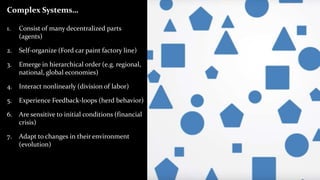
Complex Systems…
1. Consist of many decentralized parts
(agents)
2. Self-organize (Ford car paint factory line)
3. Emerge in hierarchical order (e.g. regional,
national, global economies)
4. Interact nonlinearly (division of labor)
5. Experience Feedback-loops (herd behavior)
6. Are sensitive to initial conditions (financial
crisis)
7. Adapt to changes in their environment
(evolution)
Why should you care?
It is a slightly arresting notion that
if you were to pick yourself apart
with tweezers, one atom at a
time, you would produce a mound of
fine atomic dust, none of
which had ever been alive but all of
which had once been you.
Bill Bryson, History of nearly Everything
Economic progress, in capitalist
society, means turmoil.
Joseph Schumpeter
…balance between order… and
disorder… that is often called ‘the
edge of chaos.' At this point of
dynamic tension, truly novel
emergent behavior can occur.
Arie Lewin
Where can we find
complex systems?
What are they again?:
1. They thrive off uncertainty
 “God knows what the market will
do tomorrow”
 “The Weather forecast is hardly on
point”
2. They consist of repetitive
structures yet they’re unique
 Fractals aka feedback-loops
 You’re a like a snowflake
3. Elements (agents) of the CS need
to interact
 Ants
Can you find the agents in these CSs?
1. Markets
2. Ecosystems
3. Solarsystems
8 Ways to benefit from understanding complex systems
1. Chaos is necessary for progress and not be fought
2. Therefore, generate dis-equilibrium!
3. Embrace uncertainty
4. Surface conflict
5. Allow experiments
6. Support collective action
7. Self-organization through artefacts
8. Stabilize feedback
Effectuation (effectual logic) Causation (causal logic)
Further Information:
• Santa Fe Institute of Complexity; Collected Works from many fields of
complexity science https://www.complexityexplorer.org/
• System Innovation Course; condensed Material & Videos on how to
benefit from complexity perspective https://systemsinnovation.io/
• A new IIASA study shows how even minor changes to available
infrastructure can trigger tipping points in the collective adoption of
sustainable behaviors. https://psyarxiv.com/w6dpa/download?format=pdf

Complexity

  • 1.
    Complex Systems Complexity Science Whyshould we care? Maximilian-Julius Feger
  • 2.
    What’s a ComplexSystem? What can we learn?Why should you care?
  • 3.
    What’s a ComplexSystem?  TBH no one knows - 1996 there were over 90 different definitions - Some examples: • “More than the sum of its parts” • “Agents who interact non-linearly” • “At the edge of chaos”  And Names: •Complex System •Adaptive System •Dissipative Structure Gedankenexperiment: 100 scientists examine one goose top to bottom. Is there anything that they would not find out about it?  They scientists would have been completely baffled over the V- shape of migrating geese
  • 4.
    Complex Systems… 1. Consistof many decentralized parts (agents) 2. Self-organize (Ford car paint factory line) 3. Emerge in hierarchical order (e.g. regional, national, global economies) 4. Interact nonlinearly (division of labor) 5. Experience Feedback-loops (herd behavior) 6. Are sensitive to initial conditions (financial crisis) 7. Adapt to changes in their environment (evolution)
  • 5.
    Why should youcare? It is a slightly arresting notion that if you were to pick yourself apart with tweezers, one atom at a time, you would produce a mound of fine atomic dust, none of which had ever been alive but all of which had once been you. Bill Bryson, History of nearly Everything Economic progress, in capitalist society, means turmoil. Joseph Schumpeter …balance between order… and disorder… that is often called ‘the edge of chaos.' At this point of dynamic tension, truly novel emergent behavior can occur. Arie Lewin
  • 6.
    Where can wefind complex systems? What are they again?: 1. They thrive off uncertainty  “God knows what the market will do tomorrow”  “The Weather forecast is hardly on point” 2. They consist of repetitive structures yet they’re unique  Fractals aka feedback-loops  You’re a like a snowflake 3. Elements (agents) of the CS need to interact  Ants Can you find the agents in these CSs? 1. Markets 2. Ecosystems 3. Solarsystems
  • 7.
    8 Ways tobenefit from understanding complex systems 1. Chaos is necessary for progress and not be fought 2. Therefore, generate dis-equilibrium! 3. Embrace uncertainty 4. Surface conflict 5. Allow experiments 6. Support collective action 7. Self-organization through artefacts 8. Stabilize feedback
  • 8.
    Effectuation (effectual logic)Causation (causal logic)
  • 10.
    Further Information: • SantaFe Institute of Complexity; Collected Works from many fields of complexity science https://www.complexityexplorer.org/ • System Innovation Course; condensed Material & Videos on how to benefit from complexity perspective https://systemsinnovation.io/ • A new IIASA study shows how even minor changes to available infrastructure can trigger tipping points in the collective adoption of sustainable behaviors. https://psyarxiv.com/w6dpa/download?format=pdf