PROJECT:-2
CAUCHY’S INTEGRAL FORMULA
PRESENTED BY :-
NAME – BISWAJEET BEHERA
REG.NO - 210101120045
SEC - A
BRANCH :-COMPUTER SCIENCE AND ENGINEERING
GUIDED BY :- Dr. BANITA MALLIK
CENTURION
UNIVERSITY
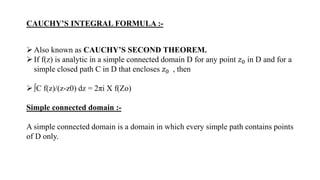
CAUCHY’S INTEGRAL FORMULA :-
Also known as CAUCHY’S SECOND THEOREM.
If f(z) is analytic in a simple connected domain D for any point 𝑧0 in D and for a
simple closed path C in D that encloses 𝑧0 , then
∫C f(z)/(z-z0) dz = 2πi X f(Zo)
Simple connected domain :-
A simple connected domain is a domain in which every simple path contains points
of D only.
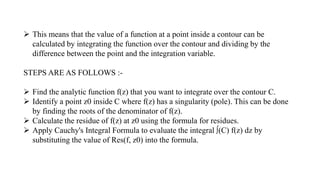
 This means that the value of a function at a point inside a contour can be
calculated by integrating the function over the contour and dividing by the
difference between the point and the integration variable.
STEPS ARE AS FOLLOWS :-
 Find the analytic function f(z) that you want to integrate over the contour C.
 Identify a point z0 inside C where f(z) has a singularity (pole). This can be done
by finding the roots of the denominator of f(z).
 Calculate the residue of f(z) at z0 using the formula for residues.
 Apply Cauchy's Integral Formula to evaluate the integral ∫(C) f(z) dz by
substituting the value of Res(f, z0) into the formula.
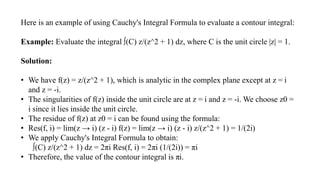
Here is an example of using Cauchy's Integral Formula to evaluate a contour integral:
Example: Evaluate the integral ∫(C) z/(z^2 + 1) dz, where C is the unit circle |z| = 1.
Solution:
• We have f(z) = z/(z^2 + 1), which is analytic in the complex plane except at z = i
and z = -i.
• The singularities of f(z) inside the unit circle are at z = i and z = -i. We choose z0 =
i since it lies inside the unit circle.
• The residue of f(z) at z0 = i can be found using the formula:
• Res(f, i) = lim(z → i) (z - i) f(z) = lim(z → i) (z - i) z/(z^2 + 1) = 1/(2i)
• We apply Cauchy's Integral Formula to obtain:
∫(C) z/(z^2 + 1) dz = 2πi Res(f, i) = 2πi (1/(2i)) = πi
• Therefore, the value of the contour integral is πi.
THANK YOU 

COMPLEX PROJECT - 2.pptx

  • 1.
    PROJECT:-2 CAUCHY’S INTEGRAL FORMULA PRESENTEDBY :- NAME – BISWAJEET BEHERA REG.NO - 210101120045 SEC - A BRANCH :-COMPUTER SCIENCE AND ENGINEERING GUIDED BY :- Dr. BANITA MALLIK CENTURION UNIVERSITY
  • 2.
    CAUCHY’S INTEGRAL FORMULA:- Also known as CAUCHY’S SECOND THEOREM. If f(z) is analytic in a simple connected domain D for any point 𝑧0 in D and for a simple closed path C in D that encloses 𝑧0 , then ∫C f(z)/(z-z0) dz = 2πi X f(Zo) Simple connected domain :- A simple connected domain is a domain in which every simple path contains points of D only.
  • 3.
     This meansthat the value of a function at a point inside a contour can be calculated by integrating the function over the contour and dividing by the difference between the point and the integration variable. STEPS ARE AS FOLLOWS :-  Find the analytic function f(z) that you want to integrate over the contour C.  Identify a point z0 inside C where f(z) has a singularity (pole). This can be done by finding the roots of the denominator of f(z).  Calculate the residue of f(z) at z0 using the formula for residues.  Apply Cauchy's Integral Formula to evaluate the integral ∫(C) f(z) dz by substituting the value of Res(f, z0) into the formula.
  • 4.
    Here is anexample of using Cauchy's Integral Formula to evaluate a contour integral: Example: Evaluate the integral ∫(C) z/(z^2 + 1) dz, where C is the unit circle |z| = 1. Solution: • We have f(z) = z/(z^2 + 1), which is analytic in the complex plane except at z = i and z = -i. • The singularities of f(z) inside the unit circle are at z = i and z = -i. We choose z0 = i since it lies inside the unit circle. • The residue of f(z) at z0 = i can be found using the formula: • Res(f, i) = lim(z → i) (z - i) f(z) = lim(z → i) (z - i) z/(z^2 + 1) = 1/(2i) • We apply Cauchy's Integral Formula to obtain: ∫(C) z/(z^2 + 1) dz = 2πi Res(f, i) = 2πi (1/(2i)) = πi • Therefore, the value of the contour integral is πi.
  • 5.