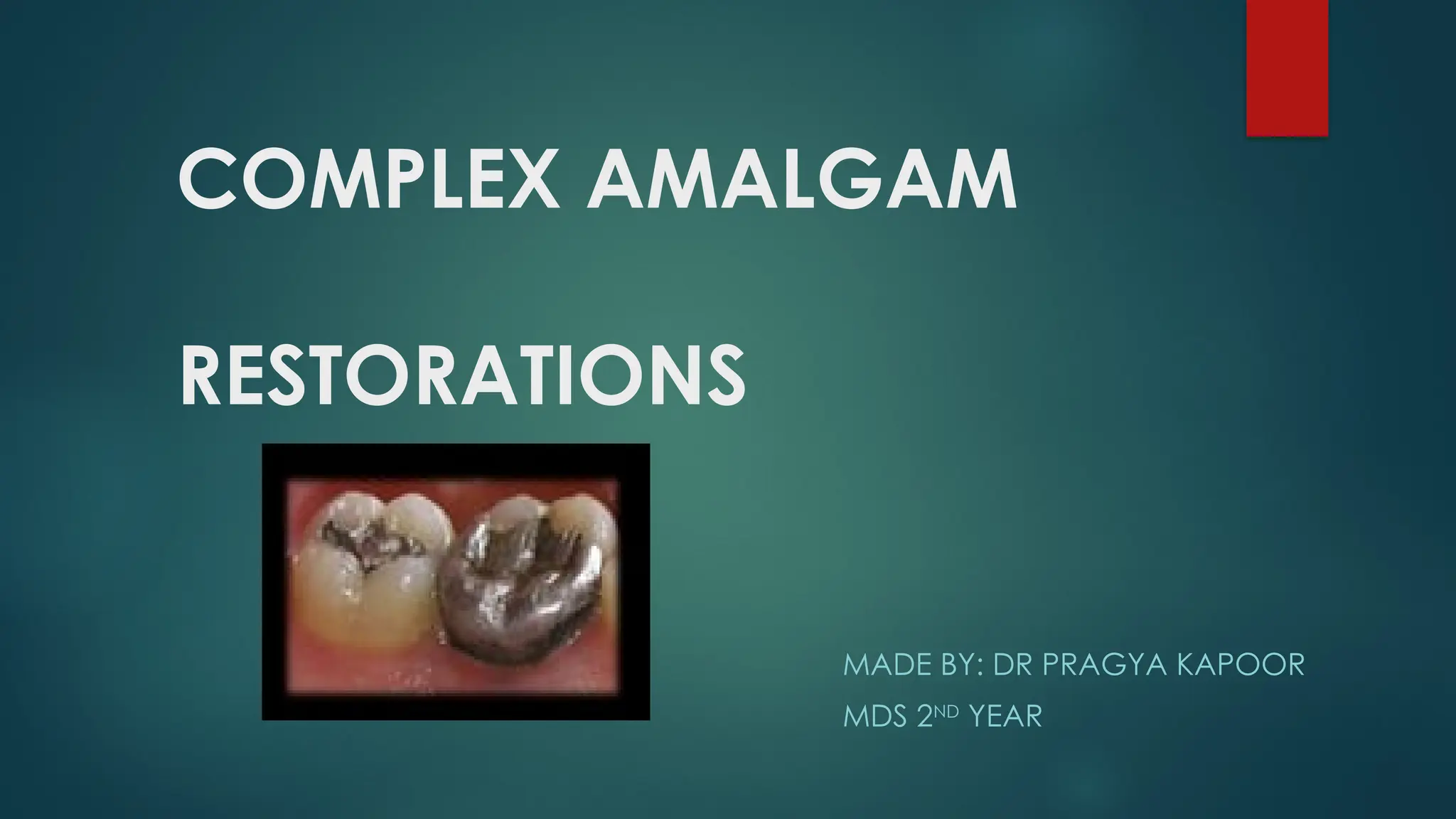
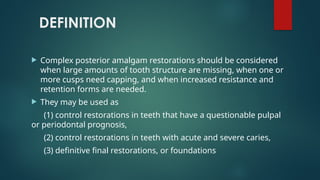
DEFINITION
Complex posterioramalgam restorations should be considered
when large amounts of tooth structure are missing, when one or
more cusps need capping, and when increased resistance and
retention forms are needed.
They may be used as
(1) control restorations in teeth that have a questionable pulpal
or periodontal prognosis,
(2) control restorations in teeth with acute and severe caries,
(3) definitive final restorations, or foundations
3.
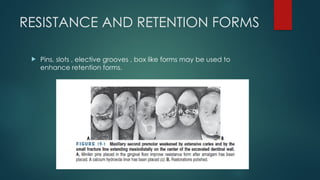
RESISTANCE AND RETENTIONFORMS
Pins, slots , elective grooves , box like forms may be used to
enhance retention forms.
ADVANTAGES
Conserves toothstructure
Appointment time
Resistance and retention
forms
Economics
DISADVANTAGES
Dentinal microfractures
Microleakage
Decreased strength of amalgam
Resistance form-amalgam restorations with cusp
coverage increase the fracture resistance of
weakened teeth
Penetration and perforation
Tooth anatomy
6.
PIN RETAINED AMALGAM
RESTORATIONS
Pin retained restoration may be defined as any restoration requiring the
placement of one or more pins in the dentin to provide adequate
resistance and retention forms.
Pins are used whenever adequate resistance and retention forms cannot
be established with slots , locks, or undercuts only.
The pin-retained amalgam is an important adjunct in the restoration of
teeth with extensive caries or fractures.
Amalgam restorations including pins have significantly greater retention
than restorations using boxes only or restorations relying solely on
bonding systems.
7.
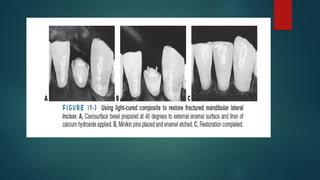
Indicated forteeth with extensive caries or fractures
large Class IV preparation on the distal surface of a canine
that involves a significant amount of the distoincisal corner.
Rarely used in anterior teeth or with composite restorative
materials.
Considered for a tooth that has insufficient enamel present
for acid etching or insufficient remaining tooth structure for
adequate retention features
9.
SLOT RETAINED AMALGAM
RESTORATIONS
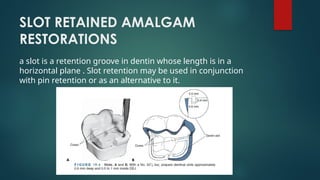
aslot is a retention groove in dentin whose length is in a
horizontal plane . Slot retention may be used in conjunction
with pin retention or as an alternative to it.
10.
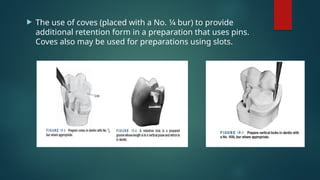
The useof coves (placed with a No. 1⁄4 bur) to provide
additional retention form in a preparation that uses pins.
Coves also may be used for preparations using slots.
11.
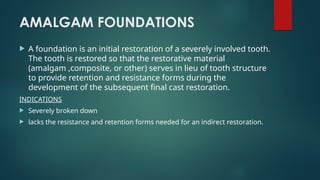
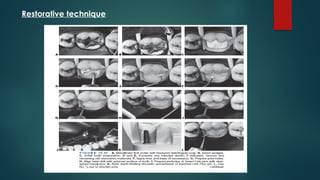
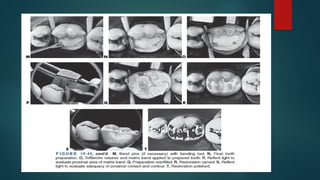
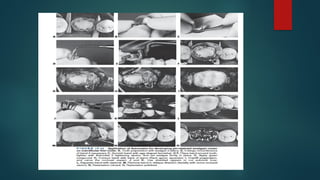
AMALGAM FOUNDATIONS
Afoundation is an initial restoration of a severely involved tooth.
The tooth is restored so that the restorative material
(amalgam ,composite, or other) serves in lieu of tooth structure
to provide retention and resistance forms during the
development of the subsequent final cast restoration.
INDICATIONS
Severely broken down
lacks the resistance and retention forms needed for an indirect restoration.
19.
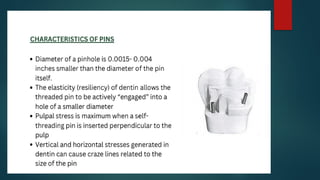
Depth ofpinholes vary from 1.3-2mm depending on the length of
the pin used.
Pin lengths more than 2mm are unnecessary and are
actually contraindicated in order to preserve the
strength of the amalgam
20.
Factors Affecting Retentionof the Pin in Dentin
and Amalgam
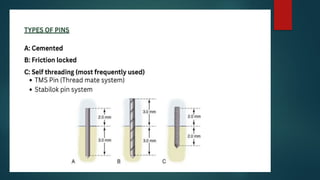
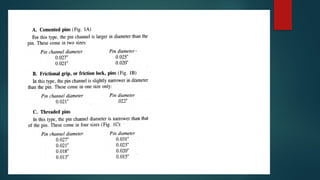
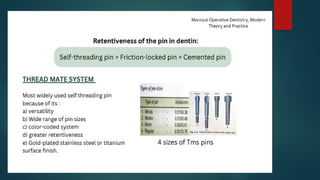
Type
Self threading pin – most retentive
Friction locked pin-intermediate
Cemented pin- least retentive
Surface characteristics
The number and depth of the elevations (serrations or threads) on the pin influence
retention of the pin in the amalgam restoration.
Orientation,number and diameter
Placing pins in a nonparallel manner increases their retention.Bending pins
to improve retention in amalgam is not desirable because bends may
interfere with adequate condensation of amalgam around the pin and
decrease amalgam retention.
21.
As thenumber of pins increases,
(1) the crazing of the dentin and the potential for fracture increase,
(2) the amount of available dentin between the pins decreases,
(3) the strength of the amalgam restoration decreases.
(4) Also generally, as the diameter of the pin increases, the
retention in dentin and amalgam increases.
(5) As the number, depth, and diameter of pins increase, the danger
of perforating into the pulp or the external tooth surface
increases.
Horizontal pins can be used for cross-splinting to provide
effective reinforcement of weak remaining cusps
22.
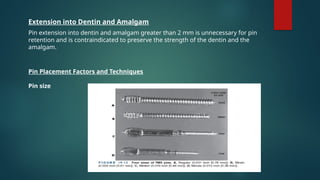
Extension into Dentinand Amalgam
Pin extension into dentin and amalgam greater than 2 mm is unnecessary for pin
retention and is contraindicated to preserve the strength of the dentin and the
amalgam.
Pin Placement Factors and Techniques
Pin size
23.
Two determiningfactors for selecting the appropriate size pin are the
amount of dentin available to receive the pin safely and the amount of
retention desired.
the pins of choice for severely involved posterior teeth are the Minikin (0.019
inch [0.48 mm]) and, occasionally, the Minim (0.024 inch [0.61 mm]).The
Minikin pins usually are selected to reduce the risk of dentin crazing, pulpal
penetration, and potential perforation.
The Minuta (0.015 inch [0.38 mm]) pin is usually too small to provide
adequate retention in posterior teeth. The Regular (0.031 inch [0.78 mm]) or
largest diameter pin is rarely used because a significant amount of stress and
crazing, or cracking, in the tooth(dentin and enamel) may be created during
its insertion.
24.
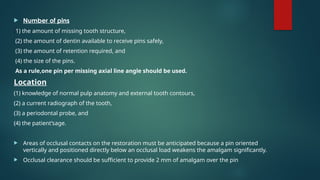
Number ofpins
(1) the amount of missing tooth structure,
(2) the amount of dentin available to receive pins safely,
(3) the amount of retention required, and
(4) the size of the pins.
As a rule,one pin per missing axial line angle should be used.
Location
(1) knowledge of normal pulp anatomy and external tooth contours,
(2) a current radiograph of the tooth,
(3) a periodontal probe, and
(4) the patient’sage.
Areas of occlusal contacts on the restoration must be anticipated because a pin oriented
vertically and positioned directly below an occlusal load weakens the amalgam significantly.
Occlusal clearance should be sufficient to provide 2 mm of amalgam over the pin
25.
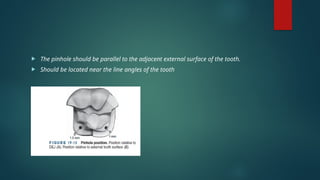
The pinholeshould be parallel to the adjacent external surface of the tooth.
Should be located near the line angles of the tooth
26.
The minimal interpindistance is
3mm for the Minikin (0.019 inch
[0.48 mm]) pin and 5mm for the
Minim (0.024 inch [0.61 mm]) pin.
Maximal interpin distance results
in lower levels of stress in
dentin
27.
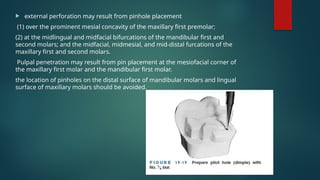
external perforationmay result from pinhole placement
(1) over the prominent mesial concavity of the maxillary first premolar;
(2) at the midlingual and midfacial bifurcations of the mandibular first and
second molars; and the midfacial, midmesial, and mid-distal furcations of the
maxillary first and second molars.
Pulpal penetration may result from pin placement at the mesiofacial corner of
the maxillary first molar and the mandibular first molar.
the location of pinholes on the distal surface of mandibular molars and lingual
surface of maxillary molars should be avoided.
28.
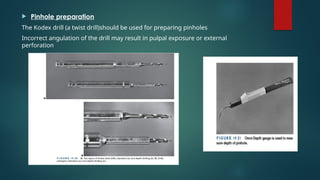
Pinhole preparation
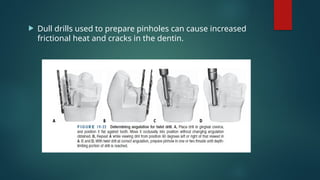
TheKodex drill (a twist drill)should be used for preparing pinholes
Incorrect angulation of the drill may result in pulpal exposure or external
perforation.
29.
Dull drillsused to prepare pinholes can cause increased
frictional heat and cracks in the dentin.
30.
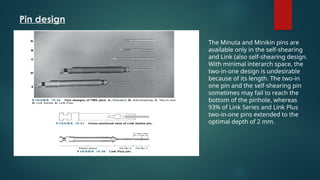
Pin design
The Minutaand Minikin pins are
available only in the self-shearing
and Link (also self-shearing design.
With minimal interarch space, the
two-in-one design is undesirable
because of its length. The two-in
one pin and the self-shearing pin
sometimes may fail to reach the
bottom of the pinhole, whereas
93% of Link Series and Link Plus
two-in-one pins extended to the
optimal depth of 2 mm.
31.
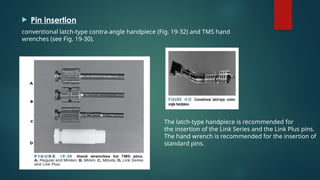
Pin insertion
conventionallatch-type contra-angle handpiece (Fig. 19-32) and TMS hand
wrenches (see Fig. 19-30).
The latch-type handpiece is recommended for
the insertion of the Link Series and the Link Plus pins.
The hand wrench is recommended for the insertion of
standard pins.
36.
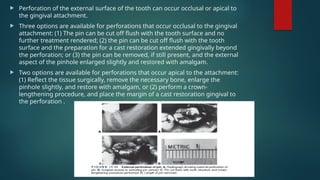
Perforation ofthe external surface of the tooth can occur occlusal or apical to
the gingival attachment.
Three options are available for perforations that occur occlusal to the gingival
attachment: (1) The pin can be cut off flush with the tooth surface and no
further treatment rendered; (2) the pin can be cut off flush with the tooth
surface and the preparation for a cast restoration extended gingivally beyond
the perforation; or (3) the pin can be removed, if still present, and the external
aspect of the pinhole enlarged slightly and restored with amalgam.
Two options are available for perforations that occur apical to the attachment:
(1) Reflect the tissue surgically, remove the necessary bone, enlarge the
pinhole slightly, and restore with amalgam, or (2) perform a crown-
lengthening procedure, and place the margin of a cast restoration gingival to
the perforation .
37.
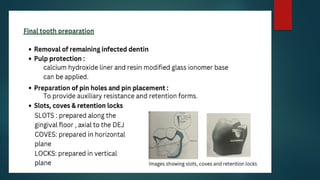
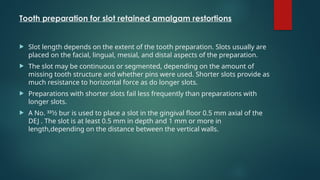
Tooth preparation forslot retained amalgam restortions
Slot length depends on the extent of the tooth preparation. Slots usually are
placed on the facial, lingual, mesial, and distal aspects of the preparation.
The slot may be continuous or segmented, depending on the amount of
missing tooth structure and whether pins were used. Shorter slots provide as
much resistance to horizontal force as do longer slots.
Preparations with shorter slots fail less frequently than preparations with
longer slots.
A No. 331⁄2 bur is used to place a slot in the gingival floor 0.5 mm axial of the
DEJ . The slot is at least 0.5 mm in depth and 1 mm or more in
length,depending on the distance between the vertical walls.
38.
Tooth preparation foramalgam foundations
Pin retention-The main difference between the use of pins for foundations and the use
of pins in definitive restorations is the distance of the pinholes from the external surface
of the tooth.
For foundations, the pinholes must be located farther from the external surface of the
tooth (farther internally from the DEJ), and more bending of the pins may be necessary to
allow for adequate axial reduction of the foundation without exposing the pins during
the cast metal tooth preparation.
The location of the pinhole from the external surface of the tooth for foundations
depends on (1) the occlusogingival location of the pin (external morphology of the tooth),
(2) the type of restoration to be placed(a porcelain-fused-to-metal or all-ceramic
preparation requires more reduction than a full gold crown), and
(3)the type of margin to be prepared
39.
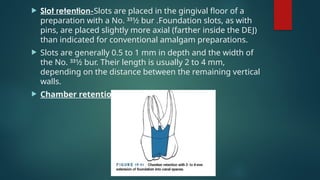
Slot retention-Slotsare placed in the gingival floor of a
preparation with a No. 331⁄2 bur .Foundation slots, as with
pins, are placed slightly more axial (farther inside the DEJ)
than indicated for conventional amalgam preparations.
Slots are generally 0.5 to 1 mm in depth and the width of
the No. 331⁄2 bur. Their length is usually 2 to 4 mm,
depending on the distance between the remaining vertical
walls.
Chamber retention
#8 The use of pins may be considered for a tooth that has insufficient enamel present for acid etching or insufficient remaining tooth structure for adequate retention features



![ Two determining factors for selecting the appropriate size pin are the
amount of dentin available to receive the pin safely and the amount of
retention desired.
the pins of choice for severely involved posterior teeth are the Minikin (0.019
inch [0.48 mm]) and, occasionally, the Minim (0.024 inch [0.61 mm]).The
Minikin pins usually are selected to reduce the risk of dentin crazing, pulpal
penetration, and potential perforation.
The Minuta (0.015 inch [0.38 mm]) pin is usually too small to provide
adequate retention in posterior teeth. The Regular (0.031 inch [0.78 mm]) or
largest diameter pin is rarely used because a significant amount of stress and
crazing, or cracking, in the tooth(dentin and enamel) may be created during
its insertion.](https://image.slidesharecdn.com/complexamalgamrestorations-250402153213-aae06f8a/85/COMPLEX-AMALGAM-RESTORATIONS-pptx-23-320.jpg)
![The minimal interpin distance is
3mm for the Minikin (0.019 inch
[0.48 mm]) pin and 5mm for the
Minim (0.024 inch [0.61 mm]) pin.
Maximal interpin distance results
in lower levels of stress in
dentin](https://image.slidesharecdn.com/complexamalgamrestorations-250402153213-aae06f8a/85/COMPLEX-AMALGAM-RESTORATIONS-pptx-26-320.jpg)



![11._complex_amalgam_restorations[1].pptx](https://cdn.slidesharecdn.com/ss_thumbnails/11-250623151040-0b210925-thumbnail.jpg?width=640&height=640&fit=bounds)


